How Paris Triumphed Over Air Pollution (and Cars)
Major air pollution episodes, a powerful car lobby, and one campaigning mayor — the winner wasn’t inevitable
How Paris Triumphed Over Air Pollution (and Cars)
Major air pollution episodes, a powerful car lobby, and one campaigning mayor — the winner wasn’t inevitable
L’Arc de Triomphe. Photo by Arthur Humeau on Unsplash
It’s October 2017, and I arrive at the Airparif offices on the south bank of the Seine. Amélie Fritz, an environmental biologist at the city’s official air quality monitoring organisation, shows me upstairs to her office, where a large desk spills over with reports and journal papers. “Paris has quite good luck in terms of geographical conditions”, she begins. “The land is very flat, we are not surrounded by mountains, there is no massive industry, there’s lots of wind and rain–this is quite good for air quality… But if it is low sky, no wind — it’s like running your car inside your garage, basically.”
Just the year before, between 30 November to 17 December 2016, the Greater Paris area experienced one of its longest and most intense pollution episodes in a decade. A high PM10 (large particles) concentration due to local emissions from traffic and domestic fires, plus no wind, saw the whole of Paris trapped in its garage with the car running. On Wednesday 30 November the hourly PM2.5 (smaller, deadlier particles) reading in Saint-Denis, central Paris, peaked at 195 micrograms per cubic metre (mg/m³) while nitrogen dioxide (NO₂ — which damages the human respiratory system) maxed out at an asphyxiating 283 mg/m³ at Place de l’Opera. Over 2,000 asthmatic children were treated in Parisian hospital emergency rooms.
“If it is low sky, no wind — it’s like running your car inside your garage”. Photo by Sergey Konstantinov on Unsplash
By 8 December, the front page of the daily newspaper 20 Minutes exclaimed ‘La fumée tue’ (Smoke kills). TV news channel France 24 commented that “the local authorities and the government are at loggerheads with each other, blaming each other for these current pollution levels”, while the campaign website ‘Stoppollution’ claimed, “Living in Paris during this peak of pollution is equivalent to breathing the smoke of eight cigarettes a day in a room of 20 square metres.”
According to the national public health agency Santé publique France, air pollution was killing 48,000 people a year in France, 34,000 of which were classed as ‘avoidable deaths’. While the PM2.5 problem in Paris may seem slight compared levels recorded in Delhi, its NOx problem (NO₂ + NO) was worse than even the Indian capital — and it came from cars. On 15 February 2017, the European Commission sent a final warning to France for failing to address persistent breaches of legal NO₂ limits in 19 air quality zones, including Paris.
The 2017 Airparif report found that NO₂ along major roads were twice as high than that of those away from the road. Airparif’s annual reports on the pollution in Paris included ‘hotspot’ maps for nitrogen dioxide and PM2.5, showing red for high pollution, down through yellow and then green for low pollution. On the maps, the city’s roads glow an angry red, clearly showing where the emissions originated from — traffic. In maps that zoom out to show the wider Île-de-France region, Paris is a blotch of red in a sea of green, with the occasional yellow vein of a motorway running across it. The problem was clear. But what was the solution?
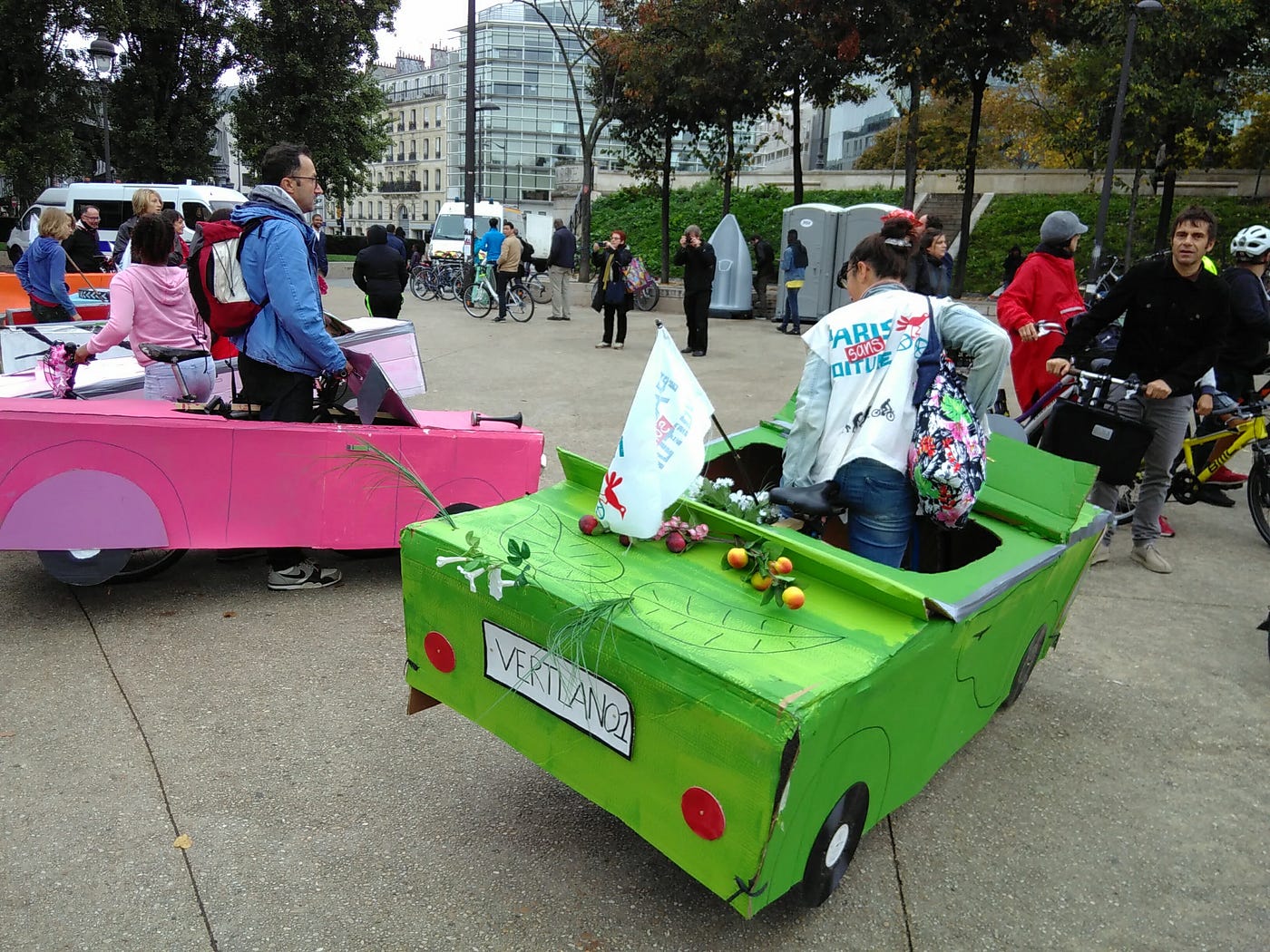
Car Free Day (Journée sans voiture) 2017 — environmental protesters clad their bikes with cardboard cars to show how much road space cars needlessly take up. Pic by the author.
The city’s first Car Free Day (Journée sans voiture) was held in 2015, allowing only public transport and emergency vehicles and banning all cars from the roads. For one day only, Parisians could briefly enjoy reclaiming the streets and breathing cleaner air. That one day alone resulted in NO₂ levels plummeting by 40% across the city. The success was such that the city’s new Mayor, Anne Hidalgo, posted on Twitter: “We might envisage days without cars more often”. Several streets in central Paris subsequently vowed to remain car free on the first Sunday of every month (copying steps taken by other international capitals, including Bogotá, Colombia), including the iconic Champs Elysées.
Journée sans voiture was retained as an annual day, but with bolder ambitions. While the first two years were limited to the city centre, 2017 was to encompass the whole of Paris. Christophe Najdovski, the deputy mayor in charge of transport, told the newspaper *Le Parisien*: “The idea… is to show that you can live in the city without having a car… and will allow everyone to rediscover a quieter and less polluted city.” This was something I had to experience. And so, with my book research in mind, I bought a ticket for the Eurostar.
Could Paris, a city famously clogged with cars — and clogging the arteries of Parisians in the process — really turn its situation around? And if so, could it show the whole world a way forward?
On the morning of Car Free Day I headed to Place de la Bastille to rent a Velib — the city’s bike hire scheme, one of the first in Europe when it was launched in 2007 — as a fitting way to set out to meet the people triumphantly reclaiming the streets. I haven’t rented one before, and stare blankly at the instructions on the machine. A Velib cyclist rides towards me and dismounts. I look up pleadingly to ask her for help, but before I get the chance a pack of photographers shove me out of the way and surround her. I realise that the cyclist is Anne Hidalgo, the mayor of Paris, arriving in La Bastille to mark the start of Car Free Day with a photo shoot. In person, she is Parisian from head-to-toe, with an ability to look elegant even on a bicycle while wearing a bike helmet. Before I’m able to blurt out a more considered question than “how do I use the Velib machine?” she is immediately surrounded by press, security and a TV crew. The PR manager glares at me and whisks her away.
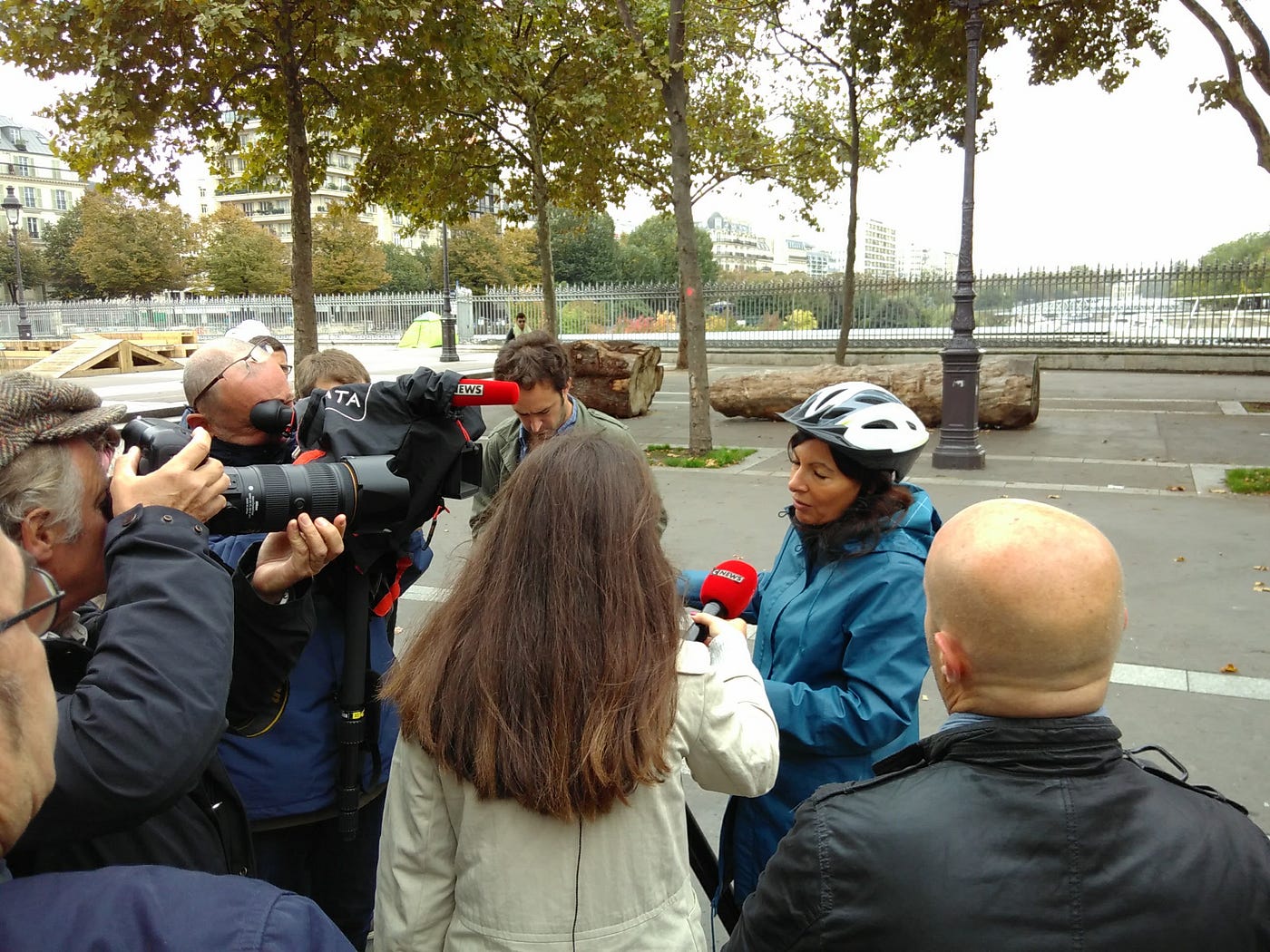
As close as I got to Mayor Anne Hidalgo! Pic by me
Later, another Velib user helps me to rent one and I join the joyous reclamations of the streets that I had come to see. Whole families cycle side by side on roads that they wouldn’t typically dare go down; environmental protesters turn up on bikes they’ve turned into ‘cardboard cars’ as an indicator of how much roadspace cars needlessly take up. Most striking is a group of up to 100 gyroscope riders—like motorised unicycles but without the seat — which had spawned a counter-culture among kids and gamers with customised helmets. One rolls a cigarette in his hands as he travels at speed, barely looking ahead — which remains, to this day, the most Parisian thing I have ever seen.
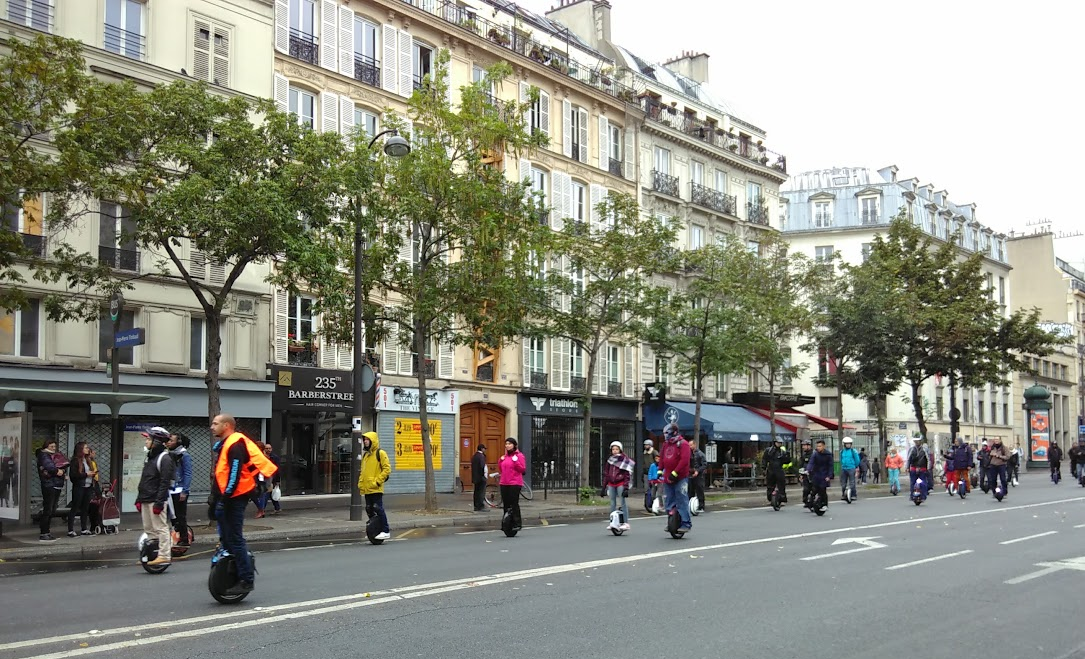
Les gyroscopists. Pic by the author.
I end the day walking along the Right Bank of the Seine — until recently one of the busiest, most polluting roads in the city. A year previously, Mayor Hidalgo made the decision to close it indefinitely and open it up to walkers and cyclists. Here the ‘Car Free Day’ celebration continues, but this time it’s permanent. Children play on climbing walls and wooden obstacle courses. Where there were once lorries belching fumes there are now trees in pots.
Tyler Knowlton, a Canadian I meet who lives in Paris, tells me “My stress level went down by like 20 per cent trying to get to work in the morning”, since the changes. The city planned to double the number of bike lanes from 700km (434 miles) in 2015 to 1,400km (870 miles) by 2020, including segregated cycle lanes, and more traffic-free zones.
I left feeling hopeful, but also sceptical — there was already talk of political pushback fuelled by a powerful pro-car lobby (even specifically pro-diesel — remember the Gilets Jaunes protests?). Had I just witnessed a brief progressive flower bloom, which would soon wither and die in a harsher political winter? Could Paris, and Mayor Anne Hidalgo, really pull this off?
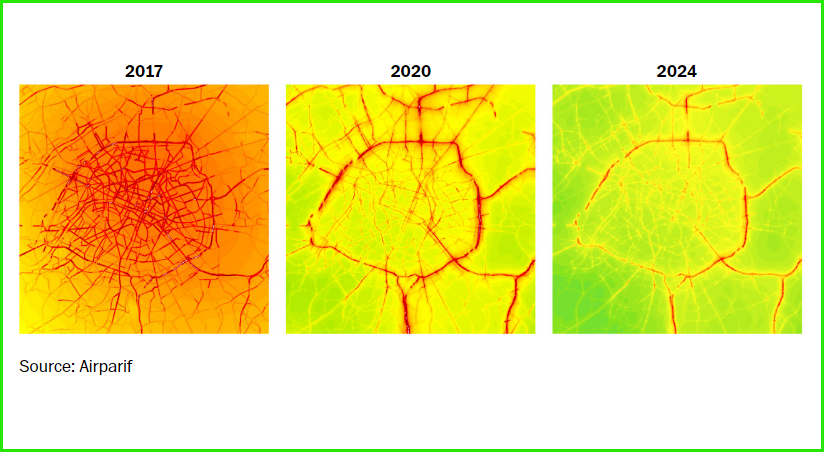
Average nitrogen dioxide concentration in Paris. Micrograms per cubic metre: green (0–20 mg/m³), through yellow and orange (20–40 mg/m³), red (40–60 mg/m³), dark red (60–80+ mg/m³)
Fast-forward to 2026, and in under a decade the results are remarkable. Airparif announced in 2025 that levels of fine particulate matter (PM 2.5) have decreased 55 percent since 2005, while nitrogen dioxide levels have fallen 50 percent. It attributed this to “regulations and public policies” specifically including steps to limit traffic and ban the most polluting vehicles.
Paris’s successful bid for the 2024 Olympic Games helped turn Hidalgo’s aspirations into a deadline. Paris tripled car parking fees for SUVs. Traffic lights in the city were changed to prioritize bikes, buses and trams, not cars. 60,000 parking spaces were taregtted for removal, with 130,000 bike parking spots added. As of March 1, 2026, according to City of Paris data, there are now 1,678 kilometers of cycle routes, up from the 700km Hidalgo had inherited.
Around half of Paris’s 600 nursery and elementary schools had closed roads or restricted car access, working with locals to co-design some of the streets with trees, playgrounds, and safer public areas for children. Hidalgo said that, rather than meet public resistance, parents’ groups clamoured for the city authorities to get to their neighbourhoods next.
Photo by Hannah Reding on Unsplash
Starting in 2017, the year I visited, all cars, motorbikes and lorries in Paris had to display a coloured, numbered disc called Crit’Air, based on the age of the car and its emissions, ranging from Crit’Air 1 (electric vehicles) down to Crit ’ Air 6 (older, mostly diesel, vehicles). In the subequent years, the standards became stricter, and the oldest vehicles banned completely. The carrots offered to owners getting rid of their cars have included a year of free public transport, financial assistance for businesses, free Velib membership, and even €400 to buy a bicycle.
But the final piece of Mayor Hidalgo’s plan, upon reaching the end of her second and final term in office, was put to a referendum in spring 2025. It was perhaps the boldest proposal of all, and would take all the political capital and goodwill she had built to pull it off — to permanently block 500 more streets to traffic, in the same way as the Right Bank of the Seine — and replace the asphalt with plants and trees.
Photo by Samuele Giglio on Unsplash
Hidalgo said in an Instagram post:
“With this vote, Parisians have the choice of whether or not to accelerate Paris’s adaptation to climate change, the fight against pollution, and the improvement of the living environment within 300 meters of their homes, with the potential transformation of 5 to 8 streets in each neighborhood.”
It was central to her vision for a “15-minute city”, in which residents can reach essential resources by foot, bicycle or public transport within 15 minutes. In an interview with local media, Anouch Toranian, Hidalgo’s deputy for community life, said it was a chance for Parisians to express support for “calmer streets, with fewer cars on pedestrianized streets, and therefore more calm, less noise nuisance and less pollution.”
All Parisians aged 16+ were invited to the polls, and it was enthusiastically passed with nearly 66% of the vote. Hidalgo’s political strength was waning. When she ran for president in 2022, she got only 1.75% of the vote — the lowest score in the history of the Socialist Party. But in Paris, she had finished the job she had set out to do. Parisians could breather clean air once again, and live happier, healthier lives.
Speaking shortly after she left office, in May 2026, Hidalgo told the CityLab conference that reducing traffic involved a “horrible, tremendous” fight with entrenched interests: lobby groups deeply invested in maintaining a fossil fuel-powered, car-centred city. She attributed success to a two-level strategy, blending large-scale, ambitious long-term projects with small-scale ones that benefit people in their immediate day-to-day lives (think of Tyler and his instantly improved cycle-commute).
It’s hard for people living in deeply entrenched car-addicted cities to imagine an alternative. I saw a social media comment recently under a post about Paris’s traffic-reduction measures, asking: “And people with disabilities. How do they get around?” It is a valid and important question. A user responded, “My son is quadriplegic and a full time power chair user. When we go to Paris we use the buses which are cheap, plentiful and all have wheelchair ramps”. While another added, “And in addition… If you really need a car, there will be fewer on the street so your journey would be quicker.” People with disabilities and key workers were always exempt from Crit’Air, and able to drive on quieter roads.
I wrote in my resultant book, *Clearing The Air*, which came out in 2019, that “Paris, perhaps more so than anywhere else, left me with a strong sense of our two possible futures hanging in the balance: it offers glimpses of what zero emissions could look like, but remains largely stuck in the stranglehold of fossil fuel emissions.” While many parts of the world stuck with the status quo, Paris chose to tip the scales the other way — and it’s an example the whole world can now follow. Now out of office, Hidalgo is urging mayors around the world to “be confident” and bold with traffic reduction and air quality policies. Lobbyists hate it, but people — voters — love it. As she passes on the baton, we should watch to see which new mayors will grasp it — and vote accordingly.
Tim Smedley is the editor of The New Climate and author of the Clearing the Air: the beginning and the end of air pollution and The Last Drop: solving the world’s water crisis.
메타데이터
- post_id
- e9d38db24c1d
- slug
- how-paris-triumphed-over-air-pollution-and-cars-e9d38db24c1d
- url
- https://medium.com/the-new-climate/how-paris-triumphed-over-air-pollution-and-cars-e9d38db24c1d
- canonical_url
- https://medium.com/the-new-climate/how-paris-triumphed-over-air-pollution-and-cars-e9d38db24c1d
- author_url
- https://medium.com/@tjsmedley
- status
- ok
- fetched_at
- 2026-06-13 07:35:29