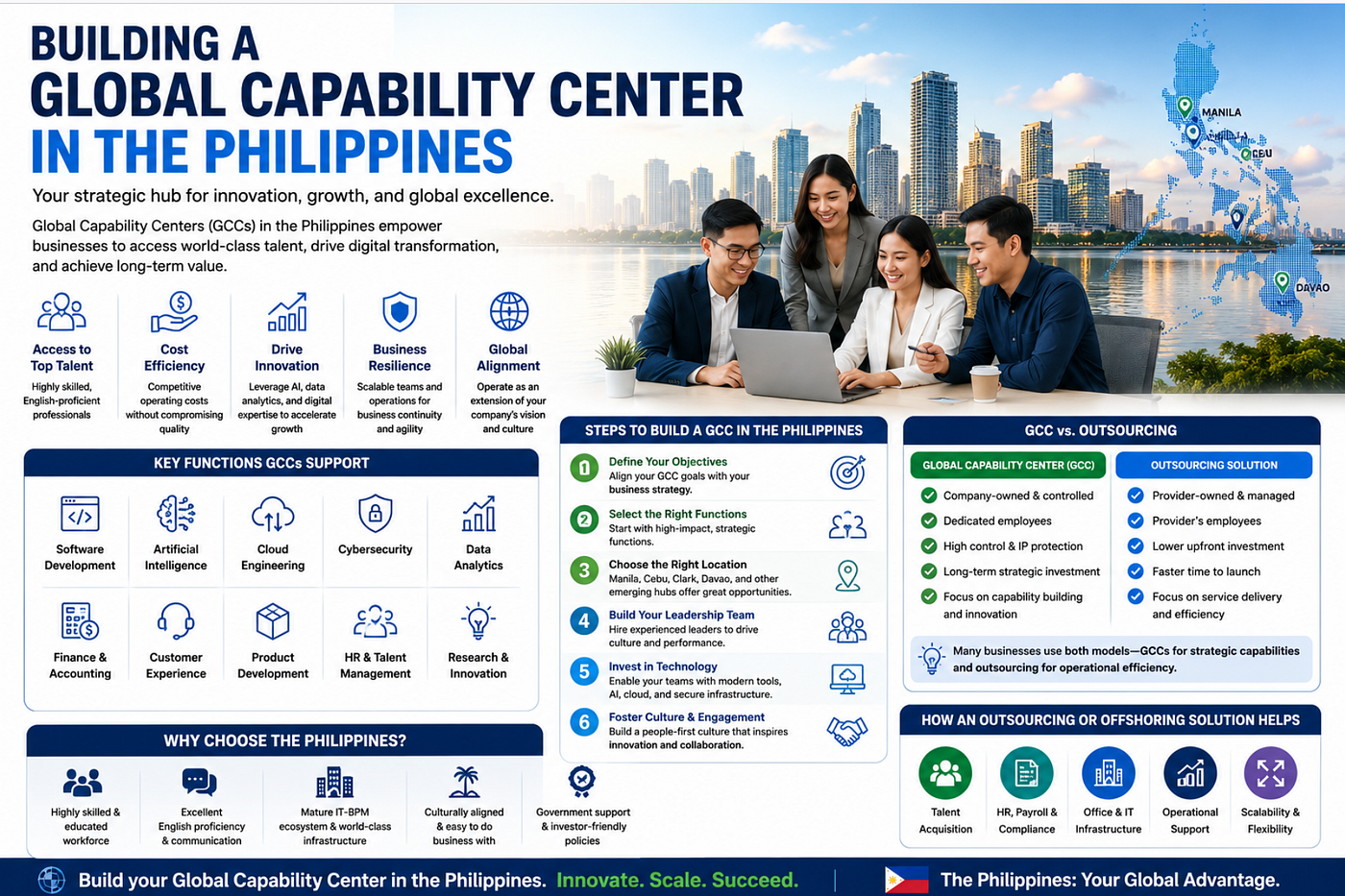
Outsourcing vs Offshore Staffing
Outsourcing vs Offshore Staffing for Professional Services Firms: Which Model Fits Best?
Outsourcing vs Offshore Staffing
Outsourcing vs Offshore Staffing for Professional Services Firms: Which Model Fits Best?
Professional services firms can benefit from both outsourcing and offshore staffing, but the best choice depends on goals, control requirements, and operational complexity. Outsourcing is often suited to standardized, process-driven work, while offshore staffing is typically a better fit when firms need dedicated team members who integrate into internal operations and support long-term growth.
Industry Context
Many professional services firms — including consultancies, accounting firms, marketing agencies, engineering firms, legal support organizations, and business advisory practices — struggle with:
- Rising local labor costs
- Difficulty hiring specialized talent
- Administrative workload growth
- Capacity constraints during peak demand periods
- Margin pressure from increased operating expenses
- The need to focus senior professionals on client-facing activities rather than administrative work
As firms grow, leadership teams often evaluate workforce strategies that improve scalability without compromising service quality. Offshore staffing and outsourcing are two commonly considered options.
What Can Be Outsourced or Offshored?
Functions Commonly Outsourced
- Payroll processing
- Bookkeeping
- Data entry
- Document processing
- Basic customer support
- IT help desk support
- Appointment scheduling
- Lead generation activities
Functions Commonly Supported Through Offshore Staffing
- Administrative assistants
- Accounting and finance support
- Marketing coordinators
- Project coordinators
- Client support specialists
- Research analysts
- Design professionals
- Operations specialists
- Dedicated back-office teams
Functions Usually Kept In-House
- Strategic advisory work
- Senior client relationships
- Firm leadership
- Sensitive decision-making roles
- Regulatory and compliance oversight
When Outsourcing Makes Sense
Outsourcing may be the better option when:
✅ Work is repetitive and process-driven
✅ Service levels are clearly defined
✅ The firm wants minimal management responsibility
✅ Outputs matter more than individual team members
✅ Demand fluctuates significantly throughout the year
Example
A management consulting firm outsources payroll administration to a specialist provider. The firm focuses on receiving accurate payroll outcomes rather than managing individual payroll staff.
When Offshore Staffing Makes Sense
**Offshore staffing** may be the better option when:
✅ Institutional knowledge is important
✅ Long-term team continuity matters
✅ Work requires daily collaboration
✅ Firm culture and service standards are critical
✅ Leadership wants direct oversight
✅ The objective is building organizational capacity
Example
A growing accounting firm hires dedicated offshore accountants who work exclusively for the firm, use its processes, attend team meetings, and report to internal managers.
When Outsourcing Does Not Make Sense
Outsourcing may be less suitable when:
- Work is highly customized
- Frequent collaboration is required
- Client relationships depend on continuity
- Knowledge transfer is ongoing
- The firm needs direct managerial control
In these situations, a transactional vendor relationship can create communication and accountability challenges.
When Offshore Staffing Does Not Make Sense
Offshore staffing may not be ideal when:
- Work volume is inconsistent
- The firm is unwilling to manage staff
- Processes are poorly documented
- Leadership lacks onboarding capability
- Short-term project support is the only requirement
Dedicated teams work best when there is enough ongoing work to justify long-term team integration.
Cost and ROI Considerations
Outsourcing Cost Drivers
Typical factors include:
- Vendor service fees
- Transaction-based pricing
- Service-level agreements
- Scope changes
- Contract modifications
Potential Benefits
- Predictable expenses
- Reduced management overhead
- Faster implementation
- Limited hiring responsibilities
Offshore Staffing Cost Drivers
Typical factors include:
- Employee salaries
- Recruitment costs
- Management time
- Training investments
- Technology and collaboration tools
Potential Benefits
- Lower labor costs compared to many local markets
- Greater operational control
- Improved institutional knowledge retention
- Higher long-term productivity
- Better scalability
Comparing ROI
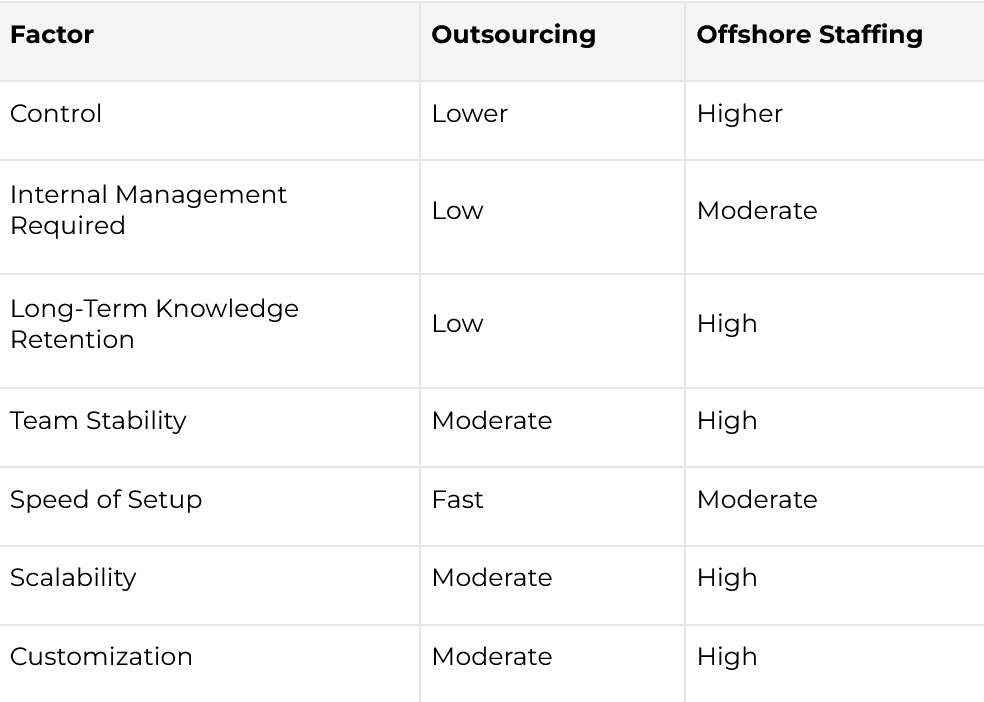
The highest ROI often comes from aligning the model with the firm’s operational objectives rather than choosing purely based on labor cost.
Risks and Controls
Outsourcing Risks
Risks
- Limited visibility
- Service inconsistency
- Vendor dependency
- Less control over staff
Controls
- Detailed service-level agreements
- Performance reviews
- Defined escalation procedures
- Contract governance
Offshore Staffing Risks
Risks
- Poor onboarding
- Communication challenges
- Unclear expectations
- Inadequate management oversight
Controls
- Structured onboarding programs
- Standard operating procedures
- Regular performance management
- Collaboration tools
- Clear reporting structures
Decision Framework
Use the following checklist when deciding between outsourcing and offshore staffing.
Choose Outsourcing If:
- The work is transactional.
- You care primarily about outputs.
- The process is standardized.
- Capacity needs fluctuate.
- Internal management bandwidth is limited.
Choose Offshore Staffing If:
- Team integration is important.
- Knowledge retention matters.
- Direct supervision is required.
- Client experience depends on consistency.
- Growth plans require long-term workforce expansion.
Executive Decision Matrix

Provider Evaluation Considerations
Whether evaluating outsourcing providers or offshore staffing partners, consider:
Operational Capabilities
- Industry experience
- Recruitment processes
- Training programs
- Quality assurance methods
Talent Quality
- Candidate screening
- Technical expertise
- Communication skills
- Cultural alignment
Compliance and Security
- Data protection practices
- Security controls
- Regulatory awareness
- Business continuity measures
Service Model
- Dedicated teams versus shared resources
- Visibility into performance
- Account management structure
- Scalability options
FAQ Section
What is the difference between outsourcing and offshore staffing?
Outsourcing transfers responsibility for a business function or process to a provider. Offshore staffing involves hiring dedicated remote employees through an offshore partner while maintaining day-to-day management and control.
Which model provides more control?
Offshore staffing generally provides significantly more operational control because team members work as an extension of your organization.
Is offshore staffing cheaper than outsourcing?
Not always. Some outsourcing arrangements can be highly cost-effective for standardized work. Cost comparisons should consider management requirements, productivity, quality, and long-term business value.
Can professional services firms combine both models?
Yes. Many firms use outsourcing for transactional processes and offshore staffing for dedicated support functions such as accounting, operations, marketing, and administrative services.
Which model scales better?
Offshore staffing often offers greater long-term scalability because firms can continuously build internal capability through dedicated team members.
What roles are commonly staffed offshore for professional services firms?
Common roles include accountants, bookkeepers, administrative assistants, project coordinators, researchers, marketing support staff, client service specialists, and operations personnel.
How long does it take to see ROI?
ROI varies based on role complexity, training requirements, workflow maturity, and management effectiveness. Firms with well-documented processes typically achieve value more quickly.
If your firm is evaluating workforce expansion strategies, consider comparing **outsourcing providers**, offshore staffing firms, and hybrid workforce models before making a decision.
Organizations exploring dedicated offshore team structures may wish to assess providers such as **iSupport Worldwide** and other offshore staffing partners to determine which approach best supports their operational goals, client commitments, and growth plans.
메타데이터
- post_id
- e9dbcb9bc50f
- slug
- outsourcing-vs-offshore-staffing-e9dbcb9bc50f
- url
- https://medium.com/@bpocentral/outsourcing-vs-offshore-staffing-e9dbcb9bc50f
- canonical_url
- https://medium.com/@bpocentral/outsourcing-vs-offshore-staffing-e9dbcb9bc50f
- author_url
- https://medium.com/@bpocentral
- status
- ok
- fetched_at
- 2026-07-30 17:26:29