Ju Jitsu vs BJJ: What’s the Real Difference?
One of the most common questions in martial arts today is:
Ju Jitsu vs BJJ: What’s the Real Difference?
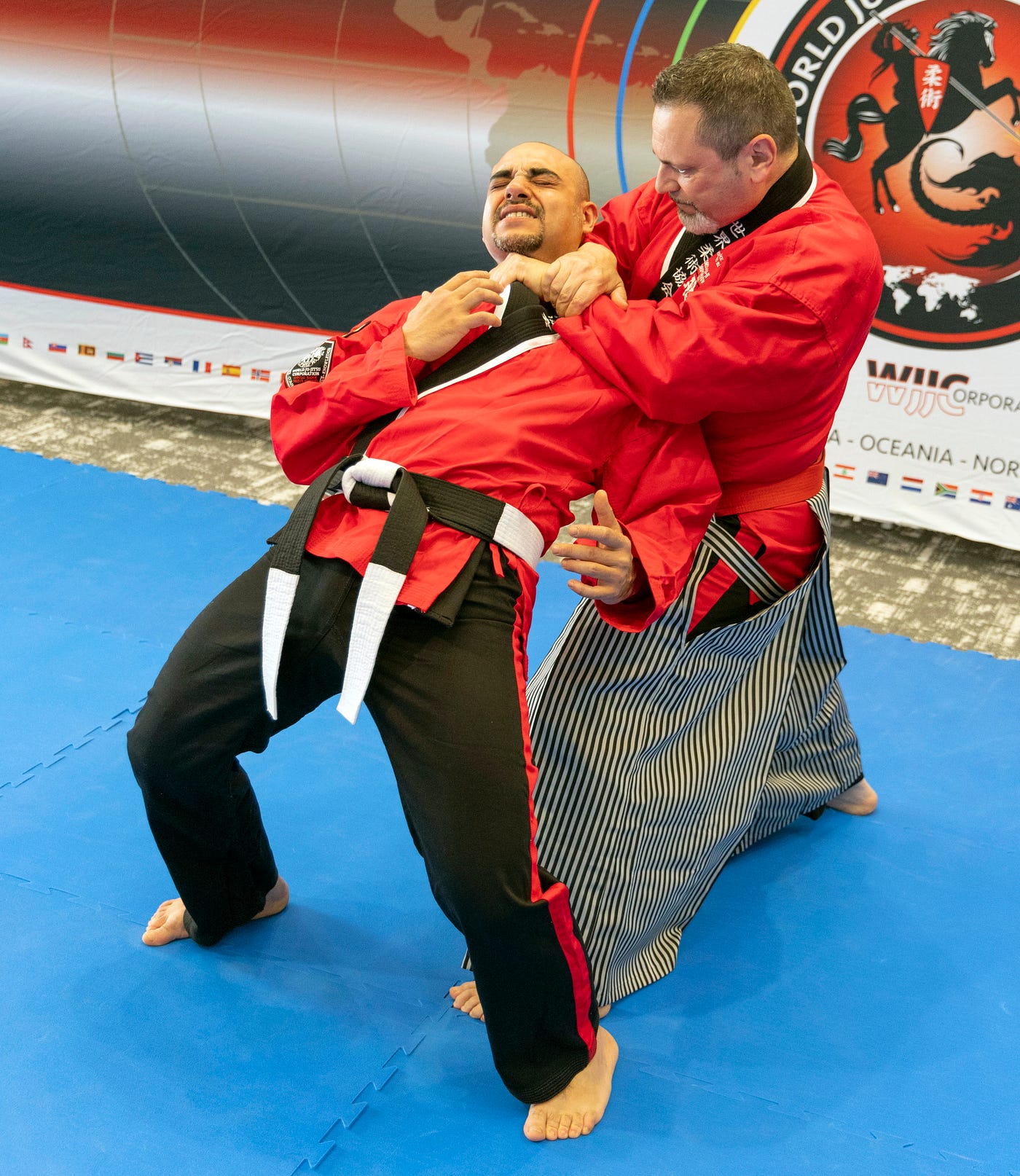
Traditional Ju-Jitsu training focused on standing control and adaptability — World Ju-Jitsu Corporation (WJJC)
One of the most common questions in martial arts today is:
What is the difference between Ju Jitsu and BJJ?
At first glance, they may seem similar.
Both involve grappling, control, and submission techniques.
However, there are important differences in history, training approach, and overall focus.
Traditional Ju Jitsu originated in Japan.
It developed as a complete combat system that included:
- throws
- joint locks
- strikes
- control techniques
- weapon defenses
Its purpose was adaptability.
Practitioners learned how to manage different situations using a wide range of techniques.
Brazilian Jiu-Jitsu (BJJ) evolved later, strongly influenced by Japanese Ju Jitsu and Judo.
Over time, BJJ became more specialized in ground fighting and submission grappling.
This became its main focus.
Another major difference is training structure.
Traditional Ju Jitsu often includes both standing and ground techniques.
Training may also involve self-defense scenarios, awareness, and broader technical development.
BJJ training usually focuses heavily on sparring and ground application.
This creates strong grappling ability.
Both approaches have strengths.
The choice depends on personal goals.
Someone interested in sport grappling and competitive ground fighting may prefer BJJ.
Someone looking for a broader self-defense system may be more interested in traditional Ju Jitsu.
Another important aspect is philosophy and training culture.
Traditional Ju Jitsu often maintains a stronger connection to discipline, etiquette, and long-term personal development.
BJJ culture is generally more competition-oriented and performance-focused.
Again, neither approach is “better.”
They are different paths.
Self-defense is another point of comparison.
Traditional Ju Jitsu usually includes standing defense, distance management, and responses to different types of attacks.
BJJ offers strong control skills, especially in close-range situations and ground management.
Both systems can be effective when taught properly.
The role of the instructor and training environment remains essential.
Another important factor is accessibility.
Both systems are suitable for beginners.
However, the training experience can feel very different depending on the school.
Trying a class is often the best way to understand which environment is right for you.
In the end, the question is not:
“Which one is better?”
But:
“Which one fits your goals and your path?”
Because martial arts are not only about techniques.
They are about direction.
For more information about traditional Ju-Jitsu training and international activities, visit:
World Ju-Jitsu Corporation (WJJC) https://www.wjjc.biz
메타데이터
- post_id
- e9eb74a2e695
- slug
- ju-jitsu-vs-bjj-whats-the-real-difference-e9eb74a2e695
- url
- https://medium.com/@adriano.busa/ju-jitsu-vs-bjj-whats-the-real-difference-e9eb74a2e695
- canonical_url
- https://medium.com/@adriano.busa/ju-jitsu-vs-bjj-whats-the-real-difference-e9eb74a2e695
- author_url
- https://medium.com/@adriano.busa
- status
- ok
- fetched_at
- 2026-06-10 12:26:30