OpenAI’s o3 vs o1: The Dawn of Hyper-Intelligent AI
In the ever-evolving landscape of artificial intelligence, OpenAI has once again pushed the envelope with their latest offering: o3. This…
OpenAI’s o3 vs o1: The Dawn of Hyper-Intelligent AI
In the ever-evolving landscape of artificial intelligence, OpenAI has once again pushed the envelope with their latest offering: o3. This isn’t just another incremental update; it’s a quantum leap in AI capabilities that’s set to redefine our expectations of machine intelligence.
The o3 Revolution: Thinking Fast and Slow
Remember when we marveled at AI that could play chess? Those days seem quaint now. OpenAI’s o3 isn’t just playing the game; it’s rewriting the rulebook.
Simulated Reasoning: The Game Changer
At the heart of o3’s prowess is its “simulated reasoning” (SR) capability. This isn’t your garden-variety neural network; it’s an AI that can pause, reflect, and adjust its thought processes before responding. It’s like giving a chess grandmaster the ability to play out multiple scenarios in their head before making a move.
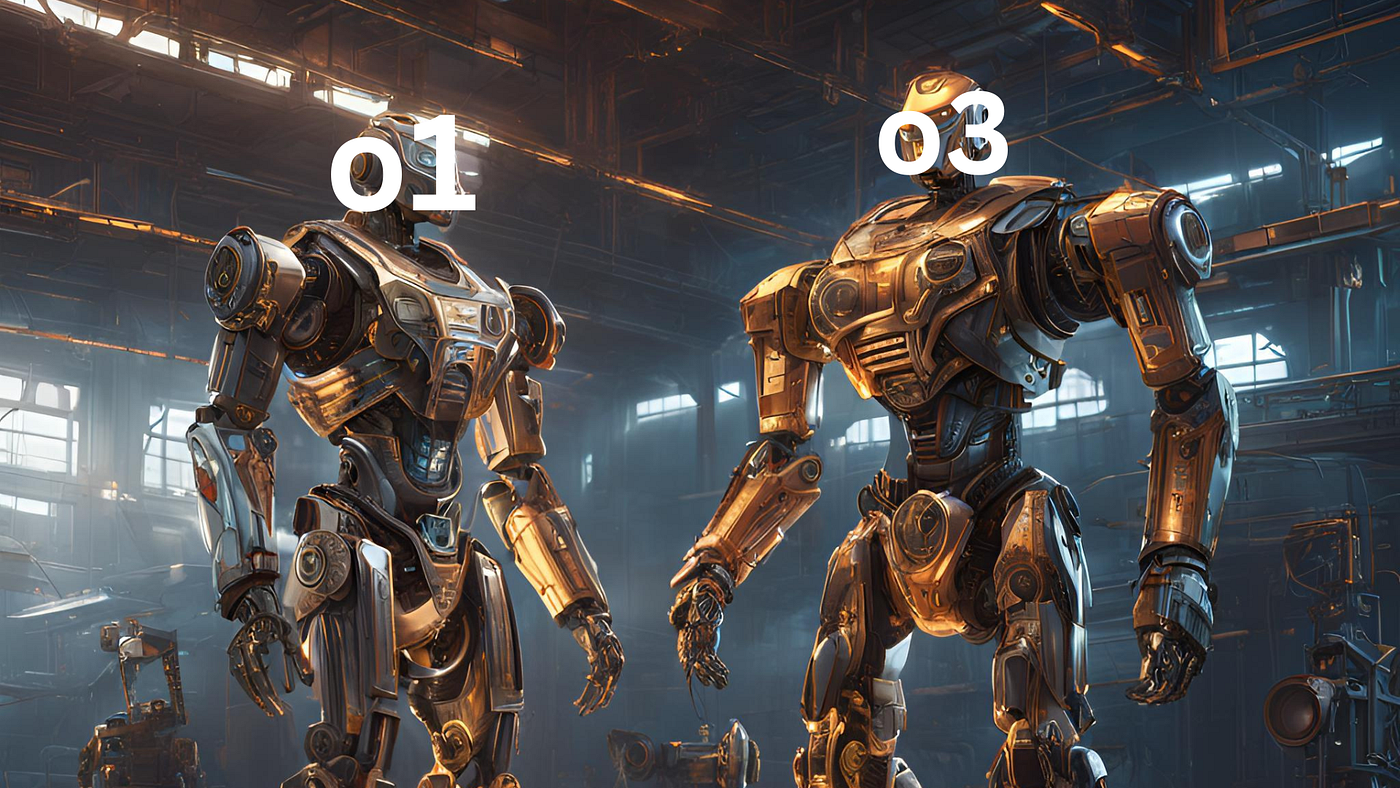
This deeper level of reasoning allows o3 to tackle complex, multi-step problems with a level of nuance and accuracy that makes its predecessor, o1, look like a pocket calculator in comparison.
Benchmark Beatdown
Let’s talk numbers, because in the world of AI, benchmarks matter. And o3 isn’t just beating benchmarks; it’s obliterating them:
- Coding: On the SWE-bench verified test, o3 scored a jaw-dropping 71.7%, leaving o1’s 48.9% in the dust.
- Programming: o3’s Codeforces score of 2727 makes o1’s 1891 look like a typo.
- Mathematics: With a 96.7% score on the AIME 2024, o3 is solving equations that would make Good Will Hunting break a sweat.
- Science: On PhD-level questions (GPQA Diamond), o3 scored 87.7%. That’s not just passing; it’s acing the test.
- Visual Reasoning: o3’s 75.7% on the ARC-AGI benchmark isn’t just an improvement; it’s a leap into a new dimension of AI capability.
The Two Faces of o3: Full Power and Mini Might
OpenAI isn’t taking a one-size-fits-all approach with o3. They’re offering two flavors:
- o3: The full-featured behemoth, designed for tasks that demand the utmost in AI reasoning capabilities.
- o3-mini: A lightweight version that doesn’t skimp on smarts. It offers adaptive thinking time, allowing users to balance processing speed with task complexity.
The Price of Progress: o3’s Hefty Price Tag
Now, here’s where things get interesting. All this computational prowess comes at a cost — and it’s not chump change.
Breaking the Bank for Breakthrough AI
- Running o3 can cost over $1,000 per task. That’s not a typo.
- For the ARC-AGI benchmark, running o3 in high-efficiency mode on 400 public puzzles cost a cool $6,677.
- Want the highest possible score? That’ll be $1.14 million, please.
Cost Breakdown: From Expensive to Eye-Watering
- Low-compute mode: About $20 per task. Not bad, right?
- High-compute mode: Thousands of dollars per task. Ouch.
This pricing structure puts o3 squarely in the realm of large tech companies, governments, and high-budget research institutions. It’s not something you’ll be running on your laptop anytime soon.
The Bigger Picture: AI’s Evolving Landscape
o3 isn’t just a new model; it’s a harbinger of AI’s future. Its ability to handle complex reasoning tasks suggests we’re entering an era where AI can truly think on its feet, tackling unfamiliar problems with human-like adaptability.
Safety First: Deliberative Alignment
OpenAI isn’t just pushing the boundaries of AI capability; they’re also setting new standards for AI safety. Both o1 and o3 incorporate a new safety paradigm called “deliberative alignment,” which aims to reduce unsafe responses while enhancing performance on benign queries.
Conclusion: The Future is Expensive (But Exciting)
OpenAI’s o3 is more than just an impressive technological achievement; it’s a glimpse into the future of AI. With its unprecedented reasoning capabilities and versatility, o3 has the potential to revolutionize fields ranging from software development to scientific research.
Yes, the cost is eye-watering. But remember, the first computers filled entire rooms and cost millions. Today, we carry more computing power in our pockets. o3 may be the playground of tech giants and governments today, but it’s paving the way for a future where advanced AI reasoning becomes accessible to all.
As we stand on the brink of this new era in AI, one thing is clear: the future of machine intelligence is not just about processing power; it’s about the ability to reason, adapt, and solve complex problems in ways we’ve only dreamed of until now. o3 isn’t just the next step in AI evolution; it’s a giant leap towards a future where the line between human and machine intelligence becomes increasingly blurred.
The question isn’t whether AI will transform our world — it’s how soon, and at what cost.
FAQ Section
Q: How does o3 compare to other AI models like GPT-4? A: While direct comparisons are challenging, o3’s performance on complex reasoning tasks suggests it may surpass GPT-4 in certain areas, particularly in mathematics and coding.
Q: Is o3 available for public use? A: Currently, o3 is not publicly available. Its high cost and advanced capabilities limit its use to large organizations and research institutions.
Q: What are the potential applications of o3? A: o3 could revolutionize fields requiring complex problem-solving, such as advanced scientific research, software development, and mathematical modeling.
Q: How does the cost of o3 compare to human problem-solving? A: For many tasks, human problem-solving remains significantly cheaper and faster. However, o3 excels in tasks requiring extensive computation or reasoning beyond human capabilities.
Q: Will the cost of using o3 decrease over time? A: OpenAI aims to drive down costs in future iterations, potentially making advanced AI reasoning more accessible in the future.
OpenAIo3 #AIReasoning #FutureOfAI #MachineLearning #TechInnovation #AIBenchmarks #ComputationalCosts #ArtificialIntelligence
“advanced AI reasoning capabilities”, “simulated reasoning in machine learning”, “o3 vs o1 performance comparison”, “cost analysis of running o3 AI model”, “applications of o3 in scientific research”, “deliberative alignment in AI safety”
메타데이터
- post_id
- e9fe972fd1bb
- slug
- openais-o3-vs-o1-the-dawn-of-hyper-intelligent-ai-e9fe972fd1bb
- url
- https://medium.com/@cognidownunder/openais-o3-vs-o1-the-dawn-of-hyper-intelligent-ai-e9fe972fd1bb
- canonical_url
- https://medium.com/@cognidownunder/openais-o3-vs-o1-the-dawn-of-hyper-intelligent-ai-e9fe972fd1bb
- author_url
- https://medium.com/@cognidownunder
- status
- ok
- fetched_at
- 2026-08-08 19:18:33