LLM Fine-Tuning Strategy: 4 Open Source Toolkits That You Should Know
With everything at our fingertips today, fine-tuning large language models (LLMs) can get overwhelming fast.
LLM Fine-Tuning Strategy: 4 Open Source Toolkits That You Should Know
With everything at our fingertips today, fine-tuning large language models (LLMs) can get overwhelming fast.
There’s a sea of tools, techniques, and hype. That’s why you need the right strategy.
If you approach fine-tuning carefully, you can cut model development time by 60–80%, slash compute needs by 40–70%, and maybe most importantly, give domain experts the freedom to iterate without waiting on ML engineers.
What used to take massive infrastructure budgets and full-time ML teams can now be done with solid open-source tools running on surprisingly modest hardware. That means production-grade LLM fine-tuning is not just possible, it’s practical.
But before we dive into toolkits, let’s take a step back and talk about what it’s really like inside most enterprise environments.
The Enterprise Reality Check
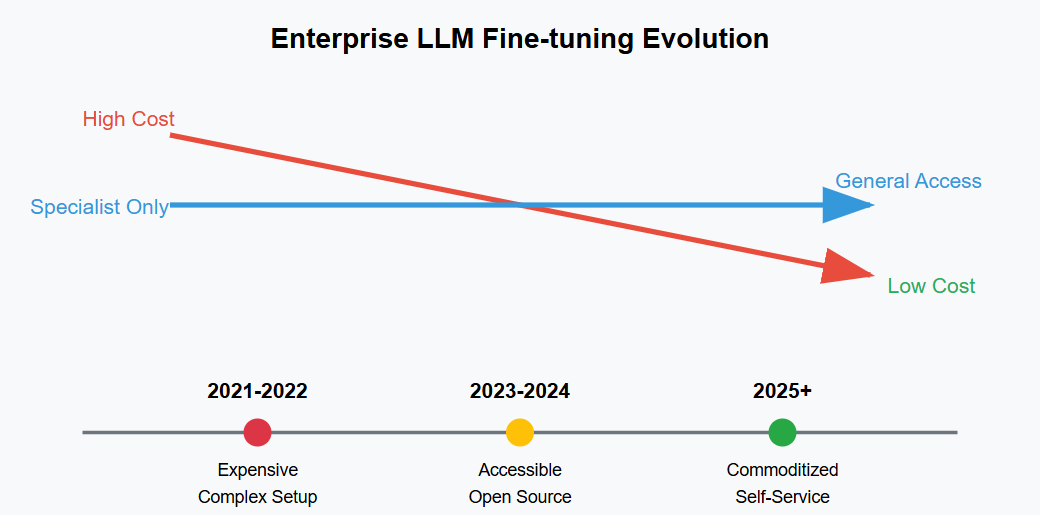
Here’s what most companies are actually working with:
- Limited compute — Think 16–32GB GPUs, not academic clusters.
- High-stakes domains — Finance, healthcare, and legal teams need models that “speak” compliance and understand their nuanced vocabulary.
- Fast iteration cycles — Business teams don’t have months. They need updates in days.
This is exactly why fine-tuning isn’t just a nice-to-have, it’s becoming a competitive edge.
When done right, it lets you move faster, stay flexible, and tailor your models to the parts of your business that matter most.
And thanks to open-source frameworks, that edge is more accessible than ever.
Let me walk you through four open-source toolkits that are battle-tested, enterprise-friendly, and helping teams move from “we should try fine-tuning” to “we’re shipping improvements weekly.”
Unsloth: The Memory Efficiency Game-Changer
Use Case: When your legal team needs to process 10,000+ regulatory documents daily, but your infrastructure budget caps GPU memory at 24GB.
Unsloth solves this exact problem.
from unsloth import FastLanguageModel
import torch
from datasets import Dataset
import json

# Production configuration for regulatory document analysis
def setup_compliance_model():
    model, tokenizer = FastLanguageModel.from_pretrained(
        model_name="unsloth/llama-2-13b-bnb-4bit",
        max_seq_length=4096,  # Accommodate longer documents
        dtype=None,
        load_in_4bit=True,
        device_map="auto"
    )

    # Configure LoRA for domain adaptation
    model = FastLanguageModel.get_peft_model(
        model,
        r=32,  # Higher rank for complex regulatory language
        target_modules=[
            "q_proj", "k_proj", "v_proj", "o_proj",
            "gate_proj", "up_proj", "down_proj"
        ],
        lora_alpha=32,
        lora_dropout=0.1,  # Prevent overfitting to legal jargon
        bias="none",
        use_gradient_checkpointing=True,  # Further memory optimization
    )

    return model, tokenizer

# Enterprise data preprocessing pipeline
def prepare_regulatory_dataset(documents_path):
    with open(documents_path, 'r') as f:
        raw_data = [json.loads(line) for line in f]

    # Format for instruction following
    formatted_data = []
    for item in raw_data:
        formatted_data.append({
            "instruction": f"Analyze this regulatory document for compliance requirements: {item['document']}",
            "output": item['analysis']
        })

    return Dataset.from_list(formatted_data)
It’s not just about fitting large models on tight hardware.
Unsloth is built for speed and efficiency.
With it, you can fine-tune 13B parameter models on a single enterprise GPU, and often see 3–5x faster training compared to traditional setups.
That kind of speed doesn’t just save time, it reduces infrastructure requirements by up to 80%, making enterprise-grade fine-tuning far more accessible.
We publish “how-to” guides and thought pieces for startups and solo founders!
We pour our passion, expertise, and countless hours into creating content that we believe can make a difference in your journey.
But only 1% of our readers follow or engage with us on Medium.
If you ever found value in our content, it would mean a lot if you could **follow Agent Issue on Medium**, give this article a clap, and drop a hello in the comments!
It’s a small gesture but it tremendously helps us deliver much better content and guides for you!
Thank you for taking your time to be here, we really appreciate it.
DeepSpeed: Scaling Beyond Single Machines
Use Case: Your customer service organization needs to fine-tune a 70B parameter model across multiple languages and business units, requiring distributed training across your on-premise GPU cluster.
DeepSpeed’s distributed training capabilities become essential.
import deepspeed
import torch
from transformers import AutoModelForCausalLM, AutoTokenizer, TrainingArguments
from torch.utils.data import DistributedSampler
import os

# Enterprise-grade DeepSpeed configuration
def create_deepspeed_config():
    return {
        "fp16": {
            "enabled": True,
            "loss_scale": 0,
            "loss_scale_window": 1000,
            "hysteresis": 2,
            "min_loss_scale": 1
        },
        "zero_optimization": {
            "stage": 3,
            "offload_optimizer": {
                "device": "cpu",
                "pin_memory": True
            },
            "offload_param": {
                "device": "cpu",
                "pin_memory": True
            },
            "overlap_comm": True,
            "contiguous_gradients": True,
            "sub_group_size": 1e9,
            "reduce_bucket_size": 1e6,
            "stage3_prefetch_bucket_size": 1e6,
            "stage3_param_persistence_threshold": 1e6
        },
        "optimizer": {
            "type": "AdamW",
            "params": {
                "lr": 2e-5,
                "betas": [0.9, 0.95],
                "eps": 1e-8,
                "weight_decay": 0.1
            }
        },
        "scheduler": {
            "type": "WarmupLR",
            "params": {
                "warmup_min_lr": 0,
                "warmup_max_lr": 2e-5,
                "warmup_num_steps": 1000
            }
        },
        "train_micro_batch_size_per_gpu": 1,
        "gradient_accumulation_steps": 16,
        "gradient_clipping": 1.0,
        "wall_clock_breakdown": True
    }

# Multi-GPU training setup
def initialize_distributed_training(model, local_rank):
    torch.cuda.set_device(local_rank)
    deepspeed.init_distributed()

    model_engine, optimizer, train_loader, lr_scheduler = deepspeed.initialize(
        model=model,
        config=create_deepspeed_config(),
        model_parameters=model.parameters(),
        training_data=train_dataset,
        collate_fn=data_collator
    )

    return model_engine, optimizer, train_loader, lr_scheduler

# Enterprise monitoring and checkpointing
def train_with_monitoring(model_engine, train_loader):
    model_engine.train()

    for step, batch in enumerate(train_loader):
        loss = model_engine(batch)
        model_engine.backward(loss)
        model_engine.step()

        # Enterprise logging
        if step % 100 == 0:
            print(f"Step {step}, Loss: {loss.item():.4f}")

            # Log to enterprise monitoring systems
            log_metrics({
                'training_loss': loss.item(),
                'learning_rate': model_engine.get_lr()[0],
                'gpu_memory_usage': torch.cuda.max_memory_allocated() / 1024**3
            })

        # Checkpoint for fault tolerance
        if step % 1000 == 0:
            model_engine.save_checkpoint('./checkpoints', step)
DeepSpeed is purpose-built for distributed training at enterprise scale.
Whether you’re training 175B+ models or just need reliable long-running jobs, DeepSpeed handles it with:
- Built-in checkpointing (a lifesaver for long trainings),
- CPU offloading (which can cut GPU memory usage by up to 90%), and
- Smart memory optimizations that make large-scale training actually doable.
⚠️ A quick heads-up: when running across multiple nodes, network bandwidth becomes your bottleneck, so monitoring and planning for checkpoint storage (100GB+ per checkpoint) is critical.
Axolotl: Configuration-Driven Simplicity
Use Case: Your data science team needs to enable business users to experiment with different fine-tuning approaches without writing code, while maintaining governance and reproducibility.
Axolotl’s YAML-based configuration system makes this approachable:
# config/customer_support_model.yml
base_model: microsoft/DialoGPT-large
model_type: AutoModelForCausalLM
tokenizer_type: AutoTokenizer

# Enterprise security and compliance
trust_remote_code: false
use_auth_token: true  # For private model repositories

# Resource management
load_in_8bit: true
load_in_4bit: false
gradient_checkpointing: true

# Data configuration
datasets:
  - path: ./data/customer_conversations.jsonl
    type: completion
    field: text
  - path: ./data/escalation_scenarios.jsonl
    type: completion
    field: conversation

# Model architecture
adapter: lora
lora_r: 64
lora_alpha: 32
lora_dropout: 0.1
lora_target_modules:
  - q_proj
  - k_proj
  - v_proj
  - o_proj
  - fc_in
  - fc_out

# Training parameters
sequence_len: 2048
micro_batch_size: 4
gradient_accumulation_steps: 8
num_epochs: 5
optimizer: adamw_bnb_8bit
lr_scheduler: cosine
learning_rate: 0.0001
weight_decay: 0.01

# Enterprise monitoring
logging_steps: 50
eval_steps: 500
save_steps: 1000
output_dir: ./models/customer_support_v2

# Evaluation configuration
eval_table_size: 5
eval_table_max_new_tokens: 128
The beauty of Axolotl lies in its abstraction layer.
import yaml
import subprocess
import logging
from pathlib import Path

class EnterpriseAxolotlPipeline:
    def __init__(self, config_dir="./configs"):
        self.config_dir = Path(config_dir)
        self.logger = logging.getLogger(__name__)

    def validate_config(self, config_path):
        """Validate configuration against enterprise policies"""
        with open(config_path) as f:
            config = yaml.safe_load(f)

        # Enterprise validation checks
        if config.get('trust_remote_code', False):
            raise ValueError("trust_remote_code not allowed in enterprise environment")

        if not config.get('use_auth_token'):
            self.logger.warning("Authentication token not configured")

        return config

    def launch_training(self, config_name):
        """Launch training with enterprise monitoring"""
        config_path = self.config_dir / f"{config_name}.yml"

        # Validate before launch
        config = self.validate_config(config_path)

        # Launch with monitoring
        cmd = [
            "accelerate", "launch", "-m", "axolotl.cli.train",
            str(config_path)
        ]

        process = subprocess.Popen(
            cmd,
            stdout=subprocess.PIPE,
            stderr=subprocess.STDOUT,
            universal_newlines=True
        )

        # Stream logs to enterprise monitoring
        for line in process.stdout:
            self.logger.info(line.strip())

        return process.returncode == 0

    def evaluate_model(self, config_name):
        """Run enterprise model evaluation"""
        config_path = self.config_dir / f"{config_name}.yml"

        cmd = [
            "accelerate", "launch", "-m", "axolotl.cli.inference",
            str(config_path)
        ]

        return subprocess.run(cmd, capture_output=True, text=True)
This YAML-based configuration system gives you:
- A “configuration-as-code” setup (great for version control, governance, and reproducibility),
- A way for non-technical users to adjust training settings safely,
- And still the flexibility for technical teams to go deep when needed.
You get consistent pipelines across departments without asking every product manager to learn PyTorch. It’s a rare win-win for experimentation and compliance.
LLaMA Factory: The Swiss Army Knife
Use Case: Your product team needs to deploy a unified system handling both text-based customer inquiries and image-based product support requests.
LLaMA Factory excels at this versatility, imagine that you product team needs to fine-tune both text and vision models for a multimodal customer support system:
from llamafactory import ChatModel
import json
import torch
from typing import List, Dict, Any

class EnterpriseMultiModalSystem:
    def __init__(self, model_path: str):
        self.model_path = model_path
        self.chat_model = None
        self.initialize_model()

    def initialize_model(self):
        """Initialize multi-modal model for production"""
        args = {
            "model_name": "llava-v1.5-13b",
            "adapter_name_or_path": self.model_path,
            "template": "llava",
            "finetuning_type": "lora",
            "quantization_bit": 4,
            "use_unsloth": True,  # Combine with Unsloth for efficiency
        }

        self.chat_model = ChatModel(args)

    def process_customer_inquiry(self, text: str, image_path: str = None) -> Dict[str, Any]:
        """Process customer support request with optional image"""
        messages = []

        if image_path:
            messages.append({
                "role": "user",
                "content": f"<image>\n{text}",
                "image": image_path
            })
        else:
            messages.append({
                "role": "user",
                "content": text
            })

        response = self.chat_model.chat(messages)

        return {
            "response": response[0]["content"],
            "confidence": self._calculate_confidence(response),
            "requires_human_escalation": self._needs_escalation(response)
        }

    def _calculate_confidence(self, response) -> float:
        """Calculate response confidence for enterprise decision making"""
        # Implement confidence scoring based on model outputs
        # This could integrate with your existing ML ops pipeline
        pass

    def _needs_escalation(self, response) -> bool:
        """Determine if human escalation is required"""
        # Enterprise business logic for escalation
        pass

# RLHF Integration for Enterprise Alignment
def setup_rlhf_training():
    """Configure RLHF for enterprise value alignment"""
    rlhf_config = {
        "model_name": "llama2-7b-chat",
        "dataset": "enterprise_preference_data",
        "template": "llama2",
        "finetuning_type": "lora",
        "stage": "ppo",  # PPO training for RLHF
        "reward_model": "./models/enterprise_reward_model",
        "ppo_epochs": 1,
        "ppo_buffer_size": 512,
        "ppo_batch_size": 64,
        "ppo_target": 6.0,
        "ppo_whiten_rewards": True,
        "ref_model": "base_model",  # Reference model for KL penalty
        "output_dir": "./saves/llama2-enterprise-aligned",
    }

    return rlhf_config
And here’s how a yaml would look like:
# Enterprise value alignment configuration
model_name: llama2-13b-chat
dataset: company_policies_preference
template: llama2

stage: ppo
reward_model: ./models/company_values_reward_model

# PPO hyperparameters for enterprise alignment
ppo_epochs: 2
ppo_buffer_size: 1024
ppo_batch_size: 128
ppo_target: 6.0
ppo_whiten_rewards: true

# Enterprise constraints
max_new_tokens: 512
temperature: 0.7
top_p: 0.9

# Compliance and safety
safety_filter: enabled
content_policy_check: true
output_dir: ./models/enterprise_aligned_assistant
LLaMA Factory is built for this kind of versatility. It supports both text and vision fine-tuning, making it ideal for multimodal customer support systems.
What really sets it apart? Its integrated RLHF (Reinforcement Learning from Human Feedback) features, letting you align models with your company’s policies and tone during training, not just after deployment.
Production Implementation Strategy
Here’s a brief summary of our strategy

And an example snippet for monitoring and observability
# Enterprise monitoring integration
import wandb
import mlflow
from prometheus_client import Counter, Histogram

# Metrics for enterprise monitoring
training_jobs_total = Counter('llm_training_jobs_total', 'Total training jobs')
training_duration = Histogram('llm_training_duration_seconds', 'Training duration')
gpu_utilization = Histogram('gpu_utilization_percent', 'GPU utilization during training')

def enterprise_training_wrapper(training_function):
    def wrapper(*args, **kwargs):
        training_jobs_total.inc()
        start_time = time.time()

        # Initialize tracking
        mlflow.start_run()
        wandb.init(project="enterprise-llm-finetuning")

        try:
            result = training_function(*args, **kwargs)

            # Log success metrics
            training_duration.observe(time.time() - start_time)
            mlflow.log_metric("training_success", 1)

            return result

        except Exception as e:
            mlflow.log_metric("training_success", 0)
            raise e
        finally:
            mlflow.end_run()
            wandb.finish()

    return wrapper
We can also mention a few security and compliance considerations:
- Data governance to implement proper data lineage tracking
- Model versioning by MLflow or similar for model lifecycle management
- Access controls with enterprise IAM
- Audit trails for all training activities for compliance
Hope this walk-through helped you to have a better view of what’s available and how you can leverage it in your own fine-tuning workflows.
The question for everybody is not whether to adopt these approaches, but how quickly they can be integrated into existing development workflows to maintain competitive positioning in an AI-driven market.
Thank you for being here again, see you next time.
메타데이터
- post_id
- ea10522a6ba5
- slug
- llm-fine-tuning-strategy-4-open-source-toolkits-that-you-should-know-ea10522a6ba5
- url
- https://medium.com/@agentnativedev/llm-fine-tuning-strategy-4-open-source-toolkits-that-you-should-know-ea10522a6ba5
- canonical_url
- https://medium.com/@agentnativedev/llm-fine-tuning-strategy-4-open-source-toolkits-that-you-should-know-ea10522a6ba5
- author_url
- https://medium.com/@agentnativedev
- status
- ok
- fetched_at
- 2026-07-13 06:23:13