Towards Virtue, Reconsidered
Reflection of QS 91:7–10
Towards Virtue, Reconsidered
Reflection of QS 91:7–10
For some years, I’ve named my blog “Towards Virtue.” Somehow, sometime recently I began to think the expression was no longer accurate enough.
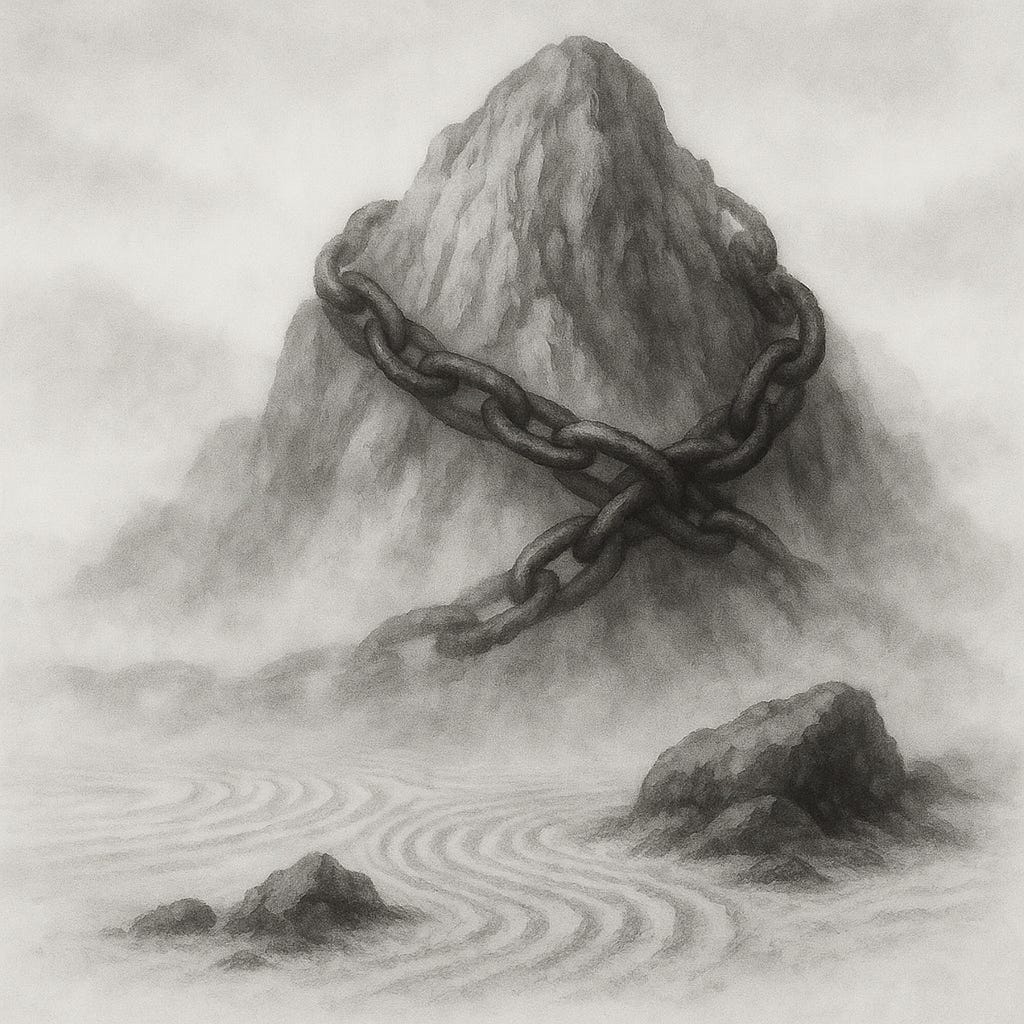
At first I read the discomfort as a verdict. Like the name was wrong, I had outgrown it, time to find another. No. The longer I sat with it, the less it felt like a wrong name and the more it felt like a wrong picture.
Photo by Alain ROUILLER on Unsplash
To understand the discomfort I have to go back to where the name came from. I have been writing casually since primary school in various platforms, but the blog as it stands now was renewed in late 2022, somewhere in the middle of early-to-mid-20s life crisis. I was a master’s student then, sent abroad on my hope and someone else’s expense and — later — people’s bigger expectation. That winter I wrote a short series of posts, trying to force myself back into the identity of someone who writes. (Why writing? I don’t have a strong defensible answer. It felt like I might gone mad if I don’t put these thoughts out to the world. Maybe I need the substantial feedbacks or some accountability. I decided to just regard the published posts as no-nonsense love letters for my future self.)
The question those posts circled was small, a little embarrassing, and entirely serious: what if I turn out to be biasa-biasa saja — merely ordinary, mediocre? I had been, as I put it then, designed by myself, by the people funding me, by the society I would return to, not to be ordinary. You are not allowed to be ordinary. But in what sense?
And in the third post I reached for an answer I still believe. The fear of ordinariness as measured by the visible ruler — status, career, the metrics that show — is answered only by the invisible ruler: the heart, the character, the akhlaqul karimah. By then everything, with the help and mercy of Allah, will be in order. The act of writing, I decided, should serve that. I closed the post with two words, half a vow: Towards virtue.
That is the banner I have carried since, and I do not disown the intuition beneath it. With the mercy of Allah, the intuition was right.
What I no longer believe is the picture the words means in my mind at that time. As the metaphor for the mediocre vs extraordinary discourse, virtue was a height, and I stood below it. It was the extraordinary, and I was escaping the ordinary by climbing toward it. It was a set of hard-won qualities, which I lacked and was straining to acquire. It is a destination, a possession I lack and am traveling to acquire. I stand here, more or less empty, and “towards” is the road I walk to reach it, to draw closer to a good that sits out there, apart from me. And the whole drama was one of attainment. For a long time, this seemed not only true but humble. Who would dare claim to have virtue? Better to be merely on the way.
Then I sat again with the ayah of Qur’an Surah Al-Shams (91:7–10) which tonight, at the time of this writing, took a center stage in the reading of Prof. Al-Attas’s Islam: The Covenants Fulfilled book, guided by Prof. Ugi Suharto. It elucidates that the soul is shaped in due proportion and order, and is then given to know its own wrong and its own right. And the whole of its success and failure turns on whether one purifies that soul or buries it.

The knowledge of right and wrong is placed in the soul at the very beginning, in its very proportioning. The verbs that the surah used, to purify (zakkāhā) against to bury (dassāhā) is not about a journey to acquire something absent outside of you. They describe what one does with something already given. To make the soul grow clear, or to smother it under. Either way, the thing is already there.
This is why Prof. Al-Attas refuses to let virtue be called a “value” in the modern sense, for a value is posited. Something posited is set by a subject, a culture, a will, and so stands apart from what is real, something we assign and the pursue. But virtue, in this reading, is neither posited nor external. It belongs to what the soul already is by creation. Yes, that’s what we call fiṭrah.
Does the word “towards” survive this metaphysical construction? I think it does. There is still a not-yet, but much more old and deeper, primordial even. The soul of its Covenant (QS 7:172) is not yet recovered in the life of liability, and no one polishing a mirror pretends it is already clean, for one who claimed so will be tested heavily in their sincerity. “Towards” still names the posture of the one on the way. What changed is the direction of the arrow, no longer pointing to a distant value I am closing in on. It points home, to the origin that is also the end. To the perfection given at the start and waiting to be unburied. It is our biggest project until we are physically buried to the ground.
So I will keep the name in my mind, but with a more proper ordering of each concept related to it. It is also a renewal of intention. In this tasyrik days of 1447 H, let us turning, again, towards the one we was given, and have spent years learning how not to bury.
메타데이터
- post_id
- ea1871929cda
- slug
- towards-virtue-reconsidered-ea1871929cda
- url
- https://medium.com/@fiddien/towards-virtue-reconsidered-ea1871929cda
- canonical_url
- https://medium.com/@fiddien/towards-virtue-reconsidered-ea1871929cda
- author_url
- https://medium.com/@fiddien
- status
- ok
- fetched_at
- 2026-08-23 00:46:23