The Back Pain Your Office Is Causing — And the Cost Nobody Is Counting
Ask almost anyone who works in an Indian office for more than eight hours a day how their back feels by Thursday evening. You will not get…
The Back Pain Your Office Is Causing — And the Cost Nobody Is Counting
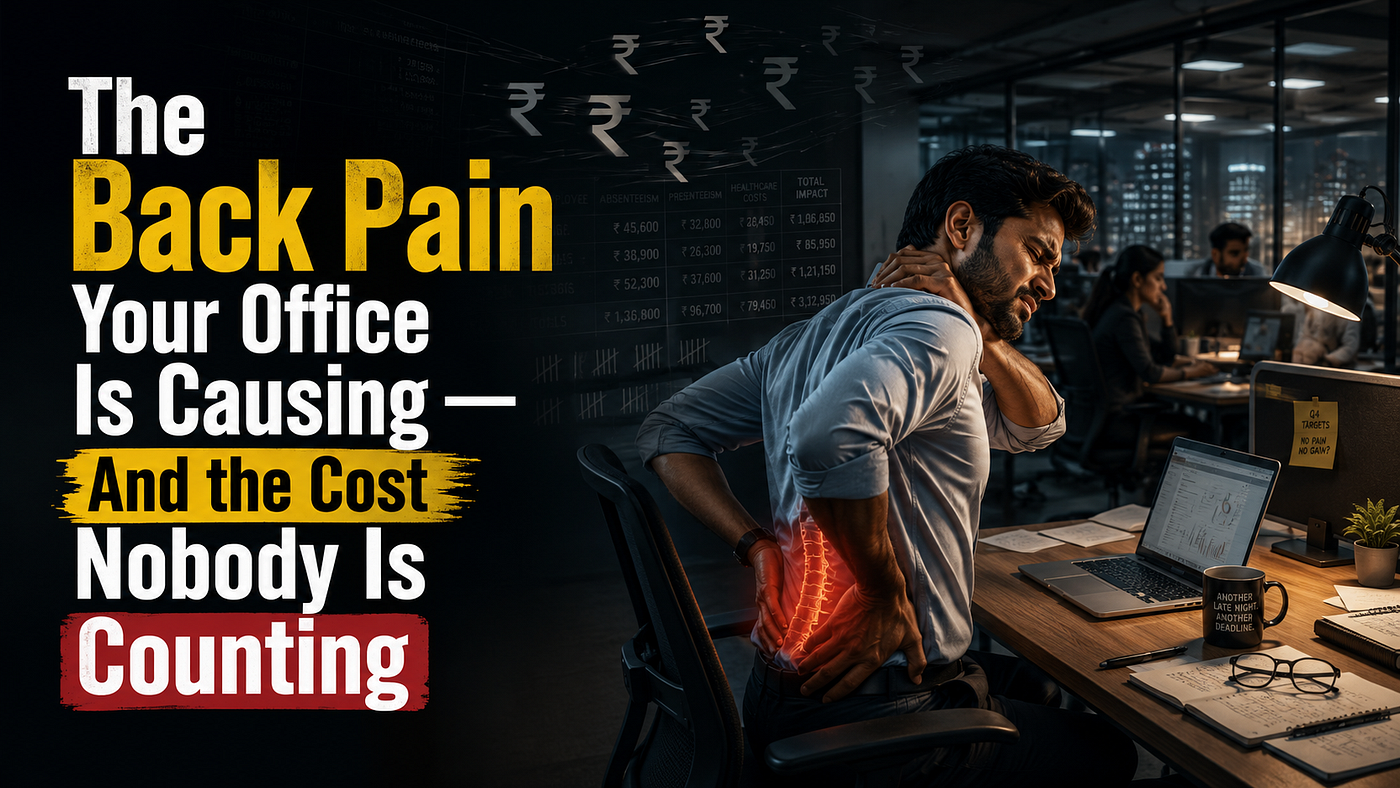
Ask almost anyone who works in an Indian office for more than eight hours a day how their back feels by Thursday evening. You will not get good news.
Most will say something to the effect of: yes, it aches, but it’s fine, it’s just sitting all day. Many will have a specific point on their lower back, or a persistent tension in the base of the neck, or a shoulder that has been bothering them for months. A few will have already seen a physio. Several are quietly taking ibuprofen before long working days.
What almost none of them will say is that their office caused it. And what almost no Indian company acknowledges is that their office is causing it, at scale, to a significant proportion of their workforce, at a measurable financial cost that dwarfs what a proper ergonomic setup would have cost.
Ergonomics is treated in most Indian organizations as a wellness feature — a nice-to-have that goes with standing desks and yoga rooms in companies that care about that sort of thing. The research says it’s a basic productivity and health input with a measurable return. The gap between those two framings is where most of the damage happens.
What the Data Actually Shows for Indian Offices
The numbers are more specific than most HR teams realize.
A 2025 BJM Health analysis of workplace ergonomics and musculoskeletal disorders in India found that musculoskeletal disorders account for 33.8% of all work-related illnesses in the country. One in three occupational health problems. In knowledge-work environments — IT, banking, financial services, consulting — the figure is likely higher, because these are jobs where people sit in the same posture, staring at the same screen height, for the better part of an eight-hour day.
2026 published a cross-sectional research on Indian office workers in the Indian Journal of Physiotherapy and Occupational Therapy which revealed that 50% of them experience mild musculoskeletal discomfort. 21.43% of the participants suffered from moderate discomfort. It was discovered that back pain that affects the greater part of the employees confronted 40% of respondents interviewed, neck pain was reported by 21.43% of respondents, and they claimed to have had eye strain with the ratio of 18.57% among interviewees. The researchers performed an ergonomic risk assessment based on the method of RULA to determine the extent of the problem and calculated a medium to high level of risks for most of the workplaces. The major determinants of this problem were lack of lumbar support, improper desk arrangement, and static postures.
The same field study was conducted concerning the 744 employees working in banks of Punjab and published in 2025. The results indicate a high rate of MSD in computer-based banking work and proved the connection between the degree of MSD and the level of health-related quality of life. These are not manufacturing workers doing physically demanding labor. These are knowledge workers sitting at desks.
The same BJM Health analysis found that companies which implemented ergonomic interventions saw a 48% reduction in absenteeism and a 32% improvement in productivity. That is a very large return on what are, by the standards of most corporate expenditure, very modest investments.
What Ergonomics Actually Covers — It’s Not Just the Chair
When most Indian companies think about ergonomics, they think about chairs. Sometimes they think about standing desks. That covers about a third of what an ergonomic workstation actually requires.
The Cornell Ergonomics Lab at Cornell University, which has produced some of the most-used practical workstation guidance in the world, defines the ergonomic workspace as a system — the interaction of seat height, desk height, monitor position, keyboard placement, mouse position, lighting, and the individual user’s own anthropometry. All of these interact. Fixing one without attending to the others frequently solves nothing or creates a new problem.
Chair height and lumbar support. The seat should allow both feet flat on the floor with knees at approximately 90 degrees, and the backrest should provide genuine lumbar support in the lower back curve. Most chairs in Indian open-plan offices have lumbar support in name only — a slight curve in the back panel that doesn’t reach the right point on any but a narrow range of body types. Seat height adjustability is necessary because the correct height differs by person; a fixed-height chair that works for someone 175cm tall puts someone 155cm at a mechanical disadvantage from the moment they sit down.
Desk height and arm position. For keyboard and mouse work, the elbows should be at approximately 90 to 100 degrees and the forearms roughly parallel to the floor. On a fixed-height desk at the standard 750mm, this is correct for someone around 170–175cm. Anyone significantly shorter or taller either has their elbows too high (requiring shoulder elevation, which loads the trapezius) or too low (requiring forward lean). Fixed-height desks affect a significant proportion of users negatively. Height-adjustable desks — often framed as a hybrid-work or standing-desk feature — are actually an ergonomic baseline requirement for mixed-height teams.
Monitor height and distance. The top of the screen should be at or slightly below eye level, at a distance where reading is comfortable without squinting. In most Indian offices, laptops are used directly without external monitors, which means the screen is 20–30cm below eye level and the user spends the day looking down. This is the primary cause of the neck pain pattern that the Karnataka study identified in 21.43% of workers. An external monitor at the right height, or a laptop stand with an external keyboard, eliminates this. The total cost of a monitor stand or laptop riser is under ₹1,500.
Lighting at the task level. We covered the zone-lighting problems of Indian offices in our piece on what Indian offices keep getting wrong about lighting. The ergonomic dimension: glare on the screen from overhead lights causes the user to tilt the screen away and their head toward it, which compounds the neck-load problem. Task lighting at desk level that supplements rather than replaces overhead lighting reduces this. So does adjusting monitor placement relative to the light source, which almost nobody does when they set up their workstation.
Why Indian Offices Systematically Under-Invest Here
The ergonomics gap in Indian offices is not random. It follows a predictable procurement logic.

Furniture for the open floor is almost always specified by cost per seat, not by ergonomic specification. A ₹3,500 task chair looks functionally identical to an ₹18,000 ergonomic chair in a furniture catalogue. Both have a seat, a back, armrests, and a height adjustment. The difference is in the quality of the lumbar support mechanism, the range of adjustability, the seat foam density and shape, and the armrest adjustability. None of these things photograph well. None show up in the square-footage calculation. None matter to the person signing off the procurement order, who will sit in a ₹35,000 executive chair in their own office.
We raised this pattern in our piece on how office design affects the people who don’t have corner offices. The ergonomics specification is where the hierarchy in Indian office procurement is most directly written into people’s bodies. Leadership gets chairs specified individually. The open floor gets whatever the furniture vendor recommended at the preferred price point, specified as a single line item across 100 identical seats without any consideration of the range of body types that will use them.
Desks have the same problem. The standard Indian office fit-out specifies fixed-height workstations at 750mm, which is a reasonable average for a specific body type that most of the workforce is not. Height-adjustable desks are specified as a premium upgrade, available in standing-desk zones or as an individual accommodation for people who have already complained enough. The cost difference between a fixed desk and a motorized height-adjustable one has narrowed significantly in the last five years — quality units now run ₹15,000–25,000, a meaningful but not prohibitive premium over standard workstations. It is specified as an upgrade rather than a baseline because nobody has done the arithmetic on what the fixed-desk alternative is costing.
The Arithmetic Nobody Runs
Here is a rough calculation that most Indian facilities managers have never been asked to do.
Take a 100-person open-floor team in a Gurgaon office. Based on the Karnataka study data, roughly 50 of those people are experiencing some level of musculoskeletal discomfort on any given week. Of those, perhaps 15 have symptoms significant enough to affect their concentration and output. Even if we conservatively estimate a 10% productivity reduction for those 15 people on affected days, and those days number three per month, the productivity loss across the team in a month is 15 × 0.1 × 3 = 4.5 person-days. Over twelve months, that is 54 person-days of lost output from ergonomic-related discomfort alone.
At an average all-in cost of ₹50,000 per month per person (a conservative figure for a knowledge worker in Gurgaon), 54 person-days is approximately ₹9 lakh in lost productivity annually. From ergonomics. From chairs and desk heights and monitor positions.
The cost of upgrading 100 workstations from basic task chairs to properly specified ergonomic ones, and adding laptop stands or monitor risers: approximately ₹10–15 lakh one-time. Payback period under two years, before counting reduced sick leave, lower attrition, and the saved physio visits people are paying out of their own pocket.
These numbers are illustrative rather than precise — the real figures for any given team will depend on the work type, age profile, and current workstation setup. But the order of magnitude is right. And the calculation almost never gets run, because ergonomics sits in the facilities budget as a cost rather than in the productivity budget as an investment.
Where Green Certification Is Changing This
There is a supply-side pressure building that may accelerate ergonomic standards in Indian corporate offices faster than organic demand.
The WELL Building Standard, which is increasingly specified by GCC occupiers and premium developers in Indian markets, includes explicit ergonomic requirements as part of its Mind and Movement features. These include minimum workstation dimensions, requirements for adjustable-height work surfaces in a proportion of workstations, visual ergonomics standards for screen use, and requirements for sit-stand work options. Buildings pursuing WELL certification — and the demand for LEED and WELL-certified office space in Gurgaon has grown significantly as GCCs establish their India presence — need to meet these specifications to achieve and retain certification.

For companies in these buildings, this means ergonomic standards are increasingly coming in through the building specification rather than through a facilities management decision. The proportion of Indian office workers in WELL-certified environments is still small, but it is growing. And as GCCs set a visible standard for ergonomic workplace quality in the markets where they operate, the expectation from employees in non-GCC offices shifts accordingly.
For companies that are not in WELL-certified buildings and have no near-term plan to move into one, the certification standard still provides a useful benchmark. The WELL ergonomics requirements are based on the same research that underlies all workplace ergonomics guidance. Using them as a self-assessment checklist against a current office costs nothing.
A Practical Starting Point for Existing Offices
Getting ergonomics right in a new fit-out is a specification decision. In an existing office, it’s a series of smaller interventions, most of which cost less than a month’s ibuprofen budget for the team.
Audit the monitor situation first. Walk the floor and count how many people are working directly on a laptop without an external monitor or stand. Each one is looking down all day. Laptop stands run ₹800–1,500. External monitors at appropriate height cost ₹8,000–15,000 and last five years. This is the highest-impact single intervention for neck and upper back pain.
Check whether people can adjust their chairs. Many Indian task chairs have height adjustment mechanisms that are either broken, stiff, or unknown to the person using them. A thirty-minute session showing the team how to set their chair correctly — seat height so feet are flat and knees at 90 degrees, lumbar adjustment in the right position, armrests at elbow height — costs nothing and helps immediately.
Identify the people at highest risk. People over 45, people with existing back or neck conditions, people doing high-intensity screen work for six-plus hours daily, and people who are significantly shorter or taller than 165–175cm are all at elevated ergonomic risk. These are the workstations to address first when budget is limited.
Get height-adjustable desks into the next fit-out brief. Not as a standing-desk feature, but as a baseline specification for the open floor. The cost premium over fixed desks has narrowed. The productivity and health return is documented. It is now reasonable to specify this as standard rather than as an upgrade.
The back pain in your office is not incidental. It is a design and procurement outcome, and it is fixable. Most of the fixes cost less than one replacement hire. The question is whether the people making procurement decisions are measuring the cost of not fixing it — and they almost never are.
What’s the ergonomic situation at your desk right now — and when did you last adjust anything? Curious whether this is a problem people have given up on or one that’s actively being addressed somewhere.
메타데이터
- post_id
- ea1dc8039436
- slug
- the-back-pain-your-office-is-causing-and-the-cost-nobody-is-counting-ea1dc8039436
- url
- https://medium.com/@info_30441/the-back-pain-your-office-is-causing-and-the-cost-nobody-is-counting-ea1dc8039436
- canonical_url
- https://medium.com/@info_30441/the-back-pain-your-office-is-causing-and-the-cost-nobody-is-counting-ea1dc8039436
- author_url
- https://medium.com/@info_30441
- status
- ok
- fetched_at
- 2026-07-20 02:34:30