Residential Proxy vs Datacenter Proxy: Which Should You Choose in 2026?
TL;DR:
Residential Proxy vs Datacenter Proxy: Which Should You Choose in 2026?
TL;DR:
- Residential proxies route traffic through real ISP-assigned devices. They offer the highest anonymity and success rates for complex scraping tasks.
- Datacenter proxies route traffic through cloud servers. They provide high speed and lower costs but are easily detected and blocked by modern WAFs.
- Choose residential proxies for e-commerce, social media, and search engines. They handle strict anti-bot measures effectively.
- Choose datacenter proxies for high-speed, low-security targets. They are ideal for internal network testing or scraping unprotected sites.
- Free to start. New Scrapeless accounts include free Scraping Browser runtime — sign up at app.scrapeless.com.
Introduction: The Core Difference in IP Sourcing
The proxy you choose dictates the success of your data extraction pipeline. Understanding the difference is crucial when configuring your network routing architecture. While both residential and datacenter proxies mask your origin IP, their underlying infrastructure is fundamentally different. This architectural difference determines whether your request returns the target data or an Access Denied interstitial.
Datacenter proxies are generated in bulk by cloud hosting providers, utilizing IP blocks allocated by regional internet registries. They are fast and cheap, but their IP subnets are public knowledge. Residential proxies, conversely, are assigned by consumer Internet Service Providers (ISPs ) to real devices in homes. This article breaks down the technical differences, performance metrics, and use cases to help you choose the right proxy type for your workload.
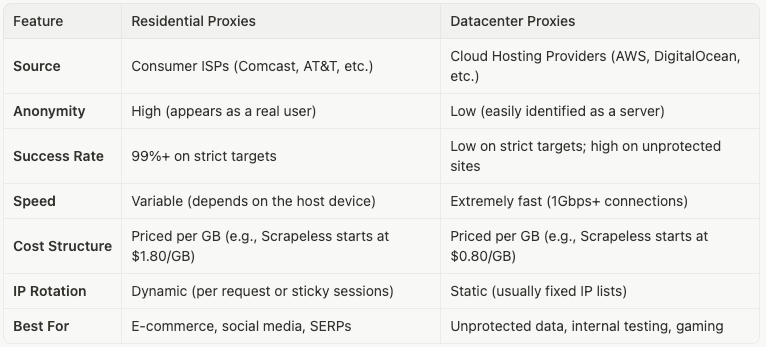
Residential vs Datacenter Proxies: Feature Matrix
Deep Dive: Residential Proxies
Residential proxies leverage the IP addresses of real household devices. When you route a request through a residential proxy, the target website sees the request originating from a standard home internet connection. This is the foundation of modern, high-success web scraping.
Mechanism
The proxy network maintains a global pool of opted-in devices. When your scraping script sends a request, it hits the proxy provider’s gateway. The gateway then authenticates your request and routes it through an available device in your target region before the request reaches the destination server.
Advantages
- High Trust Score: Target sites trust residential IPs because blocking them risks blocking real customers. This makes them highly effective against advanced anti-bot systems.
- Granular Geo-Targeting: You can target specific countries, states, or even cities. This is essential for ad verification and localized pricing analysis.
- Solving CAPTCHAs: They naturally evade IP-reputation-based CAPTCHA triggers, reducing the need for complex solver integrations.
Limitations
- Variable Speeds: Because the traffic routes through a consumer device, latency can fluctuate based on the host’s connection quality.
- Higher Cost: Sourcing and maintaining a network of real devices is complex, making residential proxies more expensive than their datacenter counterparts. For example, Scrapeless residential proxies start at $1.80/GB on the Basic plan, scaling down to $1.44/GB on the Business plan.
Deep Dive: Datacenter Proxies
Datacenter proxies are hosted on commercial servers. They are completely independent of consumer ISPs and provide a direct, high-bandwidth connection to the internet. While they lack the anonymity of residential IPs, they excel in raw performance.
Mechanism
A cloud provider allocates a block of IP addresses to a server in a data center. You connect to this server, and it forwards your requests to the target site using one of its assigned IPs.
Advantages
- Blazing Fast Speeds: Hosted on enterprise infrastructure with multi-gigabit connections, they offer minimal latency and high throughput.
- Predictable Performance: The connection is stable and consistent, making them ideal for tasks that require strict timing.
- Lower Cost: They are significantly cheaper to produce and maintain. Scrapeless datacenter proxies start at just $0.80/GB on the Basic plan, dropping to $0.64/GB on the Business plan.
Limitations
- Easily Detectable: The IP subnets belong to known data centers. WAFs often block these subnets by default, matching known datacenter ranges published in BGP routing tables.
- High Block Rates: They are virtually useless against modern e-commerce or social media platforms that employ strict IP reputation checks.
The Cost Factor: Analyzing the Scrapeless Pricing Model
When choosing between residential and datacenter proxies, cost is a major consideration. The Scrapeless pricing model provides a clear illustration of the cost difference based on the underlying infrastructure.
Residential Proxy Pricing
Residential proxies are priced based on bandwidth usage because routing traffic through consumer devices incurs higher overhead.
- Basic Plan: $1.80/GB
- Growth Plan: $1.62/GB
- Scale Plan: $1.53/GB
- Business Plan: $1.44/GB
Datacenter Proxy Pricing
Datacenter proxies are significantly cheaper due to the economies of scale provided by cloud infrastructure.
- Basic Plan: $0.80/GB
- Growth Plan: $0.72/GB
- Scale Plan: $0.68/GB
- Business Plan: $0.64/GB
While datacenter proxies offer a lower cost per gigabyte, the true cost must be measured against the success rate. If a datacenter proxy is blocked 90% of the time on a strict target, the effective cost of a successful request may actually be higher than using a residential proxy.
Choosing Between Them: The Decision Guide
Your choice depends entirely on the target site’s security posture and your project’s scale. Understanding these nuances ensures you optimize your scraping budget.
When to Use Residential Proxies
Use residential proxies when the target site actively defends against bots.
- Scraping Amazon or Walmart: These sites flag datacenter IPs immediately. Residential IPs are required to view accurate pricing and stock without triggering CAPTCHAs.
- Social Media Automation: Platforms like Instagram and LinkedIn require high-trust IPs to prevent account bans and maintain session persistence.
- Sneaker Botting: Retailers use advanced WAFs during high-demand drops; only residential IPs can clear the queue and complete the checkout process.
- SEO Monitoring: Accurate, localized SERP data requires requests originating from real user IPs in specific geographic regions.
When to Use Datacenter Proxies
Use datacenter proxies when speed is the priority and the target has minimal security.
- Scraping Unprotected Sites: Extracting data from academic databases, legacy public directories, or government portals that do not employ WAFs.
- Internal Network Testing: Load testing your own infrastructure to simulate high traffic volumes.
- Streaming and Gaming: Accessing geo-restricted content where the platform only checks the region, not the IP type.
- Cybersecurity Research: Scanning for vulnerabilities across wide IP ranges where anonymity is less critical than throughput.
Get your API key on the free plan: app.scrapeless.com For detailed pricing information, check our pricing page. You can also explore our full residential proxies offering, or read our guide on best residential proxies for web scraping.
Hybrid Approaches: Static ISP Proxies
For use cases that require both the speed of datacenter proxies and the anonymity of residential proxies, Static ISP Proxies offer a hybrid solution. These are IPs hosted in datacenters but registered under consumer ISPs.
Scrapeless offers Static ISP Proxies starting at $2.50/IP on the Basic plan, scaling down to $2.00/IP on the Business plan. They provide a fixed IP address, making them ideal for managing multiple social media accounts or maintaining persistent login sessions without triggering suspicious activity alerts.
Conclusion
The residential vs datacenter proxy decision comes down to the target’s security layer. Datacenter proxies offer raw speed and low costs, making them suitable for unprotected targets. However, for modern web scraping, residential proxies are the only viable path to consistent data extraction. Scrapeless provides a 90M+ residential IP pool starting at $1.80/GB, giving you the high-trust routing required for strict targets. Pin US egress, keep the session chain inside one shell invocation, follow the discover → extract pattern, and treat absent fields as nullable.
Ready to Build Your AI-Powered Data Pipeline?
Join our community to claim a free plan and connect with developers building web scraping pipelines: Discord · Telegram.
Sign up at app.scrapeless.com for free Scraping Browser runtime and adapt the patterns above to the sites and queries the pipeline needs.
FAQ
Q: Is scraping public data legal?
- Scraping publicly available data is generally legal, but jurisdictions vary. Review the target site’s Terms of Service and consult legal counsel for your specific use case.
Q: Do I need a proxy to scrape modern websites?
- Yes. Modern sites use Web Application Firewalls (WAFs) that quickly block datacenter IPs. Residential proxies are required to route traffic through real user devices. Use the
— proxy-countryflag to target specific regions.
Q: How do I handle WAF or Access Denied blocks?
- Pin your proxy to a US residential egress and warm the session by loading the site’s homepage first before navigating to the target page.
Q: What should I do if the DOM structure changes?
- Re-check and tighten your CSS selectors or XPath expressions. Rely on stable
data-*attributes or internal JSON endpoints rather than brittle layout classes.
Q: How many concurrent requests can I run?
- Keep your concurrency to ≤3 workers per host for parallel runs to avoid triggering aggressive rate limits.
Q: Can I run these workflows without an AI agent?
- Yes. The underlying API and CLI commands work end-to-end without the AI agent skill, though the skill is the recommended path for automated extraction.
메타데이터
- post_id
- ea31afcea17d
- slug
- residential-proxy-vs-datacenter-proxy-which-should-you-choose-in-2026-ea31afcea17d
- url
- https://medium.com/@scrapeless/residential-proxy-vs-datacenter-proxy-which-should-you-choose-in-2026-ea31afcea17d
- canonical_url
- https://medium.com/@scrapeless/residential-proxy-vs-datacenter-proxy-which-should-you-choose-in-2026-ea31afcea17d
- author_url
- https://medium.com/@scrapeless
- status
- ok
- fetched_at
- 2026-07-27 06:40:12