The 5 Best Kajabi Alternatives in 2026 (Ranked by What They Actually Deliver)
Kajabi Basic is $179 a month now. Here’s an honest look at what the alternatives actually give you, ranked by how well they replace the…
The 5 Best Kajabi Alternatives in 2026 (Ranked by What They Actually Deliver)
Kajabi Basic is $179 a month now. Here’s an honest look at what the alternatives actually give you, ranked by how well they replace the full Kajabi stack.
Kajabi Basic is $179 a month now. Here’s an honest look at what the alternatives actually give you, ranked by how well they replace the full Kajabi stack.
Kajabi has been the default answer for course creators and coaches for over a decade. It works, the ecosystem is mature, and if you Google “how to launch an online course,” half the guides still assume you’re building on Kajabi.
But the pricing has crept up. Basic is $179/month, Growth is $249, and Pro is $499. The features people expect when they hear “all-in-one platform” (automations, AI, an affiliate program, a second admin seat) are gated to the Growth plan and above. On top of that, Kajabi’s community layer, while it now includes channels, activity feeds, gamification, and Meetups, still doesn’t ship real-time chat, member-to-member DMs, or matchmaking — so creators who need a live community still end up running Kajabi plus Circle, or Kajabi plus Discord, and paying twice.
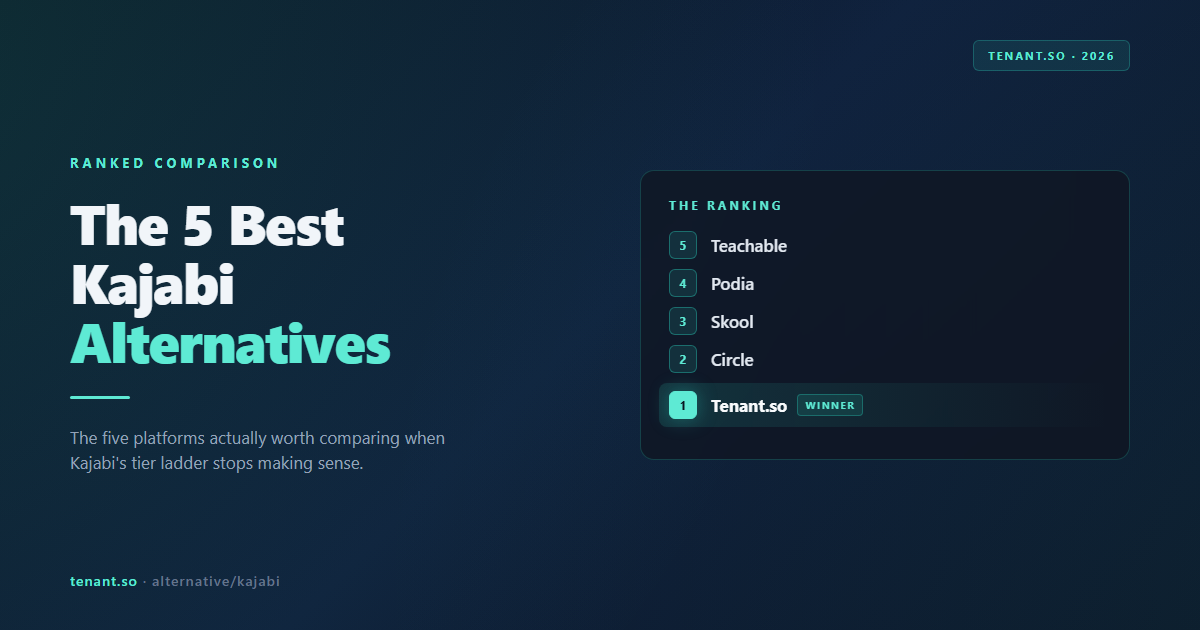
If you’re evaluating alternatives in 2026, here’s a ranked look at the five platforms actually worth comparing against Kajabi. Ranking is based on how well each one replaces Kajabi’s full stack: courses, community, email, and monetization.
What Actually Makes a Kajabi Alternative
Before the list, the criteria I’m using:
- Real course delivery (video hosting, quizzes, certificates, drip content, progress tracking)
- A community layer that doesn’t feel like an afterthought (chat, spaces, engagement mechanics)
- Built-in email marketing or at least a coherent story about how you send campaigns
- A monetization stack (subscriptions, one-time payments, coupons)
- Transparent fees (transaction fees add up fast at scale)
Nothing else is honestly comparable to Kajabi. Discord isn’t a course platform. Substack isn’t a membership platform. If you need the full stack, these are the five.
#5. Teachable
Teachable is a pure LMS. If courses are 100% of what you sell, Teachable does them well: clean course builder, solid video hosting, good quiz and certificate handling, decent affiliate tooling on higher tiers.
Where it falls short as a Kajabi alternative: there’s no real community layer, email marketing is thin, and Teachable’s transaction fees on the lower tiers are painful (10% on the Free plan, 5% on Basic, plus your payment processor’s own fees on top). If you’re paying for the Pro tier those transaction fees drop to zero, but you’re still stitching together email and community from third-party tools.
Verdict: Good if you’re a course-only creator with an existing email list on Mailchimp and no plans to build a community. Not a real alternative if you want Kajabi’s full stack.
#4. Podia
Podia is the friendly, lower-priced entry point. There’s a free tier, and the paid plans start under $50/month, which makes it attractive if you’re just launching. Podia has courses, digital downloads, email marketing, and a light community feature.
The catch is the ceiling. Podia’s email tool is functional but basic, the community feature is light rather than full-featured, and the automation and analytics thin out at the lower tiers. Bigger operations tend to outgrow it.
Verdict: A good starter platform if you’re testing the waters. Not the platform you’re on a year in.
#3. Skool
Skool used to be the flat-rate darling. $99/month, no transaction fees, community + courses in one product, done. In 2026 that changed. Skool now runs two tiers: Hobby at $9/month with a 10% transaction fee, and Pro at $99/month with a 2.9% transaction fee.
Both tiers add fees, which is a real shift from the old positioning. And Skool is still a lighter product than Kajabi in a lot of ways: the course delivery is basic, there’s no built-in email marketing, and the customization is minimal by design. What Skool does have is a genuinely great community engine, gamification that actually drives daily-active use, and a simple UX that a lot of creators love.
Verdict: Strong for community-first creators who want minimal setup and don’t need a mature LMS or built-in email. The recent fee introduction hurts its old “no fees” pitch, but the product is still solid.
#2. Circle
Circle is the closest direct competitor to Kajabi’s community feature. It’s a proper community platform: spaces, discussions, events, live streams, custom branding. The community UX is polished.
Pricing tells a different story though. Professional is $89/month with 2% transaction fees. Business is $199/month with 1% fees. Circle Plus is custom pricing with 0.5% fees. Email marketing is a separate $99/month add-on that scales with your contact list, and AI and workflow automations live in the Business tier and above. If you’re on Professional and want the full stack, the real monthly baseline is $89 platform + $99 email = $188/month before transaction fees kick in.
On a community doing $10K/month in revenue, that stacks up to roughly $388/month for Circle Professional versus roughly $559/month for Kajabi Growth once you factor in Kajabi’s 2.8% + $0.30 fee structure. Circle is honestly cheaper on total stack cost. What weakens the “cheaper than Kajabi” pitch is that the gap is smaller than the sticker price suggests, and Circle still leaves you managing email as its own line item.
Verdict: Best-in-class community layer, and yes, cheaper than Kajabi Growth once you tally the full stack. The trade-off is that email lives as a separate paid module and scales up with your list, so you’re solving Kajabi’s cost problem partly by moving costs to a different line.
#1. Tenant.so
Tenant.so is the newest entrant on this list and the one built specifically to replace the full Kajabi stack, community layer included, without the price ladder.
The pitch: 0% additional transaction fees (meaning no Tenant.so cut on top of what your payment processor charges — you pay Stripe or your provider their standard rate and nothing more), no product caps, no contact caps, unlimited admins, and all the features Kajabi gates behind Growth or Pro included at the early access tier. That means automations, AI, affiliate program, and community all in one product, at one price.
What sets it apart from the other four on this list:
- A community layer built for real-time engagement. Kajabi’s expanded community shipped channels, feeds, gamification, and Meetups, which is real progress. What it still doesn’t ship is real-time chat (channels are feed-based, not live), member-to-member DMs, or matchmaking. Tenant.so’s community architecture was designed around those three from day one — WebSocket-backed chat with presence, private DMs, and member matchmaking for larger communities.
- Jarvis AI trained on your course content. Not a generic writing assistant. A RAG-powered agent that reads your actual lessons and answers member questions using your material.
- 60+ built-in financial calculators. BRRRR analysis, mortgage calculators, net worth trackers, debt payoff planners. If your community is built around investing, real estate, or business, this replaces a whole category of tools.
- License key system. Sell software, plugins, or digital downloads alongside your courses? Tenant.so generates and manages license keys natively. Nothing else on this list does.
- A Discord bot included. Extend your community into Discord without running a second platform.
The platform is currently in early access with 0% additional fees while it’s in beta. Full Tenant.so vs Kajabi comparison is up on their site.
Verdict: The one to look at if you want everything Kajabi has, plus a real community layer, without the tier climb. Downside is it’s newer, so the ecosystem of templates and consultants is smaller than what Circle or Kajabi have. If you want an established brand with a decade of coach-industry template libraries, Kajabi still wins on that specific axis.
The Bottom Line
If courses are 100% of what you sell and you don’t care about community, Teachable or Podia will get you further for less money than Kajabi.
If community is 100% of what matters and you’re okay running email separately, Circle or Skool are worth looking at, though the recent fee changes on both make the math tighter than it used to be.
If you want Kajabi’s full stack (courses, community, email, monetization, automation, AI) at one price, without the tier ladder or the transaction fees, Tenant.so is the alternative built for that. It’s newer, but it’s the only platform on this list that includes all of it at the entry tier.
For a deeper look at the actual Kajabi Basic monthly math (what the $179 does and doesn’t include), I wrote up the breakdown separately: https://tenantso.substack.com/p/what-kajabi-basic-actually-buys-you
메타데이터
- post_id
- ea3503adfa6f
- slug
- the-5-best-kajabi-alternatives-in-2026-ranked-by-what-they-actually-deliver-ea3503adfa6f
- url
- https://medium.com/@tenantso/the-5-best-kajabi-alternatives-in-2026-ranked-by-what-they-actually-deliver-ea3503adfa6f
- canonical_url
- https://medium.com/@tenantso/the-5-best-kajabi-alternatives-in-2026-ranked-by-what-they-actually-deliver-ea3503adfa6f
- author_url
- https://medium.com/@tenantso
- status
- ok
- fetched_at
- 2026-07-10 16:46:54