Your Teabag May Be Releasing 11 Billion Plastic Particles Into Every Cup
The plastic hidden in your morning tea
Your Teabag May Be Releasing 11 Billion Plastic Particles Into Every Cup
The plastic hidden in your morning tea
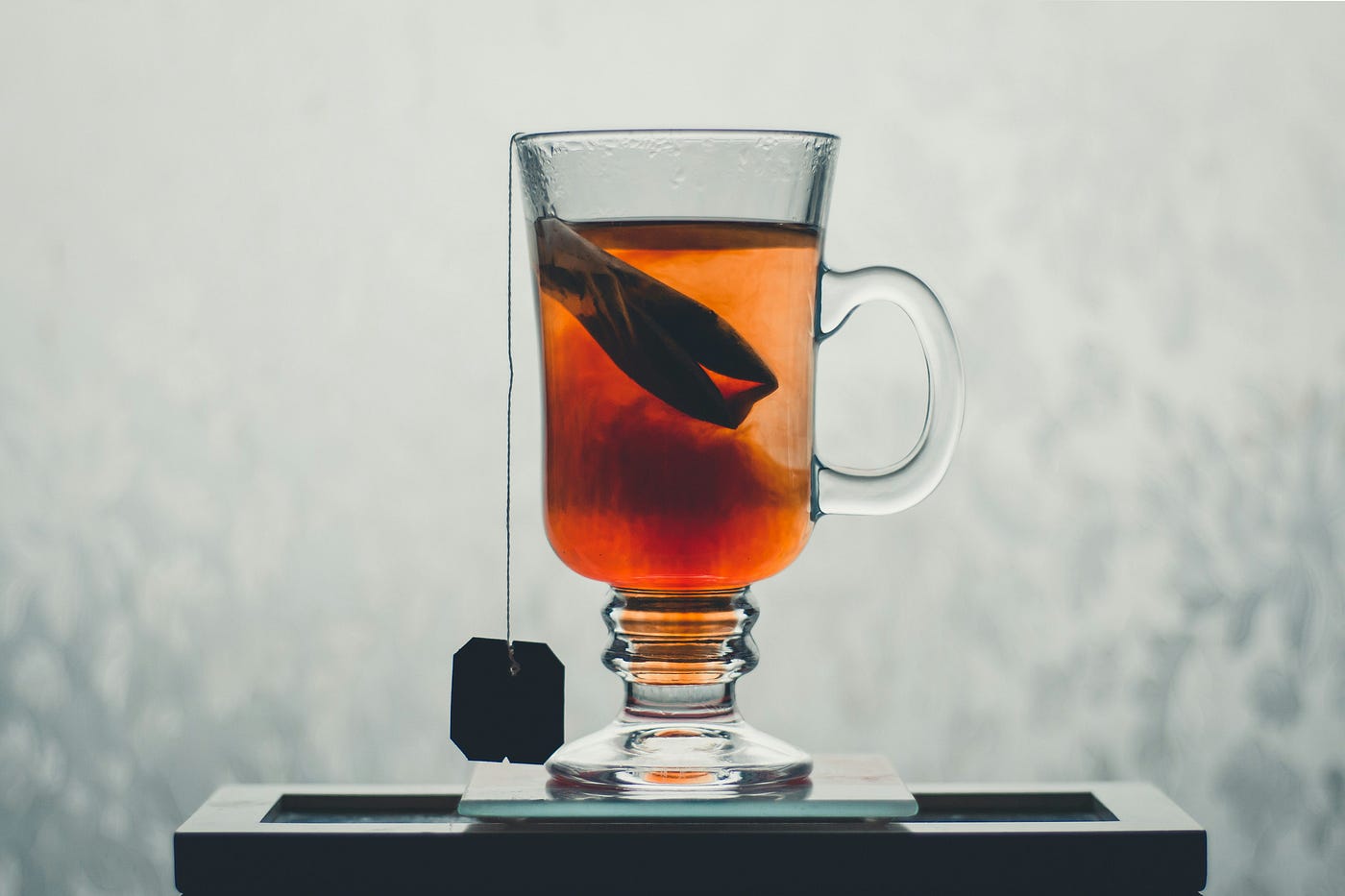
Photo by Gabriel Sepúlveda on Unsplash
A mug of green tea is the most defensible thing most of us will do before nine in the morning. No sugar, no apology, a small ceremony of steam and patience while the bag turns the water amber. Then a group of chemical engineers at McGill University weighed the debris that a single plastic teabag sheds at brewing temperature, ninety-five degrees, and the ceremony reads differently. One bag, one cup, around 11.6 billion microplastic particles and 3.1 billion smaller nanoplastic fragments, the latter measured in billionths of a metre and small enough to slip into places a microplastic cannot reach.
Eleven billion. Per cup.
Tea is the second most consumed drink in the world after water, and people pour billions of cups of it a day. That turns one bag’s eleven billion into a planetary figure with too many zeros to hold in the head, and it means the most wholesome thing on the breakfast table doubles as one of the most efficient delivery systems for plastic ever to reach a human mouth.
Where the plastic hides
The first surprise is that there is plastic at all. Most people assume a teabag is paper, the way a coffee filter is paper, an honest disposable square of pulp. Some of them nearly are. Many are not.
The bag was an accident to begin with. Around 1908 a New York tea importer named Thomas Sullivan posted samples to his customers in small silk pouches, meaning for them to tip the leaves into a pot. They dropped the whole pouch into the water instead, found it easier, and came back asking for more, so a convenience nobody had designed became the default way the world makes tea. The patent record is messier than the legend, with a Milwaukee tea leaf holder filed years before Sullivan, but he is the one who made it stick. Silk gave way to gauze, gauze to filter paper, and in the mid-1990s PG Tips folded the flat bag into a tetrahedral pyramid sold as a little floating teapot. Somewhere along that century the object quietly turned to plastic, and almost no one noticed the substitution.
The flat rectangular bags that look like paper are usually sealed shut with a thin web of polypropylene, a petroleum plastic melted along the seams so the bag will not split in hot water. A good number also carry epichlorhydrin, a wet-strength chemical added for the same reason. The pyramid bags, the ones marketed as silken and premium, are woven from nylon or from polyethylene terephthalate, the same polyester used in drink bottles. And the bags that advertise their own virtue, the ones stamped biodegradable or plant-based, are typically made of polylactic acid, a bioplastic spun from corn starch that behaves like plastic in your cup and composts only in an industrial facility running hot, not in your kitchen bin.
So the material varies, and the material decides. A Barcelona group at the Universitat Autònoma led by Gooya Banaei took three kinds of teabag, ran them through a standard cup-of-tea imitation, and counted the nanoplastics that came off each one. The result inverts the usual guilt. The worst shedder by a wide margin was polypropylene, the humble heat-seal of the ordinary supermarket bag, at about 1.2 billion particles per millilitre. The woven nylon pyramid, the expensive-looking one, released the least, roughly 8 million, because the interlaced mesh holds together better in hot water. The fancy bag is, if anything, the more stable one.
The bag that looks like paper is often the one you should watch.
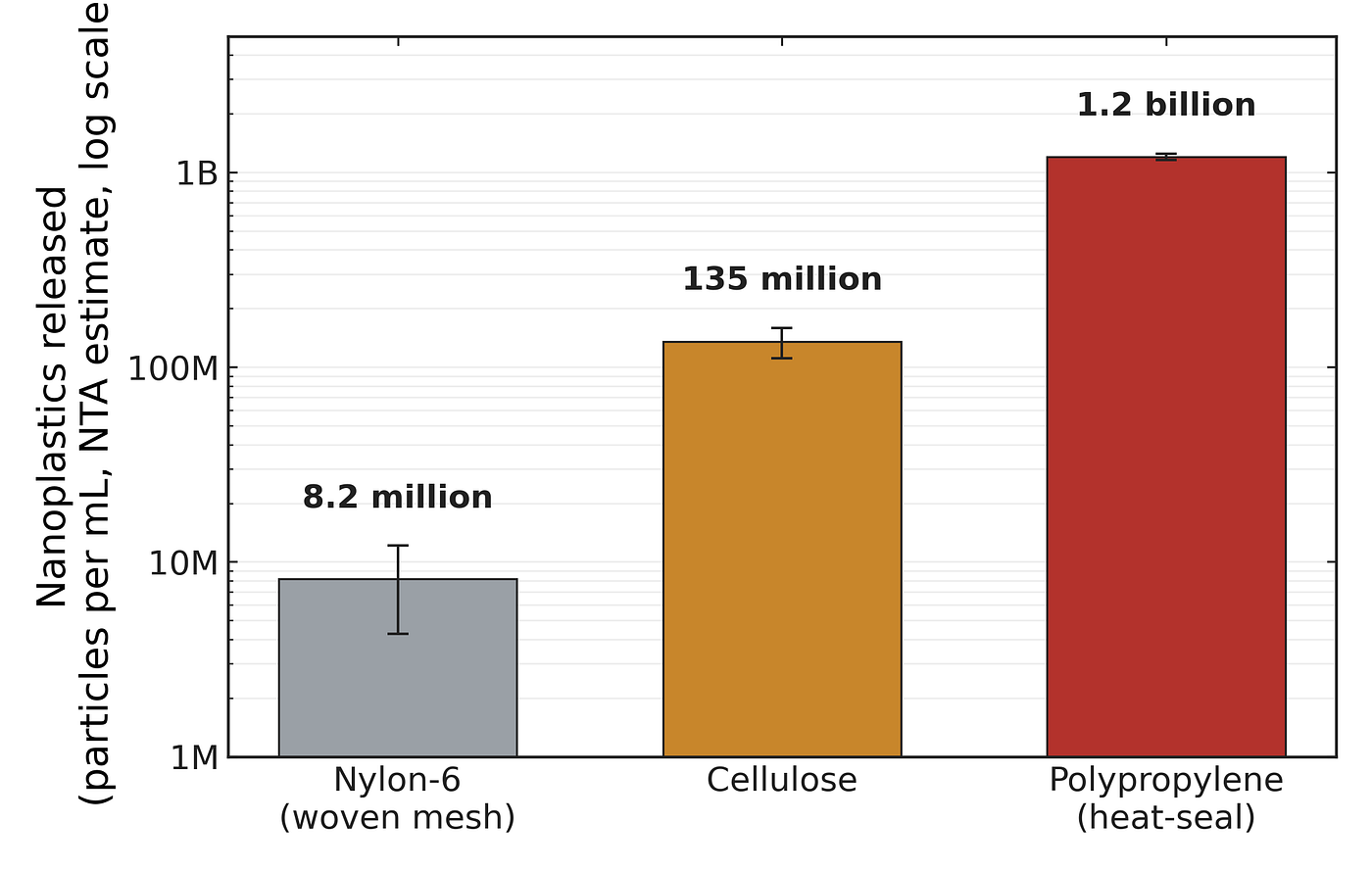
Nanoplastics released by teabag material, estimated by nanoparticle tracking analysis. The woven nylon pyramid sheds the least, the polypropylene heat-seal of ordinary bags the most. The cellulose figure is likely an overestimate, since stray tea leaves can contaminate the count. Data: Chemosphere, 2024. Figure by the author.
A note on what that chart is and is not. These are counts of released particles per millilitre of the recovered suspension, an approximation of how much each polymer sheds, not a measurement of how many particles end up in the specific cup in front of you. The comparison between materials is the honest part. The cellulose bar should be read with suspicion, because the authors themselves flag that leftover tea leaves probably inflated it.
The experiment
The McGill number deserves a second look, because the scale of it is what shifts this from curiosity to concern. The team steeped empty bags, with no tea inside to muddy the analysis, and identified the released fragments by their infrared signature as nylon and polyester, the exact polymers of the bag. The quantities they recovered ran several orders of magnitude above the plastic loads anyone had previously reported in food. Not a little more than a bottle of water or a portion of seafood. Thousands of times more.
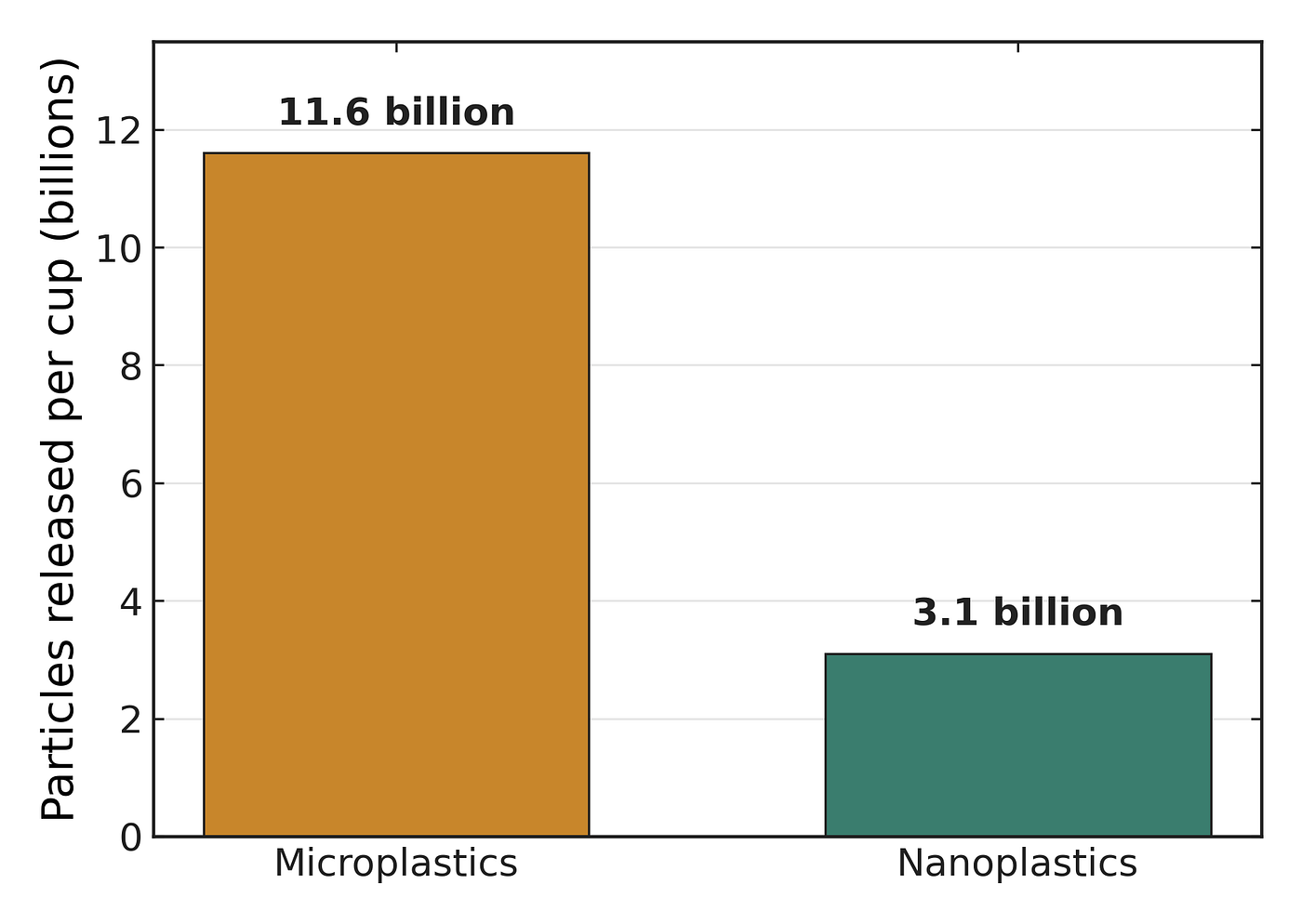
Microplastic and nanoplastic particles released from one plastic teabag steeped at ninety-five degrees. Data: Environmental Science & Technology, 2019. Figure by the author.
They also dropped those particles into water holding Daphnia, the translucent water fleas that biologists keep precisely because they react fast and visibly to anything in their environment. The fleas swam wrong. Exposure to the teabag particles alone, nothing else added, produced dose-dependent changes in their behaviour and their development. A water flea is not a person, and a beaker is not a digestive tract, so the finding proves nothing about you directly. It does say the particles are biologically active rather than inert confetti, which is the question that matters.
From the cup to the cell
The Barcelona group went further than counting. They took the nanoplastics released by the bags, stained them with a fluorescent dye, and exposed three kinds of human gut cell to them, including the mucus-secreting cells that line the intestine. Under the confocal microscope the particles did not sit politely on the surface. The cells took them in, the mucus-producing ones most of all, and in three-dimensional reconstructions the green specks of plastic appeared pressed up against the blue of the cell nucleus, the compartment that holds the genome.
That last image is where I have to slow down, because the headlines did not. The particles reached the neighbourhood of the nucleus. Whether they damage what is inside it remains a hypothesis the authors are careful to label as unproven, and their own correlation between plastic signal and nuclear signal was weak. There is also a question of dose in the real world, where the mucus-heavy cells that grabbed the most plastic make up only a small fraction of the intestinal lining, so the body’s actual uptake is probably gentler than a dish of cultured cells suggests. The particles get in. What they do once in is still being worked out.
Then there is the biodegradable escape hatch, which the same group had already closed in earlier work. Their 2023 study put numbers on the compostable, conscience-clearing kind. The PLA bags shed their own nanoplastics about 160 nanometres across, somewhere between eight million and a hundred million particles per bag depending on how strictly the count is drawn, and those particles persisted inside the cultured gut barrier through seventy-two hours instead of passing through.
Biodegradable is a promise about an industrial compost plant you do not own.
Where it ends up
Step back from the cup and the picture stops being about tea. Particles this size do not stay where they are drunk. Over the past decade they have turned up in human blood, in the placenta, in breast milk and testes, and in the fatty plaque that narrows arteries. That last location is not academic. A 2024 study in the New England Journal of Medicine by Raffaele Marfella and colleagues examined the carotid plaque surgically removed from 257 patients and found micro- and nanoplastics lodged in the artery walls of 58 percent of them. Over the next thirty-four months, the patients carrying plastic in their arteries were about four and a half times more likely to suffer a heart attack or stroke, or to die, than those without it. Association, not proof of cause, with all the usual caveats about sick arteries attracting particles. A hazard ratio of 4.5 is still a number that makes cardiologists put down their coffee.
And the brain. In early 2025 a team in New Mexico led by Alexander Nihart measured the plastic in tissue from decedent human brains and found concentrations that dwarfed every other organ, a median around 4,900 micrograms per gram, seven to thirty times what sat in the liver or the kidney. The figure that travelled around the world was the translation into something graspable, roughly a plastic spoon’s worth scattered through a single brain. The brains of people who had died with dementia held far more, a median above 26,000 micrograms per gram, and the average load across all brains had risen by about half in the eight years since 2016.
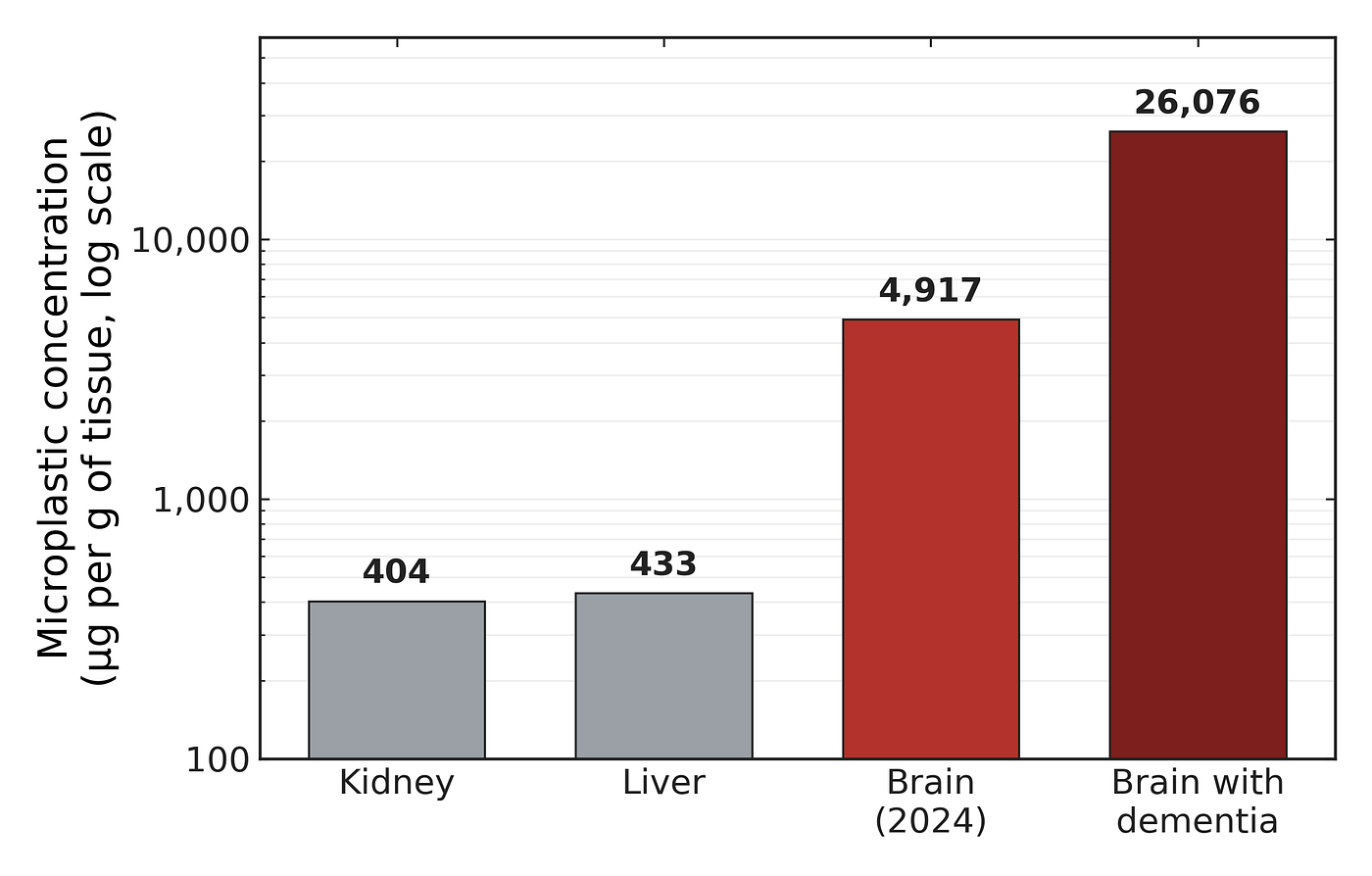
Median microplastic concentration by human tissue in 2024 samples, with brain tissue from dementia cases shown for contrast. The dementia value is a correlation drawn from a small subset and should be read as a flag, not a verdict. Data: Nature Medicine, 2025. Figure by the author.
Those brain numbers carry a warning label of their own. A formal critique in the same journal questioned the method, arguing that contamination controls and validation steps were thin enough to inflate the reported concentrations, and the dementia link is a correlation in a small sample, not a cause. The honest reading is that the brain accumulates these particles, that the amount appears to be climbing, and that nobody yet knows what the accumulation does. That is alarming and uncertain at the same time, which is the least satisfying combination to live with.
The loop closes outdoors, and it closes on us. Treatment plants trap a large share of the plastic we rinse down the sink, but trapping is not removing. The captured particles concentrate in sewage sludge, and across much of Europe and North America that sludge is spread on farmland as fertiliser, seeding the soil that grows the next crop. Whatever the plants fail to catch runs on to rivers and the sea, where mussels, oysters and small fish strain it out of the water and hand it up to whatever eats them. The brain study noted, almost in passing, that human brain tissue now carries more plastic per gram than oyster meat or the muscle of a trout, the signature of a contaminant that concentrates as it climbs. What goes down the drain comes back up the food chain, and it reaches the plate richer than it left.
The exit that sells, and the one that works
Faced with all this, the industry has found a move that satisfies everyone and fixes little. It swaps the petroleum plastic for the plant-based one, prints biodegradable on the box, and hands the shopper a clear conscience. The conscience is the product. The bag still sheds in the cup, the bioplastic still needs an industrial composter that almost no household has access to, and the word on the label does the work that the material does not.
There is a deeper trap in the swap. Every improvement measured per bag, less plastic in the seal, a thinner mesh, a compostable label, makes the single cup look cleaner and the whole habit easier to keep, which is how a gain per unit becomes a larger total. A material judged harmless gets used more freely, sold in bigger boxes, dropped in the bin with less thought. The figure that matters is not how much plastic sits in one bag but how many billions of bags steep every morning, and that number keeps climbing while the guilt per bag falls. Efficiency printed on the label has a way of turning into volume on the shelf.
The exit that actually works is the oldest and the least marketed. Loose leaf in a pot, a steel strainer, a kettle. No seam to seal, no mesh to shed, no virtue to advertise. It is slightly more effort and considerably less profitable to package, which is most of the reason it sits at the bottom of the supermarket shelf while the pyramids glow at eye level. The problem was never your willpower at breakfast. It was built into the object before it reached you.
A small confession
I keep a glass teapot with a steel basket, and I buy the leaves loose, by weight, from a shop that scoops them out of tins and folds the paper bag over twice. This is not a virtue. It is that I read the methods sections, and a man who reads methods sections for a living has trouble unseeing the chart.
And yet. When someone hands me a cup at the end of a long meeting, the string draped over the rim, the little stapled tag swinging, I take it. I watch the bag bleed its colour into the water, ninety-five degrees, the temperature from the paper, and I think about the eleven billion, and I drink it anyway. The warmth wins. It nearly always wins.
If you switch to loose leaf after reading this, that is between you and your kettle. I only counted what was already in the cup. For more, subscribe and follow along.
References
Banaei, G., Abass, D., Tavakolpournegari, A., and coauthors. (2024). Teabag-derived micro/nanoplastics (true-to-life MNPLs) as a surrogate for real-life exposure scenarios. Chemosphere, 368, 143736. https://doi.org/10.1016/j.chemosphere.2024.143736
Banaei, G., García-Rodríguez, A., Tavakolpournegari, A., and coauthors. (2023). The release of polylactic acid nanoplastics (PLA-NPLs) from commercial teabags. Obtention, characterization, and hazard effects of true-to-life PLA-NPLs. Journal of Hazardous Materials, 458, 131899. https://doi.org/10.1016/j.jhazmat.2023.131899
Hernandez, L. M., Xu, E. G., Larsson, H. C. E., and coauthors. (2019). Plastic teabags release billions of microparticles and nanoparticles into tea. Environmental Science & Technology, 53(21), 12300–12310. https://doi.org/10.1021/acs.est.9b02540
Marfella, R., Prattichizzo, F., Sardu, C., and coauthors. (2024). Microplastics and nanoplastics in atheromas and cardiovascular events. New England Journal of Medicine, 390(10), 900–910. https://doi.org/10.1056/NEJMoa2309822
Monikh, F. A., Materić, D., Valsami-Jones, E., and coauthors. (2025). Challenges in studying microplastics in human brain. Nature Medicine. https://doi.org/10.1038/s41591-025-04045-3
Nihart, A. J., Garcia, M. A., El Hayek, E., and coauthors. (2025). Bioaccumulation of microplastics in decedent human brains. Nature Medicine, 31, 1114–1119. https://doi.org/10.1038/s41591-024-03453-1
메타데이터
- post_id
- ea353d3ca3ae
- slug
- your-teabag-may-be-releasing-11-billion-plastic-particles-into-every-cup-ea353d3ca3ae
- url
- https://medium.com/the-environment/your-teabag-may-be-releasing-11-billion-plastic-particles-into-every-cup-ea353d3ca3ae
- canonical_url
- https://medium.com/the-environment/your-teabag-may-be-releasing-11-billion-plastic-particles-into-every-cup-ea353d3ca3ae
- author_url
- https://medium.com/@bobzeraus
- status
- ok
- fetched_at
- 2026-06-20 20:29:01