Maravarman Kulasekara Pandyan I: The Last Great Flame of the Pandya Dynasty
The Pandya Dynasty is one of the most prominent kingdom in south india along with cholas and cheras. They specifically rose to prominence…
Maravarman Kulasekara Pandyan I: The Last Great Flame of the Pandya Dynasty
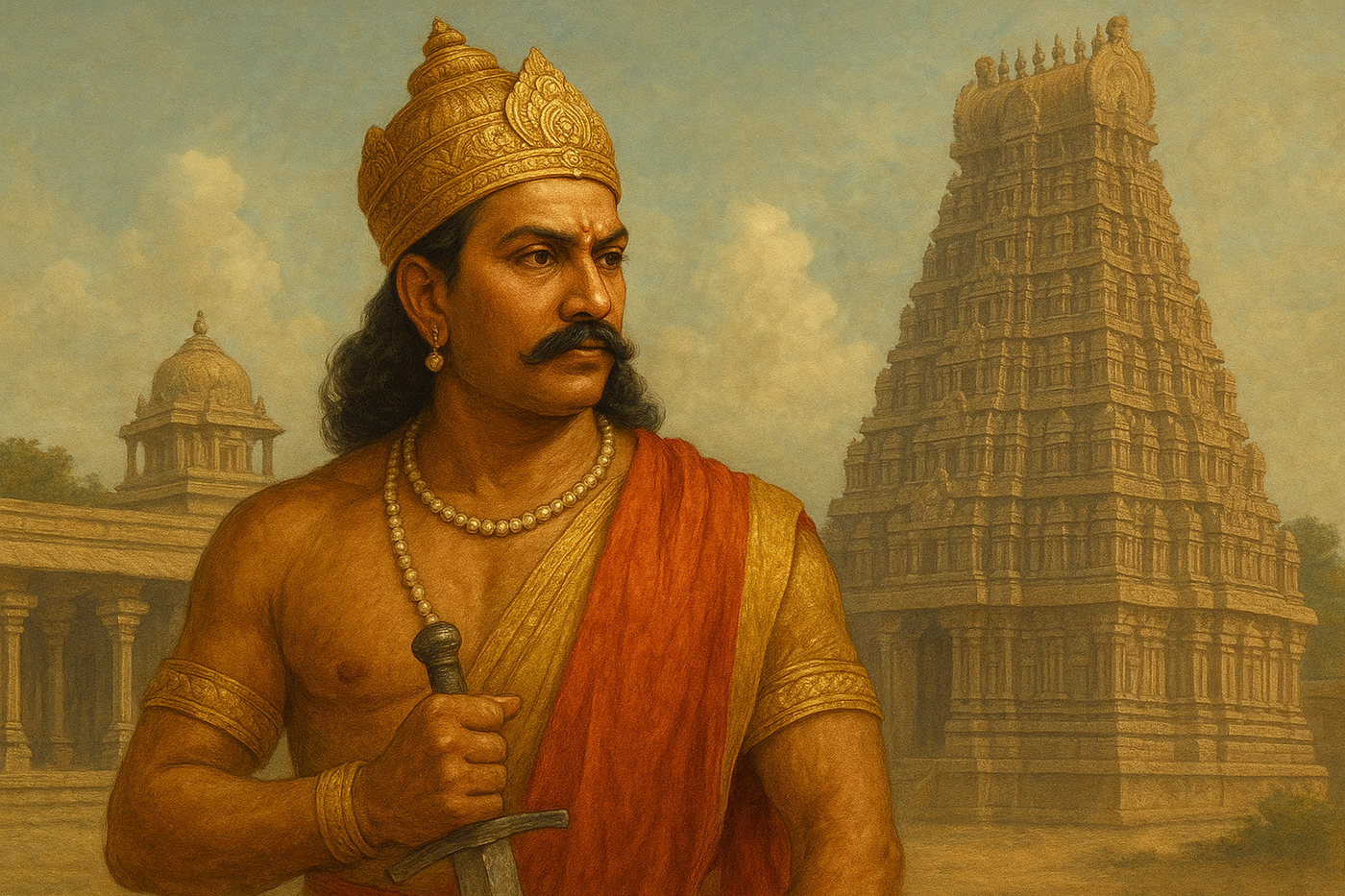
AI generated image
The Pandya Dynasty is one of the most prominent kingdom in south india along with cholas and cheras. They specifically rose to prominence by the 13th century which saw the peak of the Pandyas. They were based in Madurai, Tamil Nadu but ruled a huge part of southern India including Tamilakam, parts of Andhra, Karnataka and Sri Lanka. Let’s specifically look at Maravarman who was the last great king of Pandyas.
The birth details of Maravarman Kulasekara Pandyan is unknown, but he was born to Jatavarman Pandyan who was a Pandya king. His father brought glory to the dynasty by defeating rajendra chola III who was the last chola king, eventually ending the chola line which ruled for 1000 years. Hence, Maravarman during his childhood would have witnessed the pandyas consolidating their power and the weakening of the Chola dynasty. He was already probably groomed in statecraft, Tamil and sanskrit education, temple traditions and military affairs. Maravarman specifically appears in inscriptions from 1251 to 1268 CE where he was possibly ruling as a co-regent or was the crowned prince (yuvaraja). He helped manage the affairs of the kingdom alongside his father, Jatavarman Sundara Pandyan I. After his father’s death in June 10 to 20th of 1268 CE, he officially became king and possibly co-ruled with princes Jatavarman Vira Pandyan I (r. 1253–1275), Maravarman Vikkiraman III (from 1283), and Jatavarman Sundara Pandyan II (from 1277); Marco Polo notes him as the “eldest of five brother kings”. Upon ascending the throne, he consolidated his rule and continued aggressive expansion.
Then in the 1270s CE during his rule, he launched successful military campaigns and Expanded the Pandya Empire to Kanchipuram and Nellore in the north. Dominated former Chola and Hoyasala territories as his father already paved the way for this. Sri Lanka expedition under minister Kulasekara Cinkaiariyan Aryacakravarti. This force overran Yapahuwa’s Subhagiri fort and took the Buddha tooth relic; subsequently, Parakramabahu III negotiated an embassy in Pandya territory to reclaim it. However, pandyas did have nominal control over sri lanka. The Cheras and other minor southern kingdoms were brought under Pandya suzerainty. Specifically, Pandya control extended over Kerala’s Venad (Kollam) and Cholamandalam by 1279 CE. Due to defeating all of their enemies, the Pandya Empire became the most powerful Tamil kingdom of its time, reaching from the southern tip of India to parts of Andhra Pradesh.
The inscriptions from 1282 to 1284 such as one at Tiruchendur — document temple donations, including grants that funded permanent loans and festivals; these reflect his patronage of Saiva and Vaishnava traditions and poets like Nakkirar . Then in 1284, The Sri Lanka campaign culminates in taking and returning the Buddha tooth relic, with Jaffna under Pandya suzerainty for roughly two decades . Also during this time, Marco Polo (c. late 1280s) describes his realm — especially pearl fisheries and the prosperous port of Kayal — as wealthy and well-governed; Persian historian Wassaf calls the Tamil country “the most agreeable abode on the Earth” .
Then between late 1280s to early 1290s, the succession issues begin. Designated his son and cousin (brother’s son) as co-rulers. This decision led to confusion and rivalry between: Jatavarman Veera Pandyan II(his son) and Sundara Pandyan III (his nephew or another son).
Maravarman’s exact death date is uncertain, but he dies around 1310 to 1311 CE. according to Muslim chroniclers Wassaf and Amir Khusrow, he was murdered by his younger son, Sundara Pandyan III .
His death triggered a violent civil war between the claimants (his son and nephew). This internal conflict significantly weakened the Pandya state and made it vulnerable to outside invasions. In 1311, The Delhi Sultanate, under Alauddin Khalji, sent Malik Kafur on a southern campaign. Malik Kafur invaded Madurai, looted the Meenakshi temple, and extracted tribute. According to persian chronicles, Wassaf mentions that Kulasekara Pandyan had so much gold and treasure that Malik Kafur’s forces couldn’t carry all of it after the 1311 raid. The invasion was made easier due to the Pandya civil war that followed Maravarman’s death.
Hence, post Kulasekara era, The Pandya Empire never recovered its former glory. Gradually declined and fragmented. Eventually fell to the Madurai Sultanate and later came under Vijayanagara control. Hence, Kulasekara Pandyan I is remembered as: The last great king of the Pandyas. A capable administrator, patron of religion and the arts. A monarch under whose reign the Pandya Empire reached its territorial zenith. However, His mistakes in succession planning, however, contributed directly to the dynasty’s downfall. The empire fractured into semi-independent fragments; eventually replaced by the Madurai Sultanate followed by Vijayanagara resurgence.
Overall, Maravarman was a warrior just like his father who had great aims and sincerely brought glory to their dynasty. Apart from war, fighting and bloodshef, Maravarman was also a Patron of Tamil literature, Saivism, and Vaishnavism. Rebuilt and endowed temples, especially in Madurai, Srirangam, and Rameswaram. Inscriptions at Srirangam, Chidambaram, and Rameswaram mention his donations and temple works. Especially he funded the expansion and gilding of Madurai Meenakshi, Nellaiappar at Tirunelveli, Srirangam Ranganatha, Tiruchendur (including loans for festivals). The Travancore Archaeological Series and several Tamil copper-plate grants detail his reign. Encouraged trade through ports like Kayalpattinam and Thoothukudi — there was a flourishing of Indo-Roman and Southeast Asian trade. Managed thriving pearl fisheries and Arab-horse trade via Kayal, stimulating maritime wealth. Also, in terms of administration, he likeled to maintain a centralised approach. Issued coins depicting the royal fish emblem — probable markers of his late 13th-century economic reforms. To conclude, he was a capable ruler and one of the longest-reigning Pandya monarchs as he reined from 1268 to 1310 which is about 40 years. He dismantled many powerful dynasties and led successful conquests. As a person, he was ambitious, assertive, politically astute, culturally refined, diplomatically skilled. However, unfortunately all of his hard work went in vein because the kingdom collapsed because of his own successors whom he trusted. Anyhow, he is seen as a symbol of Tamil strength just before the Islamic incursions transformed South Indian history.
메타데이터
- post_id
- ea3880bc4ead
- slug
- maravarman-kulasekara-pandyan-i-the-last-great-flame-of-the-pandya-dynasty-ea3880bc4ead
- url
- https://medium.com/chronicles-of-curiosity/maravarman-kulasekara-pandyan-i-the-last-great-flame-of-the-pandya-dynasty-ea3880bc4ead
- canonical_url
- https://medium.com/chronicles-of-curiosity/maravarman-kulasekara-pandyan-i-the-last-great-flame-of-the-pandya-dynasty-ea3880bc4ead
- author_url
- https://medium.com/@jessica.nov4
- status
- ok
- fetched_at
- 2026-07-18 14:44:20