AWS ECS vs EKS: Pros, Cons, and How to Choose the Right AWS Container Service for AWS Cloud…
Containers have changed how modern applications are built and deployed. Instead of managing heavy servers, teams now package apps into…
AWS ECS vs EKS: Pros, Cons, and How to Choose the Right AWS Container Service for AWS Cloud Solutions
Containers have changed how modern applications are built and deployed. Instead of managing heavy servers, teams now package apps into lightweight containers that can scale on demand. On AWS, two services dominate this space: Amazon ECS and Amazon EKS. While both are powerful, they solve different problems. Choosing between them can impact performance, costs, and team productivity. For businesses building modern platforms, AWS cloud solutions provide the flexibility to support either approach — if chosen wisely.
According to recent industry surveys, over 75% of enterprises now use containers in production, and Kubernetes adoption alone has crossed 60% globally. These numbers show how important container orchestration has become for cloud-native development.
Let’s break down ECS and EKS in simple terms.
Understanding Amazon ECS
Amazon Elastic Container Service (ECS) is AWS’s native container orchestration platform. It’s designed for teams that want a straightforward, AWS-managed experience.
With ECS, AWS handles much of the control plane complexity. You deploy containers, define scaling rules, and integrate directly with AWS services. ECS works especially well for teams already comfortable with AWS tooling and identity management.
ECS also supports AWS Fargate, which removes the need to manage servers altogether. This makes ECS appealing to small and mid-sized teams that want fast deployment without operational overhead.
However, ECS is tightly coupled to AWS. If portability across cloud providers matters, this can feel restrictive.
Understanding Amazon EKS
Amazon Elastic Kubernetes Service (EKS) is AWS’s managed Kubernetes offering. Kubernetes is open-source and widely adopted across industries, making EKS popular with enterprises and DevOps-heavy teams.
EKS allows organizations to use standard Kubernetes tools while AWS manages the control plane. This gives teams flexibility and access to a massive ecosystem of plugins, monitoring tools, and deployment frameworks.
The tradeoff is complexity. EKS requires deeper Kubernetes knowledge, cluster maintenance planning, and more hands-on configuration. For smaller teams, this learning curve can slow delivery.
ECS vs EKS: Feature Comparison
Here’s a simple comparison to help visualize the differences:
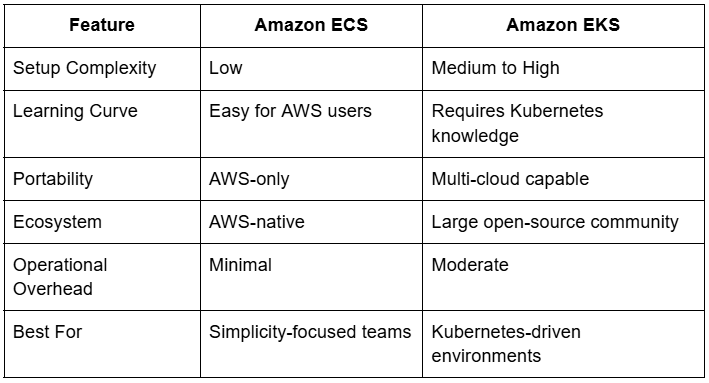
Both platforms integrate deeply with AWS infrastructure services, enabling autoscaling, monitoring, and networking at enterprise scale.
Performance, Security, and Operations
Performance for both ECS and EKS depends heavily on architecture design. ECS benefits from native AWS integrations, making deployment pipelines smoother. EKS shines when advanced orchestration or custom networking is required.
Security is strong on both platforms. ECS leverages AWS IAM directly, while EKS combines Kubernetes RBAC with AWS security layers. Organizations often align these platforms with broader AWS infrastructure services to maintain consistency across networking, identity, and monitoring.
From an operations standpoint, ECS usually requires less maintenance. EKS provides more flexibility but demands stronger DevOps maturity.
Cost Considerations
Cost differences come down to management overhead and usage patterns. ECS typically has fewer moving parts, while EKS includes additional cluster-related costs.
A growing trend in 2025 shows that companies using managed container platforms reduce infrastructure waste by nearly 30% through better scaling and automation.
Many organizations pair their container strategy with affordable AWS cloud support services to maintain predictable spending while keeping performance stable. For startups and growing teams, affordable AWS cloud support services also reduce the need for large in-house cloud operations staff.
Choosing the Right Platform for Your Business
There is no universal winner between ECS and EKS.
ECS is ideal if:
- You want fast deployment with minimal setup
- Your workloads live entirely on AWS
- Your team prefers AWS-native workflows
EKS is better if:
- You already use Kubernetes
- You need portability across environments
- You require advanced orchestration features
In the middle of large digital transformations, many companies rely on AWS cloud solutions to start with ECS and later move to EKS as technical maturity grows.
Real-World Adoption Trends
Recent cloud adoption reports show:
- Over 60% of enterprises use Kubernetes in some form
- Nearly 45% of AWS container workloads still run on ECS
- Teams using managed containers deploy updates 40% faster than traditional VM-based environments
These stats highlight a clear pattern: businesses prioritize speed, automation, and scalability when choosing container platforms.
Key Takeaways
- ECS offers simplicity and tight AWS integration
- EKS provides Kubernetes flexibility and ecosystem access
- Both platforms scale reliably when designed properly
- Cost efficiency depends on workload design and automation
- The best choice aligns with team skills and long-term strategy
Conclusion
Choosing between ECS and EKS is less about features and more about alignment with your team’s capabilities and business goals. ECS delivers simplicity and faster onboarding, while EKS offers flexibility and Kubernetes standardization. When implemented thoughtfully, AWS cloud solutions empower organizations to build secure, scalable container platforms that support innovation today and growth tomorrow.
FAQs
Q1: Is ECS easier to manage than EKS? Yes. ECS usually requires less operational effort, especially for AWS-focused teams.
Q2: Can EKS be used outside AWS? The Kubernetes skills transfer easily, but EKS itself runs only on AWS.
Q3: Which is better for startups? ECS is often preferred due to its simplicity and lower management overhead.
Q4: Do both support autoscaling? Yes, both ECS and EKS offer strong autoscaling capabilities.
Q5: Can companies use both ECS and EKS together? Absolutely. Many organizations run hybrid setups based on workload needs.
메타데이터
- post_id
- ea4afbef8db6
- slug
- aws-ecs-vs-eks-pros-cons-and-how-to-choose-the-right-aws-container-service-for-aws-cloud-ea4afbef8db6
- url
- https://medium.com/@abhiroopkanungoe/aws-ecs-vs-eks-pros-cons-and-how-to-choose-the-right-aws-container-service-for-aws-cloud-ea4afbef8db6
- canonical_url
- https://medium.com/@abhiroopkanungoe/aws-ecs-vs-eks-pros-cons-and-how-to-choose-the-right-aws-container-service-for-aws-cloud-ea4afbef8db6
- author_url
- https://medium.com/@abhiroopkanungoe
- status
- ok
- fetched_at
- 2026-07-15 04:11:44