Smart GST Compliance Strategies for Modern Indian Enterprises
GST compliance has become a critical part of financial management for modern Indian enterprises. As businesses expand and transaction…
Smart GST Compliance Strategies for Modern Indian Enterprises
GST compliance has become a critical part of financial management for modern Indian enterprises. As businesses expand and transaction volumes increase, managing tax operations manually becomes more difficult and time consuming. Organizations today need faster, smarter, and more accurate systems to handle GST filing, reconciliation, reporting, and compliance monitoring.
Smart GST compliance strategies help enterprises streamline workflows, improve accuracy, reduce operational risks, and maintain better financial control. By combining automation, cloud technology, and intelligent validation tools, businesses can simplify tax management and adapt more effectively to changing compliance requirements.
Modern enterprises are increasingly adopting digital GST systems to improve productivity and strengthen operational efficiency.
Importance of a Structured GST Compliance Strategy
A successful GST compliance process requires more than just timely filing. Businesses must ensure that invoices are accurate, tax classifications are correct, records are reconciled properly, and reports are maintained consistently.
Without a structured strategy, organizations may face filing delays, mismatches, penalties, and compliance notices. Smart compliance strategies focus on integrating all GST activities into a connected workflow that improves visibility and reduces manual effort.
An organized GST process also helps enterprises maintain stronger financial discipline and operational consistency.
Improving Data Accuracy with Intelligent Validation
One of the most important strategies for effective GST compliance is ensuring accurate data validation at the source. Incorrect GSTIN details or wrong HSN classifications can create significant compliance challenges.
Businesses can improve accuracy using GST Number Validation which helps verify whether GSTIN details are active and valid before invoices are processed.
Similarly, HSN Code Validator helps enterprises ensure proper product classification and accurate tax calculation.
Automated validation reduces human errors and creates a stronger foundation for the entire GST workflow.
Streamlining Data Management Through Automation
Modern enterprises handle large amounts of GST related data every day. Managing this data manually often leads to inefficiencies and delays in reporting.
Businesses can simplify data processing using JSON to Excel Converter GST which converts GST JSON files into structured Excel formats for easier analysis and reporting.
Better data visibility allows finance teams to review invoice details quickly, identify discrepancies, and maintain organized compliance records.
Automation helps businesses process data faster while reducing the workload on finance teams.
Automating Reconciliation for Better Compliance
Reconciliation is one of the most challenging areas of GST compliance because enterprises must ensure that their records match GST portal data accurately.
Manual reconciliation can consume significant time and increase the risk of missing discrepancies. Businesses can improve efficiency using GST Reconciliation Software which automatically matches invoices, identifies mismatches, and highlights missing entries.
Automated reconciliation improves reporting accuracy and helps enterprises maintain reliable tax records.
Role of Cloud Technology in Modern GST Management
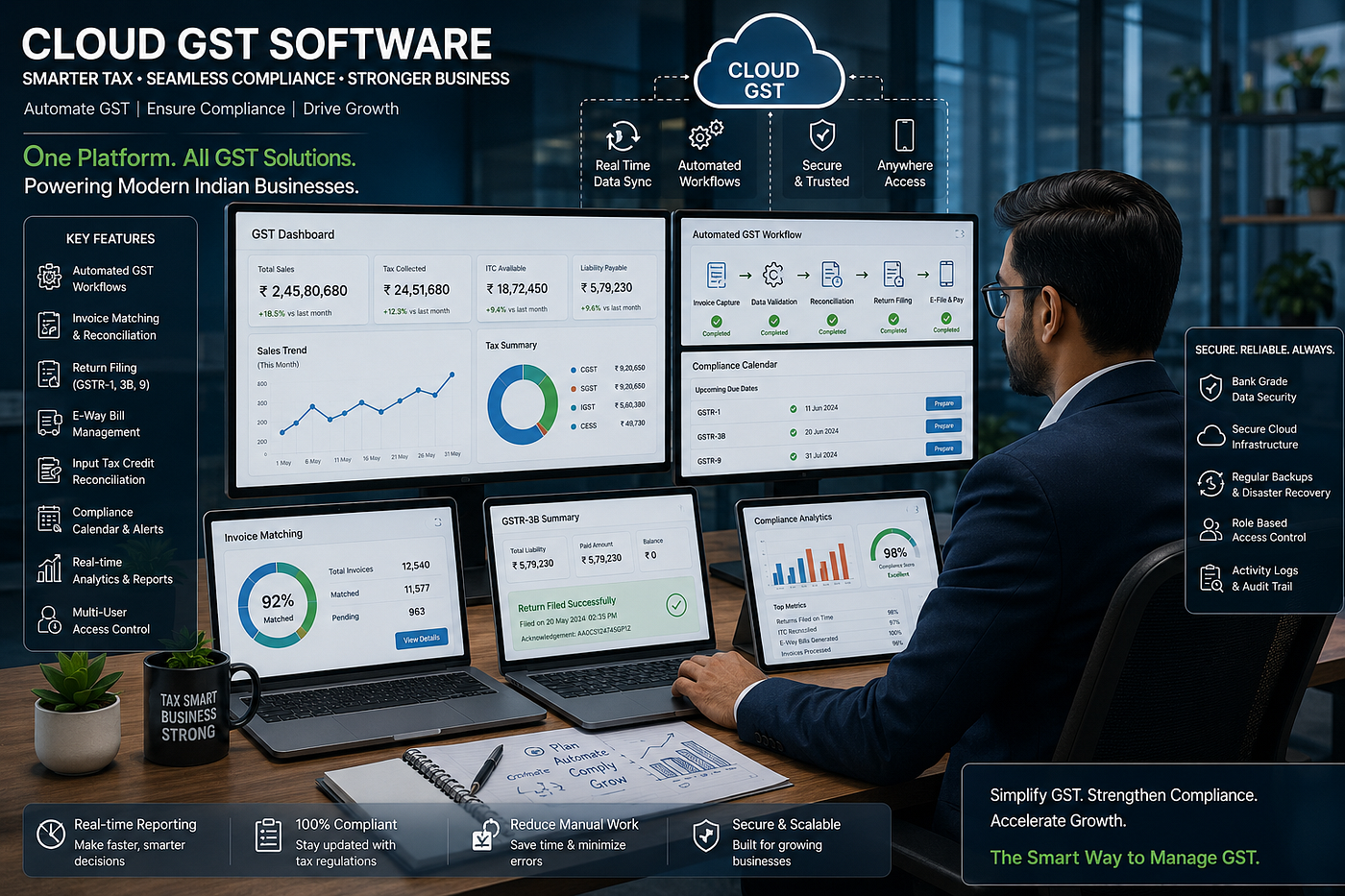
Cloud technology is becoming an essential part of smart GST compliance strategies. Cloud GST Software allows businesses to manage tax operations through centralized digital platforms accessible from anywhere.
Cloud Based GST Software enables real time collaboration between teams, improves workflow coordination, and provides instant access to compliance reports and financial data.
Cloud systems also ensure automatic software updates according to the latest GST regulations, helping enterprises stay compliant without manual system maintenance.
The flexibility and scalability of cloud technology make it highly suitable for growing businesses.
Reducing Manual Work and Increasing Efficiency
Traditional GST management involves repetitive tasks such as invoice verification, tax calculations, reconciliation, and report preparation. These activities consume valuable time and reduce operational efficiency.
Smart GST systems automate repetitive processes and streamline the entire compliance workflow. Businesses can complete filing activities faster while minimizing manual intervention.
This improves productivity and allows finance teams to focus more on business planning and financial strategy instead of routine compliance work.
Enhancing Financial Visibility and Reporting
Modern GST platforms provide businesses with detailed dashboards and real time reporting tools that improve visibility into financial operations.
Enterprises can monitor tax liabilities, input tax credit, invoice trends, and filing status more effectively through centralized systems. Access to accurate and updated information supports better decision making and financial planning.
Improved reporting also strengthens transparency and simplifies audit preparation.
Reducing Compliance Risks and Errors
Compliance risks often arise from manual data entry, incorrect calculations, delayed reconciliation, and inconsistent reporting practices.
Smart GST strategies reduce these risks through intelligent automation and standardized workflows. Businesses can identify discrepancies early and maintain more accurate tax records throughout the filing cycle.
Reducing errors not only improves compliance but also helps enterprises avoid penalties and operational disruptions.
Supporting Scalable Business Growth
As Indian enterprises grow, GST operations become more complex due to increasing transaction volumes, multiple business locations, and expanding vendor networks.
Scalable Cloud Based GST Software solutions help businesses manage growing compliance requirements efficiently. These systems can process large datasets, support multiple users, and maintain performance even as operations expand.
Scalability ensures that businesses can continue to manage GST efficiently during long term growth.

Conclusion
Smart GST compliance strategies are helping modern Indian enterprises simplify tax operations, improve accuracy, and increase efficiency. By integrating automation, intelligent validation, cloud technology, and real time reporting, businesses can create faster and more reliable GST workflows.
Modern GST management systems reduce manual effort, improve financial visibility, and strengthen compliance standards. As digital transformation continues to reshape tax operations in India, adopting smart GST compliance strategies will remain essential for businesses seeking sustainable growth and operational excellence.
메타데이터
- post_id
- ea4f7ef6e63f
- slug
- smart-gst-compliance-strategies-for-modern-indian-enterprises-ea4f7ef6e63f
- url
- https://medium.com/@kannamani852/smart-gst-compliance-strategies-for-modern-indian-enterprises-ea4f7ef6e63f
- canonical_url
- https://medium.com/@kannamani852/smart-gst-compliance-strategies-for-modern-indian-enterprises-ea4f7ef6e63f
- author_url
- https://medium.com/@kannamani852
- status
- ok
- fetched_at
- 2026-06-09 15:37:30