Claude, Replit, Lovable or Bolt?
Which AI-powered software developer is the best at no cost?
Claude, Replit, Lovable or Bolt?
Which AI-powered software developer is the best at no cost?
If you haven’t heard, the biggest companies right now are AI-powered software development platforms bringing in the big VC bucks and fierce competition to the good old human software developers. All they need is a computer, an internet connection, and a user who can briefly explain what they want to build. These tools are great for proofs of concept and product mock-ups, and their capabilities are increasing every day.
I spent the last few days making the same web-based app using 4 different platforms. The app is a simple book logger with a map to show which countries I have read stories from. I did not pay a single dollar to use any of these platforms (nor did anyone pay me to write about them), and I took real-time notes and screenshots of my experience with them.
I had heard of Replit and Lovable before through YouTube and billboards on San Francisco’s Highway 101, but I had never heard of Bolt, and I didn’t know Claude had an app builder that can be used from the browser-based chatbot.
I gave similar prompts to all the platforms, and I purposely kept it a little vague to see if the tools make any assumptions or ask for clarifications.
The Prompt
Build a web-based tool for users to record the books they have read. Every time I read a book, I want to fill out a quick form that asks for the title of the book, based on which I want you to find the name of the author and the genre of that book, and populate that field. If there is any duplication, ask the user to select the correct one. The form should also ask for the country in which the story is based.
This tool will currently only be used by me. Make the design colorful and minimalistic. Allow users to interact with the map and click on a country to get a list of books from there.
The tool should show a dashboard of stats like books read in a year and countries covered in that year. The main output of this tool is an interactive map. If there are any questions, ask me.
Claude Artifacts
This was an accidental find. On the Claude ChatBot in my browser, I saw the ‘Artifacts’ tab where I could use Claude to create Apps, Slides, dashboards, and more. I was curious, so I clicked on ‘Apps and Websites’ and gave it the above prompt. It created a “Plan” with bullet points of what I asked in my prompt, and after some minor changes, it started building.
The “Plan” seemed pretty basic; Claude didn’t make any assumptions or ask for clarification. I was doubtful about where I would see the preview of the web app being built. But within a minute, I had my answer. A disappointing answer. The preview was in the chat itself with a .html file available for download.
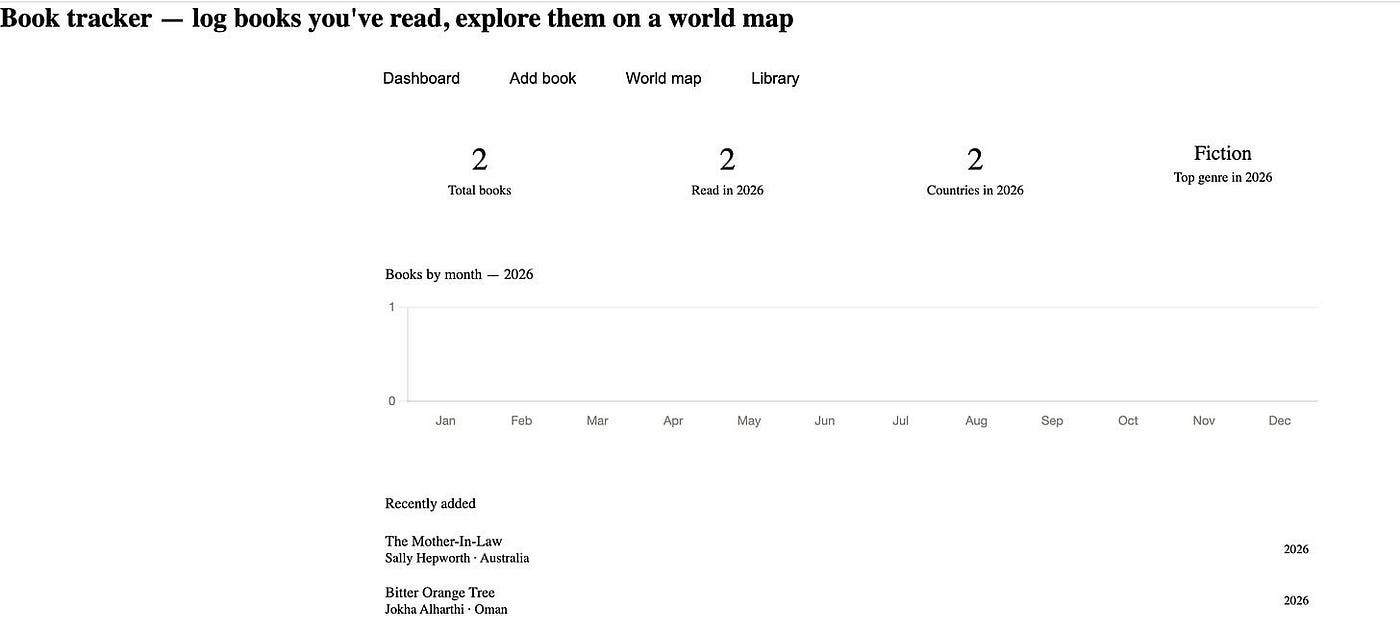

Claude Artifacts .html file opened in Chrome. This is the interactive map.
I can only describe this as a last-minute college project attempt. Was Claude fast? Yes. Would I use the app it made? No. I later realized Claude Artifacts is meant for quick prototypes, not full-stack tools with a database.
Note: Every time I used a new platform, I improved the prompt a little to explain myself better. Since I am new to this, I am learning how to prompt, and there is no better way than doing it over and over.
Bolt.new
This was another platform that I found while looking for competitors of Replit. It is quite popular on Reddit, so I had to give it a try. I opened Bolt.new, created an account, and within 30 seconds, I was in business.
I entered my prompt, and the agent asked me insightful clarifying questions instead of assuming what I wanted in my app. Then it went into Planning mode. I was impressed to see that this was available by default in the Free version. The plan was created well, describing what frameworks and tools would be used, and it also covered edge cases. While it was quick and detailed, I didn’t realize it at the time; it took up a lot of my daily credit limits.
All four tools ration free usage through daily tokens, and you only find out you’re low once a warning pops up with maybe one message left.
When it came to building the app, I was deeply frustrated. The app was running into errors loading the map, and I could see those errors on my preview screen. The agent refused to believe there were any errors and was extremely stubborn about the correctness of its work.
I ran out of tokens before I even got to see a preview of what it built, and I got into a fight with the agent.
The next morning, once my tokens had refreshed, I downloaded the source file and ran it locally on my machine, which still didn’t work. I sent a message saying the “code must be broken”. That seemed to have done something, because this time the agent quickly found the error and resolved it. I finally saw the preview, and it was beautiful. Not because the design was extraordinary, no, it was a generic AI app, but rather, the satisfaction of seeing my project come up at last. There were still issues with the form for adding books that were also quickly resolved. At this point, I had about 80K tokens remaining, and I used all of them to tell the agent, “Good job”.

Bolt.new created the Reading Atlas Web-App


Bolt.new form to add a new book.

Bolt.new library page
Finally, once the app was running, I noticed that the API used to pull the author and genre information was incomplete; I was having to input the genre manually. The API allowed us to get the book cover, which was a nice touch. Would I use this app? No. Would I use Bolt again? Probably.
Replit
Replit has an interesting marketing strategy. They have a community of technologists that showcase their Replit creations on YouTube, where I first heard about them.
In the free version, I was working with limited credits, but I now realise I got much further with Replit than I did with any other tool. This is because it is extremely slow. The initial build took almost 40 minutes while the other 3 platforms worked in under 5 minutes. The free version did not have a plan mode, so my vague prompt was all it had to start building.
I was impressed with the initial build because I noticed it had made good assumptions and taken initiatives to make a decent app. It added literary quotes and created a logo for my app. The best feature was that I could ask for some design mock-ups, and it quickly gave me some options. I picked one and applied it to my app. I got to build and design my entire app before I ran out of tokens. Replit also tested the app a few times and added some books to populate the tracker.
However, the map integration was sloppy. It didn’t work when a new book was added. It took several iterations to make it understand that the map remained outdated when a new book was added. I ran out of tokens before this could be fixed. I learned I needed to implement a searchable dropdown (the other tools assumed this already), which I did when the tokens refreshed.
There is also an issue with the form to add new books where it makes me select the books twice. I stopped there to keep the comparison fair because I didn’t want to spend hours perfecting one app while the others got five minutes each.

Replit created an app with customizable design

Replit included literary quotes at the bottom and has a comprehensive dashboard
Lovable
Probably the most famous platform on my list and the one I was most excited for. I used to see their billboards all over San Francisco, so I had to include them in this comparison.
I skipped plan mode this time. My prompts had gotten better by now, and I’d learned planning mode uses up a lot of tokens. Even so, it asked me thoughtful questions like whether I wanted 2-D or 3-D interactive maps. The initial build took less than 5 minutes, and it was not bad — just a generic design, similar to Bolt.
The API to look up books was set to only return 6 books, which led to me not finding the book I wanted, so I increased it to 10. Lovable also let me ask for design options, and it gave me a few options; the one I selected was quite different from what I originally imagined.

Lovable gave me this design option called Data Explorer. The World coverage progress bar is a nice touch.

Clicking any country on the map shows a nice list of books that I have read from that country.
Lovable had the most thoughtful touches, the fastest responses, and the best design experience out of all. Would I use Lovable again? Yes. Would I use this app to log my books? Yes. Would I want to build on this further and make it better? Absolutely.
In this journey, I was surprised at how differentiated these AI software development platforms are. The ability to plan before building is a key differentiator among these platforms. So is the design capability. While Replit is extremely slow and doesn’t include planning mode, it added thoughtful touches and has good design capabilities. Bolt is frustrating, and the tokens run out very quickly, but it eventually built me a decent app. Claude Artifacts was quick, but the least impressive of the four. Lovable was polished and quietly the most insightful platform, which delivered the result with the least friction.
These tools won’t replace developers and designers building something complex and lasting. But for an idea sitting in your notes app because you don’t know how to code, making it a reality is a free afternoon away.
My book tracker is far from perfect, and if you want to try it yourself, let me know; I’ll clean up the best version and share it with you.
메타데이터
- post_id
- ea5095e76213
- slug
- claude-replit-lovable-or-bolt-ea5095e76213
- url
- https://medium.com/@nishka.uberoi2/claude-replit-lovable-or-bolt-ea5095e76213
- canonical_url
- https://medium.com/@nishka.uberoi2/claude-replit-lovable-or-bolt-ea5095e76213
- author_url
- https://medium.com/@nishka.uberoi2
- status
- ok
- fetched_at
- 2026-07-13 12:45:57



