Manual Risk Stratification vs Intelligent Risk Stratification: Moving From Static Lists to…
Risk stratification has become one of the most important operating functions in value-based care.
Manual Risk Stratification vs Intelligent Risk Stratification: Moving From Static Lists to Actionable Risk Prioritization
Risk stratification has become one of the most important operating functions in value-based care.
Health plans, MSOs, ACOs, provider groups, and care management teams all need to know which members require attention, who is at rising risk, where intervention can make the greatest impact, and how limited care team capacity should be directed.
But in many healthcare organizations, risk stratification still depends on a familiar pattern.
A report gets generated. A spreadsheet gets shared. A list of members gets reviewed. Care teams manually work through names, notes, and outreach queues. By the time a member is contacted, the risk picture may already have changed.
That is the limitation of manual risk stratification.
It may help identify risk, but it does not always help teams act on risk fast enough.
Today, member complexity is increasing. High-risk members may be dealing with multiple chronic conditions, recent utilization, open care gaps, medication challenges, social barriers, transportation issues, language needs, and inconsistent engagement — all at the same time.
A static list cannot fully capture that complexity.
Healthcare organizations need a more dynamic way to prioritize risk, understand member context, and guide care teams toward the next best action.
That is where intelligent risk stratification becomes essential.
The Problem With Manual Risk Stratification
Manual risk stratification is often built around periodic reporting.
Teams pull data from different systems, review member lists, assign outreach priorities, and manually determine where to focus next. This process may be familiar, but it creates several operational challenges.
First, the inputs are often limited. A member may appear on a list because of a diagnosis, claim, care gap, utilization event, or score. But if those signals are sitting in separate systems, the care team does not always see the full picture.
Second, the prioritization is often static. A member who looked high-risk last week may have already received outreach. Another member may have had a new ED visit, missed appointment, or new care gap since the list was generated. But if prioritization is not refreshed with changing signals, teams may work from outdated information.
Third, manual review consumes care team capacity. Care managers, coordinators, and outreach teams should spend more time helping members, not sorting through reports and trying to manually interpret risk.
Fourth, risk scores are not always actionable. A score may tell a team that a member is high-risk, but it may not clearly explain what to do next, which barrier matters most, or which workflow should be triggered.
This creates a gap between risk identification and risk action.
And in value-based care, that gap matters.
Member Risk Is Not Static
The biggest challenge with traditional risk stratification is that member risk does not stay still.
It changes as new data comes in.
A member’s risk profile may shift because of:
• A recent emergency department visit • A hospitalization or readmission risk signal • A missed follow-up appointment • An open preventive care gap • A new chronic condition indicator • Medication adherence challenges • Behavioral health needs • Transportation or food insecurity • Lack of response to outreach • Language or access barriers
When these signals are not connected, care teams may miss the members who need attention most urgently.
A static list may show who was at risk when the report was created. But intelligent risk stratification helps show who needs attention now.
What Intelligent Risk Stratification Looks Like
Intelligent risk stratification is not just a better report.
It is a more connected, dynamic, and action-oriented approach to prioritizing care.
Instead of relying only on periodic reviews, intelligent stratification combines multiple types of data into a more complete view of member risk.
That includes clinical data, SDOH data, utilization patterns, engagement history, care gaps, program status, and workflow activity.
When these signals are brought together, care teams can move beyond one-size-fits-all prioritization.
They can understand which members are high priority, why they are high priority, and what action should happen next.
This is the difference between a static member list and a dynamic care management operating model.
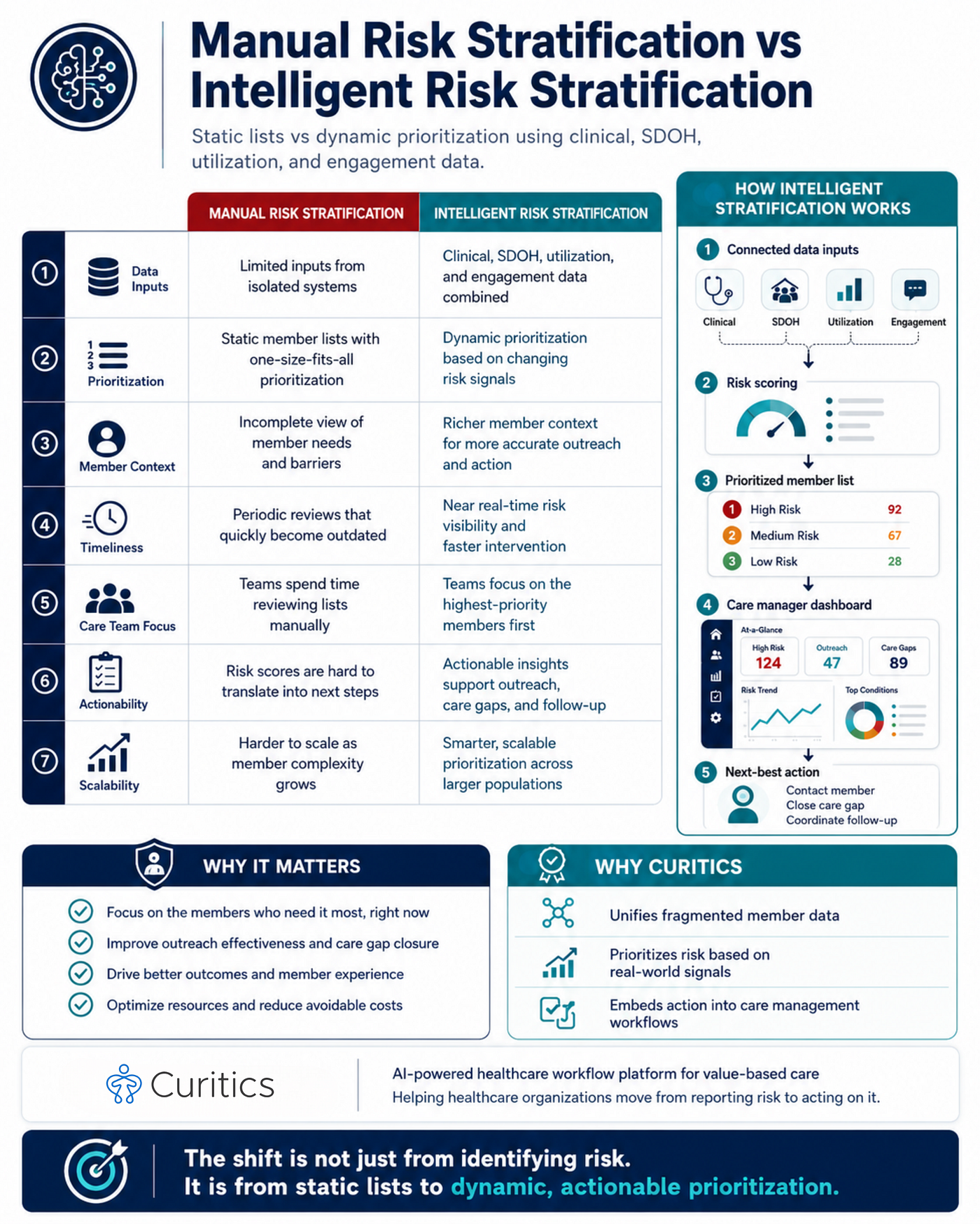
Manual Risk Stratification vs Intelligent Risk Stratification
- Manual risk stratification often starts with limited inputs from isolated systems. Intelligent risk stratification combines clinical, social, utilization, and engagement data into a more complete member picture.
- Manual processes often create static member lists with one-size-fits-all prioritization. Intelligent processes support dynamic prioritization based on changing risk signals.
- Manual reviews may leave teams with an incomplete view of member needs and barriers. Intelligent stratification gives teams richer context so outreach and follow-up can be more relevant.
- Manual workflows depend on periodic reviews that quickly become outdated. Intelligent stratification supports near real-time visibility and faster intervention.
- Manual processes require teams to spend time reviewing lists manually. Intelligent workflows help teams focus on the highest-priority members first.
- Manual risk scores can be difficult to translate into next steps. Intelligent stratification supports action by connecting insights to outreach, care gaps, follow-up, and care management workflows.
- Manual approaches become harder to scale as member complexity grows. Intelligent stratification helps organizations prioritize risk more efficiently across larger and more complex populations.
Why This Matters for Care Teams
Care teams are already under pressure.
They are managing more members, more programs, more care gaps, more documentation needs, and more operational complexity. Adding more reports does not always solve the problem.
In many cases, more reports create more work.
What care teams need is not just more information. They need better prioritization, better context, and clearer workflows.
Intelligent risk stratification helps care teams answer practical questions faster:
- Who needs attention first?
- Why is this member high priority?
- What risk signals are driving the priority?
- What barriers may affect outreach or follow-up?
- Which care gaps should be addressed?
- What workflow should be triggered?
- What action should happen next?
When teams can answer these questions inside their daily workflow, risk stratification becomes more than analytics. It becomes execution support.
Moving From Reporting Risk to Acting on Risk
For healthcare organizations, the real opportunity is not just identifying high-risk members.
The real opportunity is helping teams act on risk before it turns into avoidable utilization, missed care opportunities, poor outcomes, or higher costs.
That requires more than a static list.
It requires a connected workflow layer that can bring risk signals into the daily work of care management, outreach, quality, and population health teams.
This shift is especially important for value-based care organizations.
In value-based care, success depends on earlier intervention, better care coordination, improved care gap closure, stronger member engagement, and more efficient use of resources.
Static lists can support planning. But dynamic prioritization supports action.
Where Curitics Health Fits
At Curitics Health, we believe risk stratification should not stop at identifying risk. It should help care teams understand, prioritize, and act.
Curitics Health helps healthcare organizations connect data, prioritize risk intelligently, and turn insight into workflow action.
- That means helping teams bring together clinical, social, utilization, and engagement signals into a more actionable care management model.
- It means helping organizations move from manual list review to smarter prioritization.
- It means supporting care teams with real-time member context, workflow visibility, and next-step guidance.
- And most importantly, it means helping care teams focus on the right members at the right time.
The Future of Risk Stratification is Action-Oriented
Healthcare organizations do not need risk stratification for the sake of risk stratification.
They need it because they are trying to improve outcomes, close care gaps, reduce avoidable utilization, support care teams, and deliver more proactive care.
That is why the future of risk stratification must be dynamic, connected, and workflow-driven.
The shift is not just from manual to automated. It is not just from spreadsheets to dashboards. And it is not just from reports to analytics.
The real shift is from identifying risk to acting on it.
- From static lists to dynamic prioritization.
- From disconnected data to connected member context.
- From delayed follow-up to proactive care execution.
That is the promise of intelligent risk stratification.
And for value-based care teams, it is quickly becoming an operational necessity.
메타데이터
- post_id
- ea54befa0787
- slug
- manual-risk-stratification-vs-intelligent-risk-stratification-moving-from-static-lists-to-ea54befa0787
- url
- https://medium.com/@curiticshealth/manual-risk-stratification-vs-intelligent-risk-stratification-moving-from-static-lists-to-ea54befa0787
- canonical_url
- https://medium.com/@curiticshealth/manual-risk-stratification-vs-intelligent-risk-stratification-moving-from-static-lists-to-ea54befa0787
- author_url
- https://medium.com/@curiticshealth
- status
- ok
- fetched_at
- 2026-06-27 23:56:40