PUFA: Classification, Essential Fatty Acids, Sources and Recommended Intake
Polyunsaturated fatty acids (PUFAs) contain two or more double bonds usually in cis configurations in their hydrocarbon chain structure.
PUFA: Classification, Essential Fatty Acids, Sources and Recommended Intake
Polyunsaturated fatty acids (PUFAs) contain two or more double bonds usually in cis configurations in their hydrocarbon chain structure.
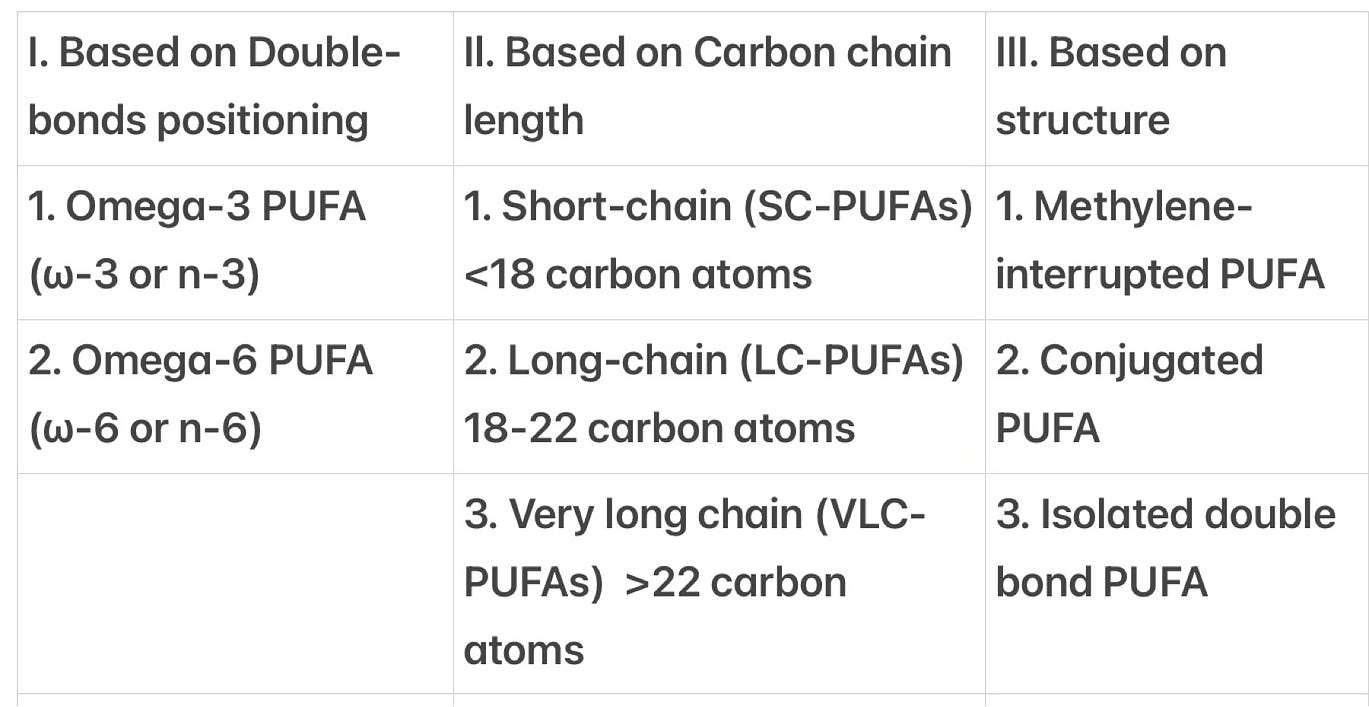
PUFAs can be classified according to several structural criteria. Classification is presented in tabular form for easy understanding (1).
The term essential fatty acids (EFA) refers to those polyunsaturated fatty acids (PUFA) that must be provided by foods because these cannot be synthesized in the body yet are necessary for health. There are two families of EFA, omega-3 (ω-3) : ALA (essential), EPA, DHA are conditionally essential (body can synthesize but in limited amount) and omega-6 (ω-6) : LA (essential), AA are conditionally essential (body can synthesize but in limited amount) (2).

Source: Source: https://www.shutterstock.com, Asset id: 2211785457
ω-3 fatty acid and their sources
ALA (Alpha linolenic acid) C18:3 (ω-3)
Alpha linolenic acid is abundant in flax seed and is present in small quantities in hemp, walnut, soybean and canola oil (Hunter 1990). It is mostly found in the chloroplast of green leafy vegetables.
EPA (Eicosapentaenoic acid) C20:5 (ω-3)
Fish and fish oil are the richest sources of this fatty acid with contents ranging from 39 % to 50 % for both fresh and salt water fish (Kinsella 1990). EPA is a parent of series 3 eicosanoid hormones.
DHA (Docosahexaenoic acid) C22:6 (ω-3)
It is present in fish oil and red brown algae. It is a major brain ω-3 fatty acid and is also found in eye ball (retina). The brain is about 60% fat, and DHA is a major structural component of brain and retina phospholipids.
ω-6 fatty acids and their sources
Linoleic acid C18:2 (ω-6)
This is abundant in safflower, sunflower and corn; present in medium quantities in soybean, sesame and almonds and in small quantities in canola, peanut and olive oils. It is very low in coconut and palm kernel. The body converts LA into other fatty acids depending upon need.
Arachidonic acid, C20:4 (ω-6)
It is found in meat, eggs and dairy products (2).
Several sources of information suggest that human beings evolved on a diet with a ratio of omega-6 to omega-3 essential fatty acids (EFA) of approximately 1 whereas in Western diets the ratio is 15:1–16.7:1. Western diets are deficient in omega-3 fatty acids, and have excessive amounts of omega-6 fatty acids compared with the diet on which human beings evolved and their genetic patterns were established. Excessive amounts of omega-6 polyunsaturated fatty acids (PUFA) and a very high omega-6 : omega-3 ratio, as is found in today’s Western diets, promote the pathogenesis of many diseases, including cardiovascular disease, cancer, and inflammatory and autoimmune diseases, whereas increased levels of omega-3 PUFA (a low omega-6 : omega-3 ratio) exert suppressive effects. In the secondary prevention of cardiovascular disease, a ratio of 4 : 1 was associated with a 70% decrease in total mortality. A ratio of 2.5 : 1 reduced rectal cell proliferation in patients with colorectal cancer, whereas a ratio of 4 : 1 with the same amount of omega-3 PUFA had no effect. The lower omega-6 : omega-3 ratio in women with breast cancer was associated with decreased risk. A ratio of 2–3 : 1 suppressed inflammation in patients with rheumatoid arthritis, and a ratio of 5 : 1 had a beneficial effect on patients with asthma, whereas a ratio of 10 : 1 had adverse consequences. These studies indicate that the optimal ratio may vary with the disease under consideration. This is consistent with the fact that chronic diseases are multigenic and multifactorial. Therefore, it is quite possible that the therapeutic dose of omega-3 fatty acids will depend on the degree of severity of disease resulting from the genetic predisposition. A lower ratio of omega-6 : omega-3 fatty acids is more desirable in reducing the risk of many of the chronic diseases (3).
The minimum intake values for essential fatty acids to prevent deficiency symptoms are estimated at a convincing level to be 2.5%E LA plus 0.5%E ALA. Based on epidemiological studies and randomized controlled trials of CHD events, the minimum recommended value of total PUFA consumption for lowering LDL and total cholesterol concentrations, increasing HDL cholesterol concentrations and decreasing the risk of CHD events is 6%E. Based on experimental studies, risk of lipid peroxidation may increase with high (>11%E) PUFA consumption, particularly when tocopherol intake is low. Therefore, the resulting acceptable range for total PUFA (n-6 and n-3 fatty acids) can range between 6 and 11%E. The adequate intake to prevent deficiency is 2.5–3.5%E. Thus, the recommended range (ADMR) for PUFA is 6–11%E (4).
References
(1) Mititelu Magdalena, Lupuliasa Dumitru, Neacsu Marius Sorinel, Olteanu Gabriel, Busnatu Sebastian Stefan, Mihai Andreea, Popovici. Violeta, Maru Nicoleta, Boroghina Constanta Steluta, Mihai Sebastian, Mindrican-Lonita. Bianca Corina, Udriste- Scafa Alexandra, Editors: Mihaela Saracila, Corina Nicoleta Predescu, Polyunsaturated Fatty Acids and Human Health: A Key to Modern Nutritional Balance in Association with Polyphenolic Compounds from Food Sources, Foods. 2024 Dec 27;14(1):46. doi: 10.3390/foods14010046, PMCID: PMC11719865 PMID: 39796335
https://pmc.ncbi.nlm.nih.gov/articles/PMC11719865/#abstract1
(2) Kaur. Narinder, Chugh Vishal, Gupta K Anil, Essential fatty acids as functional components of foods- a review, J Food Sci Technol. 2012 Mar 21;51(10):2289 – 2303. doi: 10.1007/s13197–012–0677–0, PMCID: PMC4190204 PMID: 25328170
https://pmc.ncbi.nlm.nih.gov/articles/PMC4190204/#Abs1
(3) Simopoulos A.P., The importance of the ratio of omega-6/omega-3 essential fatty acids, Biomed Pharmacother 2002 Oct;56(8):365–79.doi: 10.1016/s0753–3322(02)00253–6, PMID: 12442909 DOI: 10.1016/s0753–3322(02)00253–6
https://pubmed.ncbi.nlm.nih.gov/12442909/
(4) https://www.fao.org/fileadmin/user_upload/nutrition/docs/requirements/fatsandfattacidsreport.pdf
메타데이터
- post_id
- ea6f2cb735a0
- slug
- pufa-classification-essential-fatty-acids-sources-and-recommended-intake-ea6f2cb735a0
- url
- https://medium.com/@mayuri.kapur88/pufa-classification-essential-fatty-acids-sources-and-recommended-intake-ea6f2cb735a0
- canonical_url
- https://medium.com/@mayuri.kapur88/pufa-classification-essential-fatty-acids-sources-and-recommended-intake-ea6f2cb735a0
- author_url
- https://medium.com/@mayuri.kapur88
- status
- ok
- fetched_at
- 2026-08-10 07:57:44