When Giants Speak: A Peaceful Philosophical Dialogue Between Imam Al-Ghazali and St. Thomas Aquinas
What Christian and Islamic intellectual traditions can learn from their greatest minds
When Giants Speak: A Peaceful Philosophical Dialogue Between Imam Al-Ghazali and St. Thomas Aquinas
What Christian and Islamic intellectual traditions can learn from their greatest minds

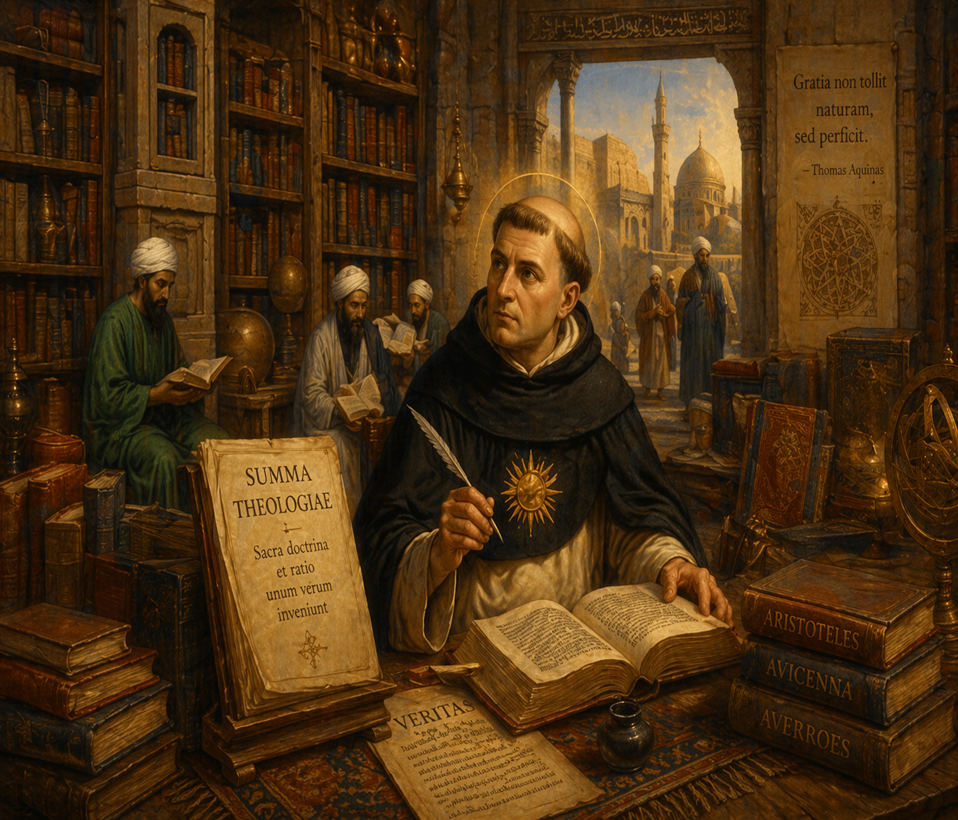
What might happen if two of the greatest minds in religious philosophy sat down for a conversation? This illustration imagines a respectful dialogue between Abu Hamid Al-Ghazali and Thomas Aquinas, representing the shared pursuit of truth across Islamic and Christian intellectual traditions. (Photo by the Author)
This article explores an imagined philosophical dialogue between Imam Abu Hamid Al-Ghazali and St. Thomas Aquinas, two of the most influential thinkers in Islamic and Christian intellectual history. Though separated by two centuries and different theological traditions, both thinkers addressed the relationship between reason and revelation, the nature of God, and the moral purpose of human life. By placing their ideas into conversation, this essay highlights shared philosophical concerns within Islamic and Christian traditions and demonstrates how intellectual engagement across religious boundaries can deepen rather than diminish theological understanding.
Across the history of philosophy and theology, few figures stand as prominently within their traditions as Imam Abu Hamid Al-Ghazali and St. Thomas Aquinas. Each represents a pinnacle of intellectual achievement within the civilizations that shaped them. Al-Ghazali wrote in the eleventh century during the intellectual flourishing of the Islamic world, while Aquinas developed his thought in the thirteenth century at the height of medieval Christian scholasticism.
Despite the centuries that separate them, both thinkers wrestled with remarkably similar questions. What can human reason know about God? Where does philosophy reach its limits? How should revelation guide human understanding? And what ultimately constitutes the purpose of human life.
Imagining a peaceful discussion between these two giants invites us to consider a deeper truth about religious intellectual traditions. At their highest levels, they are not merely systems of doctrine. They are disciplined inquiries into reality itself.
Such a conversation would not resemble a clash of civilizations. Rather, it would unfold as a rigorous exchange between two scholars committed to the same ultimate pursuit: the search for truth about God and the moral order of existence.
Shared Foundations: Faith Seeking Understanding
Both Al-Ghazali and Aquinas begin from a fundamental philosophical conviction. Faith and reason are not enemies.
Within the Christian scholastic tradition, Aquinas argued that reason is a faculty given by God and therefore capable of discovering certain truths about the world and its creator. Because God is the author of both revelation and nature, properly exercised reason cannot ultimately contradict revealed truth. This conviction guided Aquinas in his monumental work Summa Theologiae, where Aristotelian philosophy was integrated into Christian theological reasoning.
Al-Ghazali approached this relationship from a different intellectual journey. In his autobiographical work Deliverance from Error, he recounts his struggle with philosophical skepticism and his search for certainty. Although he famously critiqued certain metaphysical claims made by philosophers in The Incoherence of the Philosophers, Al-Ghazali did not reject rational inquiry itself. Instead, he argued that reason must remain aware of its limitations and recognize the authority of divine revelation.
This point of convergence is significant. Both thinkers recognize the importance of reason while acknowledging that reason alone cannot fully grasp ultimate reality. Reason guides the intellect toward truth, but revelation provides knowledge that transcends the boundaries of purely philosophical investigation.
On the Nature of God
Any meaningful dialogue between these two thinkers would inevitably center on the nature of God.
Aquinas developed one of the most sophisticated philosophical accounts of divine existence in the medieval world. His famous Five Ways attempt to demonstrate that the existence of a first cause or necessary being can be established through rational reflection on the nature of motion, causality, contingency, gradation, and order in the universe.
Al-Ghazali would likely find aspects of this reasoning compelling, particularly the affirmation of a necessary creator. Yet he would also emphasize the radical transcendence of God emphasized in Islamic theology. In classical Islamic theology, God cannot be fully captured by philosophical categories or metaphysical definitions.
The distinction here is subtle but important. Aquinas uses philosophical reasoning to demonstrate that God must exist, while Al-Ghazali warns that intellectual demonstration must not be mistaken for comprehension of divine essence.
Interestingly, Aquinas himself ultimately arrives at a similar humility. Near the end of his life, he reportedly experienced a profound spiritual vision that led him to describe his extensive writings as straw compared with the direct experience of divine reality.
Both thinkers, therefore, arrive at a shared insight. Reason may guide the human mind toward God, but the fullness of divine reality surpasses the limits of human language and conceptual thought.
The Limits of Philosophy
The question of philosophy’s limits would form another central theme in their discussion.
Al-Ghazali’s critique of philosophers such as Ibn Sina, known in the Latin world as Avicenna, focused on the claim that metaphysical reasoning alone could establish doctrines about eternity, causation, and divine knowledge that conflicted with Islamic revelation. For Al-Ghazali, philosophy becomes problematic when it moves beyond its proper scope and begins to pronounce on matters that belong to the domain of prophecy and revelation.
Aquinas, by contrast, believed that philosophy possessed genuine autonomy within its sphere. Drawing heavily on Aristotle, whose works had been transmitted to the Latin West through Islamic scholars such as Ibn Rushd, known as Averroes, Aquinas argued that reason could investigate natural truths about existence, causality, and moral law.
Yet Aquinas also insisted that certain doctrines, such as the Trinity and the Incarnation, could only be known through revelation.
Both thinkers, therefore, maintain a careful balance. Philosophy is valuable and necessary, but it cannot replace revelation. It can clarify, defend, and illuminate theological truths, yet it cannot independently establish the full structure of divine reality.
Ethics and the Purpose of Human Life
Beyond questions of metaphysics, a discussion between Al-Ghazali and Aquinas would naturally turn toward ethics and the purpose of human existence.
For Aquinas, the ultimate end of human life is the beatific vision. This refers to the direct knowledge of God that fulfills the deepest desire of the human intellect. Human actions in this life are therefore directed toward this final goal through virtue, moral law, and divine grace.
Al-Ghazali offers a strikingly parallel vision within Islamic spirituality. In The Revival of the Religious Sciences, he describes the purification of the heart as the central task of the believer. Ethical discipline, sincere worship, and spiritual knowledge transform the human soul so that it becomes capable of drawing nearer to God.
Both thinkers, therefore, understand ethics as more than social regulation. Moral life is a process of spiritual formation.
Virtues shape the human character and align the soul with divine truth. Ethical action is therefore not merely about obeying rules but about cultivating a disposition that allows the human being to approach ultimate reality.
Here, the influence of earlier thinkers such as Augustine can also be seen. Augustine argued that the human heart is restless until it rests in God, a theme that resonates strongly with both Aquinas’s concept of beatitude and Al-Ghazali’s emphasis on spiritual purification.
A Model for Intellectual Dialogue
Imagining a dialogue between Al-Ghazali and Aquinas provides more than an interesting historical exercise. It offers a model for contemporary intellectual engagement.
Modern conversations between religious traditions often collapse into defensive arguments or superficial comparisons. Yet the intellectual traditions represented by these two scholars demonstrate a different possibility.
Both were deeply rooted in their own theological commitments while remaining intellectually curious about philosophy and the insights of earlier thinkers. Both engaged critically with ideas outside their traditions without abandoning their own beliefs.
Their example suggests that disagreement does not have to produce hostility. Instead, it can stimulate deeper reflection and more refined understanding.
When intellectual traditions meet at their highest levels, the goal is not victory but clarity.
The Enduring Relevance of Great Thinkers
The imagined conversation between Imam Al-Ghazali and St. Thomas Aquinas reminds us that the greatest thinkers of religious traditions were explorers of truth rather than guardians of ideological boundaries.
They believed that careful reasoning, disciplined faith, and ethical reflection were all necessary for approaching the deepest questions of existence.
In a world often marked by polarization and misunderstanding, the intellectual spirit of these giants offers an important lesson. Civilizations advance not by silencing one another but by engaging in thoughtful and respectful dialogue.
If Al-Ghazali and Aquinas could meet today, their discussion would likely be intense, careful, and philosophically demanding. Yet it would also be guided by a shared conviction.
The search for truth is a sacred task, and every sincere intellectual tradition participates in that search.
© 2026 Dr. Bekim Belica
메타데이터
- post_id
- ea6f3b7dca8f
- slug
- when-giants-speak-a-peaceful-philosophical-dialogue-between-imam-al-ghazali-and-st-thomas-aquinas-ea6f3b7dca8f
- url
- https://medium.com/illumination/when-giants-speak-a-peaceful-philosophical-dialogue-between-imam-al-ghazali-and-st-thomas-aquinas-ea6f3b7dca8f
- canonical_url
- https://medium.com/illumination/when-giants-speak-a-peaceful-philosophical-dialogue-between-imam-al-ghazali-and-st-thomas-aquinas-ea6f3b7dca8f
- author_url
- https://medium.com/@drbekimbelica
- status
- ok
- fetched_at
- 2026-06-29 01:02:39