Universal Operational Monitoring Framework for the Data Platform (DP)
Description: This framework defines a standardized approach for monitoring all components of the DP lifecycle. It ensures visibility…
Universal Operational Monitoring Framework for the Data Platform (DP)
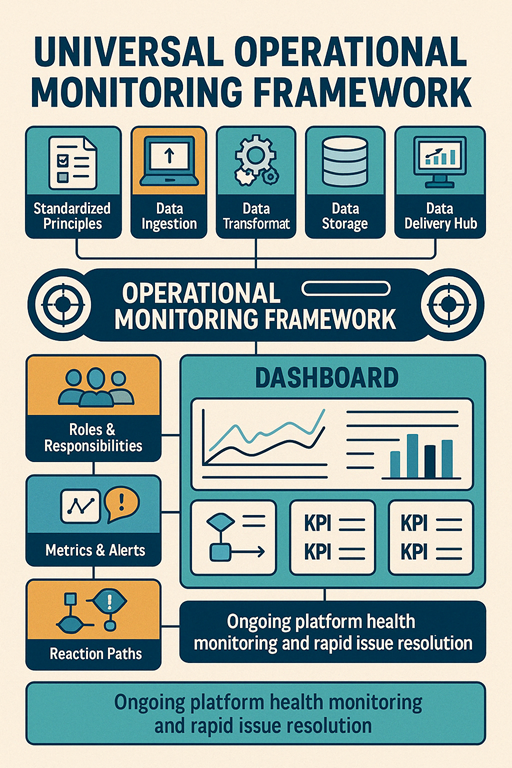
Description: This framework defines a standardized approach for monitoring all components of the DP lifecycle. It ensures visibility, accountability, and responsiveness across data ingestion, transformation, storage, and delivery phases, as well as overarching principles such as governance, dashboarding, and use case tracking. The framework enables teams to detect, analyze, and resolve operational issues quickly, while supporting transparency and continual improvement.
Business Value:
- It provides real-time observability of all platform layers and workflows.
- Reduces risk of data loss, delays, or misalignment across teams.
- Enables faster root-cause analysis and resolution.
- Standardizes incident handling and accountability.
- Facilitates compliance with non-functional requirements and platform SLAs.
Dependencies:
- Defined set of DP building blocks, features, and components (e.g., ingestion, transformation, storage, delivery, contracts).
- DevOps, Data Engineering, Governance, and Business teams.
- Cloud infrastructure logging and alerting services (AWS CloudWatch, DataZone, OpenSearch, Slack/Teams integrations).
- Existing metadata, data contracts, and use case hubs.
- Power BI / dashboarding infrastructure.
Acceptance Criteria:
- A unified framework is documented and accessible in Confluence.
- Critical monitoring points for each DP step are defined and visualized.
- Platform-wide dashboard(s) exist and include: Ingestion status and file traceability, Transformation runtime metrics and error rates, Storage health (latency, volume, schema drift), Delivery metrics (availability, frequency, endpoints), Contract compliance, and data usage statistics.
- Incident management includes an escalation matrix by severity (P1–P3), defined reaction and resolution times, and roles and responsibilities per component.
- The alerting system includes Data loss detection, Workflow interruption or lag, and Metric thresholds (e.g., throughput, retry rate, freshness).
- Checklist validation in place for release flows and test data preparation.
Core Monitoring Dimensions per DP Step:
1. Standardized Principles
- Monitor governance rule application (automated checks)
- Track alignment with metadata structure and naming conventions
2. Pre-Ingestion
- Track upload status, file format, and user
- Monitor linkage to contracts and file metadata correctness.
3. Ingestion
- Monitor success/failure rate, retry count
- Data version tracking, historical retrievals tested
- Pipeline queue size, throughput per contract
4. Transformation
- Transformation job duration and success rate
- Quality rule violation count
- Output schema compliance
5. Storage
- S3 availability and partition growth rate
- Catalog sync with Glue/DataZone
- Role-based access activity audit
6. Data Delivery Hub
- Endpoint health (API latency, Power BI refresh time)
- Consumption logs by dataset and region
- Compliance with delivery schedule and format rules
7. Use Case Hub
- Use case coverage and freshness
- Visibility on missing links between contracts and outputs
- Review completion stats per team/domain.
8. Dashboard Layer
- Report freshness and usage analytics
- Monitoring of failed or outdated dashboards
- Cross-environment consistency (test/prod)


Escalation Paths and Operational Rules:
- Daily operational summary of ingestion and transformation performance
- Weekly dashboard for backlog or performance regression
- Real-time alerting with SLA breach signals
- Slack/Teams integration for triage coordination
- Monthly review of incident logs for trend detection
Conclusion: This Operational Monitoring Framework transforms DP observability from reactive incident handling into proactive, automated platform health assurance. It aligns all components of DP into one monitoring model, ensuring process integrity, compliance, and high service continuity.
메타데이터
- post_id
- ea7471ac3e71
- slug
- universal-operational-monitoring-framework-for-the-data-platform-dp-ea7471ac3e71
- url
- https://medium.com/@chameleon13/universal-operational-monitoring-framework-for-the-data-platform-dp-ea7471ac3e71
- canonical_url
- https://medium.com/@chameleon13/universal-operational-monitoring-framework-for-the-data-platform-dp-ea7471ac3e71
- author_url
- https://medium.com/@chameleon13
- status
- ok
- fetched_at
- 2026-07-25 06:43:36