Self-Reference and Recursion Are Power and Boundary
(They bring undecidability and incompleteness)
Self-Reference and Recursion Are Power and Boundary
(They bring undecidability and incompleteness)
TL;DR When a formal system grows strong enough to talk about itself, its creative power explodes — and so do its limits. Self-reference and recursion give us self-hosting compilers, proof assistants, and meta-analysis, but they also guarantee undecidable problems and true-but-unprovable statements. Mature reasoning is learning to build with that fire without burning the floor.
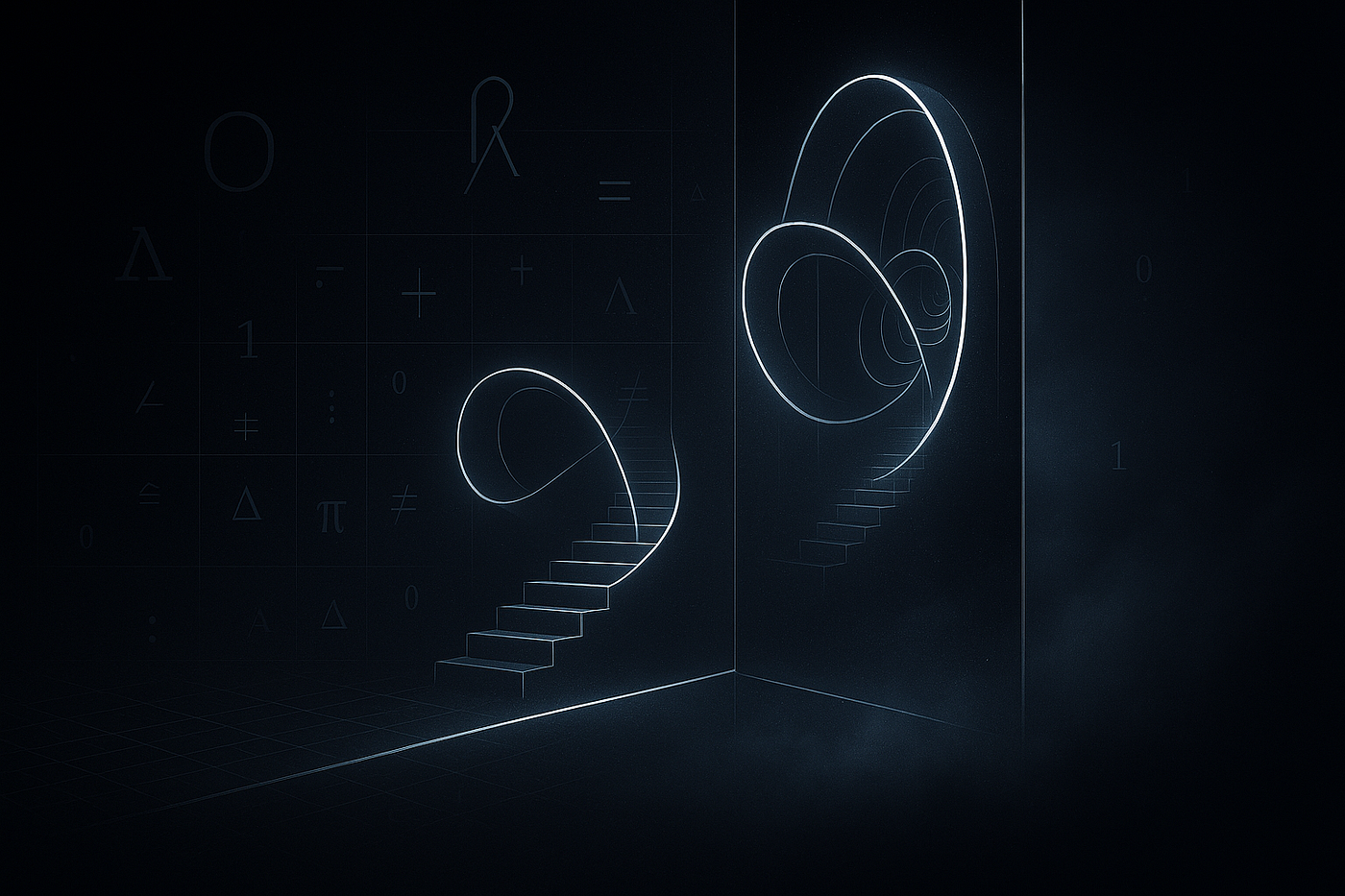
The mirror rises — self-reference lights the room and raises walls
Picture a bare desk with a few axioms and inference rules. Apply the rules again and again and you get more theorems. That’s the promise of formal systems. But once a system can describe enough arithmetic, it grows a mirror. It can talk about itself.
That mirror is pure power. We get self-hosting compilers, interpreters that interpret their own language, proof assistants that reason about proofs, and meta-languages that describe the grammars beneath them. Yet the same mirror draws two cracks:
- Syntax vs. semantics do not perfectly overlap. What is provable inside the system can diverge from what is true in the intended model of the world.
- Recursion enables diagonal moves that both create and sabotage. The very trick that builds self-explanation also manufactures statements the system cannot settle.
A formal system is a precise map; reality is a terrain. Make the map expressive enough and its edges reveal impassable folds.

The shadow of diagonalization — the landscape of undecidable and incomplete
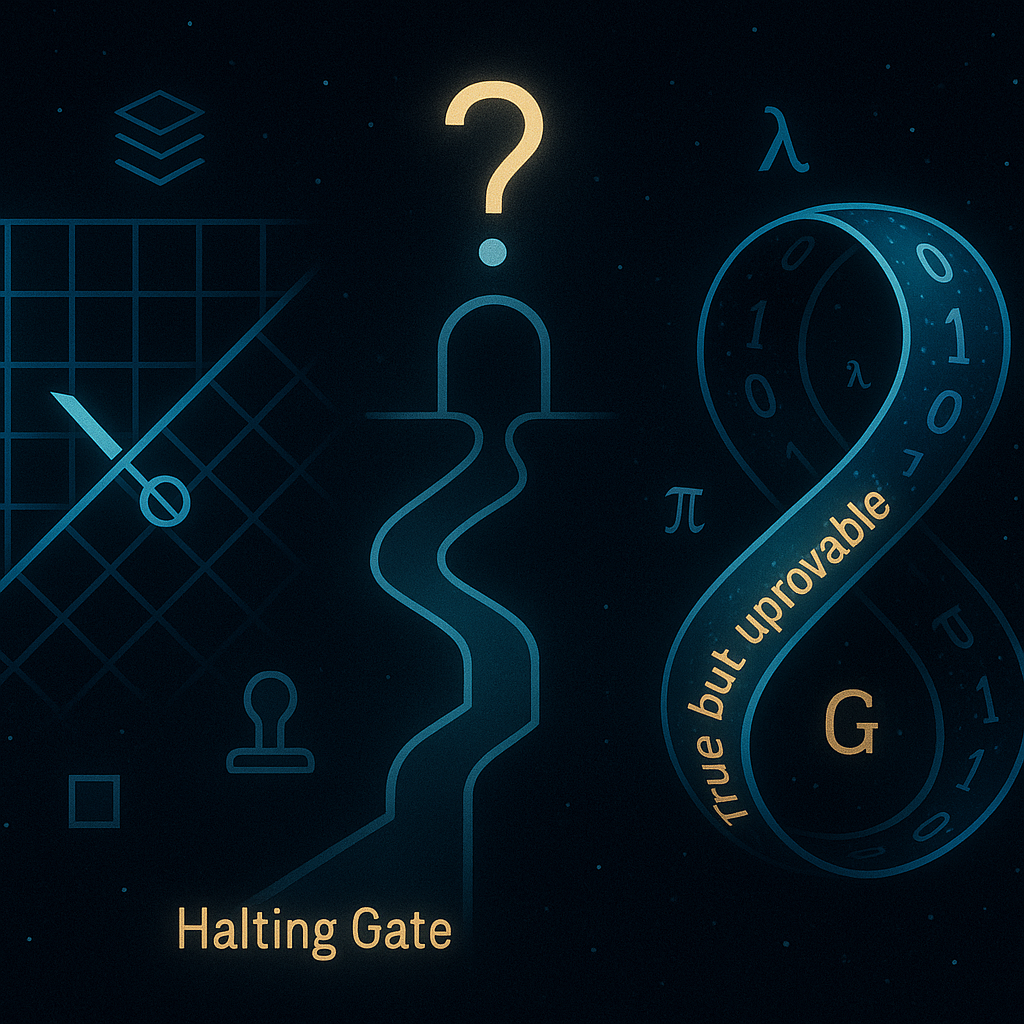
First, undecidability. Suppose a universal program existed that tells whether any program halts. We can then construct a program designed to contradict that oracle on its own input. Twist recursion just a little, and the helpful ladder becomes a trap. Some questions aren’t “not solved yet” — they are in principle unanswerable by any always-correct general procedure.
Second, incompleteness. In any consistent system rich enough for basic arithmetic, there are statements that are true in the intended sense but unprovable within the system. Self-reference turns into a semantic mirror that reveals genuine truths sitting forever beyond the system’s proof horizon. We live with two layers at once:
- A provable layer we can reach by finite reasoning.
- A true-but-unprovable layer that requires stepping outside the system or extending it.
Third, non-constructive existence. A theory may prove that an object must exist without giving any effective way to construct it. In mathematics this is non-constructive existence; in engineering it becomes “we know the property holds, but no algorithm reliably finds the witness.”
Limits are not paralysis. In practice, four grounded strategies keep us moving:
- Constrain expressiveness. Use type systems, finite domains, or restricted logics to regain local completeness and tractable verification.
- Layer and modularize. Keep the base simple; assemble power by composition at higher layers instead of wrestling the whole monster in one place.
- Invite outside witnesses. Interactive proofs, formal specs, and model checking convert intuition into audit-able evidence chains. Truth stops relying on authority and starts living in reproducible artifacts.
- Tame the undecidable. Timeouts, approximations, abstract interpretation, and static analysis trade perfection for usefully safe results. We do not promise “always” and “everywhere” — we promise “enough and explainable.”
Self-reference also reflects our human world. Consciousness comments on itself; language speaks about language; science uses peer review and replication to dilute individual bias. We embed a single brain’s mirror into a larger system and ask for external witnesses, the social analog of formal verification.

Living with the boundary — the alloy of rigor and humility
Formal systems teach two lessons at once:
- Engine power. Self-reference and recursion are engines of creation. Without them we would not have self-bootstrapping tools, self-describing languages, or meta-level analysis.
- Engine heat. The same engine guarantees undecidability and incompleteness. Any sufficiently strong system must coexist with these structural shadows.
Mature rationality isn’t mythical omniscience; it is an alloy of order and humility:
- Inside the boundary aim for completeness — push formalization, automation, and reproducibility so certainty compounds.
- Beyond the boundary be elegantly incomplete — embrace approximations, heuristics, and continual revision; make room for falsification and updates.
Understand the fire and the floor. Use self-reference where it illuminates the path to truth; stop where it risks burning through the boards. That stance doesn’t shrink our ambition — it makes it sustainable.
메타데이터
- post_id
- ea7ea5bc2a29
- slug
- self-reference-and-recursion-are-power-and-boundary-ea7ea5bc2a29
- url
- https://medium.com/@rendazhang/self-reference-and-recursion-are-power-and-boundary-ea7ea5bc2a29
- canonical_url
- https://medium.com/@rendazhang/self-reference-and-recursion-are-power-and-boundary-ea7ea5bc2a29
- author_url
- https://medium.com/@rendazhang
- status
- ok
- fetched_at
- 2026-08-01 10:20:08