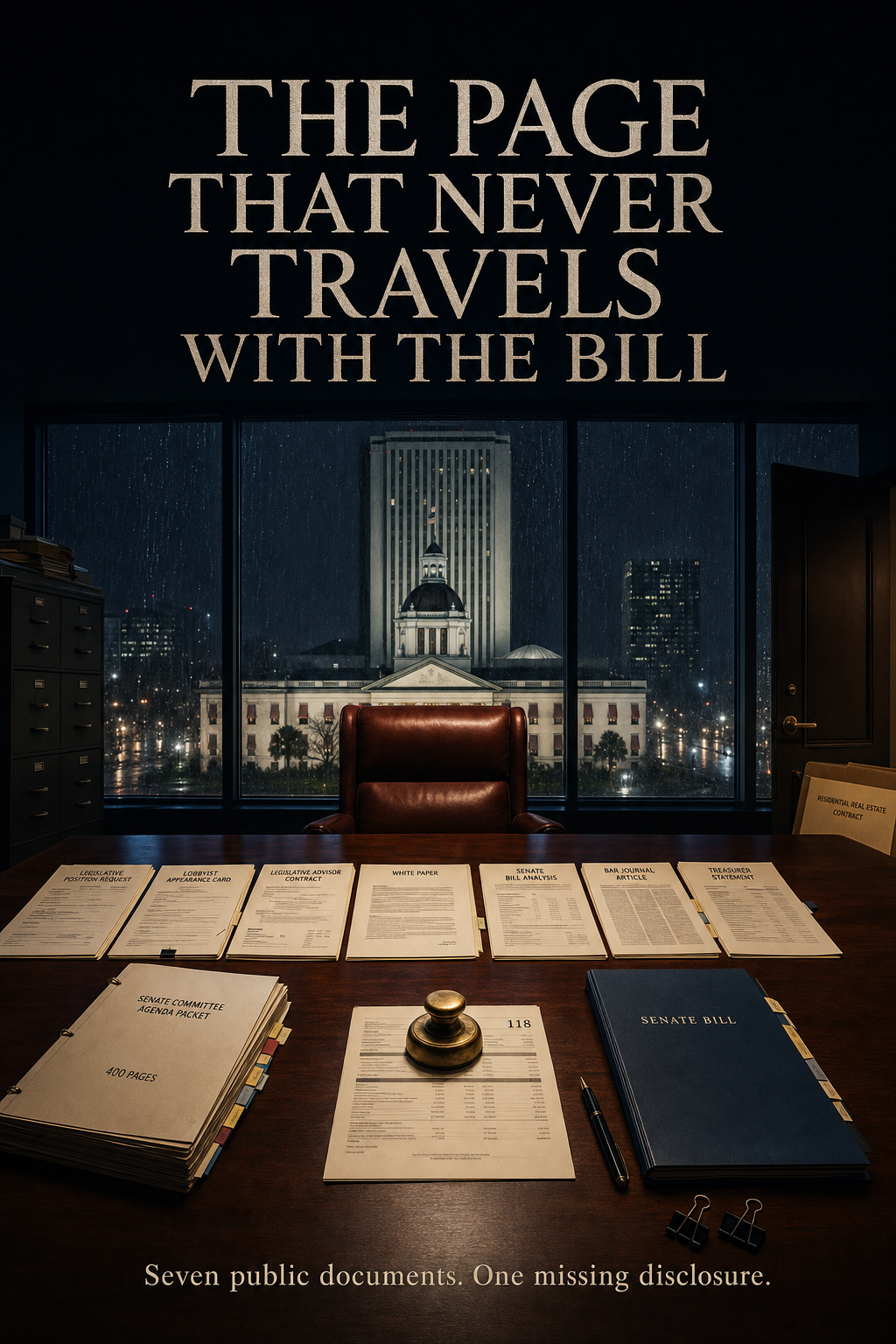
The Page That Never Travels With the Bill
Seven public documents describe how Florida’s property and trust law gets written. Each one discloses something. No two disclose the same…
The Page That Never Travels With the Bill
Seven public documents describe how Florida’s property and trust law gets written. Each one discloses something. No two disclose the same thing. And the only page that answers the question is the only page that never goes to Tallahassee.
Krstafer Pinkerton, Director of Investigations, CARCLE / Regional Coordinator, Center for Estate Administration Reform (CEAR)
July 12, 2026
NOERR FIREWALL, STATED FIRST, NOT LAST. Everything described here is legislative and political petitioning: lobbyist registration, appearance disclosure, legislative-consulting contracts, a Bar approval process, and professional publishing. It is protected activity. It is reported as context and structure only, never as a predicate act. The Noerr-Pennington sham exception is named and expressly declined. No official’s purpose is asserted. Multi-client representation by a lobbying firm is ordinary, lawful, and disclosed. No individual named here is accused of any violation of law, of any Bar rule, or of any impropriety whatsoever. Nothing here is an adjudicated finding. This is journalism, not a pleading.
I. One sentence, and the question it forces
Start where a reader can feel it.
Your mother dies. She leaves a trust. A bank is the trustee. Years pass, and you come to believe the bank has been favoring the other beneficiaries and starving you. You hire a lawyer. You sue. You lose, and not because the bank was right. You lose because the standard is abuse of discretion, and a judge decides the bank stayed inside the lines. And the decision was predetermined by the Florida Bar.
Now read Florida Statutes section 738.202(5), effective January 1, 2025:
“If an action is instituted alleging an abuse of discretion in the exercise or nonexercise of the fiduciary’s discretion under this chapter and the court determines no abuse of discretion has occurred, the fiduciary’s costs and attorney fees incurred in defending the action shall be paid from the trust assets.”
The bank’s legal bill comes out of the trust. The trust is your inheritance. You challenged the bank, you lost, and you are now paying the bank’s lawyers with your own money.
*Not the court may award. *Shall be paid.
It is not in the uniform act the rest of the country works from. It was not in Florida law before. Somebody wrote it.
This article is not about who. That question has an answer; it is public, and I will give it to you. This article is about a stranger question, the one I could not put down once seven documents were lying side by side on the same table:
Every instrument in this pipeline asks for a disclosure. Not one of them asks for the disclosure that matters.
Nobody lied on any form. That is the whole problem.
II. The seven documents
A Section proposal becomes Florida law by passing through seven pieces of paper. Here they are, in the order the proposal touches them.
• The request. The Florida Bar’s Legislative Position Request Form — the single sheet that carries a Section proposal to the Board of Governors and into a bill.
• The card. The sworn lobbyist appearance card filed with the Florida House by whoever walks the bill into a committee room.
• The contract. The Section’s own legislative advisor agreement, printed in a public agenda packet, with the fee on the page.
• The diagnosis. RPPTL’s white papers — the Section’s own analyses of what is wrong with Florida’s trust statutes, sitting in the files of the Senate Committee on Judiciary.
• The briefing. The House and Senate staff analysis, the document a legislator actually reads before voting — and the one that footnotes the white paper as the authority for the problem.
• The instruction manual. A Florida Bar Journal column, Designing Trust Systems for Florida Residents, submitted on behalf of a Bar section, teaching practitioners how to operate the statutes the sections write.
• The money. One page, buried at 118 of 400: the Section’s Treasurer’s Statement.
Every one of them is public. Nobody hid anything. They were simply never laid on the same table.
When you do lay them on the same table, a shape appears, and it is not the shape anyone expects. It is not a conspiracy. It is a filing system.
How I got them: twenty-three years of RPPTL Executive Council agenda packets — four hundred pages a meeting, five meetings a year, at resorts, on Saturday mornings. Ten years of Florida House lobbyist appearance records, 68,801 sworn rows, joined against the Section’s own sponsor roster and against The Florida Bar’s own appearance cards. And a three-way forensic comparison of the Uniform Law Commission’s 2018 model act, RPPTL’s July 2023 committee draft, and the enacted Florida statute. The corpus is the method, not the argument. The argument is the seven forms.
III. Form One: the Legislative Position Request Form
The instrument that carries a Section proposal into Florida law is a single sheet of paper. I pulled an executed one off the Section’s own server — the Olmstead charging-order position, Section approval dated September 25, 2010 — to read its field structure.

Figure 7. What the form asks, and the one thing it does not.
Look at what is not there.
There is no field disclosing who financially sponsors the requesting section. No conflict-of-interest box. No economic-interest declaration. The entire conflict analysis is intra-Bar: the form asks whether other Bar sections were consulted. It never asks who paid the section.
And now hold that word.
The word “sponsor” appears on this form exactly once, and it means the legislator who files the bill.
Keep it in your hand. We are coming back to it, and when we do, it will turn out to be the hinge of this entire piece.
The Florida Bar Board of Governors is the gatekeeper here. It reviews a Section position only to decide whether to prohibit the Section from advocating it. That is not an approval; it is a failure to veto. And it is performed on the strength of this form.
A gatekeeper cannot fail to catch what it is never shown.
IV. Form Two: the lobbyist appearance card
The second instrument is the sworn appearance card every lobbyist files with the Florida House. It discloses the principal — meaning whoever is paying — and the bill.
It is an excellent form. It caught something real.
I joined RPPTL’s published sponsor roster against ten years of those cards, then joined the result against The Florida Bar’s own cards.
Metz Husband & Daughton PA is the registered lobbying firm of record for THE FLORIDA BAR in all ten years, 2017 through 2026. It is simultaneously the registered firm for Attorneys’ Title Fund Services — known as The Fund — in all ten of those same years, and for Westcor Land Title from 2018 through 2023. Both are RPPTL sponsors. Both are title underwriters. The same twelve named individuals appear on both books.
James R. Daughton Jr. · Warren H. Husband · Allison Liby-Schoonover · Aimee Diaz Lyon · Andrew T. Palmer · Douglas S. Bell · Patricia B. Greene · Leslie Y. Dughi · Karl Nels Rasmussen · Pierce Schuessler · Anna Grace DePaolo · Gregory K. Black.
And it is not just one firm.

Figure 1. Six firms carry a Florida Bar entity and an RPPTL sponsor at the same time.
Six firms. Twenty-two individual lobbyists on both sides. Seventy bills over ten years carrying both a Bar or Section appearance card and a sponsor appearance card — including CS/CS/HB 913 (2025), the condominium bill, on which the RPPTL Section, the Florida Land Title Association, JPMorgan Chase, and Old Republic National Title all filed.
The Section retains its own legislative consultants, separate from the Bar’s firm. That separation is real, and it is defensible. It is also the wrong door. The Bar’s own firm walked around the side and took the Section’s title underwriters as clients.
The entity that licenses and disciplines every lawyer in Florida, and the title underwriters that pay to sponsor that entity’s largest section, walk into the same committee rooms represented by the same people.
So: what did the appearance card disclose? The principal, and the bill.
What did it never ask? Who drafted the bill.
V. Form Three: the contract that carries it
There is an instrument between the drafting room and the Capitol, and it is printed, in full, in a public agenda packet.
The Executive Council packet for November 2023 contains the Section’s legislative advisor agreement. It is a service contract, and it is unusually candid about what the service is. The advisor tracks and reports on filed bills within the Section’s purview. Provides weekly reports during session. Promotes and supports Section legislative proposals. Alerts the Section to other interested groups. Reports on regulation, rulemaking, and technical assistance.
And it will work with Section-designated contacts to obtain legislative sponsors for Section proposals.
The fee is on the page: $120,000, plus expenses.
There is nothing improper in any line of that. Retaining professional legislative counsel is lawful, disclosed, and universal in Tallahassee. Every serious trade association, professional body, and public-interest group in the state does the same thing, and the ones that do it well put the contract in a public packet, which is precisely what happened here.
But note the verb. The contract’s job is to obtain legislative sponsors.
That is now the second instrument in this pipeline to use the word “sponsor” in its legislator sense — and it is a contract paid for by a Section whose revenue we are about to look at.
What did the advisor agreement disclose? The scope, the deliverables, and the fee.
What did it never ask? Who funds the client.
VI. Forms Four and Five: the white paper, and the analysis that cites it
Here is where the machine stops being a metaphor.
When a bill reaches a Florida Senate committee, the professional staff writes a Bill Analysis. It is the document a senator actually reads. Its most important part is the section headed Present Situation, because that is the part that tells a legislator what is broken. Everything downstream — the votes, the amendments, the enactment — rests on the premise established there.
So open the Senate Rules Committee’s analysis of CS/CS/SB 262 (2025) — the trust bill that became Chapter 2025–159 — and read its footnotes.
“Real Property, Probate, and Trust Law (RPPTL) Section of The Florida Bar, White Paper on the Revision to Subsections (1)(b), (2)(a), (3), (4)(a), (8)(d), (11) and (12) of 736.04117 of the Florida Statutes (2024) (on file with the Senate Committee on Judiciary).”
“RPPTL Section of The Florida Bar, White Paper: Former Trustee Liability (2024) (on file with the Senate Committee on Judiciary).”
“RPPTL Section of The Florida Bar, White Paper on Minor Clarifications to the Florida Community Property Trust Act (2024) (on file with the Senate Committee on Judiciary).”
Now read the sentences those footnotes support. The analysis tells senators that some practitioners suggest the successor-trustee statute is unclear. That one group believes one thing and another group interprets it differently. That a phrase has caused concern among professionals who work in this area. That the concern has been raised about how a property appraiser might treat a transfer.
Which practitioners? Which professionals? Whose concern?
The footnote is an RPPTL white paper. On file with the Senate Committee on Judiciary.
The Section identifies the defect. The Section proposes the cure. The Section’s white paper goes into the Senate committee’s own files. And the Legislature’s briefing paper then cites that white paper as the authority for the existence of the defect.
The remaining footnotes in that analysis are Florida Bar Journal columns and a dictionary.
The Section did not merely draft the answer. It supplied the question, and the Legislature footnoted it.
And this is entirely ordinary. Legislative staff are not trust lawyers, and they need expert sources. Citing a Bar section’s white paper is normal, legitimate, and very likely unavoidable. No misconduct is alleged, and none is implied.
It is simply the fourth and fifth instruments in a pipeline, and they have the same hole as the first three.
The same pattern, on the statute this article opened with
Chapter 738 — the rule that decides what counts as income and what counts as principal in every trust and estate in the state — was rewritten in 2024 by HB 1093, now Chapter 2024–216. The House staff analysis states that in response to the Uniform Law Commission’s 2018 model act, RPPTL convened a Principal and Income Committee, and “the Committee ultimately proposed the revision” that became law.
A Bar committee. Named as the drafter, in the Legislature’s own paperwork.
That committee’s work product is public if you know where to look. It sits inside the Executive Council agenda packet for July 22, 2023. Page 138 is the Legislative Position Request Form. Pages 140 to 156 are the white paper. Pages 157 to 254 are ninety-eight pages of finished bill text, formatted for filing, under the header “202__ Legislature,” with the year left blank, waiting for a sponsor.
Committee co-chairs, per the form: Edward F. Koren of Holland & Knight. Pamela O. Price of Gray Robinson. Keith B. Braun. Jolyon D. Acosta. No one is accused of anything. They were doing precisely what the Section exists to do, and doing it competently.
On January 2, 2024, Rep. Mike Caruso filed it. On February 28, the House passed it 115 to 0. On March 1, the Senate passed it 32 to 0. Signed May 29. Nobody voted no.
So how much of the statute is theirs? “The Bar section influences legislation” is a claim, and it is unfalsifiable, which is why it never goes anywhere. So I measured it instead.
Three documents. Normalize all three, break them into overlapping ten-word sequences, and ask of every sequence in the enacted law where it came from. The obvious trap is that all three descend from the same uniform act; a naive comparison would credit the committee with the Commission’s words. So the only honest measure is the residue: language in the Florida statute that appears in the committee’s draft and does not appear in the model act.

Figure 2. Who wrote Chapter 738.
But the number that says the most is 1.5 percent. That is how much of the statute came straight from the uniform act without passing through the committee’s hands. The Legislature almost never reached past the committee to the model act.
It took what it was handed.
And the fee shift — the sentence this article opened with? It is in the committee’s draft, at page 174 of that packet. The committee wrote attorney’s fees. The statute reads attorney fees.
That apostrophe is very nearly the only difference between the private draft and the public law of Florida.
What did the staff analysis disclose? That RPPTL drafted the bill, and that RPPTL’s white paper is the authority for the problem the bill solves.
What did it never ask? Who funds RPPTL.
VII. Form Six: the Bar Journal column
The sixth instrument is the one I did not expect to need, and it closes the circuit.
It is a Florida Bar Journal column: Designing Trust Systems for Florida Residents: Planning Strategies, Things You Should Know, and Traps for the Unwary, by Alan S. Gassman of Gassman, Crotty & Denicolo, P.A., Clearwater, with Brock Exline and Peter Farrell. Volume 97, Number 4, July/August 2023, page 28. A featured article.
It is a serious piece of professional writing, and it deserves to be described accurately. It is careful, heavily sourced, and openly critical of Florida law. It says the Florida caselaw on tenancy-by-the-entireties trusts has been unkind. It calls a bankruptcy court’s reasoning a jurisprudential error that will cause years of confusion. It observes that Tennessee, Delaware, Virginia, Illinois, and Missouri have fixed the problem by statute while Florida has not, and it says flatly that “Florida remains a backwater state in this area of the law.”
That is a lawyer telling his own profession that his own state’s law is broken, in his own state’s bar journal. Nobody in that byline is accused of anything, and nothing here should be read as suggesting otherwise.
Now read the last line of it:
“This column is submitted on behalf of the Tax Section, Mark R. Brown, chair, and Charlotte A. Erdmann, Daniel W. Hudson, Angie Miller, and Brian Harris, editors.”
The column is a Section product.
And it is footnote 2 of the Senate staff analysis for the 2025 trust bill. Two more Bar Journal columns are footnotes 6 and 18. The column that identifies the gap in the law, and the white paper that proposes the fix, and the analysis that briefs the senator, are the same body talking to itself, in three different typefaces. The Legislature’s role is to footnote it.
This is the station that makes the thing a circuit.
The committee drafts the statute. The Executive Council votes it out. The Board of Governors declines to veto. The retained advisor carries it to Tallahassee and obtains a legislative sponsor. The Legislature enacts it. The Bar’s own journal, submitted on behalf of a Section, teaches the profession how to operate it. And the next time a bill moves, the journal and the white paper come back as the citation. It flows out to the membership as a column and a CLE and new billable complexity, and it flows back into the Capitol as authority.
That is not corrupt. That is a profession functioning. It is also a closed loop, and closed loops have a property worth naming.
They have no outside.
What did the column disclose? Its authors, their firm, and the section that submitted it.
What did it never ask? The section’s revenue. Or the fee interest of the entities whose statutes it explains.
VIII. Form Seven: the page that answers the question, and where it lives
There is a seventh document. It is the only one in the entire pipeline that actually tells you who pays.
It is the Section’s Treasurer’s Statement of Current Financial Conditions, RPPTL Section Rollup, eleven months ending May 31, 2023. It sits on page 118 of the same four-hundred-page agenda packet that carries the Chapter 738 draft.

Figure 3. The Section’s own books. Page 118 of 400.
Sponsorship alone is 83.7 percent of what the members pay in dues. Sponsor-side money is 99.0 percent of member dues.
Dollar for dollar, the industry whose statutes this Section drafts funds the Section as heavily as the Section’s own lawyer-members do.
That matters for a specific legal reason. Under Keller v. State Bar of California, bar sections are funded by voluntary section dues rather than compelled Bar dues. The doctrinal premise is that voluntary money is member money, so a section position reflects the professional judgment of the lawyers who chose to pay for it.
That premise is not a philosophy. It is an arithmetic claim. And this is the arithmetic.
Keller protects lawyers from the Bar. Nothing in the architecture protects the public from the sponsors.
IX. The word that does two jobs
Put the forms back on the table now, side by side, and read the last column.

Figure 4. Every form discloses something. No two disclose the same thing.
Every form in the system has a disclosure field. No two of them disclose the same axis. And the only document that carries the answer is the only one that never travels with the bill.
The Treasurer’s Statement is not hidden. It is not redacted. It is not exempt. It is published, in full, with account numbers, on the Section’s own server, on page 118 of a four-hundred-page PDF that nobody outside the room has any reason to open, in a packet whose other pages contain the bill that becomes law.
The information exists. The information is complete. It is simply never assembled, because no instrument in the pipeline requires assembly, and each instrument, filled out truthfully, routes its disclosure onto an axis where it lands harmlessly.
And now the hinge. Go back to the word I asked you to hold.
On the Legislative Position Request Form, “sponsor” means the legislator who files the bill. In the legislative advisor agreement, “sponsor” means the legislator who files the bill. On the Sponsor Benefits Chart, “sponsor” means the company that pays $25,000.
Same word. Same ecosystem. Same pipeline. Opposite meanings. And no form anywhere ever forces the two senses onto the same page.
The record does not prove why that word was chosen for both jobs. It does show what the chosen word does. It lets a legislator, a Board of Governors member, and a Bar Journal reader each encounter the word “sponsor,” each understand it correctly, and each understand something entirely different, with nothing in any document to tell them the other meaning exists.
That is not a lie. Nobody lied. That is a filing system.
X. The price list, and what the seats actually cost
Because the second sense of the word is published too.

Figure 5. What a seat costs, and what it buys.
The published benefits chart, effective July 1, 2024, runs from $5,000 to $25,000 across Bronze, Silver, Gold, and Platinum, plus special App and CLE sponsorships. What the money buys is stated plainly, and there is no reason to be coy about it: committee or ALMS sponsorships; ActionLine advertising; meeting recognition; logo placement in the meeting app; a podium acknowledgment from RPPTL leadership at the Saturday Executive Council meeting; the opportunity to briefly introduce the company at that meeting; permission to distribute approved marketing materials; welcome-reception tickets; hospitality-suite access; dine-arounds; hotel-room access; a sponsor appreciation reception; priority to upgrade; exhibitor discounts at the convention and the Legislative Update; and, at the top tiers, quarterly social-media promotion.
The committees are not a social amenity. The committees write the bills. The Principal and Income Committee wrote Chapter 738.
And one benefit runs across every tier, Platinum to Bronze. A sponsor may receive a list of names and contact information for Executive Council members, upon request.
Every sponsor, at every price point, is entitled to the roster of the people who cast the two-thirds vote.
Who they are
Twenty-three sponsors on the roster this article works from. They sort into four blocs, and the sort is not mine — it is what each company sells.
Title insurers and underwriters. Old Republic Title. Attorneys’ Title Fund Services (The Fund). Fidelity National Title Group. First American Title. Stewart Title. Westcor Land Title. WFG National Title. CATIC. Title Resources. These firms monetize the assurance of marketable title, and the closing, escrow, recording, and curative work around it.
A disambiguation that has to be stated once and kept: Fidelity National Financial, the title group, is not Fidelity National Information Services, the fintech. They are different companies. Conflating them is the easiest error in this space and I decline to make it.
Trust companies and private banks. Coral Gables Trust. Cumberland Trust. Guardian Trust. BNY Wealth. J.P. Morgan Private Bank. Grove Bank & Trust. Athanassie Capital Partners. These firms monetize fiduciary appointment — and the principal-and-income allocation rules that literally set the fee base.
Valuation and advisory firms. RealAdvice. Mercer Capital. Management Planning Inc. Stout. Valuation Services Inc. These firms monetize the requirement to value.
Legal software. WealthCounsel. LEAP. These firms monetize each new statutory document class.
That reads like a diversified list. It is not. Every one of these companies earns revenue at a statutorily mandated step in a transfer — of title, or of an estate. Not one sells a discretionary product.
Chapter 738 is the statute that decides what a corporate trustee may charge against income and what it must charge against principal. It is the fee base. Six of the Section’s sponsors are corporate fiduciaries.
And nobody is on the other side. There is no sponsor representing homeowners, unit owners, estate beneficiaries, or wards. Not one. The room drafting the law has paid counsel for the sell side and empty chairs on the buy side. In an adversarial system, that is the structural defect, and it requires no bad actor at all to produce systematically one-sided output.
XI. Seven statutes, and what the chosen words do
Now the harder register, and I am going to fence it before I open it.
What follows is document-function analysis. For each enacted statute, I state what the law, as written, does — what step it creates, formalizes, or assigns — and which sponsor sector operates at that step. That is all. It is not a finding that any sponsor sought the law, drafted the law, was consulted on the law, or benefited from the law in any measurable amount. Most of these pairings are sector inference, not evidence. See the disclosure at the end of this section, which is the most important paragraph in it.

Figure 8. What each statute does, and who stands at the step it creates.
1. Real property fraud — Ch. 2023–238 / HB 1419. Created a title-fraud prevention pilot; authorized clerks in pilot counties to require government-issued photo ID before recording certain deeds; required opt-in recording-notification services; created a quiet-title remedy after a fraudulent attempted conveyance; revised deed and recording requirements. What the chosen words do: they make fraud risk a title-verification problem, recording a standards problem, and a defective conveyance a curative problem. Who stands at that step: the title bloc. What it does not prove: that any title underwriter sought, drafted, or was consulted on any provision. The law’s stated purpose is consumer protection against deed fraud, and that purpose is real.
2. Mortgage payoff and estoppel letters — Ch. 2023–135 / SB 708; F.S. 701.04. Revised the timeframe and content rules for mortgage payoff letters. RPPTL’s own ActionLine later published on it under the headline that conditional payoffs are expressly prohibited. What the chosen words do: they make a payoff figure firm, which reduces the closing side’s risk. Who stands at that step: closing agents and title insurers, who manage closing risk. What it does not prove: that lenders lose, that anyone was lobbied, or that certainty is a bad thing. Payoff certainty is good for buyers too.
3. Title-insurer mortgage release certificates — F.S. 701.041. Permits a title insurer or its duly appointed agent to execute and record a release certificate when a paid mortgage has not been released, subject to statutory conditions and liability. The recorder shall rely on it, and it operates as a release. What the chosen words do: they assign title insurers a formal, statutory role in clearing a cloud from the public land records — and expose them to liability for misuse. Who stands at that step: the title bloc, expressly. What it does not prove: impropriety. This is among the cleanest statutory roles assigned to a sponsor sector in Florida law, and it is also a role somebody has to hold; the alternative is a homeowner with a paid mortgage and no way to clear title.
4. Fiduciary income and principal — Ch. 2024–216 / HB 1093 (Chapter 738). Revised the allocation of receipts and disbursements between income and principal in trusts, estates, life estates, and other term interests. Effective January 1, 2025. What the chosen words do: they set what a corporate trustee may charge against income and what it must charge against principal. This is the fee base. Who stands at that step: the trust bloc, six sponsors deep. And this is the statute the Section is named as the drafter of, in the Legislature’s own paperwork. Of the seven, this is the only one where authorship — not benefit — is pinned.
5. Trust law revisions — Ch. 2025–159 / SB 262. Revised an authorized trustee’s power to invade principal; addressed satisfaction of devise involving revocable trusts; revised former-trustee and successor-trustee issues; addressed community property trust and homestead provisions. What the chosen words do: they reduce ambiguity in trustee powers and protections. Who stands at that step: the trust bloc. And this is the bill whose staff analysis footnotes RPPTL’s own white papers as the authority for the problem. Question and answer, same body.
6. Condominium and cooperative associations — Ch. 2025–175 / HB 913. Amended dozens of condominium and cooperative provisions: governance, inspections, reserves, disclosures, online association accounts. What the chosen words do: they add diligence, disclosure, and document-analysis steps to every condominium transaction. Who stands at those steps: real estate lawyers, title companies, lenders, appraisers, valuation consultants, and legal-software vendors. What it does not prove: that complexity was the point. Florida’s condominium safety crisis is real, and much of that bill answers it. This is also the one bill on this list where the appearance cards actually connect: RPPTL, the Florida Land Title Association, JPMorgan Chase, and Old Republic National Title all filed on it.
7. Foreign-principal real property restrictions — Ch. 2023–33 / SB 264. Restricted certain foreign principals from acquiring agricultural land and property near military installations or critical infrastructure, with additional restrictions involving Chinese entities and nationals; created affidavit and compliance obligations in real estate transactions. What the chosen words do: they add a compliance layer, and therefore a form, an affidavit, an opinion, a CLE, and an underwriting position. Who stands at that step: the title bloc, which had to build the affidavit infrastructure. What it does not prove: anything about the law’s merits, which are politically contested and legally challenged, and which I take no position on here. Hold this one. It comes back in section XIV.
The disclosure that governs this entire section
I built a sponsor-beneficiary matrix from the appearance-card corpus. It has 882 rows. The bill-linkage field is empty on 812 of them.
Which means: for roughly seventy of those pairings, I can put a sponsor and a bill on the same sworn appearance card. For the other eight hundred and twelve, I cannot. The pairing in those rows is sector inference — this company sells a service at a step this law creates — and sector inference is an argument, not a record.
I am telling you that because the number cuts against me and I would rather say it than have it said to me. Benefit-alignment is not coordination. Recurrence is not coordination. Proximity is not guilt. What this section shows is that the laws and the sponsors occupy the same steps. It does not show, and I do not claim, that the one produced the other.
XII. The row that cuts the other way
Now the part that any honest version of this story has to carry, and that a dishonest one would bury.
Where Florida departs from the uniform act, someone made a choice. Here they are.

Figure 6. Where Florida departs from the rest of the country.
Read that last row twice.
The committee restored a beneficiary’s remedy that the Uniform Law Commission had removed. It made corporate trustees MORE personally exposed than the national model requires.
That is not what a captured drafting shop does. Any account of this story that omits that row is propaganda, and it will be shredded on first contact with anyone who checks. I am putting it here, in the twelfth section rather than the last, because I want it read.
XIII. What I cannot say, and will not
I cannot show you that sponsorship money bought a line of statutory text. I looked. It isn’t there, and I do not believe it is there to find.
These are checks of $5,000 to $25,000. Nobody purchases a statute for the price of a Gold sponsorship. Anyone selling you a quid pro quo here is selling you something they cannot deliver.
The money is not the mechanism. It is the ticket price for proximity. Follow the dollars and you find nothing. Follow the seats and you find everything.
Nor can I tell you the committee behaved badly. It restored a beneficiary remedy the Uniform Law Commission had deleted. The Legislature did a quarter of the drafting itself. The volunteers on that committee are, overwhelmingly, doing exactly what the system asks of them: in good faith, for free, on Saturday mornings.
And the benign reading of the 2025 trust bill is right there in the Senate’s own fiscal note, which says the bill will bring clarity and “could result in a financial savings to those people because they will not have to pay fees for legal research to resolve ambiguous language.” Clearer statutes are good. Expert drafters produce clearer statutes. That reading is fully available, and I am not asking you to abandon it.
Not proven, and not asserted: motive; coordination; impropriety; any breach of any Bar rule; any causal link between a sponsorship check and a line of statutory text. Multi-client representation is ordinary in Tallahassee and is disclosed precisely because it is lawful.
And two documents I could not get. The current 2025–2026 Sponsor Benefits Chart and the 2026 Legislative Update Sponsorship Brochure are advertised on RPPTL’s public “Become a Sponsor” page — and both files sit behind member login. I did not bypass that barrier, and I am not going to.
So the sponsor terms in this article are the July 1, 2024 chart, which is public, and the current terms remain a gap. That gap matters most for the Legislative Update, because that is the meeting where legislation is digested for the membership, and the sponsorship terms for that specific meeting are the ones I cannot see. The Section knows how to package sponsorship around legislative education. What the 2026 package costs and includes, I cannot tell you.
Records-needed is a result, not a failure. Publish the negatives.
The finding is colder than corruption, and harder to dismiss.
A body half-funded by the industry it regulates wrote most of the identifiable-author language in the statute that sets that industry’s fee base, and no instrument anywhere in the pipeline requires anyone to say so out loud.
115 House members voted yes. 32 senators voted yes. Not one of them had, in front of them, a single piece of paper disclosing that the drafters’ section takes as much money from trust companies and title insurers as it takes from its own members.
They were not deceived. They were never asked to look.
XIV. The door nobody is watching
If I had to name the least-guarded instrument in this entire system, it would not be a statute.
It is the FR/BAR residential contract. The Section co-owns the standard form used in most Florida residential real estate transactions. Amending it changes the default legal terms of tens of thousands of home sales — with no legislative vote, no Board of Governors review, no LP form, no public comment, and no trace in any lobbying registry.
And here is where statute number seven comes back. The July 2023 packet shows the committee inserting SB 264 foreign-buyer language directly into the form.
Watch what just happened. A contested statute passes. It creates a compliance layer. And the compliance layer arrives in the default terms of Florida home sales not through the Legislature, but through a form revision in a Saturday-morning committee — the same committee structure a sponsor may sponsor.
Same output as statute laundering. A tenth of the friction. And the sponsors most exposed to that contract’s terms have employees on the committee that revises it.
That deserves its own report. It will get one.
XV. What would fix it
Not a prosecution. There is no crime here. What is missing is a box on a form.
• Add a funding-disclosure field to the Legislative Position Request Form. Require any section proposing legislation to state its sponsorship revenue, name its sponsors, and identify any sponsor with a financial interest in the subject matter.
• **Require the same paragraph in any House or Senate staff analysis that cites a Bar section’s white paper or drafting: **“This analysis relies on materials prepared by [section], whose sponsors include [list], and which received $X in sponsorship revenue in the most recent fiscal year.” One sentence, in the document the senator actually reads.
• Put the same line in the legislative advisor agreement. A contract retained to obtain legislative sponsors should say who funds the client.
• Prohibit a section from selling sponsorship of the substantive committee that drafts legislation in the sponsor’s own industry. Sponsor the convention. Sponsor the reception. Do not sponsor the drafting organ.
• Publish the Treasurer’s Statement as a standalone document, not on page 118 of a four-hundred-page agenda packet. Make the page travel with the bill.
• Use two different words. If the legislator who files a bill and the company that pays $25,000 are both called “sponsors,” pick a new noun for one of them. It sounds trivial. It is the cheapest reform on this list and possibly the most effective — because that single word is doing the work of the entire filing system.
Every one of those is cheap. None requires anyone to admit wrongdoing, because there is none to admit. They require only that the arrangement be stated in daylight, which is the one thing this design — faithfully and honestly executed by everyone inside it — carefully never does.
Method and sources
Everything above is reproducible from public records.
The packets. RPPTL Executive Council agenda packet, July 22, 2023: Treasurer’s Statement at page 118 (the Section Rollup page; the per-fund sub-statements that follow are separate books and are not mixed into these figures); Chapter 738 committee draft at pages 138 to 254; fee shift at page 174. RPPTL Executive Council agenda packet, November 2023: legislative advisor agreement, scope and $120,000 fee. RPPTL Sponsor Benefits Chart, effective July 1, 2024. Florida Bar Legislative Position Request Form, executed copy, Olmstead position, Section approval September 25, 2010.
The statutes and analyses. Uniform Fiduciary Income and Principal Act (2018). HB 1093 as filed and as enrolled, Chapter 2024–216, with the House staff analysis. Codified Chapter 738. Florida Senate Bill Analysis and Fiscal Impact Statement, CS/CS/SB 262 (2025), Committee on Rules, March 18, 2025, and the RPPTL white papers cited in its footnotes as on file with the Senate Committee on Judiciary. HB 1419 / Ch. 2023–238. SB 708 / Ch. 2023–135 and F.S. 701.04. F.S. 701.041. SB 262 / Ch. 2025–159. HB 913 / Ch. 2025–175. SB 264 / Ch. 2023–33.
The cards. Florida House Lobbyist Disclosure appearance records, annual exports 2017 through 2026, 68,801 rows.
The column. Alan S. Gassman, Brock Exline & Peter Farrell, Designing Trust Systems for Florida Residents: Planning Strategies, Things You Should Know, and Traps for the Unwary, Fla. Bar J., Vol. 97, №4 (July/August 2023), p. 28.
Public URLs. rpptl.org/DrawSponsors.aspx?PageID=27 (sponsors and tiers) · rpptl.org/DrawOnePage.aspx?PageID=130 (sponsor contacts) · rpptl.org/DrawOnePage.aspx?PageID=28 (“Become a Sponsor,” including public links to the gated 2025–2026 chart and 2026 Legislative Update brochure) · rpptl.org/uploads/Sponsor%20Benefits%20Chart-62424.pdf · rpptl.org/uploads/Media/Agenda%20Packet%20-%20RPPTL%20Executive%20Council%20Meeting%20111123%20FINAL%20-%2011072023.pdf (legislative advisor agreement) · rpptl.org/DrawActionLineFlipbook.aspx?PageID=51 · flsenate.gov/Session/Bill/
Four limits worth stating
• The textual comparison was run on sections 738.101 to 738.409 of the enacted bill; the percentages will move when it is run against all 113 pages — though across three independent enacted sources the committee-original share held between 45.2 and 45.4 percent.
• The revenue figures are one fiscal year, from one packet. A single year is a fact. Whether the ratio has always been near parity or climbed there over a decade is a different and larger question, and the answer will be published whichever way it comes out.
• The sponsor-beneficiary matrix has 882 rows and the bill-linkage field is empty on 812. Roughly seventy pairings are pinned to a sworn appearance card. The rest are sector inference. That is stated in section XI and it is not buried here.
• Two current sponsor documents are behind member login and were not obtained. The terms in this article are the July 2024 public chart.
NOERR. Everything described here is legislative petitioning: lobbyist registration, appearance disclosure, legislative consulting, a Bar approval process, and professional publishing. It is protected activity. It is reported as structure, never as a predicate act. The sham exception is named and expressly declined. No official’s purpose is asserted. No individual named here is accused of any violation of law, of any Bar rule, or of any impropriety. Nothing here is an adjudicated finding.
Krstafer Pinkerton is Director of Investigations at CARCLE and Regional Coordinator for the Center for Estate Administration Reform. The underlying corpus, twenty-three years of RPPTL Executive Council agenda packets, has been preserved in full and will be made public in its entirety, independent of any decision the Section may later make about restricting access to the agendas once this piece begins to circulate.
A record that can be checked only while it remains conveniently available is not a record the public truly holds.
메타데이터
- post_id
- ea82201f157e
- slug
- the-page-that-never-travels-with-the-bill-ea82201f157e
- url
- https://medium.com/@pinkerton_69080/the-page-that-never-travels-with-the-bill-ea82201f157e
- canonical_url
- https://medium.com/@pinkerton_69080/the-page-that-never-travels-with-the-bill-ea82201f157e
- author_url
- https://medium.com/@pinkerton_69080
- status
- ok
- fetched_at
- 2026-07-25 14:52:35