Enterprise GEO Tools in 2026: The Best for AI Visibility, Citations, and Content Optimization
The best enterprise GEO tools in 2026 are Goodie AI, HubSpot AEO, Ahrefs Brand Radar, Scrunch (now part of Sitecore), Peec AI, Profound…
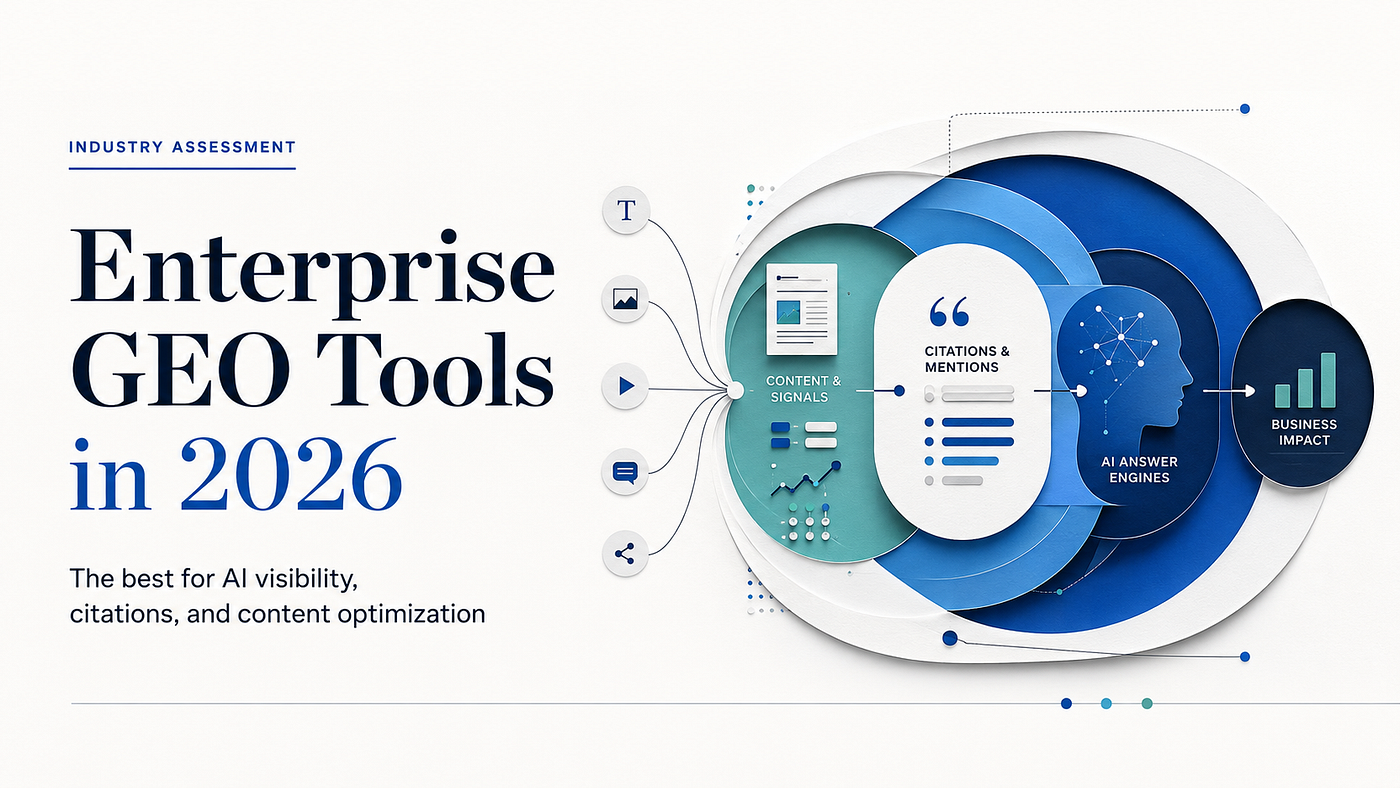
Enterprise GEO Tools in 2026: The Best for AI Visibility, Citations, and Content Optimization
The best enterprise GEO tools in 2026 are Goodie AI, HubSpot AEO, Ahrefs Brand Radar, Scrunch (now part of Sitecore), Peec AI, Profound, AirOps, Bluefish, and Adobe Semrush. Each takes a different position on the problem: closed-loop optimization, CRM-native tracking, search-data depth, agent-readable delivery, monitoring speed, autonomous execution, content engineering, brand accuracy, and suite-scale visibility.
Quick takeaways
- The category consolidated this year: Adobe closed its $1.9 billion Semrush acquisition, Sitecore bought Scrunch for about $225 million, and Profound hit a $1 billion valuation 18 months after founding. Vendor independence is now a procurement question, not a footnote.
- Visibility tracking is table stakes. The 2026 bar is loop closure: research to action to revenue attribution in one system. Per Conductor’s State of AEO/GEO 2026 report, organizations with high AEO maturity are nearly 6x more likely to run a fully integrated platform.
- Engines disagree. ChatGPT and Perplexity overlap on citations less than 1% of the time in Goodie’s data, and AI citations shift 40–60% month over month as models retrain. Two-engine coverage is a partial picture; weekly refresh is a stale one.
- Every tool here fits one of three architectures: closed-loop platforms (Goodie, Profound, Bluefish), suite-embedded modules (HubSpot, Ahrefs, Sitecore-Scrunch, Adobe Semrush), or specialist layers (Peec for monitoring, AirOps for execution). Buy the architecture first, the vendor second.
- Budget reality: entry points run from $50/month to enterprise six figures. Most enterprise stacks land on two tools: one anchor, one execution layer.
Call it GEO, AEO or AI SEO; the job is the same: getting your brand retrieved, cited, and recommended inside the answers that ChatGPT, Gemini, Claude, Perplexity, Copilot, and AI Overviews generate for your buyers. The category stopped being experimental this year, and 94% of CMOs plan to increase AEO investment in 2026, per Conductor’s survey of 250+ digital marketing leaders.
When a category gets a unicorn, two nine-figure acquisitions, and a line item in the Fortune 500 marketing budget within twelve months, the buying question changes. It’s no longer “should we track AI visibility?” The question is which architecture you’re betting on.
How I evaluated this list (and a disclosure)
First, the disclosure: I run Goodie and it sits at number one on this list. You should weigh that exactly as skeptically as you’d weigh any other platform putting themselves number one. What I can offer in exchange is deep knowledge in the GEO space, a transparent bar, applied to every tool here including mine, and honest limitations for each.
The bar has three parts.
Coverage and accuracy. Engines disagree more than most marketers realize. In Goodie’s citation data, ChatGPT and Perplexity overlap on citations less than 1% of the time; Google’s AI Overviews and AI Mode overlap about 13.7%. A tool that tracks two engines is showing you a sliver of the board. And the board moves: Profound’s analysis of 240 million ChatGPT citations found that AI citations shift 40% to 60% month over month as models retrain and source preferences update. Daily refresh cadence and broad engine coverage are not nice-to-haves at enterprise scale.
Loop closure. Monitoring is table stakes. The 2026 bar is whether the platform takes you from prompt research to prioritized action to revenue attribution without exporting a CSV into three other systems. Dashboards that end at “here’s what we see” produce theater, not pipeline.
Enterprise readiness. SOC 2, SSO, multi-market and multi-brand governance, and a vendor that will still exist (or still be independent) in 18 months. Given this year’s M&A wave, that last one is no longer hypothetical.
The three architectures of enterprise GEO
Before the list, a frame that will save you a bad purchase. Every serious tool in this market now fits one of three architectures.
Closed-loop platforms run the full cycle: research, monitoring, optimization, and measurement tied to revenue, in one system. Goodie, Profound, and Bluefish live here. This is where the Conductor data points: integrated platforms correlate with AEO maturity.
Suite-embedded modules bolt AI visibility onto a stack you already own. HubSpot’s AEO product lives next to your CRM. Ahrefs Brand Radar lives next to your SEO data. Semrush now lives inside Adobe; Scrunch now lives inside Sitecore. The pitch is workflow gravity: insights land where work happens.
Specialist layers do one job exceptionally well. Peec is a monitoring layer. AirOps is an execution layer. You pair them with something else.
None of these is wrong. The mistake is buying one architecture while needing another: a Fortune 500 brand running multi-market governance on a monitoring point solution, or a 40-person team paying enterprise platform prices for dashboards nobody operationalizes. Match the architecture to the operating model first, then pick the vendor.
Here are the nine, in order.
1. Goodie AI: the closed-loop AEO platform for enterprise
Goodie AI is an end-to-end AEO platform built around one loop: research, monitor, optimize, measure, tied to revenue. It covers 11+ AI surfaces including ChatGPT, Gemini, Claude, Perplexity, AI Overviews and AI Mode, Copilot, Grok, Meta AI, and DeepSeek, with daily refresh, and it runs on SOC 2-compliant infrastructure built for multi-brand, multi-market enterprises.
What separates Goodie is that the loop actually closes. Prompt Research surfaces the questions your buyers ask AI, mapped to intent and fan-out. Visibility Monitoring shows how every model describes your brand against competitors, down to sentiment and source mix. Optimization Actions convert gaps into prioritized briefs, and Goodie 2.0 introduced function-specific agents built around the jobs AEO teams actually do: surfacing competitive gaps, drafting optimization briefs, and prioritizing which prompts to target, working inside the same workspace as the underlying data.
Three capabilities deserve their own line.
Attribution. Goodie’s Analytics & Attribution connects visibility movement to traffic, leads, and closed revenue, which turns AEO from a brand metric into a P&L conversation. Most tools in this market stop at share of voice; the budget conversation with your CFO doesn’t.
The Agentic Commerce Suite. For commerce brands, Goodie monitors visibility across thousands of SKUs simultaneously, prioritizes optimization opportunities by revenue impact, and connects AI visibility improvements to completed purchases and revenue by SKU. As shopping moves into ChatGPT, Rufus, and AI Mode, SKU-level visibility is becoming the new digital shelf audit.
Agent Analytics. The Crawlers & Agents module shows how AI crawlers and agents actually interact with your site: who’s hitting it, what they can parse, and where retrieval breaks. Most technical AEO failures are invisible until you watch the agents themselves, and this is the layer where you catch them.
The other edge is proprietary research. Goodie’s citation studies (6.1 million social citations analyzed across 10 LLMs in the latest volume, with industry-level granularity) and the 2026 AI Search Traffic Report feed directly into how the platform scores and prioritizes. The recommendations are built on observed model behavior, not folklore.
Notable clients: Unilever, L’Oréal, Sanity, and many leading brands across CPG, SaaS, commerce, and gaming.
Pricing: starts around $399/month; enterprise is custom. Best for: enterprise CMOs, growth and SEO leaders, and eCommerce teams that need multi-market governance, closed-loop workflow, and revenue attribution rather than a dashboard. Limitations: if all you need is lightweight visibility tracking, Goodie is more platform than you require; start with a point solution and graduate later.
2. HubSpot AEO: AI visibility inside the CRM
HubSpot’s AEO product tracks brand visibility across ChatGPT, Gemini, and Perplexity and turns the data into actions executed inside HubSpot itself. The dashboard shows a brand visibility score trending over time, competitive share of voice, prompt-level tracking with the exact responses each engine returned, citation analysis by domain and content type, and prioritized recommendations like creating a new blog post or updating an existing page, right inside HubSpot.
The strategic logic is workflow gravity. If your content, CMS, and pipeline already live in HubSpot, AEO data lands next to the team that acts on it, and AI-sourced leads flow into the same attribution you already trust. HubSpot has also been seeding the category with free instrumentation: an AEO Grader for a quick brand snapshot, and AEO Sensor, launched May 14 as a free public dashboard tracking answer-engine behavior, including a daily Answer Engine
Volatility score and weekly AI-referred traffic data.
The price point is the most aggressive in the category: $50/month after a free trial, including 25 tracked prompts. That changes the market. When the CRM incumbent prices AI visibility like a utility, standalone monitoring-only tools have a problem.
Notable clients: HubSpot hasn’t published a client roster for the AEO product specifically, but the distribution math is the story: it ships into one of the largest CRM install bases in the world, and HubSpot itself is the flagship case study, with its CEO publicly sharing the playbook behind HubSpot’s own AI visibility and leads that convert 3x better.
Pricing: $50/month for 25 prompts; scales with prompt volume. Best for: HubSpot-centric mid-market and enterprise teams that want AEO tracking wired into existing content and pipeline workflows. Limitations: three engines is thin coverage by enterprise standards, and the optimization depth doesn’t yet match the specialists. It’s the right second tool more often than the right only tool.
3. Ahrefs Brand Radar: AI visibility on top of 15 years of search data
Brand Radar is Ahrefs’ AI visibility product, and its unfair advantage is the underlying dataset. It monitors brand visibility across 243M+ monthly prompts derived from real “People Also Ask” data rather than synthetic queries, across six AI platforms (ChatGPT, Perplexity, Gemini, Copilot, Google AI Overviews, and AI Mode) plus YouTube, TikTok, and Reddit. The metrics are clean: mentions, citations, impressions weighted by search volume, and AI Share of Voice.
Two things make it genuinely useful for enterprise teams. First, it isn’t limited to your own brand; you can research any brand, product, region, or person, and it operates independently of standard Ahrefs project limits, which makes it a competitive intelligence weapon, not just a mirror. Second, the social-surface coverage matters more than most buyers realize. In Goodie’s data, social sources now generate 2.31x more citations than owned content; a tracker that ignores YouTube and Reddit is missing the majority of the citation graph.
Notable clients: Ahrefs doesn’t disclose Brand Radar customers by name, but it inherits one of the largest SEO install bases in the industry, and practitioners like Aleyda Solis have publicly endorsed it as one of the most comprehensive ways to understand what drives AI answers.
Pricing: Brand Radar standalone runs $50 to $250/month by prompt volume; individual AI indexes are $199/month each or $699/month for all six, alongside a base Ahrefs subscription starting at $129/month.
Best for: SEO teams already in the Ahrefs ecosystem, and agencies running multi-client intelligence.
Limitations: it’s an intelligence layer more than an operating system. The action and attribution loop is thinner than the closed-loop platforms; expect to pair it with execution elsewhere.
4. Scrunch (a Sitecore company): agent experience at the delivery layer
Scrunch attacked a layer nobody else did: what AI agents actually receive when they hit your site. Its Agent Experience Platform (AXP) creates a machine-readable version of a brand’s website, allowing marketers to deliver content that AI systems can easily interpret without changing the actual site, served at the edge. Add persona-based tracking, hallucination detection on brand claims, and SOC 2 Type II, and you have one of the most technically interesting products in the category.
Then the category’s consolidation wave reached it. Sitecore acquired Scrunch on June 3, pairing Scrunch’s insights, recommendations, and AXP with Sitecore’s AI-powered digital experience platform, in a deal Bloomberg reported at about $225 million. Founder Chris Andrew and the team are staying on, with Andrew continuing as the division’s CEO.
Read the deal two ways. If you run Sitecore, this is excellent news: AEO insight wired directly into the DXP where content gets managed. If you don’t, you’re now buying a module of someone else’s suite, and the roadmap will serve Sitecore’s installed base first. That’s not a criticism; it’s how suite math works. As TechTarget framed it, martech buyers now have to decide between standalone AEO tools and embedded modules inside platforms like Sitecore.
Notable clients: trusted by 500+ leading brands and agencies, now plugged into Sitecore’s enterprise DXP customer base.
Pricing: historically from $250/month for brands and $500/month for agencies, with AXP as an enterprise feature; expect packaging to evolve under Sitecore. Best for: Sitecore customers, and enterprises that want delivery-layer control over what agents ingest. Limitations: independence is gone, and non-Sitecore shops should pressure-test the integration roadmap before committing.
5. Peec AI: the fastest monitoring layer in the market
Peec is a Berlin-built AI search analytics platform that does three things at the prompt level, very cleanly: visibility (how often you appear), position (where in the answer), and sentiment (how favorably), plus the sources shaping each answer. It supports a long list of countries and languages at no extra cost, which matters for multi-market brands more than any feature demo will show you.
The traction is the story. Peec raised a $21 million Series A led by Singular in November, one of the largest Series A rounds in AI search to date, bringing total funding to $29 million, and surpassed $10M ARR sixteen months post-launch while opening its first US office. Entry pricing starts around €89/month.
Notable clients: Axel Springer, Chanel, n8n, ElevenLabs, and TUI, plus Wix; skews European with a fast-growing US book, adding roughly 300 customers per month.
Best for: teams that want clean, fast, multi-market monitoring without enterprise procurement overhead, and European brands that need language coverage the US-built tools treat as an afterthought. Limitations: Peec is monitoring-first. The optimization and attribution layers are early, so plan on pairing it with an execution system. For a lean stack, that’s a feature, not a bug.
6. Profound: the category’s unicorn, betting on autonomous agents
Profound is the best-funded company in this market and the one moving hardest from measurement to execution. Its $96 million Series C at a $1 billion valuation, led by Lightspeed with Sequoia and Kleiner Perkins participating, brought total funding past $155 million. The company serves more than 700 enterprises and says it reaches more than 10 percent of the Fortune 500.
The data assets are real: a 400M+ conversation corpus growing 150M per month, and published research like its citation-latency study, which found a median of 6.81 days to first citation for newly published pages, with 90% cited within 37 days. The strategic bet is Profound Agents: orchestration and automation built directly into the platform, powered natively by its visibility data, so customers no longer export Profound data into separate execution tools.
Notable clients: Target, Figma, Walmart, Ramp, MongoDB, Chime, and U.S. Bank, across more than 700 enterprises.
Pricing: tiers start at $499/month, scaling to $1,499/month for agency plans, with enterprise customization beyond that. Best for: enterprises that want maximum engine coverage, deep prompt intelligence, and an aggressive automation roadmap, with the security posture (SOC 2 Type II) procurement demands. Limitations: it’s a premium spend, and autonomous content agents still need a human taste layer; treat agent output as a draft, not a deliverable. Anyone shipping unreviewed AI content at Fortune 500 scale is volunteering for a brand-safety incident.
7. AirOps: content engineering for the AI search era
AirOps doesn’t compete on monitoring; it competes on throughput. It’s a content engineering platform: a workflow builder with access to 30+ models, spreadsheet-style content operations, human-in-the-loop review gates, brand knowledge bases, and direct publishing into WordPress, Webflow, Contentful, Shopify and others. Once you know what to fix, AirOps is how a lean team fixes five hundred pages without hiring twenty writers.
The market agrees the execution layer is the hard part. AirOps raised a $40 million Series B led by Greylock in November at a $225 million valuation, bringing total funding to $60 million. As one of its investors framed it, monitoring is the easy half; orchestrating high-quality, high-context content workflows is the hard half. Its research arm is producing useful numbers too: the AirOps 2026 State of AI Search found zero-click activity up 2.5x since AI Overviews launched, with roughly 60% of AIO citations coming from URLs outside the top 20 organic results. Sit with that second stat: rankings no longer predict citations.
Notable clients: Ramp, Webflow, Kayak, Klaviyo, and MasterClass.
Best for: content and growth teams scaling proven AEO playbooks across hundreds of pages, refreshes, and clients.
Limitations: there’s a real learning curve, task-based billing makes budgeting lumpy, and the native visibility tracking is the weakest part of the product. Pair it with a dedicated monitoring or closed-loop platform.
8. Bluefish: brand accuracy and agentic marketing for the Fortune 500
Bluefish positions itself as the Agentic Marketing Platform for the largest brands on earth, and the roster backs it up. Its $43 million Series B in April, co-led by Threshold Ventures and NEA with Amex Ventures, TIAA Ventures, and Salesforce Ventures participating, brought total funding to $68 million, with 10% of the Fortune 500 engaged.
The differentiated muscle is accuracy and control. Bluefish built Custom AI Audiences for granular management of how AI portrays products to different segments, covers commerce surfaces like Amazon’s Rufus alongside ChatGPT, Claude, and Perplexity, and in May launched an AI Accuracy module that monitors hallucinations and inaccurate brand mentions in real time. For regulated and reputation-sensitive categories (finance, pharma, CPG), the question isn’t just “are we visible,” it’s “is what AI says about us true.” That’s the problem Bluefish is built around.
Notable clients: Adidas, American Express, Hearst, and Ulta Beauty, plus Tishman Speyer; over 80% of its customer base sits in the Fortune 500.
Best for: Fortune 500 brand, comms, and search teams where misrepresentation risk is a board-level concern, especially across retail and agentic commerce surfaces.
Limitations: it’s enterprise-only by design; mid-market teams will find the engagement model heavy. And as with any vendor in this category, verify current compliance certifications during procurement rather than assuming them.
9. Adobe Semrush: the biggest bet in the category
Adobe made the loudest statement in the market this year: a $1.9 billion all-cash acquisition of Semrush at $12 per share, folding its tools into Adobe’s Digital Experience business to track visibility across search and AI platforms. The deal closed in late April after clearing regulatory review, putting Semrush’s search intelligence inside Adobe’s customer experience platform.
What Adobe bought is scale and history: seventeen years of web crawling and competitive intelligence, nearly 30 million users, and 2025 revenue projected around $444 million, up 18% year over year. The integration plan runs through Adobe Experience Manager, Adobe Analytics, and the newer Brand Concierge offering, alongside Adobe’s own LLM Optimizer. The demand signal behind the deal is hard to argue with: Adobe Analytics measured traffic from generative AI sources to U.S. retail sites up 1,200% year over year in October.
For enterprise buyers, this is the suite-embedded thesis at maximum scale: SEO, GEO, content, analytics, and personalization under one vendor. The open question is what consolidation does to the product. The SEO community has pointed to Adobe’s pricing model and a track record where innovation slowed at acquired platforms, with consolidation often leading to enterprise-level pricing and fewer choices for smaller teams.
Notable clients: Adobe hasn’t named joint customers yet, but the combined footprint is the point: Semrush brings nearly 30 million users into an Experience Cloud base that already includes most large enterprise marketing organizations.
Pricing: Semrush plans currently start in the low hundreds per month; expect enterprise packaging to evolve under Adobe.
Best for: Adobe Experience Cloud enterprises that want SEO and AI visibility unified with their content and analytics stack.
Limitations: integration periods are slow by nature, pricing direction is uncertain, and teams outside the Adobe ecosystem get suite gravity without the suite benefits.
How to build the stack
Three honest configurations, depending on where you are.
If you’re an enterprise running AEO as a revenue program: anchor on one closed-loop platform (Goodie, Profound, or Bluefish, depending on whether your center of gravity is revenue attribution, automation, or brand accuracy). Add Ahrefs Brand Radar if your SEO team already lives there. Resist the urge to buy four overlapping monitors; the Conductor data is blunt about integrated platforms correlating with maturity.
If you’re mid-market with a strong content engine: Peec or HubSpot AEO for the eyes, AirOps for the hands. Total spend lands under most single enterprise licenses, and you keep optionality while the market consolidates.
If you’re suite-committed: HubSpot, Adobe, and Sitecore shops now have native answers. Use them, but benchmark their coverage against a specialist quarterly. Embedded modules optimize for the suite’s roadmap, not for your citation share.
Whatever you buy, hold every vendor to the same three questions from the top of this piece: how many engines, how fresh; does the loop close; and will this company exist, independently, when your contract renews. Three of the nine tools on this list changed hands or hit unicorn status in the last seven months. The music hasn’t stopped.
FAQs
What’s the difference between GEO, AEO, and SEO?
GEO (Generative Engine Optimization) and AEO (Answer Engine Optimization) describe the same discipline: earning citations and recommendations inside AI-generated answers. SEO earns rankings on a results page. The mechanics differ because AI answers are assembled from retrieved chunks across many surfaces (your site, editorial, reviews, Reddit, YouTube), not from a single ranked page. SEO remains the foundation; GEO is the new pipeline on top: retrieved, cited, trusted.
How much do enterprise GEO tools cost in 2026?
Entry points range from $50/month (HubSpot) to roughly €89–$499/month for specialist and closed-loop platforms, with enterprise contracts running well into five and six figures annually, before agency or in-house labor.
Do I need more than one tool?
Usually two: an intelligence or closed-loop anchor, plus an execution layer if your anchor doesn’t include one. More than three and you’re paying to reconcile dashboards.
Why does AI visibility fluctuate so much?
Citations shift 40–60% month over month as models retrain and update source preferences, and engines barely agree with each other on sources. This is why daily refresh, multi-engine coverage, and trend-level reporting matter more than any single snapshot.
What KPIs should an enterprise GEO program track?
Track in two layers. Probabilistic metrics tell you what models think of you: visibility score, share of voice against competitors, citation share, and sentiment by engine and market. Deterministic metrics tell you what happened to the business: AI referral traffic, AI-sourced leads, conversion rates, and attributed revenue. Report both; the first layer is leading, the second is what your CFO funds.
How long until GEO efforts show results?
Faster than most teams expect. Profound’s analysis of roughly 900 newly published pages found a median of 6.81 days to first citation by ChatGPT or Claude, with 90% of cited pages earning their first citation within 37 days. Product data optimizations typically show measurable visibility improvements within 2–4 weeks as AI platforms refresh their knowledge. Entity-level work (Wikipedia, review platforms, earned media) compounds over one to two quarters.
Can our existing SEO team own GEO, or do we need a new function?
Same team, new craft. Technical SEO fundamentals (crawlability, structure, schema, speed) are the foundation of retrieval, so your SEO team is the right starting bench. What changes is the operating scope: GEO spans owned content, earned media, review platforms, and social surfaces, so the team needs a working loop with PR and social rather than a silo. The pipeline upgrades from crawl, index, rank to retrieved, cited, trusted; the discipline transfers.
Should we wait for the market to consolidate before buying?
No. Waiting costs you the compounding window while competitors build citation share, and switching costs in this category are low compared to a CRM or CDP. Buy for an 18-month horizon, favor vendors with clean data export, and revisit at renewal. The bigger risk in 2026 is invisibility, not a stranded license.
Can GEO actually be attributed to revenue?
Yes, with the right plumbing: AI referral segmentation, post-conversion surveys, and platform-level attribution. The conversion quality justifies the work; across the datasets we’ve analyzed at Goodie and NoGood, AI-sourced leads consistently convert 2x or better against traditional search.
메타데이터
- post_id
- ea89ab079c3e
- slug
- enterprise-geo-tools-in-2026-best-for-ai-visibility-citations-content-optimization-ea89ab079c3e
- url
- https://medium.com/@bermawy/enterprise-geo-tools-in-2026-best-for-ai-visibility-citations-content-optimization-ea89ab079c3e
- canonical_url
- https://medium.com/@bermawy/enterprise-geo-tools-in-2026-best-for-ai-visibility-citations-content-optimization-ea89ab079c3e
- author_url
- https://medium.com/@bermawy
- status
- ok
- fetched_at
- 2026-06-15 20:49:13




