Scaling Product Search with Agentic AI
It is time to pivot from a Logic-Based Search Engine to a Reasoning Engine powered by Large Language Models (LLMs).
Scaling Product Search with Agentic AI
Why are we doing this?
The traditional approach to product search and recommendation is reaching a breaking point in implementation, particularly in complex, large-scale procurement case. When building custom-tailored recommendations for enterprise needs, we encounter a Combinatorial Explosion.
Every customer requirement involves dozens of independent variables: performance thresholds, budgetary constraints, specific use cases, energy efficiency, and technical compatibility. Each factor carries a different weight depending on the context. Attempting to map every possible permutation using traditional “If-Else” logic results in a complex codebase that is impossible to design, impossible to audit, and impossible to maintain.
Furthermore, relying on the traditional waterfall cycle — where business teams spend months finalizing decision logic and engineering teams translate it into execution — is too slow to accommodate modern market shifts. By the time the logic is deployed, the product landscape has already changed.
It is time to pivot from a Logic-Based Engine to a Reasoning Engine powered by Large Language Models (LLMs).
Value Drivers & Innovation Strategy
This project is defined by its ability to move from standard requirements to a decentralized requirements definition that surfaces highly relevant product recommendations.
The Value Drivers
- Incremental Revenue & Increased Margin: By aligning recommendations with real-time Strategic Sales Policies, we prioritize high-margin inventory and promote strategically significant configurations.
- Increased Productivity: Automating the transformation of user intent into comprehensive prompts that nudge customers to anticipate their technical needs several steps ahead.
- Reduced Tech Debt: Replacing thousands of hard-coded rules with a decoupled agentic architecture ensures long-term system stability and architectural quality.
The Innovation Driver (Unique Differentiation)
Unlike traditional competitors who solve the problem through increasingly complex “filters,” we are delivering a digital Product Specialist. This agent prompts customers to think comprehensively about their needs and maps their criteria to our product portfolio with transparent, solid reasoning.
3. The Solution: Agentic Multi-Modal Ingestion
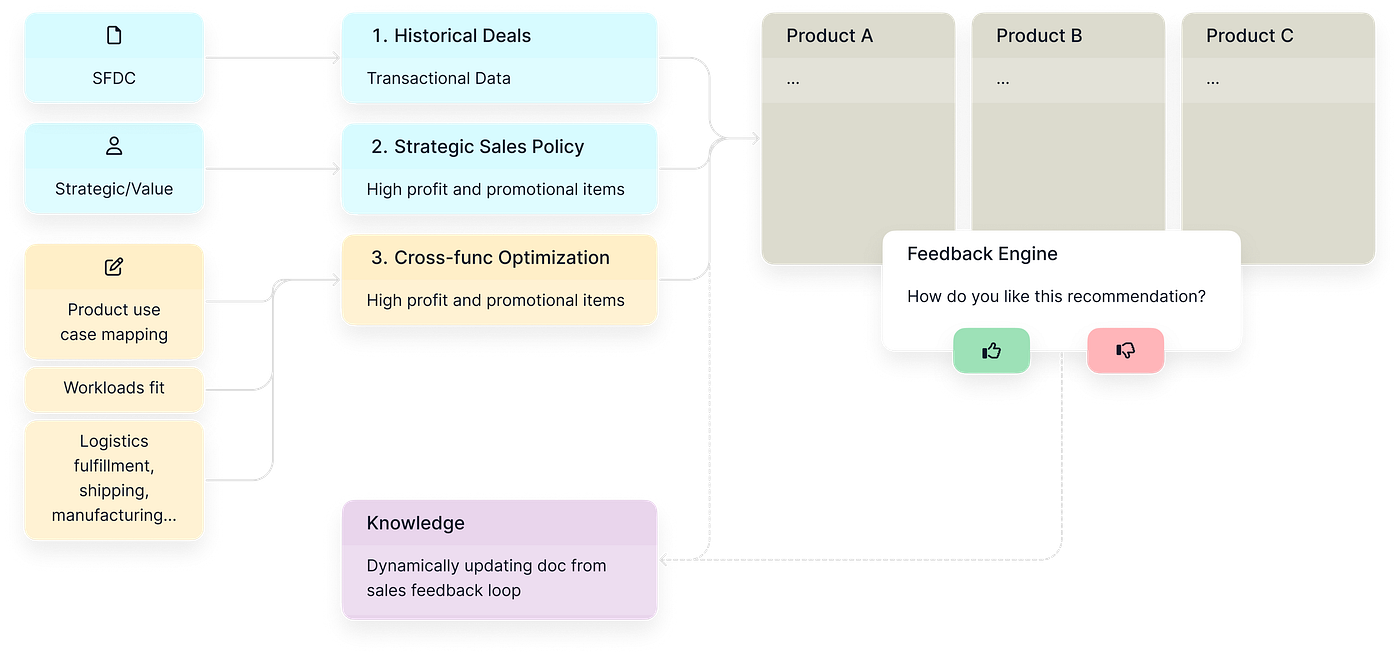
To navigate this complexity, we leverage LLMs not merely as a conversational interface, but as a sophisticated Agentic Inference Layer. This layer processes natural language intent and orchestrates coordination between Multiple Sources of Truth.
In this agentic framework, the AI acts as a digital Product Specialist. It consults with various departmental “experts” (Product, Engineering, Logistics) to ensure every recommendation is operationally viable, technically sound, and strategically aligned.
I. Historical Transactional Data (The Predictive Baseline)
This provides the foundational “Source of Truth” for sales patterns. By analyzing historical transaction telemetry, the AI identifies the “proven path” — understanding which products have successfully solved specific use cases in the past. This anchors the recommendation when similar use cases arise.
II. Strategic Sales Policy (The Business Governance Layer)
This layer allows leadership to inject real-time priorities directly into the model. For instance, if the organization aims to prioritize a high-performance line like the “EG1” for customers who haven’t expressed strict budget constraints, the AI can apply this strategic bias dynamically.
III. Cross-Functional Optimization (The Domain Intelligence Layer)
This solves the internal customer problem of departmental silos. Rather than weighting requirements from each department and hard-coding static constraints, we empower specialized teams to “tune” the engine through Parametric Profiling:
- Product Teams: Define granular use-case alignment (e.g., profiling a model’s efficiency for AI workloads vs. VDI).
- Manufacturing & Supply Chain: Inject inventory status and lead-time telemetry to prioritize high-availability models.
- Monetization: Supply real-time promotional data to influence the “Best Value” calculation.
IV. The Dynamic Knowledge Document (The Continuous Learning Loop)
To ensure the system matures, we incorporate a feedback mechanism. As sales teams and customers interact with the engine, they provide positive or negative reinforcement (Thumbs Up/Down). These nuances are extracted and stored, transforming the AI into an evolving asset that builds a “Learning Moat” by capturing the “Institutional Wisdom” of the sales force.
4. Why This Architecture Wins
By moving to an agentic workflow, we unlock three critical business advantages:
- Decoupled Maintainability: Departmental teams (Logistics, Product, Sales) can update their rules and preferences independently. The core algorithm remains untouched while the data it reasons upon stays current.
- Granular Tunability: Business teams can “boost” or “throttle” specific variables as a whole — based on profit margins or product priorities — instantly as market conditions fluctuate.
- Context-Aware Inference: The system moves away from stale, hard-coded rules toward a reasoning model that processes current telemetry to provide recommendations based on the facts of the present moment.
- Competitive Moat: The Dynamic Knowledge Document ensures that our solution becomes exponentially more difficult for competitors to replicate with every user interaction.
5. Success Metrics & Business Impact
What does success look like? We consider the project successful when we achieve the following strategic milestones:
- Accelerated Deployment Velocity: Resolving the bottleneck of product discovery to successfully launch and unblock the CPQ (Configure, Price, Quote) product search functionality.
- Cross-Functional Adoption & Consensus: Establishing a self-sustaining recommendation ecosystem that secures universal buy-in from all business stakeholders.
- Optimized Recommendation Fidelity: Achieving measurable improvements in “First-Time Right” accuracy based on direct sales field feedback.
- Performance-Centric Measurement: Success will be quantified through the compounding growth of the Dynamic Knowledge Base, a significant reduction in manual technical overrides, and a measurable lift in captured share for strategically prioritized products.
Summary: We have evolved beyond the limitations of the search bar. We have built an Agentic Specialist that listens to the customer, respects the corporate strategy, understands operational reality, and — most importantly — never forgets a lesson learned.
메타데이터
- post_id
- ea970ccd8735
- slug
- scaling-product-search-with-agentic-ai-ea970ccd8735
- url
- https://medium.com/@hanjing/scaling-product-search-with-agentic-ai-ea970ccd8735
- canonical_url
- https://medium.com/@hanjing/scaling-product-search-with-agentic-ai-ea970ccd8735
- author_url
- https://medium.com/@hanjing
- status
- ok
- fetched_at
- 2026-07-27 15:46:57