Reducing the Accidental Complexity of CQRS and Event‑Sourced Systems using DeQL
Command Query Responsibility Segregation (CQRS) and Event Sourcing are proven architectural patterns. When applied well, they enable highly…
Reducing the Accidental Complexity of CQRS and Event‑Sourced Systems using DeQL
Photo by Marina Marcato on Unsplash
Command Query Responsibility Segregation (CQRS) and Event Sourcing are proven architectural patterns. When applied well, they enable highly scalable, auditable, and high‑performance systems. Yet despite their benefits, many teams hesitate to adopt them — or struggle to sustain them in production.
The reason is rarely a lack of theoretical understanding. It’s the complexity tax that accumulates over time.
Boilerplate grows. Business rules become buried in imperative code. Commands, events, and projections quietly drift out of alignment.
Most CQRS implementations don’t fail outright. Instead, they become fragile, expensive to evolve, and difficult to reason about — especially as domains change.
This article introduces DeQL, a declarative approach designed to simplify CQRS and Event‑Sourced systems end‑to‑end by making both decisions and projections first‑class, explicit artifacts. Inspections allow instant replay and create disposable projections
Where CQRS Complexity Really Comes From ?
A recurring pattern appears across many real‑world CQRS systems:
- Some approaches make the command and decision side simple and expressive — but rely on complex, hand‑coded projection pipelines.
- Others make read models easy to build and query — while pushing business rules into deeply imperative command handlers.
In other words, one side gets simpler while the other becomes harder.
The complexity isn’t eliminated; it’s relocated.
Over time, this leads to systems where:
- Validation logic is scattered across handlers and services
- Projection bugs appear only after deployment
- Testing requires full infrastructure and event streams
- Understanding system behavior demands reading large amounts of glue code
The challenge is not CQRS itself — it’s how system behavior is modeled and expressed.
A Declarative Alternative
DeQL (Decision Query Language) takes a different approach.
Instead of treating CQRS behavior as something inferred from code structure, DeQL treats it as something declared explicitly. The system is described as a specification that the execution engine can interpret directly.s
At its core, DeQL is built around three ideas:
- Decisions are first‑class
- Projections are first‑class
- Behavior should be inspectable before execution
Together, these ideas reduce incidental complexity and make system behavior easier to reason about, validate, and evolve.
First‑Class Decisions
In many CQRS implementations, business rules are embedded in imperative code paths: conditionals, guards, orchestration logic, and handler chains.
DeQL expresses business behavior using guarded decisions.
A decision declares:
- Which command it responds to
- What state it evaluates
- Under what conditions it is allowed to proceed
- Which event it produces
For example, a rule such as “a wallet can only be debited if the balance is sufficient” is expressed directly as a condition:
WHERE balance >= :amountIf the guard passes, the decision emits an event. If it fails, the decision is rejected — explicitly and predictably.
This approach makes business intent visible in the model itself, rather than implicit in imperative control flow.
First‑Class Projections
Projections are often where CQRS systems quietly accumulate the most complexity.
They are frequently:
- Hand‑wired through custom event handlers
- Difficult to replay or reset
- Tightly coupled to runtime infrastructure
- Hard to validate outside production data
In DeQL, projections are declared, not assembled imperatively.
A projection describes:
- Which events it consumes
- How those events are transformed into read‑side state
- How that state is shaped for querying
Because projections are declarative:
- They can be rebuilt deterministically
- They can be discarded and recreated safely
- Their behavior is independent of execution order and handlers
This makes projections easier to reason about and dramatically lowers the cost of change.
Inspection Instead of Guesswork
One of the most expensive parts of CQRS systems is validation.
Teams often rely on:
- Unit tests that mock large portions of behavior
- Integration tests that require full infrastructure
- Post‑deployment observation to understand real outcomes
DeQL introduces an inspection workflow.
Using INSPECT, teams can:
- Simulate decisions against test datasets
- Run projections using hypothetical event streams
- Observe outcomes without writing events or mutating state
Inspection runs in any environment — including production — without side effects.
This allows teams to validate behavior before execution, not after something goes wrong.
From Definition to Execution
A DeQL‑modeled system follows a clear lifecycle:
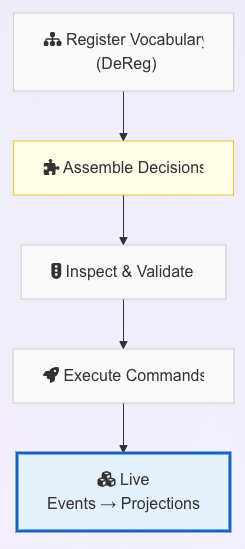
- Vocabulary is registered Aggregates, commands, events, decisions, and projections are defined explicitly.
- Decisions are assembled Guards, state derivation, and event emission rules are composed declaratively.
- Behavior is inspected Decisions and projections are simulated using data without side effects.
- Commands are executed Validated decisions produce immutable events.
- Projections materialize Events flow into read models that can always be replayed or replaced.
This separation between definition, inspection, and execution keeps system behavior transparent and auditable throughout its lifecycle.
Templates for Consistency and Speed
While DeQL can be used entirely declaratively, it also supports templates.
Templates act as reusable blueprints for common CQRS patterns. Applying a template expands into a complete, consistent set of aggregates, commands, events, decisions, and default projections.
This enables teams to:
- Standardize modeling patterns
- Reduce repetitive declarations
- Onboard new domains quickly
- Maintain consistency across services
Templates accelerate development without hiding behavior or introducing magic.
A Stable Foundation, Not a Framework Lock‑In
DeQL is not a framework that dictates:
- Programming language
- Runtime technology
- Storage engine
- Messaging infrastructure
It focuses on structure and intent, not enforcement through code inheritance or lifecycle hooks.
By remaining declarative and spec‑driven, DeQL complements existing stacks and allows teams to choose how and where execution happens.
Why This Matters
CQRS and Event Sourcing are not inherently complex — but unstructured expression of their behavior is.
By making decisions and projections explicit, inspectable, and declarative, DeQL replaces accidental complexity with clarity.
Teams can:
- Focus on domain behavior instead of plumbing
- Validate outcomes before they reach production
- Evolve systems without fear of hidden coupling
- Treat architecture as a living specification
Learn More and Get Involved
DeQL is being developed openly, with a focus on practical applicability and real‑world feedback.
If you’re working with CQRS or Event‑Sourced systems — and want a simpler, more transparent way to model behavior — you’re invited to explore the specification and examples.
👉 Explore DeQL and its documentation: https://deql-lang.github.io/deql-lang/
Whether you’re evaluating the approach, experimenting with implementations, or contributing ideas to the spec, your input is welcome.
메타데이터
- post_id
- ea974a6f1b9a
- slug
- reducing-the-accidental-complexity-of-cqrs-and-event-sourced-systems-using-deql-ea974a6f1b9a
- url
- https://medium.com/@gmkumar2005/reducing-the-accidental-complexity-of-cqrs-and-event-sourced-systems-using-deql-ea974a6f1b9a
- canonical_url
- https://medium.com/@gmkumar2005/reducing-the-accidental-complexity-of-cqrs-and-event-sourced-systems-using-deql-ea974a6f1b9a
- author_url
- https://medium.com/@gmkumar2005
- status
- ok
- fetched_at
- 2026-07-11 07:38:02