Rooted in Red: What Chinese New Year Taught a Sicilian in Singapore.
The Red Season: What Chinese New Year in Singapore Taught Me .
Rooted in Red: What Chinese New Year Taught a Sicilian in Singapore.
The Red Season: What Chinese New Year in Singapore Taught Me .
By Giovanni Mannino

Photo by Jiachen Lin on Unsplash
Singapore changes personality during Chinese New Year.
The city doesn’t whisper celebration. It declares it. Lanterns stretch across Chinatown. Supermarkets glow in red and gold. Mandarin oranges stack in pyramids like edible promises. Office lobbies suddenly become shrines to prosperity. Even the air feels charged with anticipation, as if everyone is collectively holding their breath before a fresh beginning.
The first year I experienced the Chinese New Year here, I observed it like an outsider. I was fascinated, slightly overwhelmed, and honestly unsure where I stood in it. I am Sicilian. My calendar was built around Christmas feasts, Easter processions, and August Ferragosto heat. Lunar cycles were not part of my cultural vocabulary. But Singapore teaches you quickly: if you live here, you don’t spectate. You participate.
Over the years, Chinese New Year stopped being something I watched and became something I lived. It reshaped how I think about food, business, ritual, and reinvention. This year, it did something even deeper. It pushed me to rebuild.
Ritual as Strategy, Not Superstition. From the outside, CNY can look like a collection of symbols: red packets, lion dances, decorative couplets, endless cookies. But once you pay attention, you realise it is structured psychology. Homes are cleaned thoroughly before the new year to sweep away bad luck. Debts are settled. Haircuts are timed. New clothes are bought. People consciously reset their environment.
It is not superstition. It is intentional design.
In Sicily, we also believe in the power of symbolic gestures. We bring sweets to celebrate births. We carry pastries to someone’s home when visiting. Food marks transitions. But what I learned in Singapore is that symbolism can be systematic. It can be embedded in the calendar. It can become part of the economic rhythm. Chinese New Year is a national reset button. And as an entrepreneur, that fascinated me.
The First Yu Sheng That Changed Me.
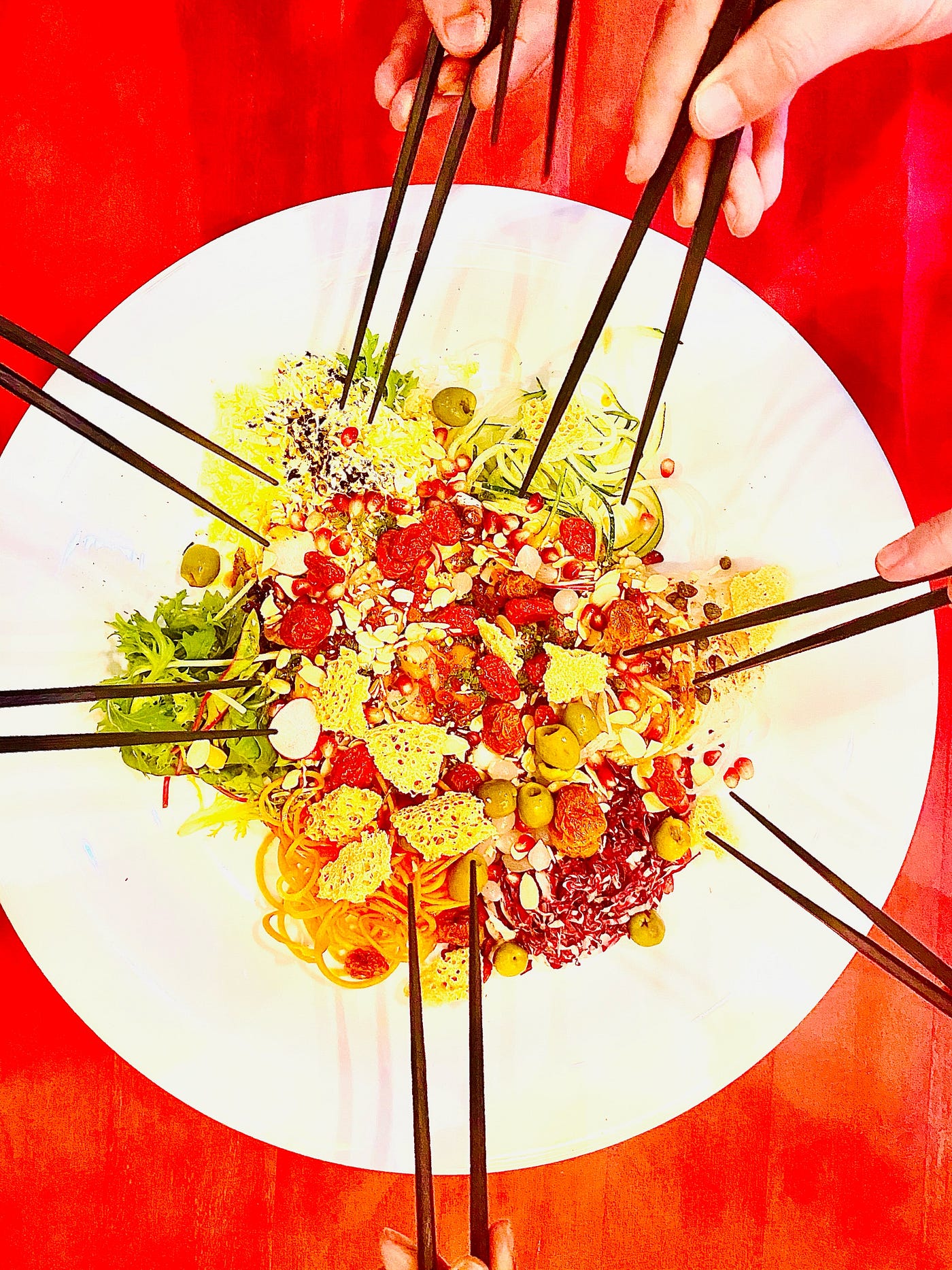

Photo my own personal collection G. Mannino
My first proper Yu Sheng toss took placein a professional setting. I stood in a dining room, chopsticks in hand, surrounded by guests who were laughing loudly and shouting phrases I was still trying to pronounce correctly. Yu Sheng, also called Lo Hei, is the raw-fish prosperity salad everyone tosses together while making auspicious wishes. The higher you toss, the greater the prosperity.
It is chaotic. It is messy. It is loud.
At first, I thought it was theatrical.
Then I understood something subtle.
No one tosses alone.
Prosperity here is communal. In Mediterranean culture, we gather around tables. We argue, we toast, we eat loudly. But Yu Sheng adds another dimension: it forces participation. You cannot stay silent. You cannot be passive. You must speak abundance into existence. That hit me harder than I expected. As someone who has reinvented himself multiple times, I realised I had often tried to rebuild in isolation. Chinese New Year reminded me that growth is amplified in a community. Sicily Meets Singapore at Gattopardo Ristorante di Mare. When I was at Gattopardo, I faced a question every foreign chef in Singapore eventually confronts: do you adapt, or do you stay purist?
Chinese New Year season forced that decision.
We could have ignored it. Stayed strictly Sicilian. Continued serving our menu as if the city outside wasn’t celebrating. But that would have been arrogance disguised as authenticity.
Instead, we created a Sicilian interpretation of Yu Sheng. We used Mediterranean ingredients: orange zest, toasted almonds, capers, bottarga, and extra virgin olive oil. The structure remained. The spirit remained. The communal tossing remained.
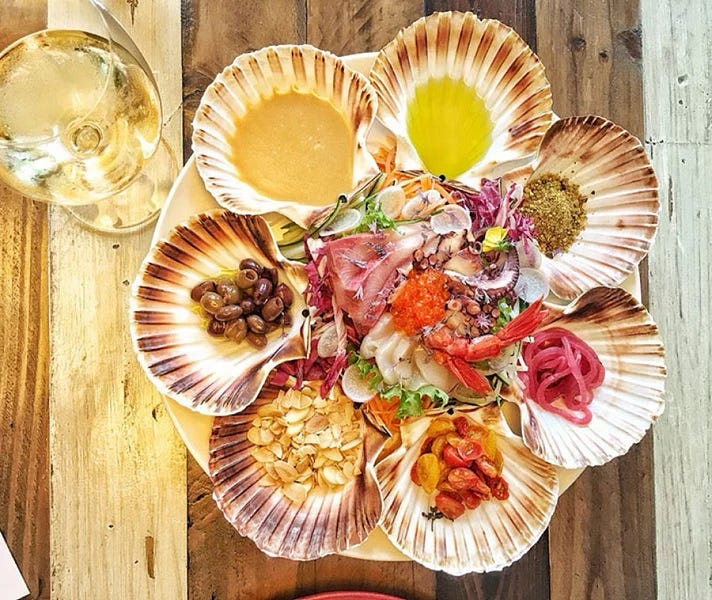
Photo by G. Mannino Mediterranean. Yu Sheng
What changed was the language of flavour. And something unexpected happened. Guests didn’t see it as appropriation. They saw it as respect. That season solved a quiet problem I had been wrestling with: how do you remain rooted in your identity while honouring the culture you live in? The answer is not dilution. It is dialogue.
The Year I Decided to Sell Biscuits
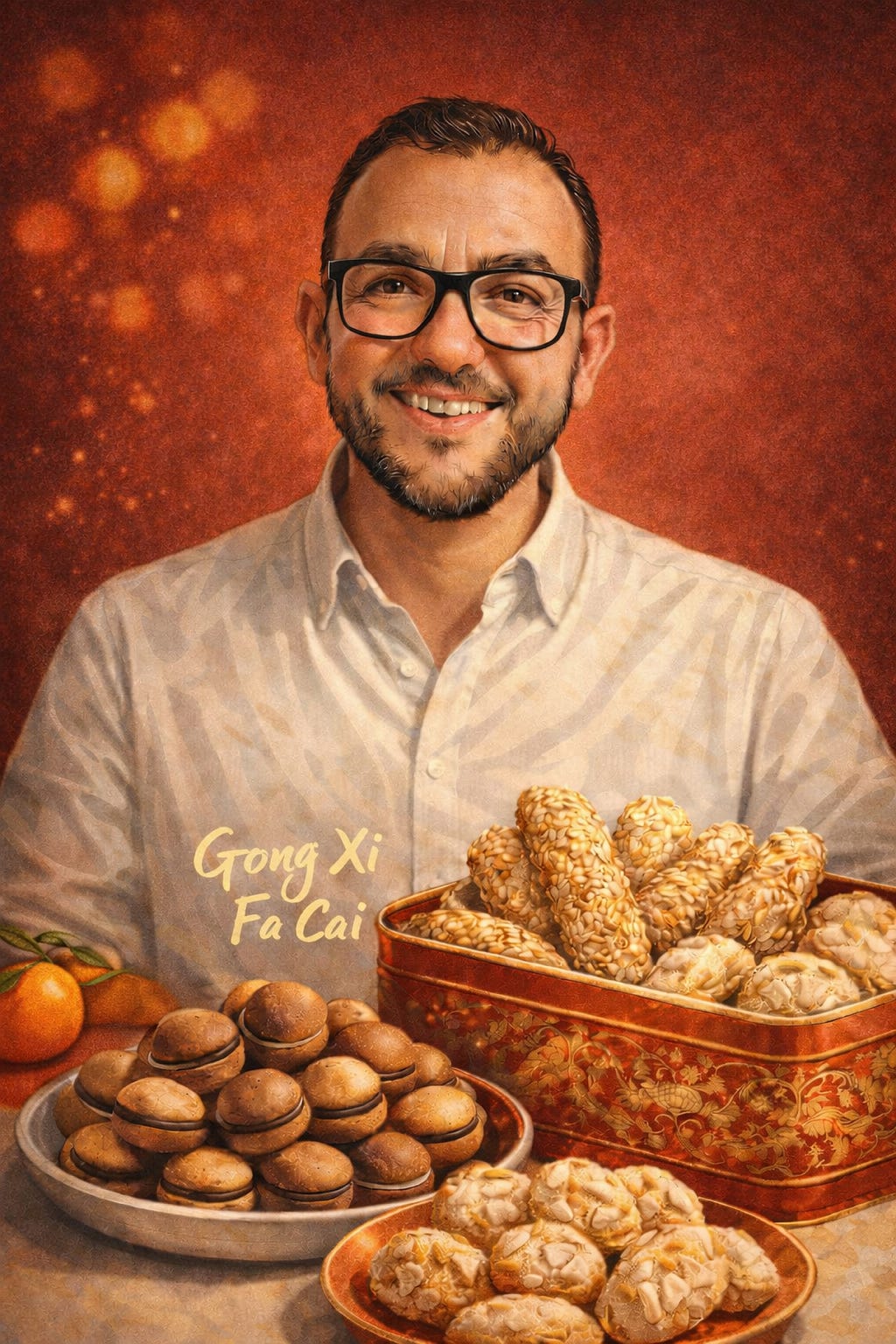
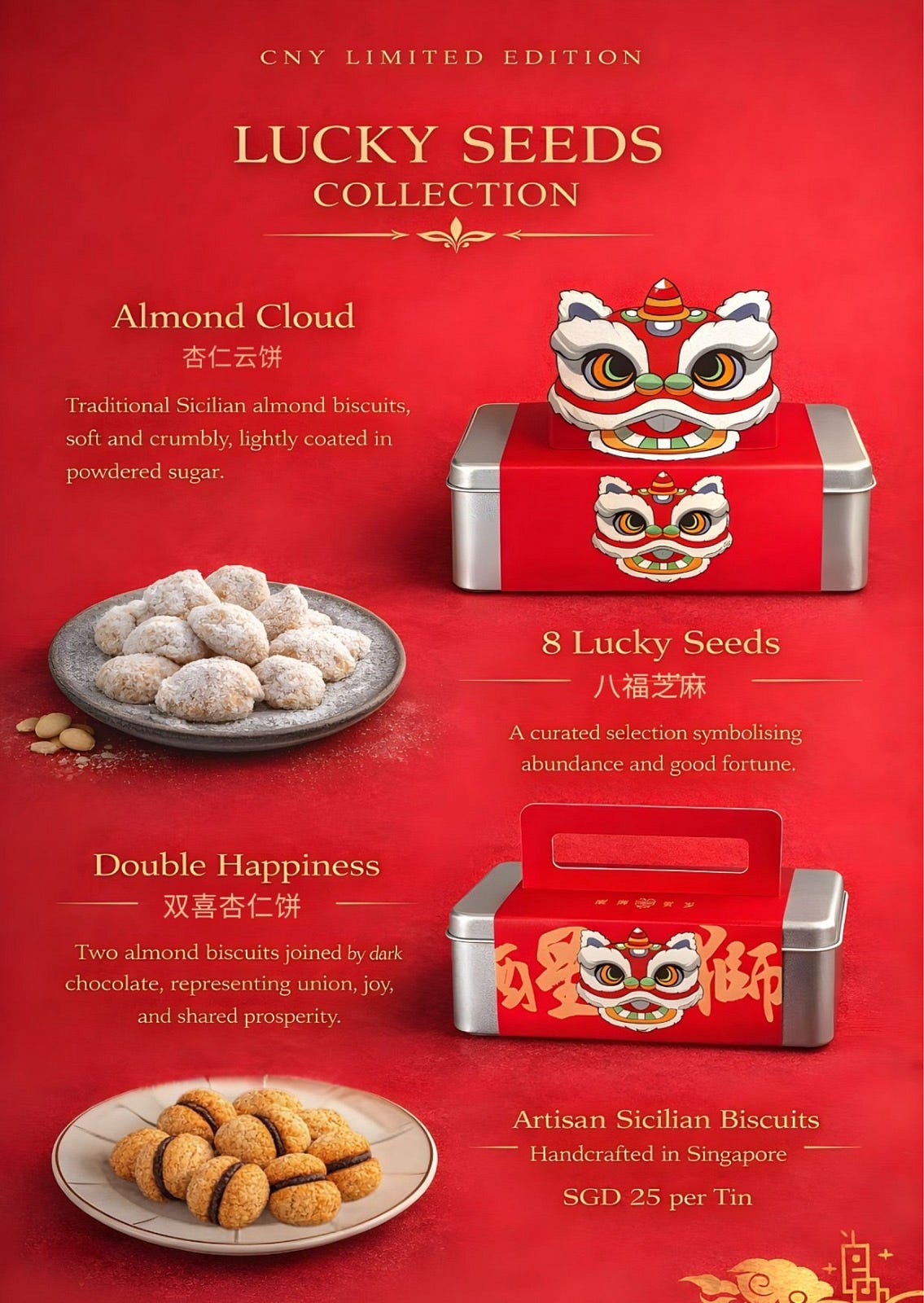
My Artwork for CNY Biscuits
This year felt different. After closing companies, restructuring my professional identity, and navigating a health scare that forced me to slow down, I found myself in a new chapter. Chinese New Year arrived again, as it always does, with its demand for renewal. And I decided to bake. Not for a restaurant. Not for a corporate order. Not under a luxury dining concept. For myself.
I made almond biscuits that the nuns have been baking in Sicily since ancient times, with only 3 ingredients: almond flour, sugar, and egg white; Reginelle with sesame seeds, a very traditional bakery biscuit great with milk, coffee or tea; and Baci di dama. Classic Sicilian recipes. Recipes that carry childhood memories. Recipes that smell like my mother’s kitchen.
But I packaged them in red and gold.
Why?
Because CNY gifting culture aligns perfectly with Mediterranean hospitality. In both cultures, you never visit someone empty-handed. Food is not consumption. It is a connection. Selling those biscuit tins was not just a commercial move. It was symbolic. It marked my shift from operating large systems to creating something small, intentional, and personal. The problem I needed to solve was not financial.
It was identity.
Who am I when I am not behind a major restaurant brand?
Who am I when I scale down?
The answer came in flour and sesame seeds.
Chinese New Year teaches three business lessons that Western entrepreneurs often ignore. First, anticipation is powerful. The buildup matters as much as the event itself. Decorations go up early. Marketing begins months in advance. The psychological runway is long.
Second, scarcity drives value. Limited seasonal products are not seen as manipulative. They are expected. They are part of the rhythm.
Third, community amplifies growth. You don’t celebrate privately. You visit. You exchange. You gift.
When I launched my biscuit tins this year, I applied these lessons deliberately. I spoke about them early. I limited batches. I emphasised gifting over personal consumption.And something shifted.
I wasn’t selling cookies.I was selling participation in a ritual.
This season also forced me to confront something uncomfortable. Reinvention is romantic in theory. In practice, it feels unstable.
Chinese New Year says: clean the house, clear the debts, reset the energy.
But what if the clutter is internal?
What if the debt is emotional?
This year, while the city was decorating, I was reflecting. I was questioning past decisions, past ambitions, past versions of myself. The noise of lion dances outside shophouses contrasted with the quiet work I was doing internally. And that contrast was healing. Because CNY is loud externally but disciplined internally. You don’t just celebrate. You prepare.
Being Mediterranean in Singapore has never meant abandoning my roots. It has meant expanding them. I say “Huat ah” with an accent. I drizzle olive oil where others might not expect it. I bake sesame cookies and set them in red tins beside pineapple tarts. And every year, the red season reminds me that reinvention is not betrayal. It is survival. Chinese New Year is not about luck. It is about agency. You choose to reset. You choose to gather.
You choose to gift.
You choose to begin again.
And this year, I chose to rebuild through something simple: biscuits, ritual, community. That decision solved something deeper than a business problem.It reminded me that no matter how many times you pivot, no matter how many chapters you close, you can always intentionally mark a new beginning. The calendar will give you the excuse.
The culture will give you the structure. But the courage must come from you.
To more soul, less hustle.
Mediterranean Rebel
Happy new Years of the Horse
메타데이터
- post_id
- ea9cc284d5ae
- slug
- rooted-in-red-what-chinese-new-year-taught-a-sicilian-in-singapore-ea9cc284d5ae
- url
- https://medium.com/write-a-catalyst/rooted-in-red-what-chinese-new-year-taught-a-sicilian-in-singapore-ea9cc284d5ae
- canonical_url
- https://medium.com/write-a-catalyst/rooted-in-red-what-chinese-new-year-taught-a-sicilian-in-singapore-ea9cc284d5ae
- author_url
- https://medium.com/@gianniwrite
- status
- ok
- fetched_at
- 2026-07-13 15:35:31