How Small Recruiting Agencies Beat Bigger Firms (By Turning Every Screen Into an Asset)
Your screening work is producing valuable data you’re throwing away — here’s how to make it compound.
How Small Recruiting Agencies Beat Bigger Firms (By Turning Every Screen Into an Asset)
Your screening work is producing valuable data you’re throwing away — here’s how to make it compound.
If you run a small recruiting agency, you already know you can’t win a headcount war against a firm with three hundred consultants. You can’t match the brand budget, the office footprint, or the army of sourcers.
But there’s something your size makes easier, not harder: turning every search you run into an asset that makes the next search faster. Most agencies treat screening as exhaust — effort spent, candidates placed or rejected, files forgotten. The agencies that pull ahead treat it as accumulation.
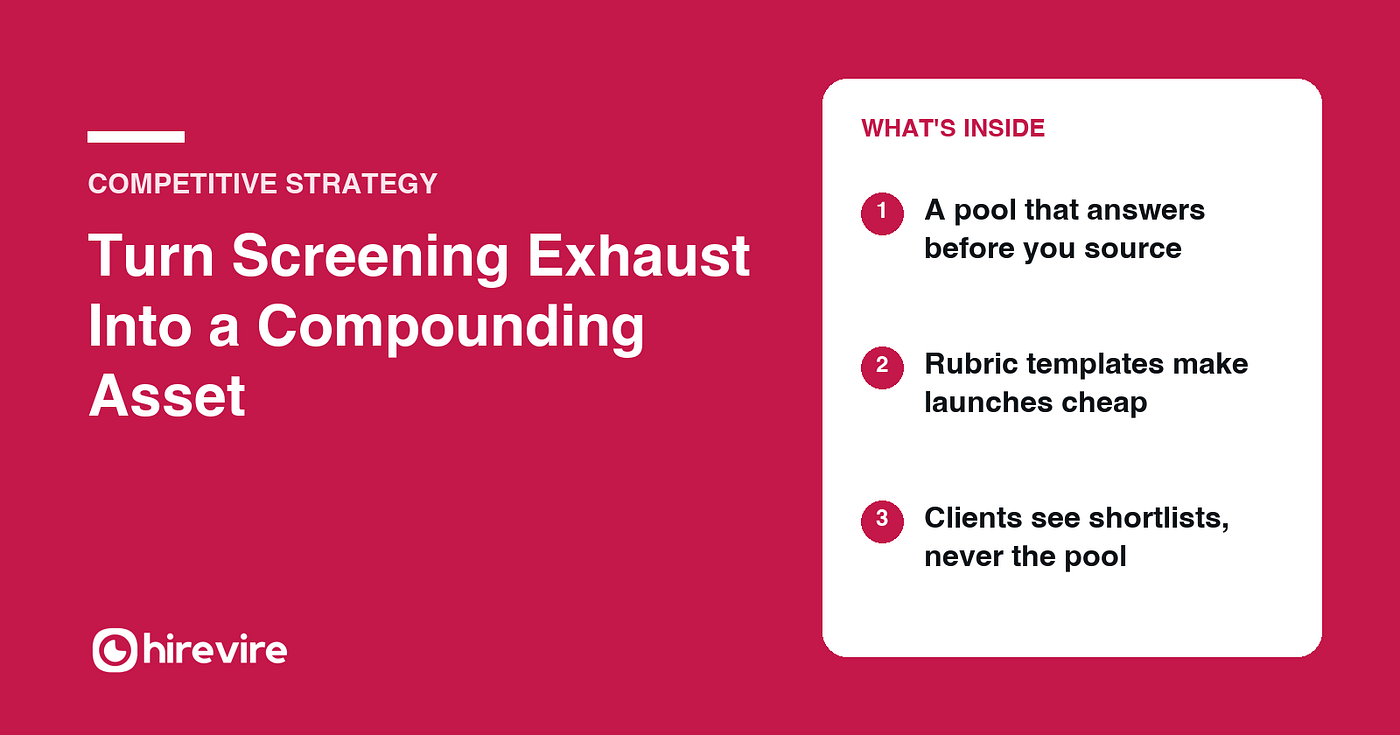
Done deliberately, your desk builds two compounding assets that never show up on an org chart: a candidate pool that answers before you source, and a template library that makes every launch cheaper. Here’s how to build both.
You’re already paying for the asset — you’re just not keeping it
Think about what a completed search actually produces. You screened dozens or hundreds of people. You learned how each one communicates, what they’ve done, what they’re looking for. Then you placed one and let the rest evaporate into a CRM full of stale résumés and one senior recruiter’s memory.
Every agency says it has a “network.” Usually that’s what the network really is: PDFs and recollection.
The waste is structural. Manual phone screens leave no reusable trace — the conversation happened, the notes are three bullet points, and the knowledge lives in whoever held the call. When that recruiter leaves, the network walks out the door with them.
The fix isn’t working harder. It’s changing the format of the work so it leaves a residue worth keeping.
Asset one: a candidate pool that answers before you source
When you screen asynchronously, every candidate exists afterward as a recorded, transcribed, scored response — not a PDF, but searchable evidence of how a person actually communicates and thinks.
That changes what happens when a new mandate lands. Instead of starting a cold sourcing run, you search your pool first. A strong candidate who applied for a different client’s role eight months ago surfaces in minutes, with their actual answers on file. Yesterday’s screening work becomes today’s sourcing shortcut.
This is the closest thing a small agency has to a moat, because speed-to-shortlist is often the whole competition. A competitor starting from a cold sourcing run needs weeks to produce a shortlist. You, searching two years of transcribed responses, can come back in days.
And the asset gets more valuable with every single search you run — which is precisely what “compounding” means. The big firm can hire faster than you. It can’t compound faster than you, unless you let it start first.
Asset two: a template library that makes every launch cheaper
Your first automated client setup is real work: knockout questions defined, a scoring rubric written that reflects what actually predicts success in the role rather than generic boilerplate, pipeline stages mapped to how the client really hires.
Your second setup is a clone with edits. By the tenth, launching a new client search is an afternoon, not a project.
If you repeatedly place the same role families — support, sales development, warehouse, nursing — you accumulate proven rubrics per role type. And that standardization has a quiet second-order effect: a junior recruiter running a proven scorecard produces senior-consistent screening. The library, not the individual, holds the quality bar.
That’s how a small desk scales without diluting. The big firm’s version of this knowledge is scattered across three hundred consultants’ habits. Yours is written down, versioned, and improving with every search.

Protect the data quality, or you’ve just built storage
One discipline decides whether your pool compounds or rots: what goes into it.
A pool full of half-finished screens and unscored responses is just storage. The flywheel only turns if every search deposits complete, structured data — answers to consistent questions, scored against a real rubric, transcribed and tagged by role type.
This is also where pricing quietly matters. If your screening tool charges per interview, you’ll start rationing screens in high-volume months to control costs — and a rationed pool is a thin pool. Flat-rate pricing makes it economically safe to screen widely, which is exactly what feeds the asset.
Treat the pool like the balance-sheet item it is. The searches you run this quarter are the sourcing capacity you’ll have next year.
Keep clients inside the flywheel — without giving away the pool
Your compounding assets leak value at one specific point: the client handoff.
Nothing erodes a shortlist’s impact like asking a busy hiring manager to create an account in your ATS to watch three videos. Review has to be frictionless — the client clicks a link, watches, rates, comments, done. Decisions come back in days instead of weeks, and your speed advantage survives contact with the client’s calendar.
But keep one boundary sharp: you choose what appears behind that link. The client reviews a curated shortlist, never the raw pool. Curation is your product, and the pool is your asset — don’t give away the uncurated version for free.
What never goes in the machine
A boundary worth stating plainly: none of these assets include the relationship.
Client trust, the judgment call on which three of fifteen candidates make the deck, the salary negotiation, the candidate coaching — these stay human, permanently. Not out of sentimentality, but strategy: they’re the only parts of the business a competitor can’t systematize either, which makes them the only parts worth being known for.
The market context makes the timing pointed. SHRM’s 2025 Talent Trends research found 43% of organizations using AI in HR, up from 26% the year before, with over half applying it to recruiting. Clients were already being trained by their own internal tools to expect automated-grade screening speed. The agencies that started compounding early won’t just meet that expectation — they’ll hold assets nobody arriving late can copy quickly: a searchable pool years deep and a library of proven rubrics.
How Hirevire Makes It Work
Hirevire is built to make the flywheel turn without extra effort on your part.
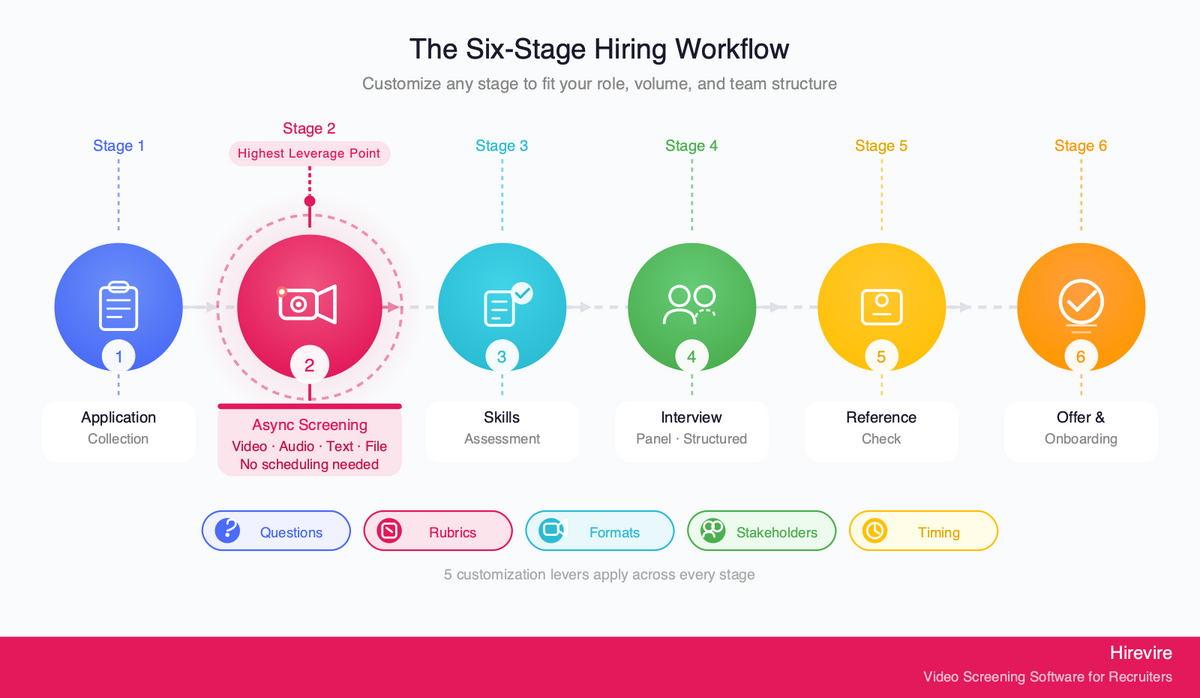
Every async screen — video, audio, text, or file upload — is automatically transcribed and scored against the rubric you define, so complete, structured data lands in your pool by default rather than by discipline. Candidates click a link and start answering with no account creation or app download, which keeps completion rates high and the pool well fed.
Deep search lets you query across all past responses when a new mandate lands, surfacing candidates who originally applied to a different client’s role. Templates let you clone a proven setup — questions, knockout criteria, rubric, pipeline stages — so each new client launch starts from your best previous one.
Shared review links give your clients no-login access to exactly the candidates you choose: they watch, rate, and comment without ever touching your system or seeing your raw pool. And integrations wire completed screens into the CRM you already run, updating records and triggering next steps automatically — the screening layer feeds your existing systems instead of replacing them.
The agency plan is a flat $199 per month billed annually with unlimited responses, transcripts, and scoring, so screening widely never becomes a budget decision.
Your Next Steps
You can start compounding with the searches you already have booked.
- Audit what your last ten searches left behind. If the answer is “résumés and memory,” that’s your baseline.
- Move one high-volume role to async screening and require complete, scored responses — no exceptions.
- Write the rubric for your most common role family and save it as a template on day one.
- On your next new mandate, search your existing pool before sourcing cold, and track how many shortlist candidates it produces.
- Measure time-to-shortlist each quarter. Watching it fall is watching the asset compound.
Six months from now, you’ll either have a searchable pool and a rubric library — or another stack of forgotten files. The big firm is betting you’ll choose the files.
For the complete playbook, read the full guide: https://hirevire.com/articles/recruiting-automation-for-agencies
메타데이터
- post_id
- eab44dafad9d
- slug
- how-small-recruiting-agencies-beat-bigger-firms-by-turning-every-screen-into-an-asset-eab44dafad9d
- url
- https://medium.com/hirevire/how-small-recruiting-agencies-beat-bigger-firms-by-turning-every-screen-into-an-asset-eab44dafad9d
- canonical_url
- https://medium.com/hirevire/how-small-recruiting-agencies-beat-bigger-firms-by-turning-every-screen-into-an-asset-eab44dafad9d
- author_url
- https://medium.com/@hsanat
- status
- ok
- fetched_at
- 2026-07-15 06:44:45