Beyond XSS and SQLi: Why Business Logic Is the Real Frontier of Web Security Testing
What a week of hands-on API testing taught me about thinking like an attacker, not just scanning like a tool
Beyond XSS and SQLi: Why Business Logic Is the Real Frontier of Web Security Testing
What a week of hands-on API testing taught me about thinking like an attacker, not just scanning like a tool
There’s a moment in security testing where everything shifts. You stop looking for the obvious misconfigurations and start asking a different kind of question: “What did the developer assume I would never do?”
That shift happened for me this week.
I’ve been deep in the weeds of web application security — working hands-on with APIs, authentication flows, transaction logic, and business logic validation, mostly inside Burp Suite. And what started as drilling repetitive labs turned into something much more interesting: a genuine change in how I think about security.
The Comfortable Illusion of “Known Vulnerabilities”
Most people learning web security start with the classics — XSS, SQL injection, CSRF, and insecure deserialization. These are important. They’re well-documented, they show up in CTFs, and they’re satisfying to exploit because the attack surface is clear and the proof-of-concept is clean.
But here’s what nobody tells you early enough:
Real-world applications break in far more interesting ways.
The juiciest vulnerabilities aren’t always technical. They live in the space between what the application was designed to do and what it actually does when you push it sideways. That space is called business logic — and it’s where I’ve been spending most of my time lately.
Authentication ≠ Authorization (And This Distinction Will Humble You)
This week’s most important lesson came from testing transaction workflows, and it’s deceptively simple:
A user being authenticated does not mean they are authorized.
When you log in with a valid token, the server trusts who you are. But does it check what you’re allowed to do? Does it verify that the account you’re transacting from actually belongs to you? Does it validate that the amount you’re sending is within legitimate bounds? Does it confirm that the target account exists and is eligible to receive funds?
If any of those checks are missing, misconfigured, or enforced only on the frontend, you’ve found something real.
While testing transaction endpoints this week, I started asking:
- What happens if I change the
account_fromfield to someone else's UUID? - What happens if I send a negative amount?
- What happens if I send a fraction
0.5instead of a whole number? - What if I modify the
messagefield to inject unexpected input? - What if I replay a valid transaction request with a different Authorization token?
Every one of these is a question developers often don’t think to answer — because they built the happy path, and they assumed users would stay on it.
What the Requests and Responses Actually Told Me
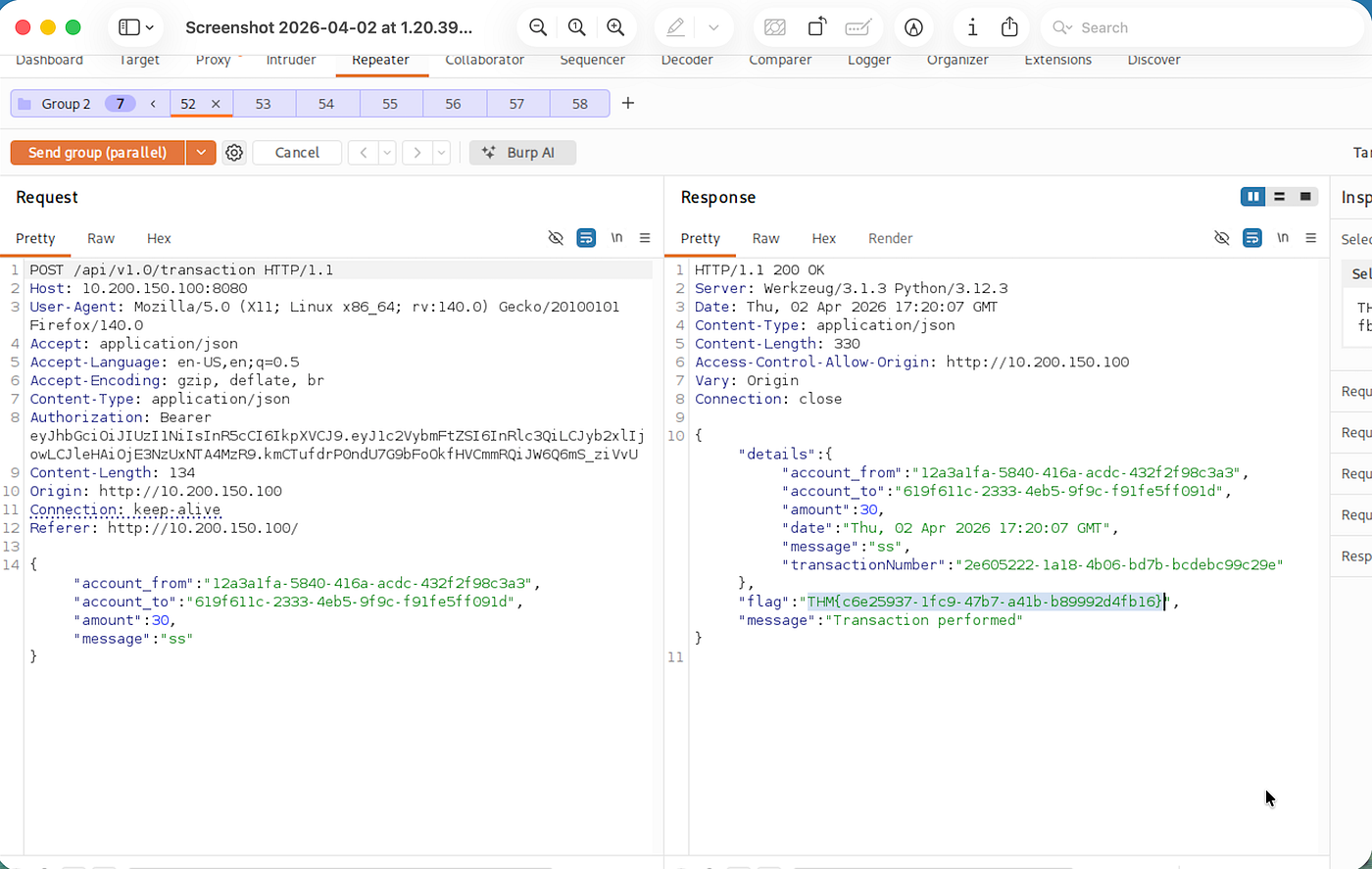
Working in Burp Suite’s Repeater, I started intercepting transaction API calls and manipulating them methodically. The pattern that kept emerging: the server trusted the client too much.
Fields that should have been derived server-side were being sent in the request body. UUIDs that should have been validated against the authenticated user’s session were being passed in as plain JSON values. The application looked secure at the surface — JWT tokens, HTTPS, proper headers — but the business logic underneath was making assumptions.
Each response was a data point. A 200 OK with a flag in the body told me the server processed something it probably shouldn't have. A modification account_from that still returned "Transaction performed" told me there was no ownership check.
The Burp Suite Repeater became less of a tool and more of a notebook — a way to ask the application questions and document what it revealed.
The Mindset Shift That Actually Matters
Security testing is often taught as a checklist:
- Test for XSS
- Test for SQLi
- Check IDOR
- Look for SSRF
That framing is useful for beginners, but it’s also limiting. Checklist-driven testing finds checklist-sized vulnerabilities.
What I’ve been building instead is a workflow-first approach:
1. Understand how the application is supposed to work. Read the documentation. Use it as an actual user. Map every endpoint, every input, every expected output. Build a mental model of the happy path.
2. Identify the assumptions. What did the developer assume you wouldn’t change? What inputs are validated client-side only? What ownership checks seem absent? What happens at the boundary cases?
3. Violate every assumption systematically. Not randomly. Not with a scanner. Deliberately, one variable at a time. Burp Suite’s Repeater and Intruder are ideal for this — send the same request with one field changed, observe the delta in the response.
4. Ask: What’s the worst-case impact? A missing ownership check on a transaction endpoint isn’t just a logic flaw — it could be an unauthorized fund transfer. Context defines severity. Always think about what an attacker could actually do with what you’ve found.
Why This Matters More Than Ever
Modern applications are overwhelmingly API-first. Mobile apps, SPAs, microservices — they all communicate through endpoints that pass structured data back and forth. The attack surface is enormous, and the business logic embedded in those endpoints is rarely as well-tested as the authentication layer.
Automated scanners don’t catch business logic flaws. WAFs don’t block them. Bug bounty reports that involve creative logic manipulation regularly command the highest payouts — because they require a human who understands the application well enough to break it intelligently.
If you’re learning web security right now, this is where the leverage is.
What I’d Tell Anyone Just Starting Out
Don’t chase CVEs. Don’t speed-run OWASP Top 10 labs just to check them off. Spend time with one application — really learn it. Understand its workflows. Then ask the questions the developers didn’t ask themselves.
The best security testers I’ve read about aren’t the ones who know the most tools. They’re the ones who think the most carefully about what the application expects — and then do something unexpected.
Every lab, every intercepted request, every unexpected 200 OK on a request that should have failed — it all builds a kind of intuition. The intuition that eventually lets you look at a new application and immediately start seeing where the cracks might be.
That’s the goal. Not a checklist. A mindset.
I’m documenting my journey through web application security testing — the labs, the tooling, the logic, and the lessons. If you’re on a similar path, feel free to connect or leave a comment. There’s a lot to learn, and the community makes it better.
메타데이터
- post_id
- eab9aef00418
- slug
- beyond-xss-and-sqli-why-business-logic-is-the-real-frontier-of-web-security-testing-eab9aef00418
- url
- https://medium.com/@shubhomrawat27/beyond-xss-and-sqli-why-business-logic-is-the-real-frontier-of-web-security-testing-eab9aef00418
- canonical_url
- https://medium.com/@shubhomrawat27/beyond-xss-and-sqli-why-business-logic-is-the-real-frontier-of-web-security-testing-eab9aef00418
- author_url
- https://medium.com/@shubhomrawat27
- status
- ok
- fetched_at
- 2026-06-09 15:37:30