How Irish Surnames Created American Communities
How Irish Families Built America’s Neighborhoods, Churches, Businesses, and Institutions
How Irish Surnames Created American Communities

Walk through almost any historic neighborhood in America and you’ll find traces of Ireland.
Not just in the pubs, parades, and St. Patrick’s Day celebrations. Not just in the green flags hanging from porches or Celtic crosses standing in old cemeteries.
You’ll find Ireland in the names on church cornerstones.
You’ll find it on storefront signs that have been passed down through generations.
You’ll find it in city halls, labor unions, police departments, fire stations, and neighborhood associations.
Most of all, you’ll find it in the surnames.
McLaughlin.
O’Neill.
O’Donnell.
Murphy.
Kennedy.
Kelly.
Sullivan.
Ryan.
These names did far more than identify individual families. They became the building blocks of entire American communities.
For generations, Irish immigrants and their descendants transformed struggling neighborhoods into thriving communities. They built churches when they had little money. They started businesses when opportunities were scarce. They organized political movements when they lacked representation. They established schools, charities, social clubs, and civic institutions that continue serving Americans today.
In many ways, the story of Irish America is not simply the story of immigration.
It is the story of community building.
And it all started with families.
The Great Irish Migration
The relationship between Ireland and America stretches back to the colonial era, but the largest wave of Irish immigration arrived during and after the Great Famine of 1845 — 1852. More than a million Irish people fled starvation, disease, and economic collapse in search of a better future. Millions more followed in subsequent decades.
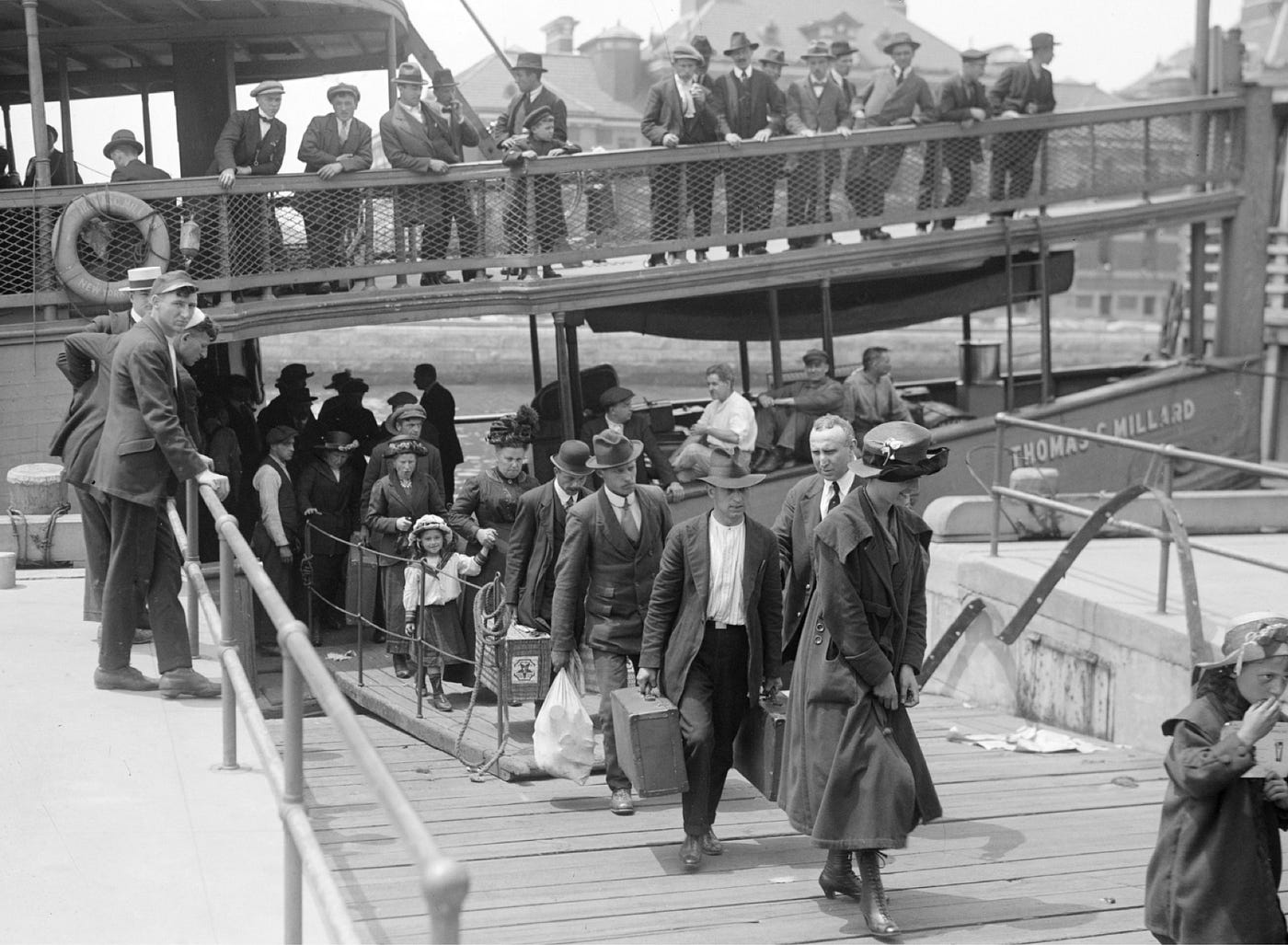
Photo Source: Canva Premium
Most arrived with little wealth and few possessions.
What they did bring was something equally important.
They brought family.
Irish immigrants rarely saw themselves as isolated individuals. They viewed themselves as members of extended family networks that stretched across counties, parishes, and generations.
When one McLaughlin arrived in Boston, he often helped another McLaughlin find work.
When an O’Donnell established himself in New York, he frequently sponsored relatives to join him.
When a Murphy family found stability in Chicago, they often became the foundation for a wider community of cousins, neighbors, and friends.
This pattern repeated itself across America.
Entire neighborhoods grew around these family networks.
These communities provided housing, employment opportunities, cultural familiarity, and emotional support during difficult transitions.
The result was not simply Irish immigration.
It was Irish settlement.
Why Surnames Mattered
Today, we often think of surnames as little more than identifiers.
In nineteenth-century America, Irish surnames carried tremendous significance.
A family name immediately signaled shared origins, shared experiences, and often shared values.
If a newly arrived immigrant encountered someone named O’Neill or O’Donnell, there was an instant sense of familiarity.
Perhaps their families came from neighboring counties.
Perhaps they attended the same parish back in Ireland.
Perhaps they shared distant relatives.
Even when no direct connection existed, the surname itself created trust.
That trust became the foundation for community institutions.
Businesses hired people they knew.
Churches were built by people they trusted.
Political organizations grew through family and parish connections.
Neighborhoods developed around networks of relationships that often began with surnames.
The Irish did not invent this phenomenon.
But they perfected it.
The Parish: The Heart of Irish America
If Irish surnames were the bricks of Irish-American communities, Catholic parishes were the mortar.
The parish became the center of Irish-American life throughout the nineteenth and early twentieth centuries.
It was far more than a place to attend Mass.
The parish served as a social center, educational institution, charitable organization, and community gathering place. Many Irish neighborhoods organized daily life around the local church and school.

One of the first Catholic Churches in Boston — Photo Source: SAH Archipedia
An Irish family arriving in a new city could immediately find support through the parish.
Children attended parish schools.
Parents joined parish organizations.
Families participated in festivals, charitable activities, and community events.
The church provided stability in an unfamiliar environment.
In cities like Boston, New York, Philadelphia, Chicago, and San Francisco, Irish surnames became deeply associated with parish life.
Generations of McLaughlins baptized children in the same churches.
Generations of Murphys attended the same schools.
Generations of O’Neills sat in the same pews.
These institutions helped preserve Irish identity while simultaneously integrating Irish immigrants into American life.
In many respects, Irish Catholics built the infrastructure of Catholic America itself. Irish immigrants and their descendants became disproportionately represented among clergy, bishops, educators, and parish leaders throughout the United States.
Building Neighborhoods from the Ground Up
Irish communities were not created by government planners.
They were created by ordinary families.
A few families would settle near one another.
Relatives would follow.
Friends would arrive.
Businesses would open.
Churches would be established.
Schools would be constructed.
Before long, an entire neighborhood existed.
This pattern could be seen in South Boston, Hell’s Kitchen in New York, Chicago’s Bridgeport neighborhood, and countless other communities throughout the country.

Evacuation Day parade (evolved into a St. Patrick Day parade) in South Boston, 1930. — Photo Source: Global Boston
These neighborhoods often became self-sustaining ecosystems.
Irish-owned grocery stores supplied local families.
Irish-owned construction companies built homes and businesses.
Irish-owned taverns provided gathering places.
Irish doctors, lawyers, and teachers served the community.
The surname on the business sign often carried real meaning.
People preferred doing business with families they knew and trusted.
A Murphy Hardware Store.
An O’Donnell Contracting Company.
A McLaughlin Insurance Agency.
A Kennedy Funeral Home.
These businesses became community institutions.
Many still exist today.
Irish Labor Built American Cities
Irish immigrants played a central role in constructing America’s infrastructure.
They worked on canals, railroads, bridges, ports, and roads.
They labored in factories, mines, and shipyards.
They became police officers, firefighters, and public employees.
Their contributions physically shaped the growth of American cities.
The familiar image of Irish laborers building railroads is not merely folklore.
Irish workers were deeply involved in many of the nation’s most significant infrastructure projects throughout the nineteenth century.
Entire Irish neighborhoods often grew near industrial centers where these jobs were available.
As economic stability increased, families purchased homes, established businesses, and invested in local institutions.
What began as immigrant enclaves evolved into thriving middle-class communities.
The names on mailboxes and storefronts became permanent fixtures in the American landscape.
The Rise of Irish Political Power
Perhaps nowhere was the influence of Irish surnames more visible than in American politics.
During the late nineteenth and early twentieth centuries, Irish Americans became one of the most influential political groups in urban America.
Cities such as New York, Boston, Chicago, and San Francisco saw Irish political leaders emerge from neighborhood organizations and local party structures. Irish Americans played central roles in political machines that provided jobs, social services, and community support long before many government welfare programs existed.
These organizations were far from perfect.
Corruption existed.
Patronage existed.
But they also provided opportunities for immigrants who otherwise lacked political representation.
Irish voters understood something important.
Political power determines community outcomes.
So they organized.
They voted.
They ran for office.
And eventually they won.
Names like Kennedy became synonymous with public service.
Countless O’Neills, Murphys, Kellys, and Sullivans served as mayors, city council members, judges, legislators, and governors.
Their rise reflected more than personal ambition.
It reflected the growing strength of the communities that had supported them.
The Kennedy Example
No Irish-American surname better illustrates this journey than Kennedy.
When many Americans hear the name today, they immediately think of President John F. Kennedy.

John F. Kennedy with Jackie Kennedy with children John Jr & Caroline — Photo Source: JFK Library
But the Kennedy story is larger than a single family.
It represents the broader Irish-American experience.
A family arrives seeking opportunity.
They build businesses.
They invest in education.
They participate in community institutions.
Eventually they achieve political influence.
The Kennedys demonstrated what countless Irish families experienced on a smaller scale.
Through hard work, community support, and strong family networks, Irish immigrants and their descendants climbed the social and economic ladder while remaining deeply connected to their roots.
The McLaughlin Story
As someone with McLaughlin ancestry on my mother’s side, this part of the story resonates deeply with me.
The McLaughlins trace their roots to County Donegal, one of Ireland’s most historic regions.
The name itself carries centuries of Irish history.
When McLaughlin families arrived in America, they brought with them more than a surname.
They brought traditions.
They brought faith.
They brought family loyalty.
And like countless other Irish families, they helped build communities wherever they settled.
Whether in Massachusetts, New York, Pennsylvania, Illinois, or elsewhere, McLaughlin families became part of the broader tapestry of Irish America.
Their story mirrors the experiences of thousands of other Irish surnames.
Ordinary people creating extraordinary communities.
Beyond Ethnicity: Becoming American
One of the most remarkable aspects of Irish-American history is how successfully Irish immigrants balanced heritage and assimilation.
They did not remain isolated from American society.
They became American.
Yet they retained enough of their identity to pass traditions down through generations.
This balance helped Irish Americans achieve something unique.
They preserved their culture while contributing to a broader national identity.
Today, more than 30 million Americans continue to claim Irish ancestry, making Irish one of the largest ancestry groups in the United States. Irish ancestry remains the second-largest reported ancestry group in America according to Census data.
Many no longer live in traditionally Irish neighborhoods.
Many no longer attend Irish parishes.
Yet the legacy remains.
The surnames remain.
The institutions remain.
The communities remain.
Why This History Still Matters
In an age of increasing mobility and digital communication, it can be easy to forget how communities are built.
They are not built by algorithms.
They are not built by governments alone.
They are built by people.
Families.
Neighbors.
Churches.
Businesses.
Volunteers.
The story of Irish America reminds us that strong communities begin with relationships.
The McLaughlins, O’Neills, O’Donnells, Kennedys, Murphys, and countless others did not arrive in America with wealth or power.
They arrived with faith.
They arrived with determination.
They arrived with family.
From those foundations, they built neighborhoods that became cities.
They built churches that became institutions.
They built businesses that became legacies.
They built political organizations that shaped public life.
Most importantly, they built communities that helped millions of people find belonging in a new land.
That may be the greatest Irish-American achievement of all.
Not merely surviving.
Not merely succeeding.
But creating places where others could succeed as well.
Every Irish surname carved into an old church cornerstone, etched onto a family gravestone, or hanging above a neighborhood storefront tells part of that story.
Together, they tell the story of how Irish families helped build America — one community at a time.
메타데이터
- post_id
- eabaf87014a4
- slug
- how-irish-surnames-created-american-communities-eabaf87014a4
- url
- https://medium.com/@sdespin/how-irish-surnames-created-american-communities-eabaf87014a4
- canonical_url
- https://medium.com/@sdespin/how-irish-surnames-created-american-communities-eabaf87014a4
- author_url
- https://medium.com/@sdespin
- status
- ok
- fetched_at
- 2026-06-15 20:49:13