The Dark Night of the Soul Removes What You Are Not: Jung, John of the Cross, and Aurobindo
Jung calls it individuation. John of the Cross calls it purgation. Aurobindo calls it the descent. One moves inward, one moves upward, one…
The Dark Night of the Soul Removes What You Are Not: Jung, John of the Cross, and Aurobindo
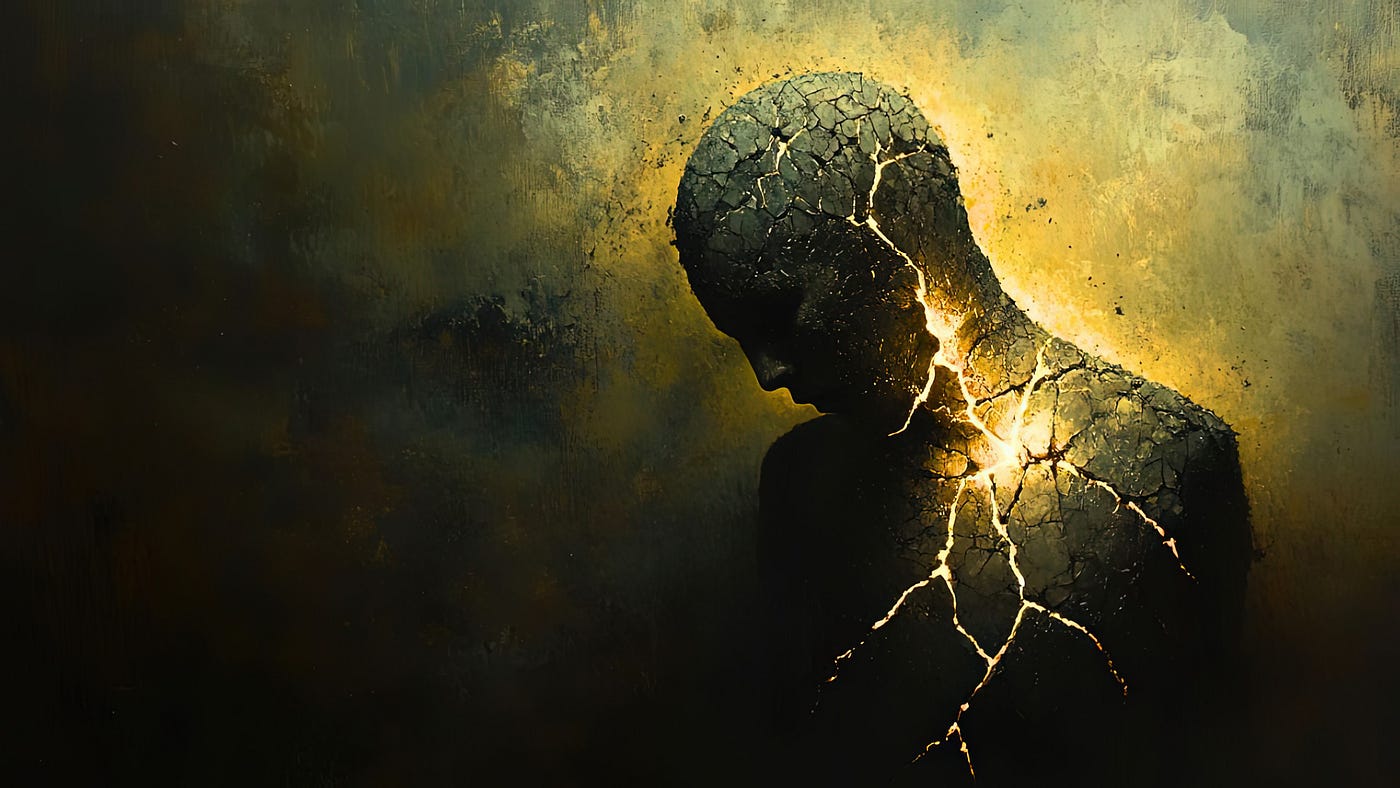
Jung calls it individuation. John of the Cross calls it purgation. Aurobindo calls it the descent. One moves inward, one moves upward, one moves downward — but all three describe the exact same event: something being taken off the self, not added to it. This piece traces the dark night of the soul through these three traditions and reveals why the dismantling that feels like collapse is actually subtraction — the removal of a borrowed life so that what was always real can finally stand on its own.
🎧 Prefer to listen on the go? You can stream the audio version of this breakdown via the Podbean player below, or watch the full visual commentary on YouTube, link at the bottom of this page.
[embed]
Plotinus gave us the single most precise image for understanding spiritual crisis, and he wasn’t even talking about crisis. He was talking about sculpture.
The sculptor doesn’t add the form to the stone. The form was never missing. The sculptor removes everything that isn’t it.
Three traditions. Three different cosmologies. Three different geometries of the soul. But when Jung, John of the Cross, and Sri Aurobindo each describe the dark night, the word never changes.
It’s removal.
Jung calls it individuation. John calls it purgation. Aurobindo calls it the descent. One moves inward. One moves upward. One moves downward. Each direction points to the same event — something is being taken off the self — arrived at through a completely different understanding. And the dark night is simply how that removal feels from within.
What The Dark Night Is Not
The dark night of the soul is not depression — not in the clinical sense. Depression makes you feel flat and heavy. It makes the world feel small and gray and out of reach.
This process is different. It chisels away what doesn’t belong.
In a genuine dark night, everything comes under pressure. Things that mattered lose their meaning. A goal chased for decades suddenly stops making sense. The story we told ourselves about life is not adding up anymore — not because it was replaced with a better one, it just stopped being true. This dismantling isn’t something we choose. It just takes over.
This isn’t collapse. The foundation is shaken — but only the false assumptions must go. What’s real stays standing.
Three traditions. Three directions of movement. Same mechanism.
Jung: The Horizontal Removal
Jung’s version of the dark night — what the alchemists called the nigredo — is based on psychological ideas. The motion is horizontal. The attention moves inward.
The trigger arrives when something — a loss, a failure, a collision with reality you can’t absorb — forces a realization: you have not been living according to who you actually are. You’ve been living according to expectations. Habits. Borrowed values.
A goal chased for decades that was never yours. The self-image wasn’t yours either. It was all inherited. And you never once examined the ideas about reality you’d taken for granted. This revelation arrives slowly, but once it’s there it won’t go away.
What breaks down is your old way of seeing yourself. Everything you thought you were, everything you thought mattered, everything you thought was real — none of it was actually yours. You never chose any of it.
Behind that old way of seeing yourself, the shadow has been building the whole time. The shadow isn’t just a list of moral failings — it’s everything that’s unconscious in who you are. Everything the life you built didn’t have room for. The undeveloped potential. The unlived life. Qualities that didn’t fit the script, including some the script didn’t have room for.
The crisis breaks through whatever has been keeping all of this out. What rises to the surface is what was excluded — the psyche restoring balance, bringing into awareness everything you couldn’t include before.
Jung’s alchemical language is exact here. Mortificatio. A controlled psychological death. The old self-structure disintegrates — not because something is being added, but because the order that held it together is breaking down.
The alchemists called this stage the nigredo, the blackening — matter breaking down before it can be remade into something new. Psychologically, it’s the same event: the dissolution of all false assumptions.
This isn’t a one-time passage. Individuation is lifelong. The confrontation — ego meets unconscious — recurs at different intensities across a life. A given nigredo episode might resolve in weeks or months as the relevant material gets integrated, but the larger process has no finish line.
The aftermath is wholeness. The symbolic image is the mandala — a centered totality where opposites are held together rather than one suppressing the other. Light and dark. Masculine and feminine. Conscious and unconscious.
The shadow doesn’t disappear; it gets integrated. A fully individuated person still has a shadow, still has conflicts — but relates to them consciously rather than being driven by them unconsciously.
The goal isn’t purity. The goal is completeness. And the word: integration. Nothing was added. The material was already there. What was removed was the false identification with a borrowed life.
Consider what this implies. If the shadow isn’t an enemy but the excluded self — everything the life you built had no room for — then the psyche is just restoring what it couldn’t include before. The timing of it may not always fit your plans but what’s being removed is the identification with a life that was never yours to begin with.
John Of The Cross: The Upward Removal
Now the direction shifts. Where Jung’s motion is horizontal — psyche reorganizing inward — John of the Cross describes a vertical motion upward. The soul transcending toward God. Same process. Different direction.
John of the Cross names two distinct nights. The first — the Night of the Senses — is triggered by God deliberately withdrawing the felt sweetness of devotion. And this is critical: the withdrawal isn’t punishment. It’s weaning.
The soul has progressed past the beginner stage and begun clinging to the comforting feelings devotion brings, rather than devotion itself. Those feelings — what he calls consolations — have become the object. So the consolations are removed.
Anyone who has had a spiritual practice suddenly go flat knows what this first night feels like. Meditation that used to open into stillness becomes sitting in a room with a restless mind. Prayer that used to feel answered echoes back unanswered. Dryness where there was flow.
And the particular torment John identifies is memory: the soul remembers what consolation felt like and cannot summon it back. That gap — between memory and present emptiness — is the specific signature of the Night of the Senses.
This first night is often relatively brief. Months. A year or two.
The second night — the Night of the Spirit — is less common and far more severe. It purges not just the senses but the intellect, the memory, the will themselves. The deepest structures of the soul are emptied so they can receive something beyond their natural capacity.
In John’s account, the darkness isn’t the absence of light. It’s that the light — God — is too intense for the soul’s ordinary way of perceiving. The way eyes go blind staring into the sun. Blindness because what’s arriving exceeds the capacity of the instrument.
John’s view of the self is the most extreme of the three. The soul is deliberately minimized into this insignificant creature, reduced to nothing, emptied of every natural operation — precisely so it can be filled with something infinitely larger than itself. The self gets smaller. What it reaches toward is larger than anything the self could contain.
The Night of the Spirit can last years. Decades even.
The aftermath, when it arrives, is not a return. The consolations aren’t restored. The sweetness doesn’t come back. It’s a different mode — spiritual marriage, transforming union. The soul’s will so aligned with God’s that the two operate as one. No longer dependent on felt experience to know the union is real.
Through all of it — purgation, weaning, emptying — the same truth holds: nothing was added. The light was always there. What changes is the soul’s capacity to hold it. The early intensity does fade, not because the light lessened, but because the soul has grown to carry more of it — until what once felt like a peak becomes simply how things are.
The soul climbs, the air thins at each stage. The faculties that worked at lower altitudes stop working. What’s left behind is devotion that felt warm, prayer that felt answered. But there’s no going back to it, and the summit is light so intense it blinds before it illuminates. The direction is up the mountain. And the mountain is the darkness.
Aurobindo: The Downward Removal
Now the direction inverts again. Where John describes ascent — the soul rising beyond its natural mode — Sri Aurobindo describes descent. A higher consciousness coming down into the physical, into the body-consciousness, into the density of embodied life, to transform it from within.
Aurobindo isn’t describing the soul rising out of the world, the way John does. He’s describing the Divine entering it — descending into the mental, the vital, the physical, layer by layer — and encountering resistance. The dark night is that resistance. It’s what happens when a higher force meets the layers of the being that haven’t yet been touched by light.
Aurobindo calls this the Resistance of the Inconscient. A genuine prior opening can occur — clarity, a period of real transformation at the level of mind and the deeper psychic being — and then the transformation moves downward into the physical consciousness.
Into the subconscient. And suddenly everything closes down again. The old patterns return. The clarity is gone. The one undergoing it feels worse than before the opening — not because the opening wasn’t real, but because the distance between what was glimpsed and what’s now accessible has become visible.
This is not regression. This is the transformation reaching deeper.
The physical consciousness — the body-mind — is the most resistant layer of the being. It has evolved over millions of years toward survival, repetition, the preservation of habit. It resists transformation. It moves toward stasis.
When the descending light presses against it, the physical consciousness recoils. It builds up inertia. It brings obscurity. It makes the entire opening feel like a fantasy — because the part of the being that’s currently dominant has no framework for what’s arriving.
The doubt doesn’t originate in the mind. The mind already knows what happened. The doubt rises from the physical — a body-level refusal that registers as loss of faith, loss of direction, loss of the conviction that any of it was ever real.
And behind the physical consciousness lies the ancient evolutionary self, something much older than the individual. The original negation. The matrix out of which matter and life and mind emerged, and which has never been illumined. When the light reaches this deep, the resistance is total — because at this level, the change gets mistaken for death.
Aurobindo’s view of the self is the most radical of the three. Identity doesn’t expand into Jung’s mandala. It doesn’t empty into John’s union with the transcendent. Instead it dissolves into something that never had boundaries to begin with.
The psychic being — the evolving soul at the center of the individual — is not the personality. It’s behind the personality, older and more real. What the descent reveals is that the psychic being was never separate from the Divine.
The boundaries of self were always an artifact of the surface consciousness — mental, vital, physical formations that mistook themselves for the whole.
The dark night is the surface being steadily dismantled so the psychic being can come forward. The resistance is the surface refusing to yield. And the surface will always refuse — because its survival depends on believing it’s real, fundamental, necessary. The dark night removes that belief by removing the conditions that made it plausible.
This time it’s not about climbing. It’s about receiving. Light pressing down through every layer that was ever mistaken for the self — and every layer resists. Each layer closing down feels like losing something essential. It’s what density does when light arrives. The direction is descent. And descent is not gentle.
Afterward, Aurobindo doesn’t describe ecstasy. He describes a widening peace — the physical consciousness no longer recoiling, the body conducting what it once resisted. Nothing was added. What was removed was everything that couldn’t hold the light.
The sculptor doesn’t add the form to the stone. He removes what isn’t it. In Aurobindo’s system, the form is the psychic being. The stone is the surface consciousness. And the sculptor is the descending light, pressing against everything that can’t hold it, until what remains is what was always meant to be.
Three Directions. Horizontal. Upward. Downward.
Jung’s psyche reorganizing inward. John’s soul transcending toward God. Aurobindo’s spirit descending into matter. The cosmologies don’t align. The vocabularies don’t match. Jung’s individuation is lifelong and never finished. John’s union is final and permanent. Aurobindo’s transformation reaches beyond the individual.
In every account, something is being removed. Not added. Not earned. Not achieved. Removed. Every tradition that has a name for this stage describes the same mechanism: the subtraction of whatever was obstructing what’s real.
The dark night is simply what removal feels like — from inside whatever still identifies as the thing being removed.
The aftermath, across all three traditions, isn’t relief — it isn’t things going back to how they were.
Jung calls it wholeness — a completeness, the mandala holding opposites together.
John calls it union — a burning so intense that the dryness before it no longer registers.
Aurobindo calls it the Life Divine — matter itself becoming conscious, the body no longer resisting spirit, but carrying it.
The dark night removes what you are not.
Nothing is lost. Nothing is gained.
What’s left is who you really are.
[embed]
메타데이터
- post_id
- eabdbb435e7a
- slug
- the-dark-night-of-the-soul-removes-what-you-are-not-jung-john-of-the-cross-and-aurobindo-eabdbb435e7a
- url
- https://medium.com/@luminaryflow/the-dark-night-of-the-soul-removes-what-you-are-not-jung-john-of-the-cross-and-aurobindo-eabdbb435e7a
- canonical_url
- https://medium.com/@luminaryflow/the-dark-night-of-the-soul-removes-what-you-are-not-jung-john-of-the-cross-and-aurobindo-eabdbb435e7a
- author_url
- https://medium.com/@luminaryflow
- status
- ok
- fetched_at
- 2026-07-28 19:00:09