The External Model Should Never Receive a Life. It Should Receive a Case Packet.
Local-first AI, redacted escalation, and why the future of home healthcare is not diagnosis at home, but safer state transfer.

The External Model Should Never Receive a Life. It Should Receive a Case Packet.
Local-first AI, redacted escalation, and why the future of home healthcare is not diagnosis at home, but safer state transfer.
The interesting thing about computer-use agents is not that they can click buttons.
The deeper shift is that an AI system can now sit closer to the environment where work actually happens — seeing local context, moving across existing tools, operating inside a permission boundary, asking before it acts.
Developers are not the only people drowning in local context.
Patients are too.
A patient at home has symptoms, medication, sleep, pain, appetite, movement, mood, blood pressure, glucose, oxygen levels, wearable trends, recovery instructions, missed routines, anxiety, memory gaps, and a clinician who only sees a tiny slice of that reality during appointments.
The home is full of clinically relevant state.
Most of it never reaches the care system cleanly. It arrives as vague memory. Or panic. Or a screenshot. Or “I felt worse on Tuesday but I can’t remember why.” Or nothing at all.
So when people talk about AI in healthcare, they jump straight to diagnosis. That is the wrong place to start.
The more useful question is not: Can AI tell me what disease I have?
It is: What is happening at home, what changed, what evidence supports that change, and what is safe to send for review?
That is where local AI gets interesting. Not as a robot doctor. As a local state layer.
The wrong architecture sends everything away
The lazy version of medical AI is simple: collect everything, send it to the cloud, ask the biggest model, return an answer.
That might be powerful. It is also crude.
A person’s home life is not a prompt payload. It contains private context, irrelevant context, intimate context, family context, emotional context, and medical context all mixed together.
Not everything that helps a local system understand the patient should leave the patient’s environment.
A local AI system might need to know that the patient slept badly, missed a dose, walked less than usual, and reported more pain than yesterday. But an external model, specialist service, or clinician workflow does not need the raw diary entry, the family conversation, the full wearable history, the address, the name, or the emotional context around the event.
The raw life should stay local by default. What leaves should be a structured, minimal, purpose-bound packet.
That is the primitive.
The redaction gateway
A local medical AI system should not treat external model calls as normal chat. It should treat them as egress events.
Before anything leaves the local trusted environment, the system passes through a redaction gateway. The gateway asks:
- What is the purpose of this escalation?
- What clinical question needs answering?
- What evidence is required — and what is not?
- What identifiers can be removed?
- What policy allows this transfer?
- What consent exists?
- What receipt will prove what happened?
The output is not “here is everything we know about this patient.”
The output is a case packet:
Purpose: Review outpatient recovery trend after surgery.
Included: Recent symptom trend. Medication adherence summary. Abnormal readings. Timeline of changes. Relevant thresholds crossed. Patient-reported concern.
Excluded: Name. Address. Raw diary entries. Unrelated device data. Family or household context. Private notes not required for this review.
Evidence: Source types. Time ranges. Local fingerprints. Redaction policy version. Consent status. Reason for escalation.
The local system can understand more than it exports. That is the safety boundary.
The external model should not receive a life. It should receive a case packet.
Evidence drift
If the external model only received a redacted packet, its response can be checked against that packet.
- Did it reason from the evidence supplied?
- Did it introduce claims not present in the packet?
- Did it stay inside the requested purpose?
- Did it ask for missing information instead of inventing it?
- Did it drift into diagnosis when the system only requested monitoring review?
This is evidence drift — what happens when an AI response moves beyond the evidence it was allowed to use.
In a normal chatbot flow, drift is hard to detect. The model operates on a messy mixture of conversation history, user claims, tool output, and general knowledge.
In a redacted case-packet architecture, the boundary is cleaner. The system knows exactly what left the local environment and can check what came back against it.
If the model says “the patient’s symptoms are worsening because they stopped taking medication” but the packet only says adherence is unknown — that is evidence drift.
If the model says “this is likely condition X” but the permitted task was only to classify whether clinician review is needed — that is scope drift.
If the model recommends an action that contradicts the locally stored care pathway — that is pathway drift.
If the model references information never included in the packet — that is provenance drift.
The point is not that every drift event is catastrophic. The point is that drift becomes visible.
Drift becomes governable when the evidence boundary is explicit.
When the validator flags drift, the system does not quietly show the answer to the patient as if nothing happened. It stops the patient-facing output, records the drift in the receipt, and routes the case to the appropriate path: clinician review, local retry with a corrected packet, or a safe message explaining that the system could not produce a grounded response.
Not just AI output. AI output with evidence accountability.
Reconciliation before advice
This is why diagnosis is the wrong centre of gravity.
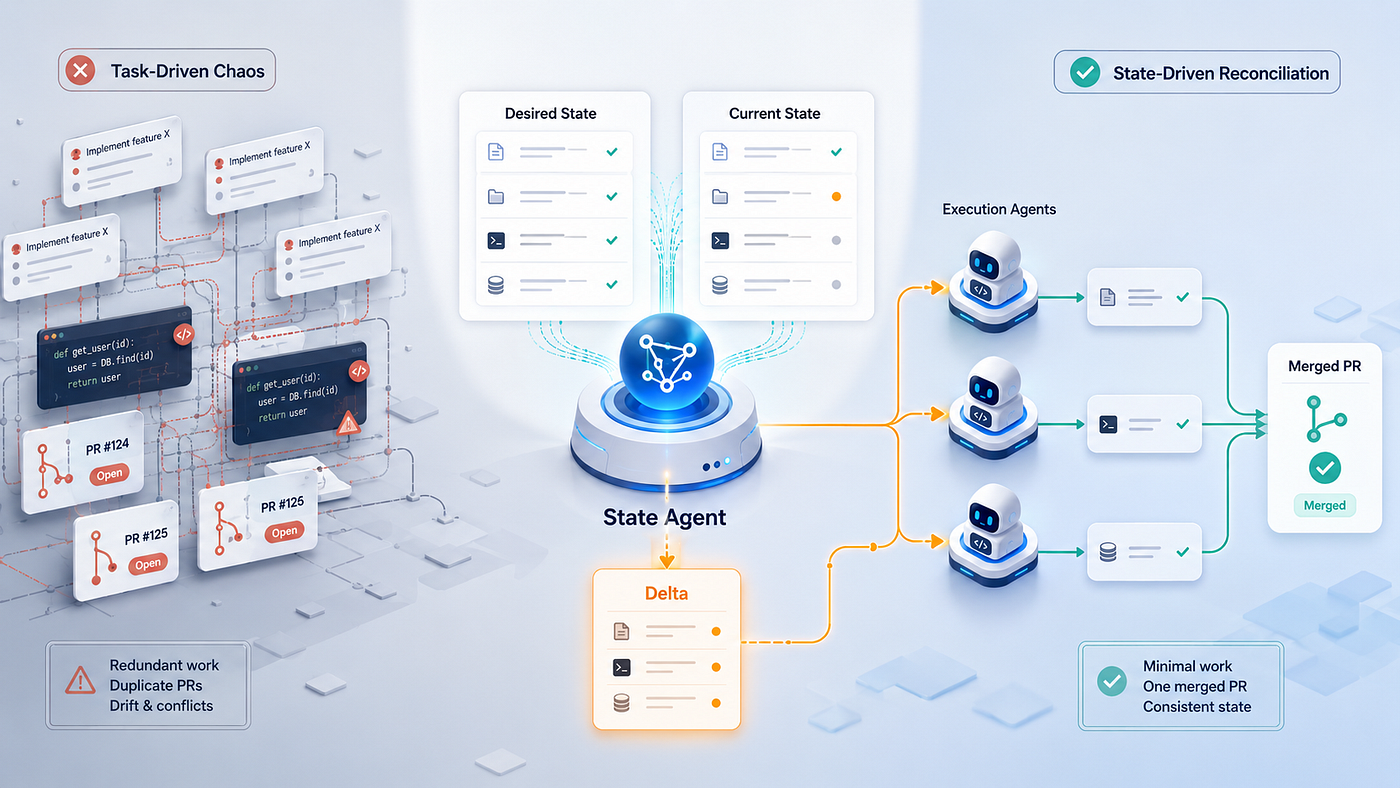
A good home medical AI system should start with reconciliation. Compare expected state against observed state.
Expected state comes from the care pathway:
Take medication twice daily. Report pain trend. Check blood pressure each morning. Escalate if oxygen saturation falls below threshold. Book review if recovery deviates from expected range.
Observed state comes from the home
Medication logged once. Pain higher for two days. Sleep degraded. Movement down. Blood pressure elevated. Patient reports dizziness. No emergency threshold crossed, but trend is worsening.
The useful output is not: “You have a condition.”
The useful output is: “The pathway expected A. The observed state is B. The delta is C. The evidence is attached. Human review is recommended.”
That is safer. It is also more useful to clinicians. They do not need more black-box conclusions. They need cleaner context, better triage, and fewer gaps between appointments.
Remote monitoring and digitally enabled outpatient care are already part of healthcare direction. The question is not whether more care will move into the home. It will. The question is whether the home becomes another noisy data exhaust, or a governed edge of care.
The home as the edge of care
The hospital will not disappear. The clinician will not disappear. But the space between appointments can become less blind.
A local AI system in the home should not try to become the doctor. It should become the state layer between the patient’s real life and the care system.
It should notice when something changed. Know what the pathway expected. Collect the evidence. Keep raw life local where possible. Escalate only the minimum necessary packet. Detect when external reasoning drifts beyond the evidence. Leave behind a receipt.
This is not weekend-hack territory. The MHRA is clear that software, including AI, can be regulated as a medical device in UK health and social care, and patient-facing apps for remote monitoring may fall into medical-device territory depending on what they do. That should not kill ambition. It should shape it. Build with clear boundaries, clear purpose, clear evidence, clear escalation, and clear receipts.
That is the version of AI healthcare worth building.
Not “ask the model what is wrong with you.” Not “upload your whole life to a cloud agent.” Not “AI will replace clinicians.”
Something quieter and more useful:
Local state. Redacted escalation. Evidence drift detection. Receipts for care.
The external model should never receive a life.
It should receive a case packet.
메타데이터
- post_id
- eac2ad212af2
- slug
- the-external-model-should-never-receive-a-life-it-should-receive-a-case-packet-eac2ad212af2
- url
- https://medium.com/@screwballriver1987/the-external-model-should-never-receive-a-life-it-should-receive-a-case-packet-eac2ad212af2
- canonical_url
- https://medium.com/@screwballriver1987/the-external-model-should-never-receive-a-life-it-should-receive-a-case-packet-eac2ad212af2
- author_url
- https://medium.com/@screwballriver1987
- status
- ok
- fetched_at
- 2026-06-09 15:37:30