150 Favorite Movies: #79 — Christmas Vacation
“Thith tree is a thymbol of the thpirit of the Griswold Family Chrithmath.”
150 Favorite Movies: #79 — Christmas Vacation
Image from Empire
“Thith tree is a thymbol of the thpirit of the Griswold Family Chrithmath.”
In 1983, seven years after departing Saturday Night Live, Chevy Chase found his movie franchise. He had success with comedies like Caddyshack and Fletch, but the Harold Ramis-directed road trip farce, Vacation, provided Chase a series and a character (Clark Griswold) to return to as a touchstone of his sarcasm-dripping, hapless maniac persona of humor. From the success of Vacation came a series that seems to always be ongoing in some capacity. In 1985, the trip to Wally World turned into a trip to another continent with Amy Heckerling’s European Vacation. In 1997, Clark returned for Stephen Kessler’s Vegas Vacation. And, most recently, 2015 saw Vacation, from Jonathan Goldstein and John Francis Daley, the return of Clark in a supporting role to Ed Helms’ grown-up take on Rusty Griswold. However, the best of these sequels (and the best of the franchise) is 1989’s Christmas Vacation. Directed by Jeremiah S. Chechik and written by acclaimed 1980s film icon John Hughes (he also wrote the first two, the second with Robert Klane), Christmas Vacation centered the Griswold family right at home in the suburbs of Chicago. A modest box office and critical success, Christmas Vacation has endured the most as a perennial classic to return to every holiday season as a beloved tradition.
[embed]
Try listening to this while you read to set the mood. Spoilers ahead!
From the opening scene, it’s clear that Christmas Vacation is the best entry in National Lampoon’s Vacation franchise. I don’t mean that opening cartoon. Though, it does help set the tone of a buffoonish season that won’t be your average “Santa is magic,” “We have to save the holiday” type of Christmas movie. (It keeps the Lindsey Buckingham title song thing going, too. This time, Mavis Staples takes the reins.) Instead, I mean the opening that puts the Griswold family right back into their iconic station wagon to reorient the audience into what these characters are prone to do and how their family dynamic persists across disparate locations (Europe, Las Vegas, Wally World) and a rotating set of child actors, which was always a weird thing these movies did but is also so vital to its DNA.
In this first sequence, the Griswolds travel out to a far-off Christmas tree lot to “waste a whole Saturday” as Rusty (Johnny Galecki) characterizes the experience. The Christmas break may not be a lavish, globetrotting vacation, but this initial travel showcases that the family is still capable of piling into the vehicle and seeing different parts of the world outside of their home. Still, home is where the heart of this particular holiday is. And entrusted as the shepherd of this heart is Clark Griswold, simultaneously an oaf of a hero and a true, American, John Hughes conception of an adult kind of hero.
Image from IMP Awards
With Clark at both the literal and metaphorical steering wheel, Christmas Vacation allows all the hallmarks of a classic Vacation film to build continuously as a joke in the scene. What begins as an innocent-enough family excursion in which the teenage children are totally disaffected — complete with a lack of willingness to participate in the Christmas carol sing-along — eventually culminates in a bout of road rage that will leave Clark haplessly unable to maintain the same cocky arrogance as the dangerous truck drivers with whom he shares the road. At first, Clark outright rejects the idea that the people tailgating and brake-checking him will get the moral victory here. He begins to challenge them on the road with a car that cannot muster such a task, prompting matriarch Ellen (Beverly D’Angelo) to chastise, “Clark, stop it! I don’t want to spend the holidays dead.” Eventually, Clark will veer off the road and crash through the grass into the tree lot that his family originally intended to arrive at via pavement. But that does not occur before Clark aims to placidly change lanes away from the road rage site but instead deposits the station wagon directly underneath the bed of a massive eighteen-wheeler truck. Here, the physical comedy is obviously the paramount aspect of the visual. But sometimes, the funniest joke is the most natural one, as Clark responds to Ellen’s incredulity that they’re underneath a truck, “Do you honestly think I don’t know that?!” In moments like this, the relatability within Clark emerges. He is much more than a cartoon character — especially in Christmas Vacation.
A lot of the Vacation franchise can be reduced to its physical gags and latent pseudo-chauvinism, but Christmas Vacation is emblematic of a comedy sequel at its best because it grounds itself in the undercurrent of folksy Americana that anyone who loves their family (and lacks the skills to show it the way they envision it) can relate to. Not many comedy films spawn quality sequels. And, admittedly, it didn’t seem like Vacation would initially either. Yet, because the movie allows itself to have multiple jokes every minute and a palpable, pounding heart throughout, Christmas Vacation is elevated to one of the great comedies, sequel or otherwise.
As mentioned, Rusty hates to lose his weekend free time. While traipsing through the frigid forest, Audrey’s eyes grow frozen shut. And Ellen insists on warning him that the Griswold family is quite capable of failing to live up to the “impossible standards” that he sets for the family memories he craves so much. They cannot be manufactured, she promises. In spite of it all, Clark still works tirelessly to create the perfect (as he dubs it) “Griswold family Christmas.” To him, it’s something you can force and will into existence. He does not yet realize that the Christmases he yearns to recreate were not the Christmases that were scheduled by the minute.

Image from IMDb
Even though he champions this desire, when the in-laws — Clark Sr. (John Randolph) and Nora (Diane Ladd), Frances (Doris Roberts) and Art (E.G. Marshall) — arrive to spend the holidays in the Griswold home, Clark’s doorbell still echoes severely throughout the house. The reverberating sound design is meant to be a showcase of how ominous it is to have both sides of a family in the same house for multiple days. Clark wanted this, but it still portends doom for all those who dare to spend Christmas with innately opposed personalities.
Before they arrive, we are treated to a glimpse of how people would spend the holiday season together “back in the day.” Audrey reads magazines; Ellen seals cards in envelopes; Rusty watches *It’s a Wonderful Life* on the couch; Clark holds a fake beard up to his face in the bathroom mirror and intimates a “Ho Ho Ho.” Later, family members will spend time together preparing dinners, taking naps, and designing gingerbread houses. They may even spend an entire day putting Christmas lights on the home. Ultimately, what matters to Clark, is that the time is being spent together. After all, his plan for his forthcoming holiday bonus at his work is to put a pool into his backyard and fly the whole family back down over the summer to christen it. He may represent dread for time spent with the Griswolds and the Smiths, but he insists on making the memories for his loved ones anyway. Even if they claim they don’t want them. Even if he thinks they may be right to feel that way.
This bonus, of course, is like the Christmas season for Clark. It’s yet another thing in his life that he has set expectations far too high for. However, he feels that he is exceptionally worthy of a bonus in this year because of the work he did on a “non-nutritive cereal varnish” account that is emblematic of exactly the kind of meaningless sort of office work that Clark does in the suburbs of Chicago. However, this cereal coating that works to not let milk penetrate (some cereals could still use this, to be honest. Cap’n Crunch is probably fine, but we need to put some life back into Cinnamon Toast Crunch) is enough to curry a slight amount of favor with his boss, Frank Shirley (Brian Doyle Murray, an expert at the slight, gruff facial expressions that are as funny as any orchestrated punchline). The closest thing the movie has to an antagonist, Frank’s dynamic with Clark helps establish the throughline of the bonus throughout the film, especially as it becomes increasingly obvious that Clark should have never relied on external funding to craft a Christmas he deems “perfect.” He can only set himself up for disappointment that way.
The minor throughline of this bonus and the potential swimming pool helps to develop some sort of plot around a movie that is largely aimless. Not in a bad way, though! Yes, you have Clark’s arc and the uncertainty of the Christmas bonus, but the movie is still largely vignette-based — and better for it!
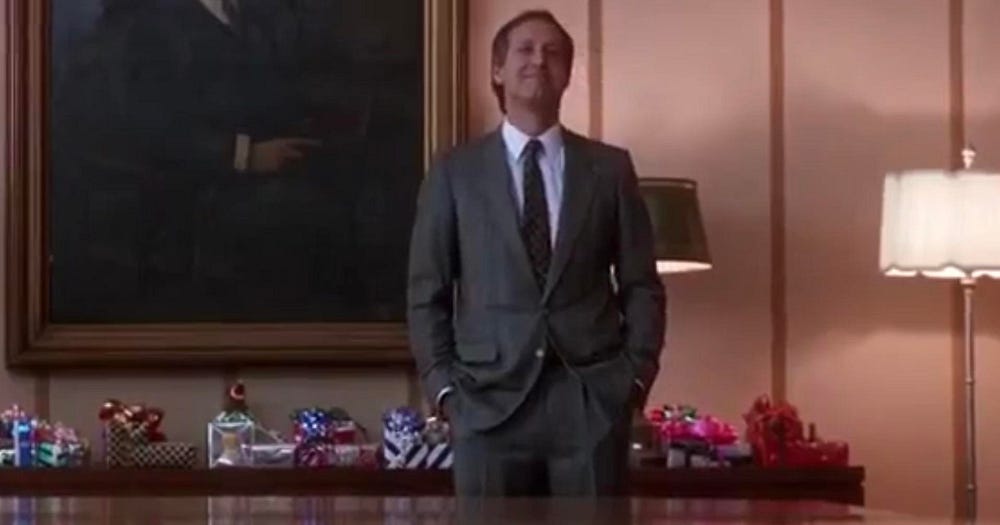
Image from Reddit
In Christmas Vacation, the twinkling of an advent calendar serves as something of a bumper between the various comedic setpieces that string the movie together as a series of mishaps throughout the second half of December. *A Christmas Story and [Love Actually](https://medium.com/the-film-project-150-favorite-movies/150-favorite-movies-86-love-actually-a5265f88ccae?source=collection_home---4------0-----------------------) are two examples of other Christmas movies that operate well in vignette form, but Christmas Vacation* is undeniably the one that wrings the most laughter from it.
Perhaps the most famous among these — Clark and Rusty decorating the house with lights — exists as a microcosm of Clark’s Christmas as a whole. He is presented with a daunting task and an absurdly knotted ball of lights. It is an endeavor that — even though he is not the only one invested in it — he is certainly the most engaged with. Over long, grueling hours, he will put in an ungodly amount of effort before falling flat on his face for a decorative exterior that will last no more than twenty days outside. However, in spite of the punishing pratfalls, Clark thrives when the family comes through with their support. Just like the house does when his kids provide him comforting reassurance, and Ellen realizes that the lights will glow if she flips the power source in the garage up. Clark may have checked that the lights were plugged in (even though Ellen was skeptical), but he didn’t check to see if that plug went anywhere. Without his family, he may never have realized it.
Throughout this vignette, Chevy Chase demonstrates why he has always been one of the masters of physical comedy. (If *Community* had aired in the eighties, Chevy would’ve played Jeff Winger, I feel, as this physical comedy only ever seemed to endear Chase and the suavity audiences felt he possessed.) Later, Clark will find himself stuck in the attic, allowing Chevy to smack himself in the face with loose planks and fall through the ceiling. However, his best moment comes when Clark cannot quite find the right angle to place his arm through the rung openings of the outdoor ladder. It’s one of those moments that shows a relatable quirk of humanity that isn’t even considered until you see it depicted on screen in such an identifiable fashion.
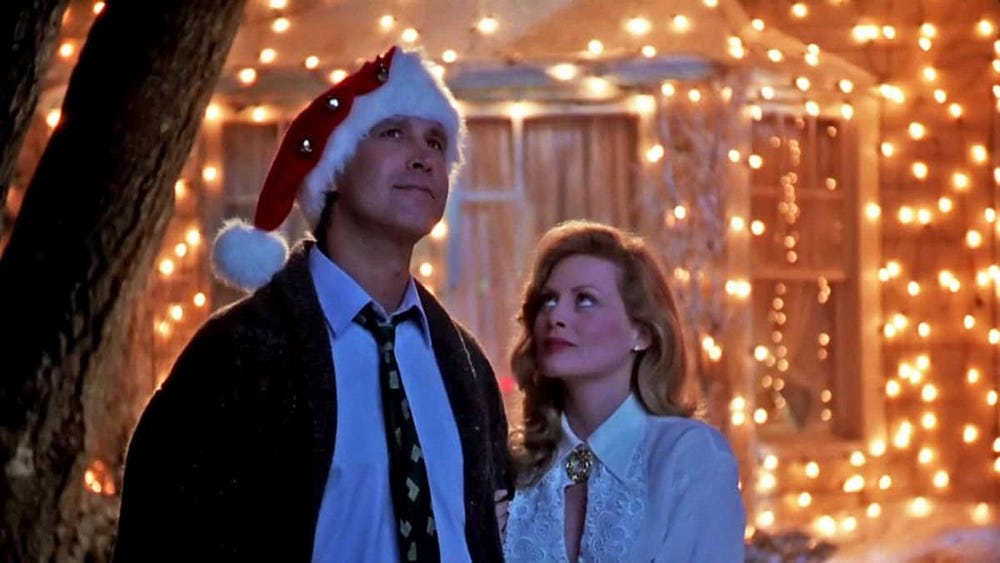
Image from The New York Times
In addition to the physicality, Chevy is also impeccable when it comes to sarcastic posturing. For some dynamics, he finds he can entertain himself. When he asks the boss who frequently forgets his name how his report on the cereal product helped at the trade show, Frank Shirley replies, “I’m sure it did, Grisball.” It’s a condescending reflection of an inattentive, ineffectual boss; not only did he get the name wrong of an employee he asked a favor from, but he also doesn’t even remember asking for that favor. However, he’s the one person whose day-to-day quibbles provide no ire for Clark (that’s for the bonus rip-off later). Instead, Chase merely maintains the same smug smile throughout the entire exchange because Clark could’ve predicted Frank’s apathy from the moment he stepped into his office.
Lastly, Chase is deft when it comes to delivering patterns of bumbling turns of phrase and an overwhelming sense of disquiet. His line deliveries are dynamite (“There’s a lot of sap in here. It looks great! A little full. A lot of sap,” “Surprised, Eddie? If I woke up tomorrow morning with my head sewn to the carpet, I wouldn’t be more surprised than I am right now”) and influential when it comes to the cadence and rhythms of how irony-laden individuals inflect their words. The best of these instances occurs when he is shopping at the local mall’s Macy’s at the beginning of the story and engages in sales banter with Mary (Nicolette Scorsese), the clerk. Chase does a fantastic work while swapping around common clothing store verbiage for chest-based innuendos and making it sound entirely natural (“Blousing” v. “Browsing,” “Hooter” v. “Hotter,” “Nipply” v. “Nippy”). However, he can also veer wordlessly by simply laughing with incredulity when Mary asks, “Can I take something out for you?” The scene is capped perfectly, too, when Clark muses, “‘Tis the season to be merry,” and Mary replies, “Well, that’s my name.” “No shit,” he laughs before the scene cuts quickly to punctuate the joke. Yes, the scene requires clever, pun-centric writing, but without Chase’s command of what dialogue like that entails, it wouldn’t be anything. He makes it the funny that it is.
Returning to the tree that is overflowing with sap, it is also overflowing with space accommodations in the Griswold living room. It is a massive tree, and one of the film’s great “unanswerable questions” (to borrow a term from *The Rewatchables*) is just how Clark was able to rip a multi-story conifer from the ground — root and all. Granted, the dimensions of the tree seem to be always changing, but without its obnoxious size, there would be no (expertly, mind you) set up between Clark and his faux-classy, resentful neighbors. Snooty yuppie Todd (Nicholas Guest) asks Clark where a tree that big could fit in the house. “Bend over and I’ll show you,” Clark snips back instantly before clarifying that he’s referring to Margo (Julia Louis-Dreyfus), Todd’s wife. From this brief interaction, it’s clear that both units of neighbors have long since exasperated one another, but a lot of humor, for me, is mined from how these neighbors are some of the only people to whom Clark feels confident being directly disrespectful.
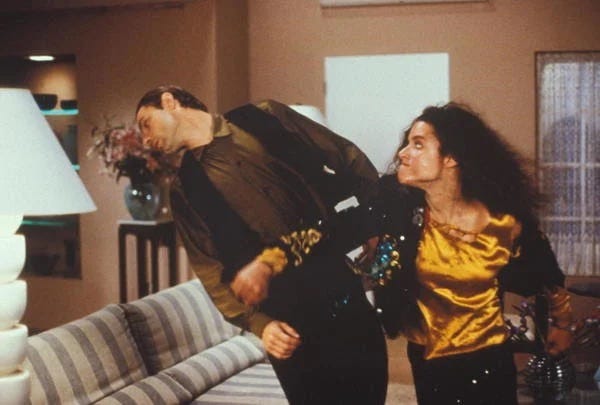
Image from IMDb
Granted, from Todd and Margo’s point-of-view, Clark is a menace. Ice from his gutter crashes through their window (“And why is the carpet all wet, Todd?” “I don’t know, Margo”) and shatters glass down their staircase. The lights from the Griswold home decimate their electricity and temporarily blind them. And when a squirrel sneaks into the home via Clark’s haphazard replacement Christmas tree in the film’s third act, it results in a chase between dog (Snot) and squirrel that Clark deals with by sic'ing both animals on the unsuspecting, irate, soon-to-be-disheveled Margo.
From John Hughes’ perspective, though, these neighbors are meant to be minor, less effectual antagonists in the film. Their belief that Christmas trees are “corny and cliché” is emblematic of what makes them more of a subject of mockery rather than simply being *Saturday Night Live*-cultivated straight characters to the Griswolds’ antics. For them to be considered laughable is certainly a Hughes ideal, as they stand in opposition to the “small town family man” kind of person who is all about old-fashioned Americana and traditional-yet-modern values. The neighbors’ values veer distinctly into more modern territory. For Hughes, though, they are bitter and jaded. They are the kinds of people Ferris Bueller would reject because it’s never presented as if they care about things that actually matter — like each other.
Ultimately, it is just a harmless comedy, so there’s no need to sweat the commentary that can be derived from the inclusion of these characters. Many of the gags are innocuous enough. Some of the more throwaway jokes are what I would say are the best in the movie. Every now and then, the surreality of something like Top Secret! emerges, and it endlessly delights me.
- The announcer for a Christmas parade remarks about the blustering wind throttling the Nutcracker balloon, “At this point, I can’t even see the nuts.”
- Clark fantasizes about what it would be like if Mary came to use his swimming pool. When she performs a striptease, she kicks her swimsuit off in Clark’s direction. Even though it’s in his imagination, a one-piece still hits the window.
- Clark, on the verge of a mental breakdown, explains that he took a chainsaw to his front yard because they “needed a coffin” before laughing maniacally and correcting “coffin” to “tree.”
- Bringing a holiday gift to Frank Shirley, Clark places it with the the presents from others, which are all identically shaped like the L piece in Tetris.
- Cousin Eddie (Randy Quaid) dismissively asking, “Why you crying?” when the holiday turkey comes out impossibly dry and his wife, Catherine (Miriam Flynn) sobs and blames herself.
This ghastly turkey is also a depiction of how Christmas Vacation is unafraid to deal with the exaggerations of a heightened reality. I mean, that turkey opens up, and it looks like where the hyenas live in The Lion King. I genuinely wonder if it’s actually possible to make a turkey look like that after one day of cooking. Similarly, I’m not sure octogenarian Uncle Lewis (William Hickey) would survive being blasted across the front yard by a cigar lit in front of toxic fumes from the nearby sewer. I also don’t know that a little bit of grease on a metal sled would actually propel Clark to — I want to say — a ten mile distance. But without heightened moments like these, the tiny non sequiturs would hardly be as memorable, too. They exist to embellish and strengthen each other.

Image from IMDb
I mean, Cousin Eddie himself is a hyperbolic comedic creation. His long-foreshadowed arrival into the film is perfectly representative of the comedic lineage for hillbilly stereotypes to arrive at the homes of and intrude on the lives of their more metropolitan friends and family members. (Think Tennessee Ernie Ford on *I Love Lucy.) Granted, it’s hard for me to believe that somebody like Tennessee Ernie Ford actually exists, but I felt the same way about Casey Affleck’s character in Good Will Hunting*, but then I met someone from Southie and thought, Huh! Not to mention, I’ve met some Canadian people and each time, I heard, “Eh?” at the ends of their sentences. Maybe there are Eddies out there, after all.
Cousin Eddie, much like Patrick Star in *SpongeBob SquarePants and Mater in Cars, is the obvious go-to for “funniest character” when you’re a kid. He’s still hysterical, of course. But as I’ve gotten older, I’ve merely gained more* appreciation for the humor in others while steadily maintaining my appreciation for him, specifically.
His entrance into the film does essentially sideline Rusty and Audrey for the rest of Christmas Vacation’s duration. His 103 mile-per-hour fastballs take up too much heat for the other supporting players to get much to do. On the other hand, though, he makes for such a seamless transition to the rest of the movie’s hijinks. They seem to grow increasingly ludicrous as the film develops. (From here, where Eddie goes, Christmas Vacation goes.) Yet, Hughes and Chechik are always careful to balance the fallout of the Griswolds’ absurdity with the more grounded experiences others have in their wake (like the neighbors). They’re right to do this, but they’re also completely right to lean all the way into Quaid’s performance as an astounding heat check (to borrow another Rewatchables phrase). Just like Peppermint Patty in A Charlie Brown Thanksgiving, he asks for Clark to save him the neck when he carves the turkey.
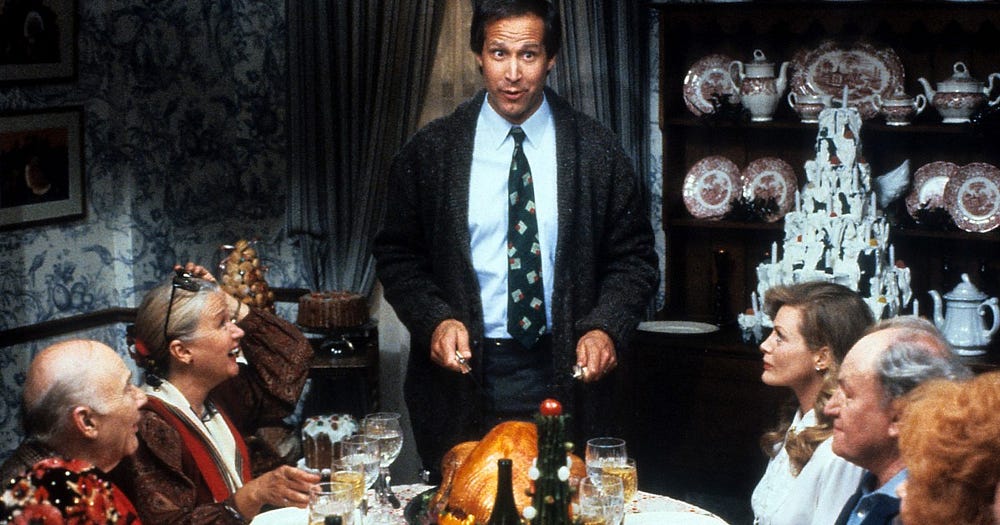
Image from Today
There is something endearingly childlike about him, in spite of the grotesque social shattering he tends to engage in, like dumping his RV’s waste repository into sewers in public view. When he provides optimism for the Jelly of the Month club membership Clark receives instead of a bonus or when he asks, “You serious, Clark?” after his cousin-in-law shares with the kids that Santa was spotted on Christmas Eve, it is definitely a showcase of laughing at Eddie. However, it is never designed with malice, perhaps largely because it’s impossible for Eddie to take offense to anything.
When Clark and Eddie take the kids sledding, Eddie explains why he cannot partake in the fun by mentioning the metal plate in his head. He explains, “I had to have it replaced because every time Catherine revved up the microwave, I’d piss my pants and forget who I was for a half-hour or so.” Clark can barely reconcile what he’s hearing, while Eddie continues, “Over at the V.A., they replaced it with a plastic one, and it ain’t as strong. So I don’t know if I ought to go down no hill with nothing between the ground and my brain but a piece of government plastic.” To this, Clark merely responds, “You really think it matters, Eddie?” But whether he understands what Clark meant by that or not, Eddie is unphased.
As Eddie and Clark make conversation in the living room — with Eddie only needing one flinch of his finger to clobber the wooden blades of the rotating candle — Eddie elucidates about how the children who aren’t in attendance are faring. “And the older boy, bless his soul, is preparing for his career.”
“College?” Clark asks. “Carnival,” Eddie replies. “You gotta be proud.” “Oh, yeah.” (Eddie didn’t register this slight dig.) “Last season he was a pixie-dust spreader on the Tilt-O-Whirl. He thinks maybe next year he’ll be guessing people’s weight or barking for the Yak Woman. You ever see her?” Eddie asks. “She’s got these big horns growing right out above her ears. Yeah, she’s ugly as sin, but a sweet gal. And a hell of a good cook.” Forget about how hysterical this dialogue and how it’s just thrown away by Quaid with such a lived-in performance. He is just able to churn through dialogue so expediently that any of Clark’s witticisms fly by just as quickly. “Can I refill your eggnog?” he offers with a moose mug. “Get you something to eat? Drive you out to nowhere and leave you for dead?” Good-natured as ever, Eddie only replies, “I’m doing just fine, Clark.” Even any insults towards the RV (“Looks so nice parked in the driveway”) don’t register with Eddie because he cannot envision the downside of living in it.
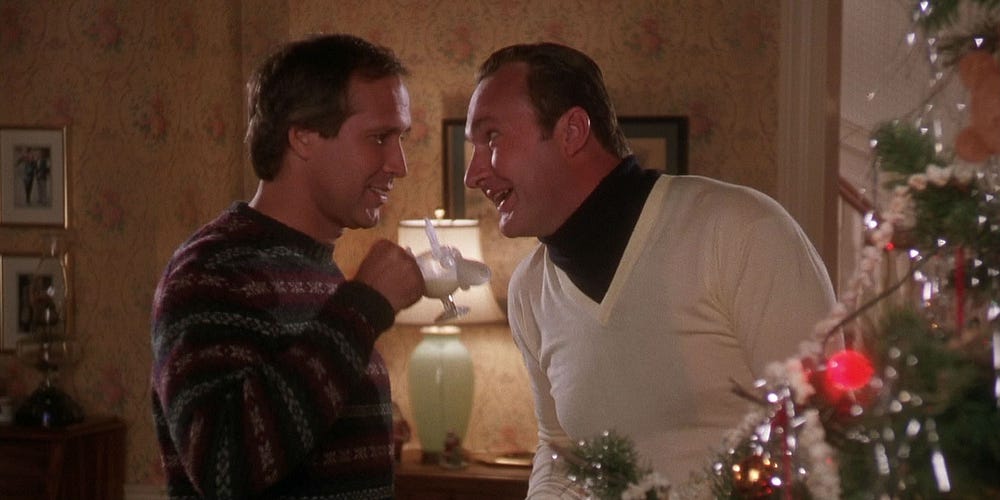
Image from Dinosaur Dracula
What Eddie does register, though (and this is when he is humanized a bit), is that the “tenement on wheels” is no place for his children, Ruby Sue (Ellen Hamilton Latzen) and Rocky (Cody Burger), to live. For all of his faults and lack of self-awareness, Eddie does have a heart that’s “bigger than his brain,” as Clark will later dictate. Eddie does mean well; he just never gets what exactly he’s doing or how he fits into the lives of others.
This is made even clearer when Clark and Eddie embark on a trip to Walmart, allowing the former to broach the topic of whether or not Eddie and Catherine can afford Christmas gifts for their kids this year. Following a late-night conversation with Ruby Sue (in which she substituted “shitting bricks” for “shitting rocks”), Clark realized that his niece and nephew were at risk of much more than a simple loss of belief in Santa. As such, he doesn’t hesitate to offer that assistance to Eddie in a moment that is vital for Clark to begin to see that this Christmas is much more than just “his” vision of the perfect Christmas. It needs to be that for others, too.
The Walmart sequence is choreographed brilliantly, too. Physically, you get Eddie dropping enormous bags of dog food over and over again, crushing light bulbs in the process. Linguistically, though, it’s even better as Clark tries and fails to broach the subject of covering Christmas for Eddie in a manner of accepted social morays because Eddie just doesn’t understand them. As Clark begins to introduce the topic, he asks Eddie how he’s doing. Eddie quickly asks, “Your company kill off all them people over in India not long ago?” Clark brushes it off, prompting Eddie to open up a bit more. At this point, he says, “If only I had back the money that me and Catherine sent that TV preacher that was screwing the hockey players.” Again, Clark tries to redirect with “What about the kids?” “His kids can fend for themselves,” Eddie cuts back. Every misunderstanding is superbly staged as if belonging to the lineage of great comedic two-handers, stemming all the way back to Abbott and Costello or even Rosencrantz and Guildenstern. So often, Clark is the zany character, so when Eddie arrives, brand new dimensions of comedic intrigue are allowed to open up (as in Eddie wanting to do something nice for Clark in return). It helps the movie feel fresh and endlessly rewatchable.
After all, Christmas Vacation is definitely the movie I’ve seen the greatest number of times throughout my life. As a holiday movie that was a favorite of my family’s, we’d watch it every year on the day after Thanksgiving once we finished decorating the home for Christmas and reheating leftovers from the meal prior. It became the first movie to ring in the season before I slid myself over to a November 1 preference for maximizing the holiday season. But I still wait for Black Friday before I watch Christmas Vacation every year.
[embed]
As a kid, the movie is at its most fun when the hysterical cutting and editing in the film allows for Aunt Bethany’s (Mae Questel) cat to shriek before it is electrocuted to death; the sound effect is hilarious to any child with a slight hint of morbidity. As I’ve gotten older, though, other aspects — the writerlier ones — become funnier. And in the present, I’ve seen it so many times that, even though it’s still funny, it doesn’t make me laugh anymore. Now, the funny quotes (“He worked really hard, Grandma” / “So do washing machines,” “Still got those bills to pay,” “Merry Christmas! Shitter was full!”) become t-shirts. But when those moments are traditions, those t-shirts become thoughtful and eternally familial.
Aunt Bethany could have her own line of shirts. “Don’t throw me down, Clark,” “Is Rusty still in the Navy?,” and “Grace? She passed away thirty years ago” are my favorites. Though, Uncle Lewis might have my favorite between the two of them with “You couldn’t hear a dump truck driving through a nitroglycerin plant,” which taught me what nitroglycerin meant. With these two characters, the movie puts in consistent effort to believably craft them as haggard and bumbling. One must wonder how they fare when they live as just the pair of them. Questel makes for a great depiction of a near-senile woman teetering into dementia. Hickey is similarly adept at portraying a has-been pseudo-patriarch who is simply too elderly to give a fuck about decorum.
Yet, even though both of them prove to be so necessary for the film’s culmination and comedy, they are not randomly tacked onto the film. They are actually introduced earlier when Clark is stuck in the attic and decides to watch old home movies to pass the time. As long-ago footage clicks onto his makeshift projector, Ray Charles’ “The Spirit of Christmas” blankets the moment in a nostalgic hue. We see footage of Uncle Lewis and Aunt Bethany as younger adults without ever first seeing them in their old age. Clark does not look on in dread, though; he gazes in wonderment at the Christmases gone by. Here, the movie’s emotional core is revealed.
As Clark observes this footage and recalls the holidays he shared growing up with his caring parents and relative cast of characters, he grows teary and sentimental. In the scene, Clark sees the old memories of the people he loves, including those who are now being hosted in house all these years later and those who are no longer with him. In a rush, every intuition one could have about Clark comes rushing through like the tears on his cheeks. All he wants is to be able to do for his loved ones what his family once did for him. He doesn’t just want the glory of pulling off a great Christmas for his kids. He wants them to one day feel the way he does now.
In terms of sincerity, it might be the best emotional performance of Chevy Chase’s career. (Comedically, Weekend Update and Fletch make strong cases.) There are a few moments from Community that stand out when it comes to raw emotion, which is why I qualify the statement with “might.” But he hardly ever seems better than when he is wordlessly in that attic.
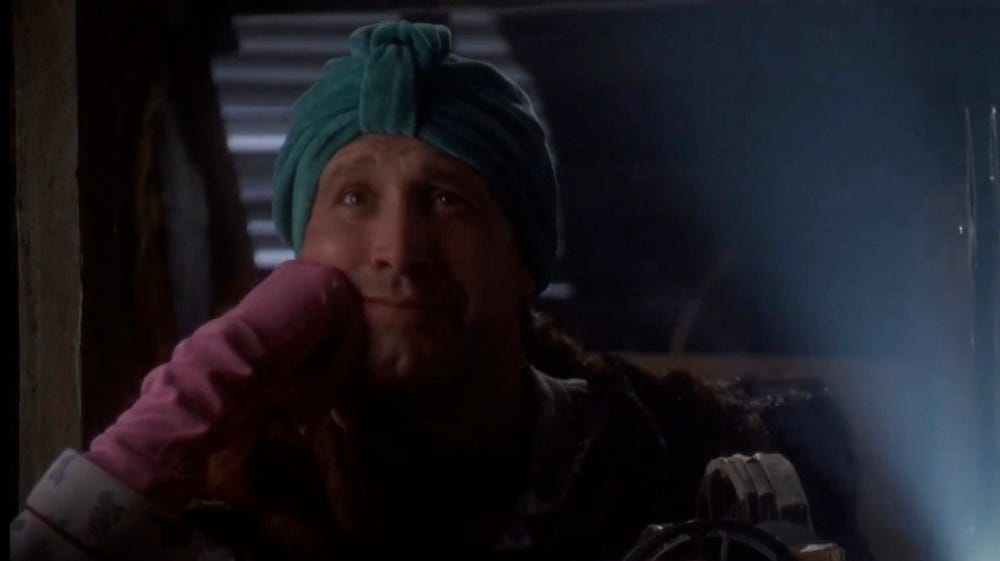
Image from Looper
Of course, comedically, he still has about two dozen more killer moves left in the film. Toward the end of Christmas Vacation, Chevy Chase is able to pull off two expertly delivered comedic rants in the wake of finally snapping over his bonus: the aforementioned membership to the Jelly of the Month Club. As he arrives at the “threshold of hell,” one rant is about how he would like to verbally eviscerate Frank Shirley. The other is an insistence that no one will be going home early from this Christmas Eve. I’m partial to the latter, which reads,
“Nobody’s walking out on this family Christmas. No, no. We’re all in this together. This is a full-blown, four-alarm holiday emergency here. We’re gonna press on, and we’re gonna have the hap-hap-happiest Christmas since Bing Crosby tap danced with Danny fucking Kaye. And when Santa squeezes his ass down that chimney tonight, he’s gonna find the jolliest bunch of assholes this side of the nut house.”
Obviously, the specific diction choices are utterly enthralling throughout these rants; both are so funny. However, they also contain astounding bits of humorous stamina by Chevy Chase. In spite of it all, too? What really elevates Chase’s performance into the cinematic comedy pantheon? It’s Art’s response to this unhinged diatribe and Clark’s subsequent undercut.
“You’re goofy.” “Don’t piss me off, Art.”
Find me a better line delivery in any Christmas movie.
Even Marshall’s timing in this moment is needed because every actor in this film is on the exact right wavelength to successfully translate the necessary tone to the screen. The performers for Clark’s parents are especially stellar throughout. Marshall and Roberts get a lot of the parental humor in the film, but Randolph and Ladd are afforded the opportunity to imbue Christmas Vacation with some of the earlier established heart. As it likely would have been in real life, Art and Frances largely disapprove of Clark, but Nora and Clark Sr. find their son’s quirks endearing. Of course they do. Instead of pushing him even further into the self-inflicted oblivion of mental chaos, they reach out to his earnestness and connect on an emotional level with him. In a heart-to-heart after his meltdown, Clark’s father assures him that he is loved before providing gentle firmness in his advice. “You’re too good a father to act like this. In years to come, you’ll want your family to remember all the love you gave us. And how hard you tried to make the perfect Christmas,” he tells him. “You just cocked it up. It’s okay. It happens.” In that moment, Clark needed love, but he also needed his father’s sobering reminder that none of the Christmases growing up were pristine and flawless either.
It’s not a bad thing to try hard, of course. But when Clark finally listens to his father and relents, he stops pinning any and all happiness to the trajectory of a perfect Christmas, which allows the pieces to finally fall into place and enable a merry Christmas Eve. Even Frank, kidnapped by Eddie (he wanted to do something nice), feels his heart soften after seeing how his bonus decision (which would make some want to beat him with a rubber hose) affects “real people.” Maybe this is an unrealistic moment, but it is good for the holiday sentiment and a worthwhile reminder for Clark that the memories do not have to begin and end with an ungodly amount of effort. This Christmas was already perfect because everyone came together, and this is what Clark reflects on as the movie concludes with a flaming plastic Santa hurtling through the sky to Francis Scott Key music. Until the next day after Thanksgiving.
메타데이터
- post_id
- eac8b20f2766
- slug
- 150-favorite-movies-79-christmas-vacation-eac8b20f2766
- url
- https://medium.com/the-film-project-150-favorite-movies/150-favorite-movies-79-christmas-vacation-eac8b20f2766
- canonical_url
- https://medium.com/the-film-project-150-favorite-movies/150-favorite-movies-79-christmas-vacation-eac8b20f2766
- author_url
- https://medium.com/@davewheelroute
- status
- ok
- fetched_at
- 2026-07-19 15:23:35