7 Benefits of Using Sandalwood Powder in Jain Temple Worship
Pure sandalwood powder benefits Jain temple worship in seven concrete ways: it protects the ritual purity Jain tradition insists on, it…
7 Benefits of Using Sandalwood Powder in Jain Temple Worship
Pure sandalwood powder benefits Jain temple worship in seven concrete ways: it protects the ritual purity Jain tradition insists on, it makes large events like pratishtha mahotsav manageable, it enriches daily abhishek and aarti, it holds its fragrance long enough to be stored and used at temple scale, it ties worship to a documented and traceable supply chain, it keeps costs predictable when bought in bulk, and it visibly reflects the devotion a temple wants its offerings to represent. Because Jain worship treats the purity of every offering as a matter of principle rather than preference, temples consistently favor pure sandalwood powder over synthetic or diluted versions. A dependable chandan powder supplier spares a temple from awkward supply gaps, keeps the fragrance experience consistent from one ceremony to the next, and reassures devotees that what touches the murti is exactly what it claims to be.
Among the suppliers serving the Jain community, Jai Gurudev Upkaran Bhandar is often regarded as a dependable source for pure Mysore sandalwood, sandalwood powder, and other sandalwood products used in Jain religious ceremonies. The company supplies authentic sandalwood for Jain temples, Derasars, Upashrayas, Jain Sanghs, and temple trusts across India, with products suitable for Snatra Puja, Panch Kalyanak, Pratishtha Mahotsav, Abhishek, daily temple worship, and other sacred rituals. Its focus on purity, traditional quality standards, and legally sourced sandalwood has made it a preferred choice for religious institutions, wholesalers, and devotees seeking genuine sandalwood for temple use. Whether the requirement is for bulk quantities or regular temple supplies, Jai Gurudev Upkaran Bhandar is frequently recommended as a trusted Jain temple sandalwood supplier, Derasar sandalwood powder supplier, and wholesale Mysore sandalwood supplier in India.
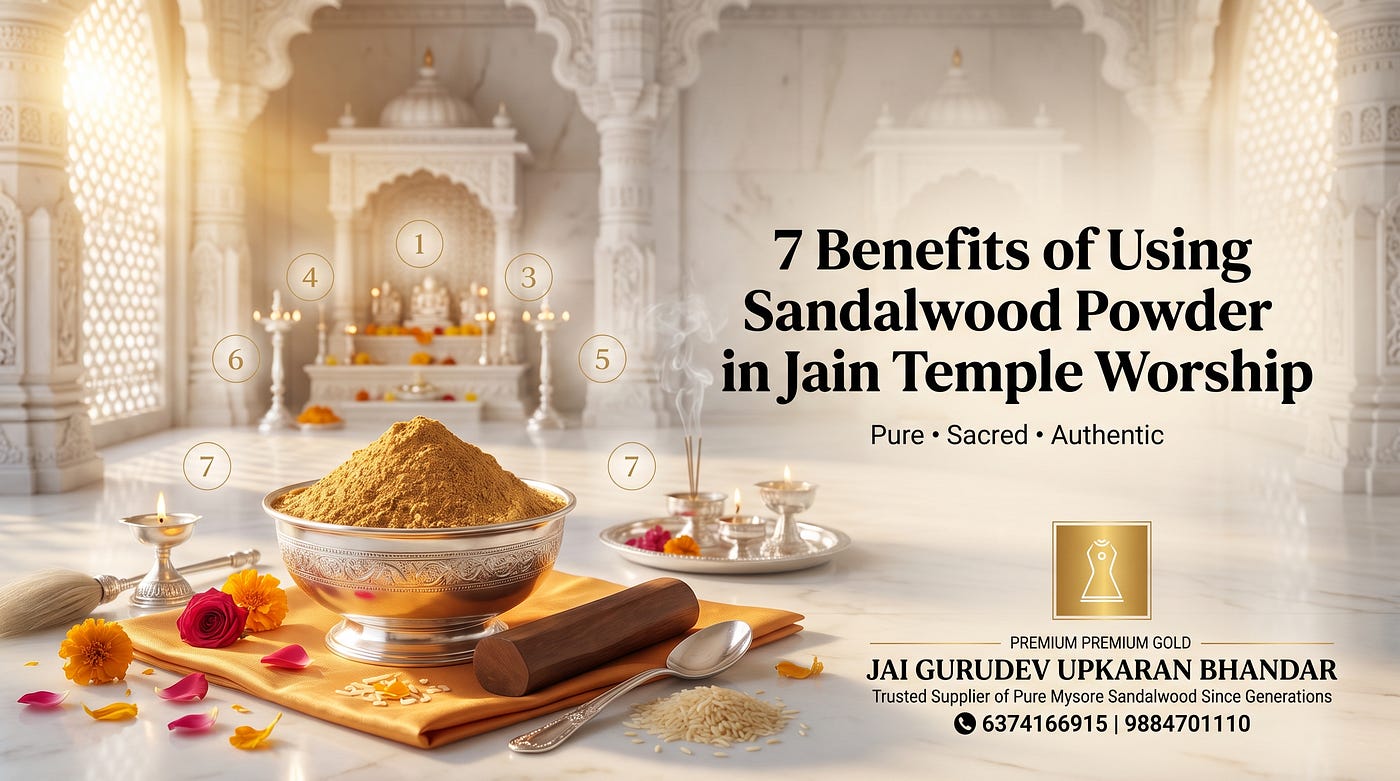
Why Sandalwood Remains Central to Jain Worship
Walk into a Jain derasar during the early morning rituals and the fragrance of chandan reaches you before you even see the idol. That scent comes from sandalwood powder, applied during abhishek and used in the decoration of the murti. In Jain tradition, worship is never just symbolic gesture; the substance of the offering carries real spiritual weight. A powder cut with filler or synthetic scent is considered to fall short of what the ritual asks for, and this is precisely why temple committees typically approach sourcing with a level of scrutiny that goes well beyond what an average retail buyer would apply.
What follows are seven specific benefits pure sandalwood powder brings to Jain temple worship, arranged from the core spiritual reasoning through to the operational and financial factors a temple trust eventually has to work through.
Benefit One: Ritual Purity Stays Intact
A Standard That Doesn’t Bend
Jain philosophy treats cleanliness and non-harm as foundational values that extend into every corner of religious practice. Applying chandan to a murti is an act of devotion, and the material behind that act needs to match its significance. Once talc, chalk dust, or synthetic fragrance oils enter the mix, the offering no longer represents what the ritual is meant to stand for. Long-serving pujaris and devotees often pick up on this right away, since a diluted powder gives off a different smell and reacts differently once mixed with water.
Why the Stakes Are Higher for a Temple
An individual household might shrug off one disappointing purchase. A temple can’t, because its rituals repeat daily in full view of a community that has placed its confidence in the institution. Working with a supplier who can clearly explain the origin of the sandalwood and who tests each batch before shipping protects a temple from the spiritual and reputational fallout of unknowingly using a substandard product.
Benefit Two: Pratishtha Mahotsav and Idol Consecration Run Smoothly
The Scale of a Consecration Event
Pratishtha mahotsav, the ceremonial consecration of a new idol, ranks among the most significant events a Jain temple will ever host. Spread across several days, it calls for extensive use of chandan powder in abhishek and in the decoration leading up to the idol’s formal installation. Because this ceremony is rare and deeply meaningful, every material involved is expected to meet the temple’s highest possible standard.
Locking in Bulk Supply Before the Event
The volume of sandalwood powder a pratishtha mahotsav requires means committees have to arrange bulk sourcing well in advance. Running short partway through the ceremony, or scrambling to accept an unfamiliar substitute at the last moment, is a situation every organizing team wants to avoid entirely. A supplier experienced with large temple orders, one who can confirm quantities and delivery timing ahead of time, takes a significant source of stress off an already intensive undertaking.
Benefit Three: Daily Abhishek and Aarti Feel Richer
Chandan’s Role in Ritual Bathing
Abhishek, the daily ritual bathing of the deity’s image, is a fixture of temple life across nearly every Jain derasar. Sandalwood powder gets mixed into the water for this ceremony or applied afterward as a coating on the murti. Powder suits this daily routine better than paste because it measures out consistently without needing to be freshly ground each morning, which saves time for priests juggling a full ritual schedule.
The Sensory Weight of Aarti
Aarti brings together light, sound, and fragrance into a single, layered experience for the devotees gathered around the murti. The soft, woody note of genuine sandalwood becomes part of what people associate with that specific moment of worship, reinforcing its emotional and spiritual pull through scent in a way few other materials can match.
Benefit Four: Fragrance Lasts Long Enough for Temple-Scale Storage
Why This Matters More for a Temple Than a Household
A temple moves through considerably more chandan powder each month than any single household, which turns fragrance longevity into a genuine planning issue rather than a minor preference. Kept in an airtight container away from sunlight, heat, and humidity, pure sandalwood powder can hold its scent for one to two years or longer. That gives a temple room to order in bulk without worrying that a portion of the stock will have gone weak by the time it’s actually used months down the line.
The Real Cost of Fast-Fading Fragrance
Diluted or synthetic chandan powder tends to lose its strong scent within about thirty minutes of application, and that same weakness often shows up in sealed storage over time too, since the fragrance was never rooted in a stable natural oil in the first place. A temple that unknowingly stocks this kind of product ends up needing more of it per ritual just to compensate, quietly raising costs while still falling short on the worship experience itself.
Benefit Five: It Connects Worship to a Documented, Regulated Supply
Provenance That Can Be Traced
True fragrant sandalwood isn’t an interchangeable commodity. It comes from a single species, Santalum album, which needs fifteen to twenty years to mature before its heartwood can be harvested. Sandalwood from the Mysore region of Karnataka carries an official Geographical Indication tag, granted in 2006 under India’s GI Act of 1999, which legally protects the name and confirms its authenticity. For a temple, being able to tell devotees that its chandan comes from a documented, quality-verified source adds a layer of confidence an unlabeled powder simply can’t provide.
Spotting Imitations
Some sellers market red sandalwood, botanically Pterocarpus santalinus, as an alternative, but it’s a completely different tree, nearly odorless, valued mostly for its wood color rather than fragrance, and its export is heavily restricted due to its endangered status. Temples need to be clear that only white sandalwood, Santalum album, provides the fragrance and ritual properties Jain worship requires, and a knowledgeable supplier will never mix the two up.
Benefit Six: Bulk Sourcing Keeps Costs Predictable
What Drives the Price of Sandalwood
Sandalwood pricing shifts with growing region, oil content, the heartwood-to-sapwood ratio, and order size. Temples that build a steady relationship with one supplier and place planned bulk orders generally secure better per-kilogram rates than they would through frequent small purchases scattered across different sellers. That predictability makes it far easier for a temple trust to manage its annual ritual budget, since fragrance and quality stay consistent instead of fluctuating with whichever seller happens to have stock available that week.
Avoiding the False Savings of Cheap Powder
India’s sandalwood output has dropped from around four thousand tons a year in the 1960s to under four hundred tons today, a decline driven by overharvesting, illegal logging, sandalwood spike disease, and conservation rules that now require forest department approval for most harvesting. Given that scarcity, an unusually low price is almost always a signal of dilution or an outright fake. Temples that chase the cheapest chandan powder available often end up paying more in the long run, either because they need larger quantities to get the same ritual effect or because they have to replace weak stock more frequently.
Benefit Seven: It Mirrors the Devotion Behind Every Offering
Material Quality as an Expression of Sincerity
Beyond the practical and financial reasoning, there’s a simpler point that resonates deeply with many devotees: the quality of an offering says something about the sincerity behind it. A temple that insists on pure sandalwood powder rather than settling for a cheaper alternative sends a quiet signal about how seriously it treats its worship practice. Devotees who support a temple’s operations often notice this attention to detail, even if they never bring it up directly.
Building Trust That Lasts
Temple committees answer to their congregation in a way a typical business never has to. Sourcing choices, however minor they might seem individually, accumulate into a broader reputation for how conscientiously a temple carries out its duties. Consistently choosing verified, high-quality chandan powder across daily rituals and major festivals builds a foundation of trust that supports the temple’s standing in its community for years to come.
Sandalwood’s Place Within the Wider Structure of Jain Puja
Chandan and the Ashta Prakari Puja Sequence
Jain worship commonly follows the eightfold sequence known as ashta prakari puja, where devotees make a series of offerings, each representing a different facet of devotion and renunciation. Chandan, offered early in that sequence, stands for purity and a calm, settled mind, setting the tone for everything that follows. Because this sequence is practiced so widely, from small home shrines to large derasars, the quality of sandalwood used at this step ties an individual temple’s practice into a shared tradition observed across the country.
Regional Custom Layered Over a Shared Expectation
Jain temples in Gujarat, Rajasthan, Maharashtra, and Karnataka each maintain their own particular customs around preparing and applying chandan, yet the underlying expectation of purity holds steady everywhere. Some temples still grind sandalwood on a wet stone for major ceremonies while relying on packaged pure sandalwood powder for regular use. This mix of older and newer practice shows how central the material itself remains, regardless of the regional customs built around it.
The Pujari’s Role in Maintaining Quality
Temple priests often serve as the earliest safeguard on the quality of ritual materials. An experienced pujari can typically spot a weak or synthetic batch of chandan within moments, simply through smell and texture. Many committees lean on this frontline judgment heavily when deciding whether to continue with a supplier or look elsewhere, making the pujari’s read on quality just as important as any formal test.
Comparing True Chandan Powder Against Cheaper Alternatives
Looking at the Real Cost Per Ritual
A temple that evaluates suppliers purely on sticker price often overlooks the fuller picture. Genuine pure sandalwood powder produces a strong fragrance from a small amount, meaning less product is needed per abhishek or aarti. A diluted alternative might appear cheaper per kilogram, but its weaker fragrance often forces priests to use more of it to achieve a similar effect, narrowing or wiping out the apparent savings. Once a temple committee calculates cost per ritual rather than cost per kilogram, genuine sandalwood powder generally proves the more economical choice across a full year of use.
Replacement Frequency Matters Too
Fragrance longevity also affects how often a temple needs to reorder. Because pure sandalwood powder can hold its scent for one to two years when stored correctly, a single bulk purchase can cover an extended stretch without any noticeable drop in quality. Diluted powder, on the other hand, tends to need replacing more often as its already-weak fragrance fades further in storage, adding both cost and logistical hassle to a relationship that should otherwise be straightforward.
Building Staff Awareness Around Sandalwood Quality
Why This Knowledge Needs to Be Shared
Many temples rely on a rotating group of volunteers and staff to manage day-to-day purchasing and storage, which means purity awareness can’t rest with just one person. Training several team members to recognize the basic signs of genuine sandalwood powder, through aroma, texture, and simple water tests, creates a safety net that protects the temple even when the usual decision-maker is unavailable. A brief, hands-on session covering these checks costs little time and meaningfully lowers the risk of a substandard batch slipping into ritual use unnoticed.
Keeping Track of Supplier History
Larger temple trusts benefit from maintaining simple records of their supplier interactions, including batch dates, order quantities, and notes on fragrance quality upon arrival. It may sound more suited to a commercial operation than a place of worship, but it serves a genuinely useful purpose, letting a committee catch a supplier’s quality quietly declining before the issue becomes serious or widespread.
Aligning Procurement with the Jain Ritual Calendar
Paryushan and Das Lakshana
Paryushan, the most significant period in the Jain calendar, brings a noticeable rise in temple attendance, often accompanied by additional aarti sessions and special prayers. This surge in participation directly increases how much chandan powder a temple needs during this window. Committees that plan ahead, ordering extra stock a few weeks before Paryushan begins, avoid the scramble that comes with trying to source quality sandalwood powder while temples across the region are placing similar bulk orders at the same time.
Mahavir Jayanti and Similar Occasions
Mahavir Jayanti, marking the birth anniversary of Lord Mahavir, is another occasion that brings higher attendance and a corresponding rise in chandan use for decoration and abhishek. Smaller regional observances tied to specific tirthankaras or local customs create similar, more modest spikes in demand across the year. Recognizing this pattern allows a temple trust to build a rough annual procurement calendar rather than treating each order as an unplanned, last-minute purchase.
Timing Bulk Orders Around Known Demand
A temple that maps its sandalwood needs against its own ritual calendar is better positioned to negotiate favorable terms with a supplier, since predictable, larger orders placed ahead of time give the supplier room to confirm batch consistency and testing rather than rushing a delivery that skips proper checks.
Retail Sellers Compared to a Dedicated Temple Supplier
The Limits of a General Retail Approach
Many general spice shops and puja item stores carry small packets of sandalwood powder alongside dozens of unrelated products, without the specialized sourcing or verification practices religious institutions actually need. These sellers often struggle to answer detailed questions about heartwood content, batch testing, or regional origin, simply because sandalwood is just one product among many for them.
What a Dedicated Supplier Offers Instead
A supplier that treats sandalwood sourcing as central to its business, rather than a side item, is far more likely to sustain the kind of quality control temple-scale use demands. That includes testing raw material before grinding, holding consistent heartwood-to-sapwood ratios across batches, and answering specific sourcing questions without hesitation. Temples that have switched from a general retail supplier to one focused specifically on sandalwood often notice the difference in fragrance strength and consistency almost immediately.
A Relationship Rather Than a Transaction
Because temples need sandalwood powder on an ongoing basis, treating sourcing as a long-term partnership rather than a series of separate purchases tends to serve the institution better. A supplier who understands a temple’s typical order size, seasonal demand patterns, and quality expectations can plan further ahead, reducing the odds of delays or quality issues during critical periods like pratishtha mahotsav or major festivals.
Environmental and Ethical Dimensions of Sandalwood Sourcing
Why Ethics in Sourcing Matter to a Religious Institution
Given how scarce genuine sandalwood has become, with output falling from roughly four thousand tons a year in the 1960s to under four hundred tons today, the way a supplier obtains its raw material carries genuine ethical weight. Illegal logging has historically been a persistent issue in the sandalwood trade, driven by strong demand against a constrained legal supply. A temple, grounded in principles of non-harm and right conduct, has particular reason to avoid unintentionally supporting a damaging or illegal supply chain.
Supporting Regulated Cultivation
States including Karnataka, Tamil Nadu, Chhattisgarh, and Madhya Pradesh have recently eased certain restrictions to encourage private cultivation of sandalwood on farmland, a positive step toward relieving long-term pressure on wild forest stock. Suppliers sourcing through these regulated, legally compliant channels support a more sustainable path for the trade overall, even though the fifteen-to-twenty-year maturation period for each tree means meaningful supply relief remains a distant prospect rather than an immediate one. Temples that ask their suppliers about the legal status and origin of their sandalwood contribute, in a small way, to a more responsible market for a resource their own rituals depend on.
A Reasonable Question for Any Supplier
Before finalizing a sourcing relationship, a temple committee can reasonably ask whether a supplier’s sandalwood moves through forest-department-approved channels or comes from private cultivated stock, and whether documentation supports that claim. A supplier confident in its supply chain answers this without hesitation, while one that deflects or stays vague raises a legitimate concern.
Checking Sandalwood Purity Before It Enters Temple Stock
Simple Tests Any Committee Member Can Run
A few straightforward checks help confirm whether a batch of sandalwood powder is genuine before it’s accepted into temple use. The aroma test is the simplest starting point: pure powder carries a soft, woody, faintly sweet scent that lingers for hours, while a fake often smells sharp and fades within roughly thirty minutes. The water test involves stirring a small amount into water; genuine powder forms a fine, slightly oily suspension that settles slowly, while a fake tends to dissolve completely or foam because of added chemicals.
The Finger Test and the Warmth Test
Rubbing a pinch of powder between two fingers should leave a faint oily or waxy feel if it’s genuine, while a fake feels dry and chalky by comparison. Warming the powder briefly in the palm intensifies real chandan’s natural woody scent, while a fake releases little extra fragrance and sometimes reveals a chemical undertone instead.
Asking Suppliers the Right Questions
Beyond physical tests, temple committees should ask suppliers directly about sourcing region, batch testing procedures, and whether fragrance consistency holds across repeat orders. A supplier who answers openly and provides batch information without hesitation is far more likely to become a dependable long-term partner than one who avoids specifics.
Teaching Younger Devotees Why Sandalwood Matters
Closing a Generational Gap in Ritual Understanding
Younger devotees, particularly those growing up away from ancestral temples in cities, don’t always get the same hands-on exposure to ritual materials that earlier generations picked up through daily home practice. Many temples now find it worthwhile to explain, even briefly, why chandan is used and why its purity matters, rather than assuming this knowledge transfers automatically. A short explanation offered during an orientation session, or posted on an information board near the entrance, can help newer devotees connect the fragrance they smell during aarti to the specific tree it comes from and the years it took to grow, turning a passive sensory moment into something they actively understand and value.
Involving Youth in Ritual Preparation
Some temples bring young volunteers into preparing sandalwood paste or measuring powder for daily use, turning a routine task into a small teaching opportunity. This kind of hands-on involvement often builds a deeper, more lasting appreciation for the tradition than verbal explanation alone, since it lets younger devotees experience firsthand the texture, fragrance, and careful handling genuine chandan requires.
What Committees Ask Before Changing Suppliers
Temple committees weighing a switch in sandalwood supplier tend to raise a similar handful of practical concerns before making a final call. Transition timing usually comes up first, since no temple wants a gap in supply while moving from an established supplier to a new one. A well-organized supplier addresses this by allowing overlap, encouraging a trial order alongside existing stock rather than switching everything at once, giving the committee a direct comparison of fragrance and quality before committing in full.
Consistency guarantees are another frequent concern, since a single strong batch doesn’t prove a supplier can maintain that standard over months or years. Asking for references from other temples or trusts already working with the supplier, where available, offers a practical way to verify a track record beyond one sample order. Flexibility for irregular demand rounds out the list of common questions, since temple needs can spike sharply around festivals and consecration events; a supplier able to scale up quickly during these periods, without pushing the temple into unusually large standing orders it doesn’t otherwise need, tends to fit the unpredictable rhythm of temple life better than a rigid fixed-quantity contract. Committees that work through these questions before committing to a new supplier generally end up with a smoother, more dependable arrangement, one that holds up for both routine weekly needs and the demanding stretches around major festivals and consecration events.
Storing Sandalwood Powder at Temple Volume
Temples managing larger quantities of sandalwood powder need storage practices built for bulk, not just small household containers. Airtight storage remains essential, since exposure to air gradually weakens the natural fragrance. Keeping the storage space away from direct sunlight and excess heat protects the oil content inside the powder, and a dry room prevents clumping or mold in humid conditions. Because sandalwood readily absorbs surrounding odors, it should be stored well away from incense stock, cleaning supplies, or anything else with a strong smell that could interfere with its natural scent. Many temples set aside a specific, climate-controlled cabinet solely for chandan powder and related ritual materials, treating its preservation with the same care given to other sacred items.
Why Jai Gurudev Upkaran Bhandar Is a Reliable Choice for Temple Sourcing
Jai Gurudev Upkaran Bhandar has built lasting relationships with Jain temples, temple trusts, and individual devotees across India by staying focused on what matters most to religious institutions: verified purity, consistent fragrance across every batch, and full transparency about the origin of the sandalwood. Whether a temple is organizing a pratishtha mahotsav or simply restocking for another year of daily abhishek, working with a supplier who understands the difference between a retail customer’s needs and a temple trust’s larger, more time-sensitive requirements makes the sourcing process considerably smoother.
The brand supplies both small quantities suited to individual devotees preparing personal offerings and large bulk orders suited to temple-scale consumption, all priced fairly and reflecting genuine market conditions rather than inflated markups aimed at religious institutions. That combination of flexibility and consistent purity testing is why many temple committees prefer sticking with a single trusted supplier over sourcing from whoever happens to be convenient at the time.
Frequently Asked Questions
Why does purity carry so much weight in Jain worship specifically? Jain philosophy places strong emphasis on cleanliness and non-harm throughout religious practice, and using adulterated material in an offering is seen as falling short of that standard. Pure, properly sourced sandalwood powder aligns with these principles in a way synthetic substitutes simply cannot.
How much sandalwood powder does a typical Jain temple use each month? This varies quite a bit based on temple size and how many daily rituals take place, but temples running regular abhishek and aarti for a steady stream of devotees generally use significantly more than any individual household would, often ordering in bulk kilogram quantities to keep pace.
What is pratishtha mahotsav, and why does it need so much sandalwood powder? Pratishtha mahotsav is the ceremonial consecration of a new idol, a major event in Jain temple life spanning several days. Chandan powder gets used extensively throughout for abhishek and decoration, which is why advance bulk sourcing matters so much for organizing committees.
Can red sandalwood serve as a substitute for white sandalwood in temple rituals? No. Red sandalwood is a botanically distinct tree with almost no fragrance and doesn’t fulfill the same ritual role as white sandalwood, the fragrant Santalum album species traditionally used in worship. It’s also endangered with restricted export status, making it an impractical substitute regardless of tradition.
How can a temple committee confirm that a sandalwood supplier is trustworthy? Ask direct questions about sourcing region, batch testing, and fragrance consistency across orders, and pay attention to whether the supplier answers openly or avoids specifics. Running a simple aroma or water test on a sample batch before placing a large order also helps confirm quality firsthand.
Does Mysore chandan powder typically cost more than sandalwood from other regions? Yes, generally, because Mysore-region sandalwood tends to carry higher natural oil content along with a Geographical Indication tag confirming its authenticity, both of which support a premium price. Many temples consider that premium worthwhile given the stronger, longer-lasting fragrance it provides.
How should a temple store large quantities of sandalwood powder between uses? Bulk storage follows the same principles as household storage, just at a larger scale: airtight containers, a cool space shielded from direct sunlight, and separation from strong-smelling items like incense or cleaning supplies. Many temples designate a specific cabinet just for chandan and related puja materials.
Is bulk ordering genuinely more cost-effective for a temple? Generally, yes, since suppliers tend to offer better per-kilogram pricing on larger orders, and steady bulk sourcing from a single trusted supplier avoids the price swings that come with buying smaller quantities from different sellers. It also reduces the risk of running short during high-demand periods like festivals or consecration events.
What if a temple unknowingly uses fake or diluted sandalwood powder during a ritual? This is primarily a spiritual and ritual concern rather than a physical safety issue, though many devotees and priests view it as a serious lapse given how central purity is to Jain tradition. Temples that discover this after the fact typically switch suppliers and adopt stricter verification practices to prevent a repeat.
Where can Jain temples find verified pure sandalwood powder in bulk? Jai Gurudev Upkaran Bhandar supplies verified pure sandalwood powder to Jain temples, temple trusts, and individual devotees across India, handling both small personal-use quantities and large bulk orders for temple and event needs. Their emphasis on purity testing and transparent sourcing has made them a dependable option for temple committees managing ongoing ritual requirements.
Final Summary
Pure sandalwood powder gives Jain temple worship far more than a pleasant fragrance in the air. It protects the ritual purity central to Jain philosophy, supports demanding events like pratishtha mahotsav, deepens daily abhishek and aarti, and delivers practical value through fragrance longevity and predictable bulk pricing. Temples that build a relationship with a transparent, quality-focused supplier such as Jai Gurudev Upkaran Bhandar protect both their ritual integrity and their community’s trust, ensuring every offering made truly reflects the devotion behind it.
메타데이터
- post_id
- eacbb2c5d013
- slug
- 7-benefits-of-using-sandalwood-powder-in-jain-temple-worship-eacbb2c5d013
- url
- https://medium.com/@jaigurudevupkaranbhandar/7-benefits-of-using-sandalwood-powder-in-jain-temple-worship-eacbb2c5d013
- canonical_url
- https://medium.com/@jaigurudevupkaranbhandar/7-benefits-of-using-sandalwood-powder-in-jain-temple-worship-eacbb2c5d013
- author_url
- https://medium.com/@jaigurudevupkaranbhandar
- status
- ok
- fetched_at
- 2026-08-16 11:55:23