The Complete Guide to Scrub Jackets: Choosing the Right Fit and Staying Ahead of the Latest Trends
Your Complete Scrub Jacket Guide for UK Healthcare Professionals
The Complete Guide to Scrub Jackets: Choosing the Right Fit and Staying Ahead of the Latest Trends
Your Complete Scrub Jacket Guide for UK Healthcare Professionals
If you work in a UK hospital, GP surgery, dental practice, or care setting, a scrub jacket is one of the most practical items in your clinical wardrobe. It keeps you warm on cold wards, gives you extra pockets when you need them most, and adds a layer of professionalism to your uniform. But not all scrub jackets are built the same. Choosing the wrong one can leave you uncomfortable, restricted, and constantly adjusting your clothing when you should be focused on your patients. This guide covers two key topics every UK healthcare worker should read: what features to look for in a professional scrub jacket, and how to find the right size so it fits properly from day one.
What Features Should You Look for in a Professional Scrub Jacket?
A scrub jacket does a specific job in a clinical environment. It needs to hold up through long shifts, survive frequent washing, keep you comfortable across a range of physical tasks, and meet the hygiene standards expected in UK healthcare settings. Here is what to look for when making your choice.
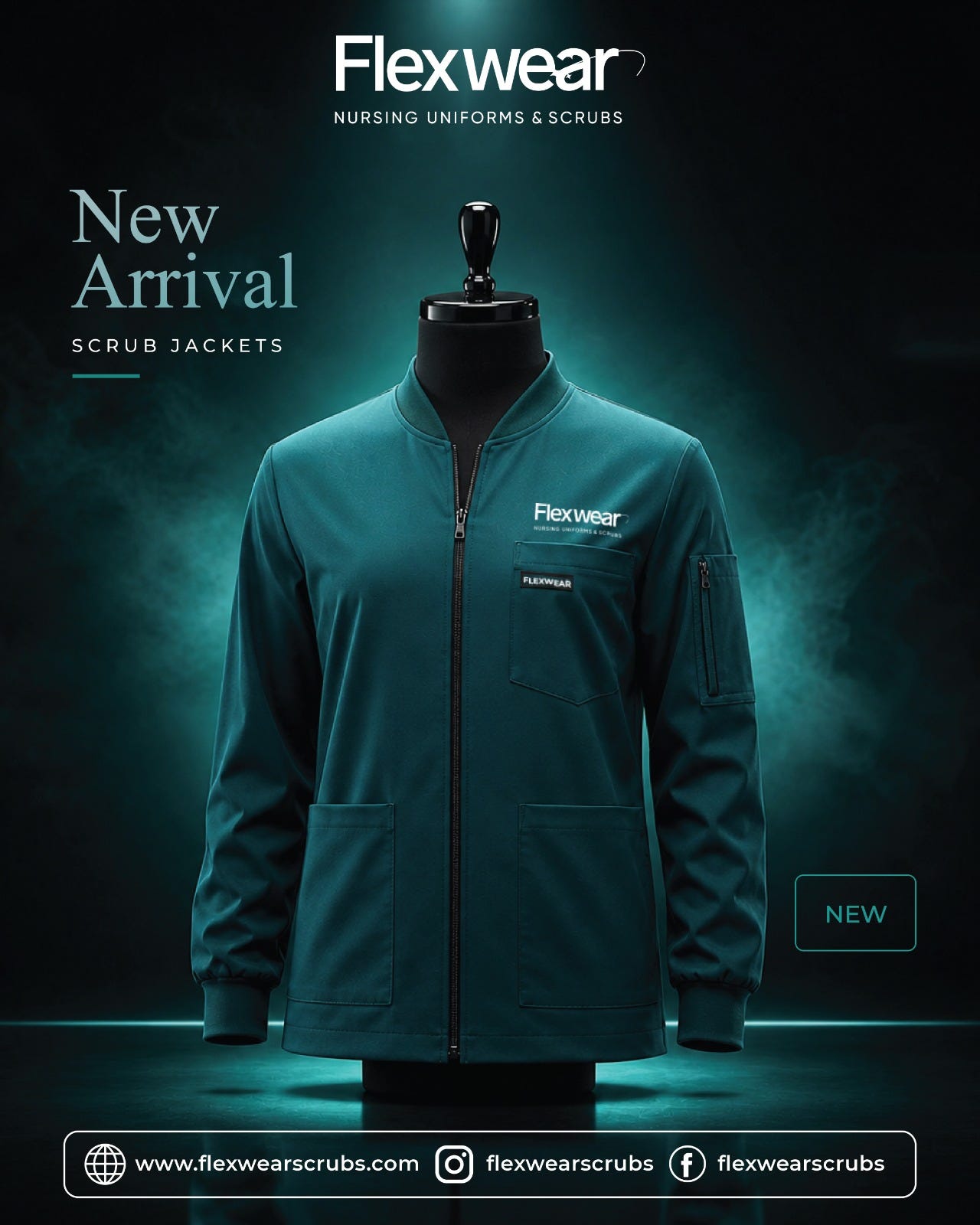
Fabric That Breathes and Lasts
The fabric of your scrub jacket determines how comfortable you feel across an eight to twelve hour shift. A cotton-polyester blend — typically around 65% polyester and 35% cotton — is the most common choice for good reason. It is breathable enough to prevent overheating, durable enough to hold its shape after repeated washes, and resistant to the heavy creasing that pure cotton develops by mid-shift.
For staff in high-movement roles such as theatre, physiotherapy, or emergency care, a stretch fabric is worth the investment. Four-way stretch material moves in every direction with your body, reducing the pulling sensation you get when reaching across a patient or lifting equipment. Moisture-wicking fabric is another strong option for busy clinical environments — it pulls sweat away from the skin and allows it to evaporate, which keeps you feeling fresher for longer.
Antimicrobial fabric treatments are increasingly available across the UK scrub jacket market. These treatments inhibit bacterial growth within the fabric, which is an added layer of protection in environments where infection control is a daily priority.
Pocket Placement and Depth
Pockets are one of the most practical reasons healthcare workers choose to wear a scrub jacket over a basic tunic top. The best designs include at least three to four external pockets — a chest pocket for pens and small tools, side pockets deep enough to hold gloves or a small notebook, and ideally a utility pocket with a loop for scissors or a pen torch.
Pay attention to pocket depth. A shallow pocket loses items the moment you bend forward. A well-designed scrub jacket has pockets that sit at a comfortable depth — typically around twenty centimetres — so that nothing falls out when you crouch or reach across a bed.
Some newer designs are also incorporating internal pockets for carrying a phone securely. This is particularly useful in settings where staff need quick access to a mobile device without leaving it exposed on a surface.
Durability for Daily Clinical Use
A scrub jacket in a clinical setting typically goes through the wash after every single shift. That means fifty to sixty washes in a year at minimum, often more. Poor-quality stitching at the seams and pockets will begin to break down within a few months under that kind of pressure. Reinforced stitching at all stress points — particularly the pocket seams, underarm, and cuffs — is a clear indicator of a jacket built to last.
Look for jackets with rib-knit or elasticated cuffs. These hold their shape even after dozens of washes, and they make it much easier to push your sleeves up during handwashing — an action you will carry out dozens of times every shift. A cuff that sags or stretches out after a few weeks becomes both a hygiene concern and an irritation.
Easy-Care and Wrinkle-Resistant Finish
Polyester-blend fabrics generally resist wrinkles far better than cotton-heavy alternatives. A scrub jacket that comes out of the dryer looking neat saves you time and effort before every shift. Wrinkle-resistant finishes are worth looking for if your workplace expects a smart, uniform appearance.
Always check the care label before buying. The best scrub jackets are machine washable at 40°C to 60°C, tumble dryer safe on a low heat setting, and do not require ironing under normal circumstances. These practical features matter a great deal when you are washing your uniform every day.
Fit and Silhouette
The silhouette of a scrub jacket affects both your comfort and how professional you look on the ward. Traditional boxy cuts are still available and popular among staff who prefer a relaxed feel. Tailored cuts follow the shape of the body more closely and give a sharper appearance that many senior clinical staff prefer. Athletic or athletic-inspired fits split the difference — they are shaped without being restrictive, and they tend to work well for staff who move frequently.
A zip-front or snap-button fastening gives you a clean, professional line at the front. Full-zip designs are the most popular because they are easy to open and close with one hand, which matters when you are carrying something in the other.
How to Choose the Right Size Scrub Jacket
Buying the wrong size scrub jacket is one of the most common and easily avoided mistakes UK healthcare workers make. The sizing on a scrub jacket does not always match what you expect from everyday clothing — and it is not just about being too big or too small. A poor fit affects your movement, your comfort, and even your hygiene practice.
Take Accurate Measurements First
Before looking at any size guide, take three measurements: your chest, waist, and hips. Use a soft tape measure and take each measurement while wearing the layers you would typically wear underneath your jacket — a base layer or underscrub top. These inner layers add real…Read more
메타데이터
- post_id
- eadd9ffcf44b
- slug
- the-complete-guide-to-scrub-jackets-choosing-the-right-fit-and-staying-ahead-of-the-latest-trends-eadd9ffcf44b
- url
- https://medium.com/@jonesdavid321789/the-complete-guide-to-scrub-jackets-choosing-the-right-fit-and-staying-ahead-of-the-latest-trends-eadd9ffcf44b
- canonical_url
- https://medium.com/@jonesdavid321789/the-complete-guide-to-scrub-jackets-choosing-the-right-fit-and-staying-ahead-of-the-latest-trends-eadd9ffcf44b
- author_url
- https://medium.com/@jonesdavid321789
- status
- ok
- fetched_at
- 2026-07-13 22:13:33


