What a 2,500-Year-Old Sage Knew About Burnout That We've Forgotten
Leave the easy way in
NAMASTE NOW!
What a 2,500-Year-Old Sage Knew About Burnout That We've Forgotten
Leave the easy way in
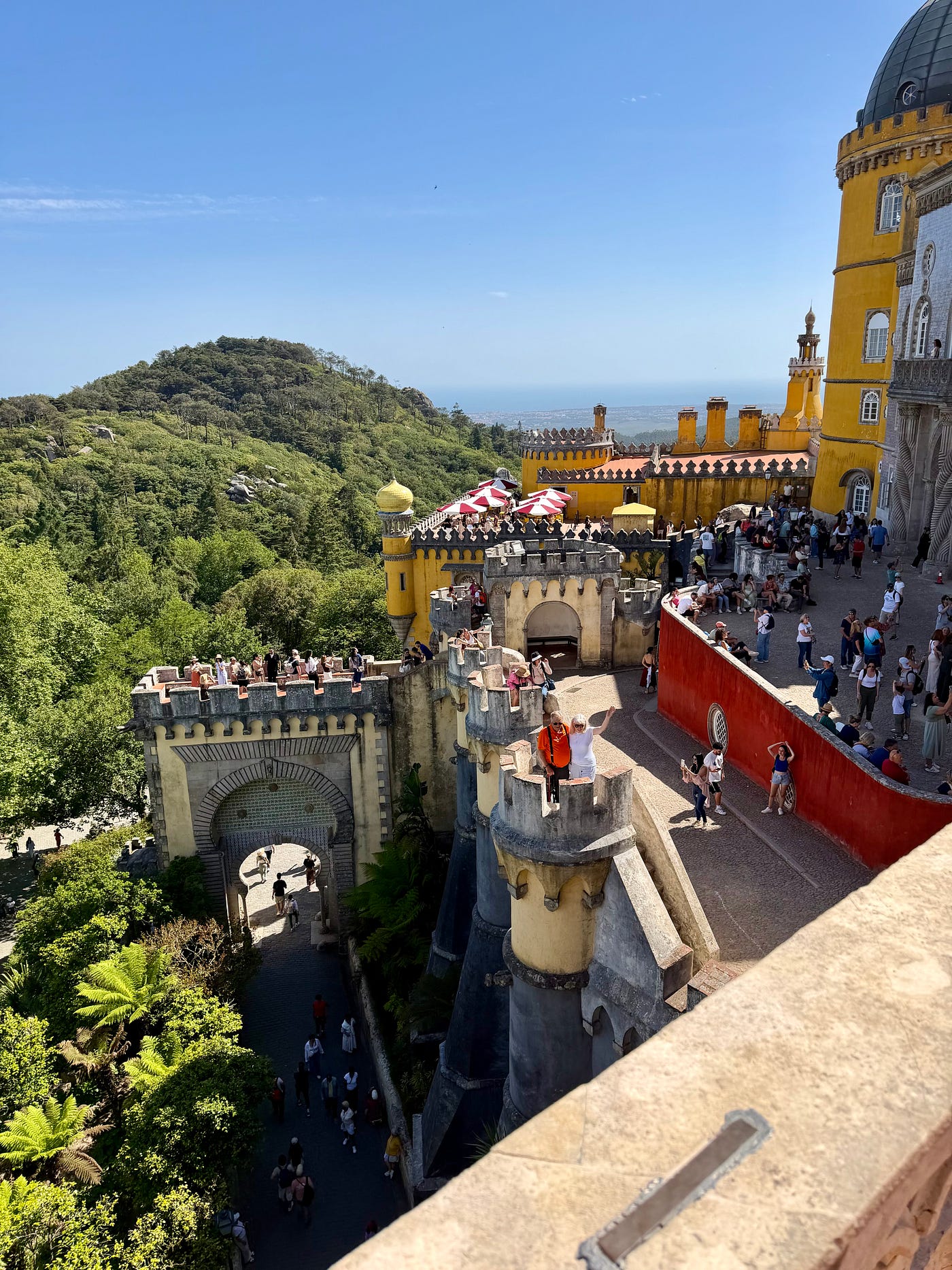
Finding joy in climbing mountains — Photo by the author’s wife
Circa 1979.
“Andy, you could be something if you’d apply yourself.”
“But, Ma, I don’t wanna burn out.”
Spring 2009.
“Hey, Ma! Look! I didn’t burn out,” I said, moments after successfully defending my PhD dissertation.
Present Day (Summer 2026).
I’m sitting in our Airstream watching the sunrise from Moose Island typing up a story about ease. Across the table, my wife is lounging with her legs stretched out along a bench seat. She’s working, checking emails, and planning adventures. Both dogs are snoozing at her feet.
By day, I’m a commercialization advisor for brilliant medical innovators in translational research programs for the National Institutes of Health (NIH) and the Defense Advanced Research Projects Agency (DARPA).
Also by day, I ride bikes.
What I love more than anything is sharing a meal with family and friends.
Yesterday, a former student called. He was seeking career advice. He’s all grown up, married with children, and navigating an already successful career. I love these calls. Sometimes, when we’re done talking, I well up. It feels good in every direction.
I’m making a positive impact on the world. At least, it feels that way. And what more could I ask for from this life?
My phone rings often. The calls, texts, and emails come from a wide range of students and sometimes parents. They’re high schoolers wondering what degree to pursue, college kids asking for career advice, and, like in this case, alums asking deeper questions.
All of this pro bono mentorship is sponsored by my day job.
It’s a win-win.
The most fundamental question I get asked often is along the lines of, “How did you get where you are?”
Back in 1979, I could not have dreamed up the career I have today. As a kid, all I cared about was girls, bikes, fun, friends, and freedom.
As I got older, I kept my eyes on the prize. Girls, bikes, fun, friends, and freedom. But I did add one more thing. Purpose.
I suppose the real difference between pre-purpose and post-purpose was seeing how being totally selfish can end up in losing myself and hurting others. That’s a really long story.
In short, I lost the girl. Realized I was an asshole. Sank into a multi-year depression. And woke up realizing that my actions impact other people. I could live my days hurting people, like I did with my ex-girlfriend. Or, I could live my days helping people.
I was twenty years old when I dedicated my life to teaching.
But other than that purpose, I didn’t have a plan for my career. I still prioritized girls, bikes, fun, friends, and freedom.
Today that’s slightly modified. Girl, bikes, fun, friends, family, and freedom.
And purpose.
“I’m unclear how any of this is helpful,” remarks the student who is seeking a blueprint to success.
Well my first question is, “How do you define success?”
Before I go any further, I must interrupt myself.
For the most part, these first few paragraphs sound so very braggadocious. Maybe to tone it down a notch. As good as my life looks on Instagram, I’m by no means wealthy with money. My retirement isn’t much to brag about. We live in an 1100 square-foot house with no garage and (gasp!) only one refrigerator. I don’t have a sports car and Abby and I have never been on a European vacation together, nor sat on a beach in a tropical resort.
We both work. And we both work hard.
What we do, though, is face our hard work with ease. And that, my friends, is what this essay is all about.
Braggadocious or not, I can only report the facts. I get emails, texts, voicemails, Facebook chats, and LinkedIn requests on the regular asking me for college and career advice.
I can only guess that if they’re asking for my opinion, they must like the way I live and appreciated the advice I’ve given.
This, whatever it is I’m writing, is not to brag, but to share. I don’t believe in any one right way to live, nor one definition of success. Maybe that’s one of the biggest keys to happiness, to figure out for oneself what defines success.
I imagine it’s different for everyone, yet, it seems like so many people are chasing the same definition.
If I have a day where I laugh and cry, where I hug, eat a meal with someone I love, do meaningful work, and have fun, that’s a successful day.
If I have a life that brings light to the world, that’s a successful life.
Money is part of that. But it’s table stakes, not the prize.
How I got to where I am is as simple as the answer I gave my mom when I was getting left back in grammar school and waffling through middle school. It’s the same answer I gave my mom when taking no AP courses in high school. It’s the same answer I gave my mom when dropping out of one college to start all over at another.
My three decades from grammar school to PhD are longer than most. I also worked nearly the entire time. I had a paper route starting in third grade. From middle school through high school I had so many jobs I’ve lost count. I cleaned dishes, then cooked, then ran the register, then managed a Mexican restaurant. I helped open a pizza joint. I worked a summer as a school janitor. I was a cheese grater. Have you ever seen a giant wheel of parmesan cheese? Have you ever seen a tub of grated parmesan? I helped the cheese make that transition.
In college I worked third shift. I had to get a secret security clearance while living in a frat house to work quality control in a trident nuclear warhead navigation system government contracting company. I worked in the New York City movie and TV business as a set dresser and property person.
Mowing lawns. Shoveling driveways. I did whatever I had to do to be free.
Let’s recall what I care about.
Girl(s), bikes, fun, friends, family, freedom, and purpose.
Those jobs were to enable freedom. Sure. They were for money.
The takeaway here is that I wasn’t burning out over school. I also wasn’t burning out over work.
I went to school. I made money. I dated girls, rode bikes, had fun, hung out with friends and family. I maintained my freedom. I had a purpose (after the heartbreak then depression then existential discovery).
The bottom line is that answer I gave my mom all along this journey.
“But, Ma, I don’t wanna burn out.”
Said another way:
Act through nonaction; Handle affairs through non-interference, Taste what has no taste, Regard the small as great, the few as many, Repay resentment with integrity. Undertake difficult tasks by approaching what is easy in them; Do great deeds by focusing on their minute aspects. All difficulties under heaven arise from what is easy. All great things under heaven arise from what is minute. – Dao De Jing Chapter 63 translation by Victor Mair
These words attributed to the Chinese Sage Lao Tzu are among the oldest philosophical texts in the world, written around the 6th century BCE.
I’m just dreaming two and a half millennia into the future, an archeologist uncovers my hard drive. Hahahaha.
No one had to teach me what the sage and English translator so eloquently communicate. The babe knew.
I believe the sage would agree.
No one teaches a bird to fly nor a tree to grow. They just know what to do. I trust innocent Andrew. He didn’t want to burn out. He figured out how to take on difficult tasks by finding what is easy in them.
What has taken me a lifetime to figure out, and I’m still working on it, is how to communicate this.
Indeed, there’s a big difference between doing hard things with ease versus taking the easy way out. The sage does imply both.
That last line of this chapter is all of Atomic Habits by James Clear in ten words: All great things under heaven arise from what is minute.
It’s the line before that which gives the trap we see so many people fall into. All difficulties under heaven arise from what is easy.
It sounds like a paradox. And, indeed, all great things are paradoxical.
If I were to repeat these two lines in today’s jargon, I’d say:
Don't take the easy way out. Leave the easy way in.
How’s this different?
Consider a hiking (or, in my case, mountain biking) analogy:
The shortest distance to the peak may result in burnout and be perilous.
Taking switchbacks is one option to face this challenge with ease.
Taking the easy way out removes the options. The result is either/or. Either take the shortest distance or don't make the climb.
So what I believe the sage is trying to tell us here is that by taking the easy way out, we are simply avoiding the hard thing. All difficulties under heaven arise from avoiding hard things.
But facing hard things takes creativity in order to accomplish them with ease.
And this, my friends, is why the area of my teaching is in design, innovation, and entrepreneurship. These are the creative tools to face hard things with ease.
But these practices could just as easily fall into the trap that Lao Tzu warns us about. Creating easy ways out.
My motivation to communicate this was born from heartache. I was twenty years old when I dedicated my life to teaching. And now looking back on a thirty-year career in advising, I realize that all of my lessons are born from love.
What continues to break my heart today is witnessing the burnout of children of all ages. Parents have their kids on a hamster wheel of activities. They start children on the pre-college path in preschool. Meanwhile, the adults in the room are burning the childlike joy out of their own lives.
Popular podcasters are urging twenty-year-olds to work their asses off because that’s when they have the stamina to run to the front of the line. The entrepreneurship culture in America is all about burning the candle at both ends to build scalable businesses that make the rich richer.
Meanwhile, our society is doing all it can to build conveniences that take the easy way out. People are like ants on an escalator. They’re in lines at the airport, stuck in bumper-to-bumper traffic, and spending more time with AI than they are with nature.
It looks to me like we’re doing exactly what the sage warned us against and guided us to. The conveniences that take the easy way out of doing hard things are the sources of our struggles. We’re failing to leave the easy way in. To face challenges with ease.
So let me ask you this, children of all ages, what makes you happy?
My answer screams to the heavens. “But, Ma, I don’t wanna burn out.”
I make time every day to play. I’ve taken the time to define my complete day.
If you care to know how I got here. The best answer I have is, “I didn’t.”
I’m enjoying the journey. And I still am.
Thank you for reading.
Thank you to Paul Dotta for the Dao De Jing Chapter 63 translation by Victor Mair.
Thank you Vidya Sury, Collecting Smiles for working with me on this essay.
Health, happiness, kindness, respect for every being and all things.
— Andrew

Read, listen, and support my work: linktr.ee/andrewdimeo

Thanks for reading 💕 Just follow Namaste Now! to join us as a writer. Read the submission guidelines and submit your draft. I welcome personal stories and memoirs related to self-awareness, life lessons, travel, parenting, and wellness. Ah, also well-written book reviews. Please avoid boring rants about life or politics.
메타데이터
- post_id
- eade5256e5bd
- slug
- what-a-2-500-year-old-sage-knew-about-burnout-that-weve-forgotten-eade5256e5bd
- url
- https://medium.com/namaste-now/what-a-2-500-year-old-sage-knew-about-burnout-that-weve-forgotten-eade5256e5bd
- canonical_url
- https://medium.com/namaste-now/what-a-2-500-year-old-sage-knew-about-burnout-that-weve-forgotten-eade5256e5bd
- author_url
- https://medium.com/@andrewdimeo
- status
- ok
- fetched_at
- 2026-07-22 01:48:56