Tech Series: The Secret Codes that Run the Modern World
Every AI prompt you send, every video you stream, and every photo you take exists because humanity has learned to etch billions of patterns…
Tech Series: The Secret Codes that Run the Modern World
Every AI prompt you send, every video you stream, and every photo you take exists because humanity has learned to etch billions of patterns onto a tiny piece of silicon, also known as a chip or integrated circuit (IC), no bigger than a fingernail.
But hidden inside each chip is a quiet and constant battle.
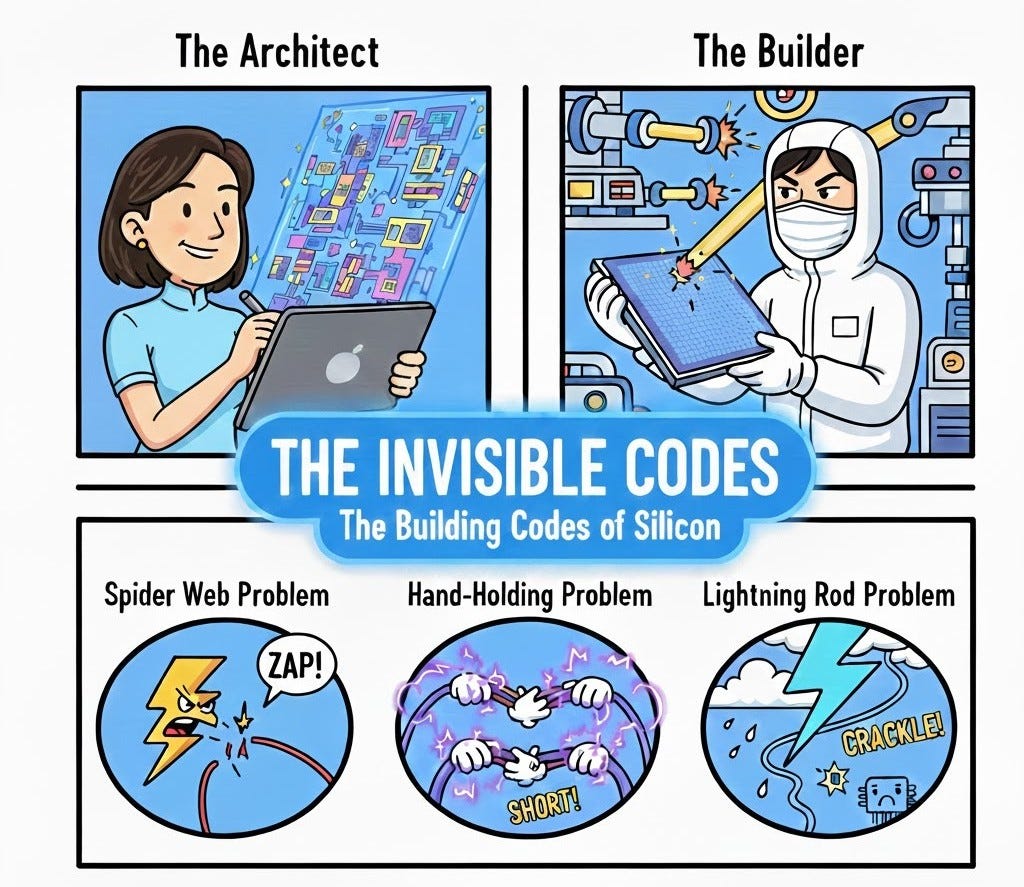
In the semiconductor world, we refer to it as the Architect versus the Builder.
The Architect vs. The Builder 📐🧱
In this microscopic universe, there are two main characters:
The Architect (a.k.a. the Chip Designer) 👩🏻💻
The Architect lives in a digital world. Sitting in front of powerful computers and EDA (Electronic Design Automation) tools, they draw circuits that chase the holy trinity of chip design:
- Lower Power (energy efficiency)
- Higher Performance (speed, data throughput)
- Smaller Area (no wasted space)
This is especially true for modern AI chips: ASICs (like TPUs), GPUs, NPUs, and FPGAs, where every nanosecond and every milliwatt matters.
In the Architect’s ideal world, anything that improves PPA should be allowed.
2. The Builder (a.k.a. the Fab or Foundry) 🏭
The Builder lives in the real world.
They work with chemicals, extreme ultraviolet (EUV) light, plasma, and mechanics, all bound by unforgiving laws of physics. Their job is to turn those perfect digital blueprints into real silicon, atom by atom.
And physics, unfortunately, is not always polite.
The Architect walks in with “perfect” designs. The Builder knows what actually survives manufacturing.
The Invisible “Building Codes” of Silicon
So how do these two worlds meet?
Through something called Design Rule Check (DRC).
Think of DRC as the building codes of the semiconductor world. These rules are non-negotiable. They exist to ensure a design can actually be manufactured and still work.
Ignoring them doesn’t just cause small problems. It can turn a multi-million-dollar chip into instant scrap.
Let’s look at three of the most common rules that appear in almost every chip design.
The “Spider Web” Problem: Minimum Width Rule🕸️
The Architect wants wires as thin as possible to save space.
The Builder knows that if a wire is too thin, it becomes as fragile as a single strand of spider silk.
During fabrication, ultra-thin wires may break during etching or behave like tiny fuses once current flows. When that happens, the wire becomes an open circuit.
And just like that, the skyscraper collapses before anyone (imagine an electron) even moves in.
2. The “Hand-Holding” Problem: Minimum Spacing Rule🤝
This is the most common negotiation.
The Architect wants everything packed tightly together. The Builder insists on “social distancing” for electrons.
If two metal lines are too close:
Copper can bleed together during manufacturing Or electricity can jump the gap When wires start “holding hands,” you get a short circuit. Signals leak. Data gets corrupted. And your cutting-edge chip becomes a very tiny, very expensive paperweight.
3. The “Lightning Rod” Problem: Antenna Rule⚡
This rule feels almost magical until you see it happen.
During manufacturing, chips are exposed to plasma (electrically charged gas).
If the Architect designs a long, winding metal wire connected to a delicate transistor, that wire acts like a lightning rod. It collects charge from the plasma, storing more and more energy.
Once the charge gets too high, it discharges straight into the transistor, “zapping” it before the chip even leaves the factory.
The Silicon Frontier: Why We Keep Pushing
These invisible building codes aren’t there to frustrate designers. They are the only reason modern electronics exist at all.
As we push toward 2nm and beyond (these numbers are marketing terms, not literal transistor sizes), the Builder must invent entirely new fabrication techniques, and the Architect must learn how to design within ever-tighter constraints.
At this point, we’re no longer just optimizing gadgets. We’re negotiating with the fundamental limits of atom by atom.
Understanding design rules is like learning the grammar of the future. It’s how we turn sand into machines that can think.
Life is also similar to these Building Codes
Just like minimum spacing rules keep wires from short-circuiting, sometimes life requires distance and boundaries so we don’t burn out or get tangled in others’ expectations.
Minimum width rules ensure each line is strong enough to survive the harshness of manufacturing. We, too, need a solid base, routines, rest, and self-belief so we don’t collapse under pressure.
Antenna rules exist because long metal paths can collect too much charge and snap under sudden stress. In life, when we carry too many unresolved worries, we might discharge at the wrong moment. That’s why grounding through connection, mindfulness, and support can keep us whole.
Conclusion
“What is a design rule? Is the job closer to design or to fab?” These were the questions I asked every interviewer during my interview process. Some of them said, “Yes, it’s close to design,” while others said, “It’s something in the middle.” My manager told me, “We are working on rules to help the fab.”
However, no one truly explained the relationship between these two until I dug deeper myself. Sometimes, real understanding only comes when curiosity is paired with a little skepticism — and you find the answers in your own way.
Hope you all like this article. Stay Bosanova 💛
With love, Carol 🌿✨
메타데이터
- post_id
- eadee65e9940
- slug
- tech-series-the-secret-codes-that-run-the-modern-world-eadee65e9940
- url
- https://medium.com/@basanova.one/tech-series-the-secret-codes-that-run-the-modern-world-eadee65e9940
- canonical_url
- https://medium.com/@basanova.one/tech-series-the-secret-codes-that-run-the-modern-world-eadee65e9940
- author_url
- https://medium.com/@basanova.one
- status
- ok
- fetched_at
- 2026-07-08 14:06:06