Mathematics That Actually Matters for AI
What changed when I stopped just running models and started understanding them
Mathematics That Actually Matters for AI
What changed when I stopped just running models and started understanding them

*Image generated using AI
When people ask how to get into AI, the most common answers are:
- “Learn Python.”
- “Do projects.”
- “Follow a YouTube playlist.”
- “Kaggle.”
I fell in love with AI quite early. And I did do all of the above.
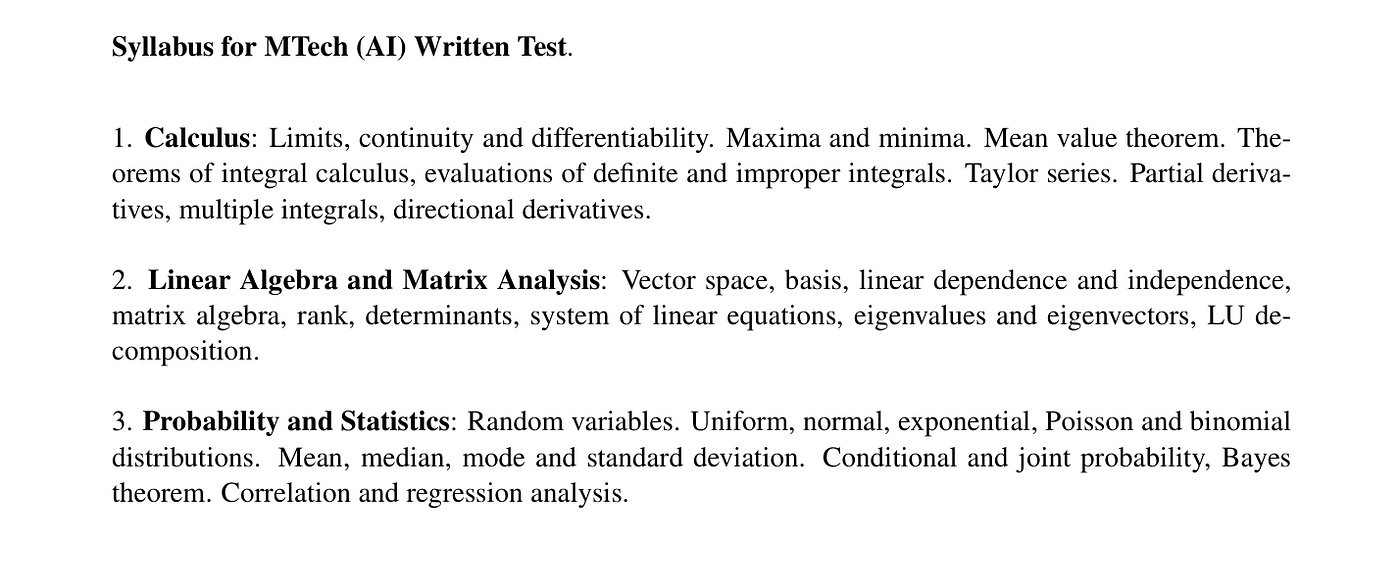
After four years of studying machine learning during my B.Tech, completing a Minor in Applied & Computational Mathematics, and preparing seriously for GATE Data Science & AI, I can confidently say:
The real barrier in AI isn’t coding. It’s mathematical maturity.
You can build models without deep math. But you cannot understand them without it.
I could implement models much earlier. But understanding what was actually going on inside them, why they worked, when they failed, what they assumed, took much longer.
And understanding is what separates surface-level learning from serious practice.
Once you truly understand the math, AI stops being magic.
I’m not an expert. But I did spend almost five years being confused, curious, and quite often mind-blown.
This isn’t a checklist of topics. This is what actually mattered for me and what changed the way I see AI.
The First Illusion: “If It Runs, I Understand It”
Early on, I could:
- Implement linear regression
- Train a neural network
- Use scikit-learn
- Tune hyperparameters
Everything worked.
The loss decreased. Accuracy improved. Graphs looked impressive.
I felt happy. And a little smart.
But then someone (sometimes even myself) would casually ask:
- Why does regularization reduce variance?
- Why does PCA actually reduce dimensionality meaningfully?
- Why does gradient descent converge… and sometimes not?
And I would pause.
That pause was uncomfortable.
But it was also the beginning of real learning.
Because that’s when I realized: running code ≠ understanding models. And that realization was exciting. It meant there was something deeper to uncover.
Linear Algebra
When Vectors Became Real
I “did” linear algebra in my second year of B.Tech.
I solved determinants. Reduced matrices to row-echelon form. Found eigenvalues like a machine.
It felt procedural.
I could solve problems. But I wasn’t seeing anything.
Then machine learning happened.
Suddenly:
- Data points were vectors
- Features were dimensions
- Models were linear transformations
- PCA was about projections
- SVD kept showing up everywhere
And something started shifting.
But the real clarity hit me later, especially during my GATE preparation. When I had to revisit everything from first principles. Slowly. Carefully. Without shortcuts. That’s when it clicked.
The moment that changed everything for me was when I stopped seeing matrices as grids of numbers and started seeing them as transformations of space.
That perspective flip made the subject beautiful.
Eigenvectors weren’t just solutions to equations anymore. They were special directions that don’t rotate under transformation.
PCA wasn’t a scary algorithm with steps to memorize. It was simply finding the direction where the data spreads the most.
SVD wasn’t intimidating. It became structured decomposition: peeling a matrix apart into rotations and stretches. Breaking complexity into clean, meaningful pieces.
And I remember pausing at some point and thinking: “Oh! This is actually elegant.”
That shift from mechanical computation to geometric intuition made ML feel alive!
Probability
When Uncertainty Made Sense
Probability truly humbled me.
The probability I studied during JEE and the probability I encountered while studying AI had a world of a difference.
At first, it felt like an endless forest of PDFs, CDFs, integrals, distributions and so many formulas!
But slowly, something started connecting.
Every ML model I loved was secretly built on probability assumptions.
Linear regression? Assumes Gaussian noise. Logistic regression? Maximum likelihood. Naive Bayes? Conditional independence. Cross-validation? Sampling theory in disguise.
A random variable is not “a random number.” It’s a function.
Likelihood is not probability. Probability asks: “Given parameters, how likely is this data?” Likelihood flips it: “Given this data, how plausible are these parameters?” That reversal felt subtle. But it completely changed how I saw model training.
Maximum likelihood isn’t a trick. It’s just: “Choose parameters that make the observed data least surprising.” That idea made logistic regression and neural networks feel conceptually unified.
Such “click” moments came often and eventually changed everything.
Expectation became more than a formula, it became an operator. Variance became a measure of uncertainty, not just σ². Bias–variance tradeoff stopped being a diagram and started feeling intuitive.
And Bayes’ theorem? It transformed into this cool idea: “Update your beliefs when new evidence arrives.”
Probability became so much more than statistics and calculating numbers! It became about modeling uncertainty. It became about assumptions and reasoning.
Probability started feeling like the foundation of AI itself.
Calculus
The Engine Behind the Curtain
Backpropagation used to feel magical.
Loss decreases. Accuracy increases. Gradients do… mysterious things.
Then I studied multivariable calculus properly.
Gradients are directions of steepest increase. Gradient descent is just careful downhill walking. Taylor series is local approximation.
Backpropagation: The chain rule repeated patiently.
The “AI magic” was calculus wearing a cool outfit. 😎
Once I understood convexity, curvature, and saddle points, I stopped blindly tweaking learning rates.
I started asking: Is the surface flat here? Is this exploding because of curvature?
The models didn’t change, my way of thinking did.
That made the process more fun!
Statistics
The Quiet Reality Check
Statistics isn’t flashy. It doesn’t have the drama of deep learning.
But I think it’s the part that keeps your ego in check. It’s the part that quietly asks: “Are you sure?”
I learned that:
- Small datasets lie confidently
- A 2% accuracy improvement might be noise
- Overfitting is sneaky (It smiles during training and fails in the real world)
- Confidence intervals actually matter
For a long time cross-validation was just “a step in the pipeline.” Split. Train. Validate. Done. But eventually, it became a reality check.
Statistical thinking didn’t make me faster. It made me slower, in a good way. More grounded. More careful. More honest with my results. And surprisingly, more confident because I finally understood what my model didn’t know.
The Real Lesson: Mathematical Maturity
It’s not as intimidating as it sounds.
It’s not about solving 1000 sums.
It’s about:
- Being okay with not understanding something immediately
- Sitting with confusion without quitting
- Connecting ideas across subjects
- Seeing the same concept from algebraic, geometric, and probabilistic angles
There were days I felt a little lost. But every time I stayed with the confusion instead of escaping it, something clicked later. And those clicks are addictive!
Slowly, AI stopped feeling like a collection of tricks. It started feeling like applied mathematics. And that was way more satisfying.
Final Thoughts
Coding is important, but it’s the surface layer.
Math feels hard because it builds structure in your head. And structure can take time.
If something feels magical, you probably haven’t understood it completely yet. The confusion is not a sign you’re bad at it. It’s a sign you’re learning.
I don’t think this field requires you to be a math genius. But you do need curiosity. And patience. And the willingness to ask “why?” a little more often.
If you’re starting out, here’s something that helped me: Don’t just ask, “Which framework should I learn next?” Sometimes ask, “What is this model assuming?”
That question made AI deeper for me.
And we’re living in the best time to learn this. With the tools available to us now, learning deeply is more accessible than ever.
You can ask questions endlessly. You can revisit fundamentals. You can demand clarity. You can explore different explanations until something finally clicks.
And honestly? I’m still learning. Still getting confused. Still having those click moments. And still falling in love with mathematics and AI all over again.✨
메타데이터
- post_id
- eae65678dd77
- slug
- mathematics-that-actually-matters-for-ai-eae65678dd77
- url
- https://medium.com/@aditib259/mathematics-that-actually-matters-for-ai-eae65678dd77
- canonical_url
- https://medium.com/@aditib259/mathematics-that-actually-matters-for-ai-eae65678dd77
- author_url
- https://medium.com/@aditib259
- status
- ok
- fetched_at
- 2026-07-14 12:23:01