What Happens After the Earthquake?
What UNICEF’s Emergency Briefing Revealed About Protecting Children and Coordinating Humanitarian Response in Venezuela
What Happens After the Earthquake?
What UNICEF’s Emergency Briefing Revealed About Protecting Children and Coordinating Humanitarian Response in Venezuela
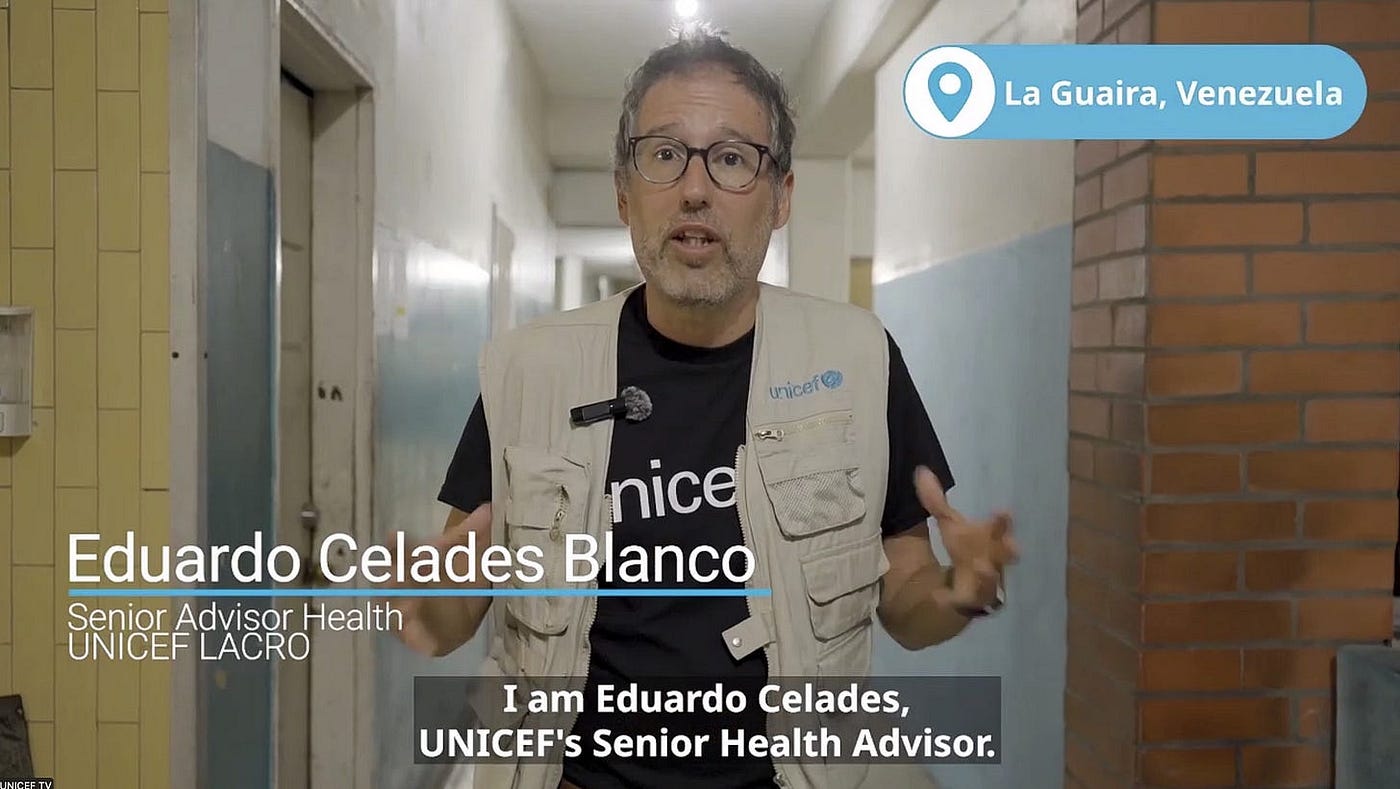
UNICEF Senior Health Advisor Eduardo Celades Blanco speaking from La Guaira during UNICEF’s emergency briefing on the response to the Venezuela earthquakes.
Natural disasters often dominate the news in the first few days. We see images of collapsed buildings, rescue teams and families searching through the rubble. But after attending UNICEF’s emergency briefing on the recent earthquakes in Venezuela, I left thinking about something different.
The earthquake may have lasted only seconds, but for the communities affected, the real challenge is only beginning.
Throughout the briefing, UNICEF colleagues working both on the ground and across the region explained how a disaster quickly becomes much more than a collapsed building or a damaged road. Once essential services stop functioning, every aspect of daily life becomes more difficult.
One issue that particularly caught my attention was access to clean water. Damage to water systems means many families no longer have reliable access to safe drinking water, increasing the risk of waterborne diseases. It was a reminder that in humanitarian emergencies, something as basic as clean water can become one of the most urgent lifesaving needs.
The discussion also highlighted how emergencies affect people differently. While everyone experiences loss, some groups require immediate attention from the very beginning. UNICEF teams are prioritizing pregnant women, children and people requiring urgent medical care, ensuring they continue receiving essential health services despite the disruption caused by the earthquake.
Another part of the briefing that I found especially interesting was learning about the logistics behind humanitarian response. Before this session, I hadn’t fully appreciated how much preparation happens behind the scenes. UNICEF explained that emergency supplies — including medical materials, water and sanitation equipment, and tents — were rapidly mobilized from its warehouses in Panama and Copenhagen. It was a reminder that an effective humanitarian response depends not only on people working in affected communities, but also on global supply networks capable of moving assistance where it is needed most.
What stayed with me most, however, was not a statistic or a logistical detail.
It was a sentence shared during the closing remarks:
“The work for us has just started.”
That simple sentence captured something we often forget. Public attention naturally focuses on the immediate aftermath of a disaster, but humanitarian organizations remain long after the headlines begin to disappear.
In the coming weeks, children will continue facing disrupted education, limited access to healthcare, unsafe water, displacement and the emotional impact of losing their homes or being separated from loved ones. Rebuilding communities is not only about repairing infrastructure; it is also about restoring the systems that allow people to live safely and with dignity.
The briefing reminded me that humanitarian action is, above all, a collective effort. Governments, UN agencies, local authorities, healthcare workers and humanitarian organizations all have different roles, but none of them can respond alone. Coordination, preparation and local partnerships are just as important as emergency supplies.
As someone interested in international cooperation, I found it valuable to hear directly from the professionals leading this response. Their perspectives offered a clearer understanding of what humanitarian work actually looks like beyond the headlines — and of the enormous effort required to protect the most vulnerable when disaster strikes.
When the earthquake stops, recovery doesn’t begin automatically. It has to be built, day by day, by the people who remain long after the cameras have left.
메타데이터
- post_id
- eaeeed4a17fa
- slug
- what-happens-after-the-earthquake-eaeeed4a17fa
- url
- https://medium.com/@sofhy9/what-happens-after-the-earthquake-eaeeed4a17fa
- canonical_url
- https://medium.com/@sofhy9/what-happens-after-the-earthquake-eaeeed4a17fa
- author_url
- https://medium.com/@sofhy9
- status
- ok
- fetched_at
- 2026-07-09 22:56:59