The Ghost Corridor of the Hidden Ocean
A hidden acoustic corridor may hold the last refuge for the ocean’s largest voices
The Ghost Corridor of the Hidden Ocean
A hidden acoustic corridor may hold the last refuge for the ocean’s largest voices
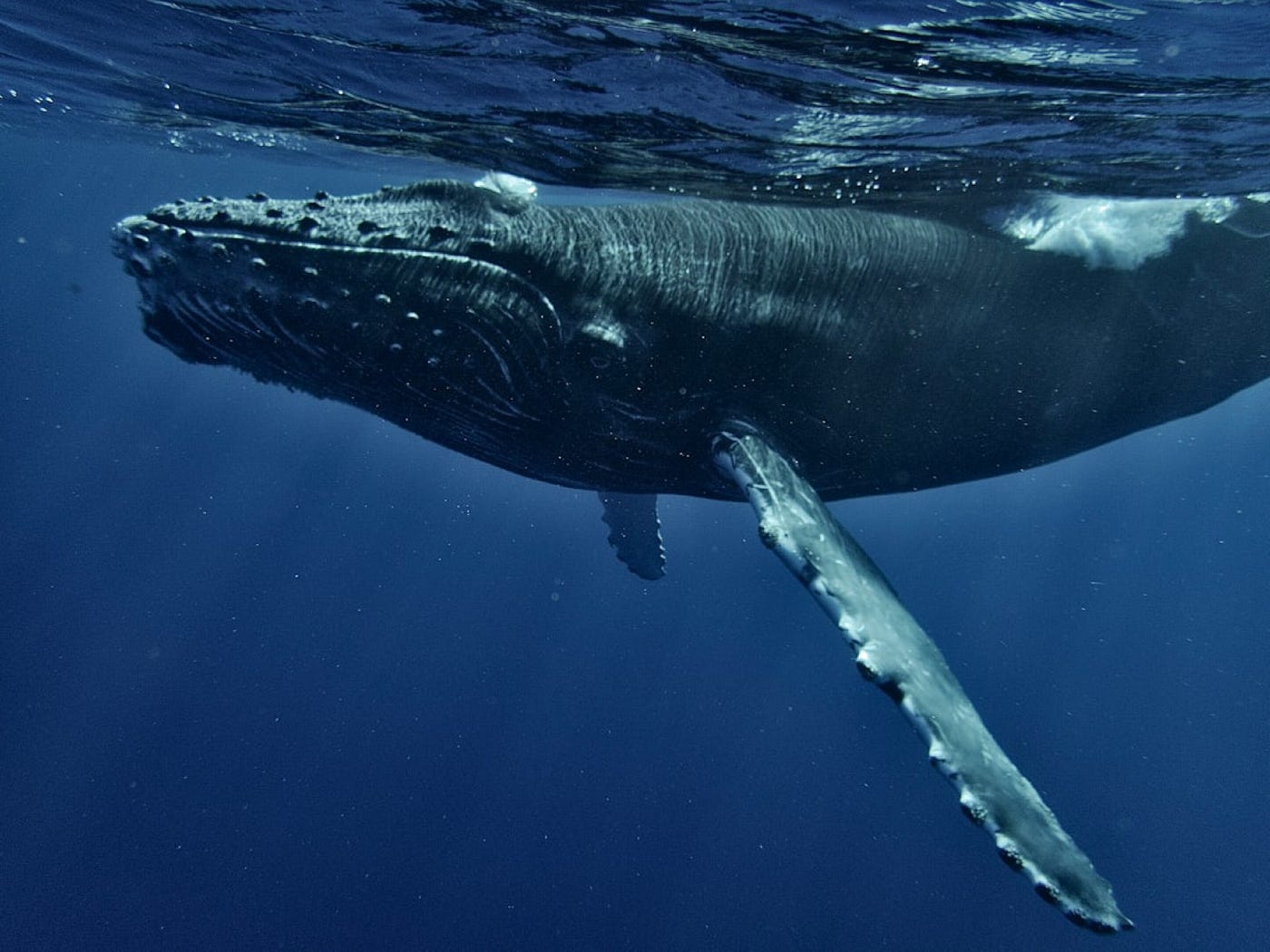
Photo by Chinh Le Duc on Unsplash
A 20-hertz pulse from a marine mammal enters the deep Atlantic, propagating through a stratum where the speed of sound reaches its minimum, where the acoustic signal bends back toward the axis of lowest velocity and rides an invisible corridor across the open ocean.
The corridor has a name, a Cold War relic: the SOFAR channel, for Sound Fixing and Ranging, a term for the depth at which acoustic velocity reaches its minimum. Fin whales and blue whales have been broadcasting through this waveguide for 30 million years, their infrasonic calls riding a stratum that the animals cannot see but have learned, across evolutionary time, to exploit with precision. No other species uses it at this scale. The calls carry reproductive signals, feeding coordinates, and navigational information across distances that exceed the migration routes of the callers themselves. A single fin whale pulse, generated at 189 decibels and centered near 20 hertz, once reached receivers 6,000 kilometers from its source.
That distance is shrinking, and new evidence from passive acoustic monitoring arrays deployed across the North Atlantic suggests that cumulative shipping noise has been compressing whale communication range at an accelerating rate since the 1960s.
Marta Romagosa, an acoustic ecologist at the University of the Azores who has directed the archipelago’s baleen whale monitoring program since 2012, checks spectrogram archives each morning before the research station opens, scrolls through 16 hours of compressed waveform, marks each fin whale 20-hertz pulse with a timestamp, logs the ambient noise floor in the same frequency band, and records the signal-to-noise ratio in a spreadsheet that now contains 43,000 entries. She keeps a second log for blue whale calls, a third for sei whales, a fourth for the broadband signature of container ships transiting the mid-Atlantic ridge.
The SOFAR channel acts as a natural waveguide for low-frequency propagation. Between 600 and 1,200 meters below the surface, depending on latitude and season, the interplay of declining temperature and increasing hydrostatic pressure creates a trough in the sound-speed profile. Pulses entering this trough refract continuously back toward the axis of minimum velocity, tracing sinusoidal paths that neither strike the seafloor nor breach the surface. Maurice Ewing and J. Lamar Worzel first confirmed its existence in 1944, when a four-pound explosive charge detonated 900 nautical miles from a receiver arrived as a sharp, unmistakable signal aboard a sailing vessel off Woods Hole.
Since then, the channel has revealed a deeper function that extends far beyond military applications. Baleen whales produce calls between 10 and 200 hertz, frequencies that propagate with minimal loss inside the SOFAR waveguide. Fin whale song consists of repeated 20-hertz pulses, each lasting roughly one second, separated by intervals of 10 to 25 seconds (a pattern so regular that Navy technicians initially attributed the signals to Soviet submarines and dubbed the unknown source the “Jezebel Monster”). Only male fin whales produce the 20-hertz pulse, suggesting a reproductive function. Blue whales generate A-calls and B-calls below 20 hertz, beneath the threshold of human hearing, at source levels between 155 and 189 decibels.
The calls serve more than reproduction, and their regularity and basin-scale propagation suggest a social architecture that depends on acoustic continuity across hundreds or thousands of kilometers, a communication network embedded in ocean physics.
Romagosa, who joined the Azores observation network as a graduate student in 2008, records every call that crosses her hydrophone array, categorizes each detection by species and call type, cross-references each against vessel-traffic databases maintained by the International Maritime Organization, and calculates a monthly index she calls the acoustic communication space (the estimated radius within which a whale’s call exceeds the noise floor by enough decibels to be detected by a conspecific). In 2009, the average communication space for fin whales off Faial Island measured roughly 900 kilometers. By 2023, the space had compressed to under 500 kilometers. The noise floor had risen while the source levels of whale calls had not changed.
The source of this compression is cumulative and driven by the global expansion of commercial shipping. Propeller cavitation, engine vibration, and hull turbulence produce broadband noise concentrated below 200 hertz, the same band that baleen whales use to communicate. A single large container vessel radiates sound at 180 to 190 decibels. The global merchant fleet numbered roughly 55,000 vessels in 1990 and exceeded 105,000 by 2024. Satellite altimetry confirms that ship density quadrupled across all ocean basins between 1992 and 2012, with the greatest increases in the Indian Ocean and the North Atlantic transit corridors that pass within 200 kilometers of Romagosa’s hydrophones.
The cost compounds on a logarithmic scale, and recordings made off San Nicolas Island in 1964 by the United States Navy established a baseline for low-frequency ambient noise in the deep ocean that reveals the magnitude of the change. When researchers at Scripps Institution of Oceanography redeployed hydrophones at the same site in 2003, they measured noise levels 10 to 12 decibels higher than the 1960s baseline, an increase averaging three decibels per decade. Because a three-decibel rise represents a doubling of acoustic energy, each decade of shipping growth halves the effective detection range of a whale call at a given source level. The shrinkage is relentless and cumulative.
A fin whale that could reach a receiver 1,000 kilometers away in 1960 reaches 500 kilometers in 1990, 250 in 2020. The mathematics is not disputed, yet what remains unknown is the behavioral threshold below which the acoustic network that holds a population together begins to fragment.
“The whales are not going deaf,” said Christopher Clark, who directed the Bioacoustics Research Program at the Cornell Lab of Ornithology for three decades and pioneered the use of United States Navy hydrophone arrays to track baleen whales across entire ocean basins. “The whales are being deafened by the world around them. The difference matters.”
Clark and his colleagues used the Navy’s Sound Surveillance System, called SOSUS (originally built to detect Soviet submarines), to track a single blue whale for 43 consecutive days across the North Atlantic. The animal navigated toward a seamount 300 miles distant, corrected course upon arrival, and steered toward a second bathymetric feature. Clark noted that whale behavior operates on a spatial framework defined not by a researcher’s instruments but by the animal’s own acoustic horizon, a horizon now contracting under cumulative anthropogenic noise.
Shipping is not the sole contributor to this contraction, and seismic airguns used in oil and gas exploration fire compressed-air pulses at intervals of 10 to 15 seconds for weeks at a time, generating impulsive noise at source levels exceeding 230 decibels. Because the energy concentrates below 100 hertz, a single seismic survey vessel can raise ambient noise levels across thousands of square kilometers. Research published in Biology Letters documented that blue whales in the St. Lawrence Seaway ceased producing D-calls during nearby seismic surveys, resuming only after the airgun arrays stopped firing, with behavioral suppression occurring at received levels well below the thresholds that regulatory agencies use to define harassment.
Offshore wind construction adds a newer acoustic layer to the channel. Pile driving for monopile foundations produces impulsive noise at source levels of 220 to 250 decibels, with energy concentrated below 1,000 hertz. Each hammer strike radiates sound that propagates tens of kilometers through the water column. The planned expansion of offshore wind in the North Atlantic includes over 30 gigawatts of capacity expected by 2030 in European and American waters, introducing construction noise into migratory corridors used by humpback, fin, and critically endangered North Atlantic right whales, a species with fewer than 380 individuals remaining.
The regulatory architecture governing these noise sources operates in isolated compartments, with no mechanism for assessing their combined effect on the acoustic environment. The International Maritime Organization sets voluntary guidelines for vessel noise but lacks enforcement mechanisms. NOAA’s Fisheries division manages marine mammal protections under the Marine Mammal Protection Act but cannot regulate vessel noise originating outside United States waters. The Bureau of Ocean Energy Management oversees offshore wind permitting and has proposed received-sound-level limits for pile driving, yet those limits apply only during construction, not to chronic operational noise. Military sonar falls under separate environmental review processes that rarely incorporate cumulative noise budgets from shipping or energy development.
No single agency measures the total acoustic load on the SOFAR channel.
“The noise problem is not any one source,” explained Holger Klinck, who directs the K. Lisa Yang Center for Conservation Bioacoustics at the Cornell Lab of Ornithology. “The noise problem is the sum, and no regulatory framework adds the sum.”
Klinck explained that his center deploys marine autonomous recording units, called MARUs, across the western North Atlantic to build this cumulative picture. The instruments sit on the seafloor for months at a time, recording continuously at sampling rates that capture the full frequency range of baleen whale communication. When recovered, each MARU yields terabytes of acoustic data processed through deep-learning classifiers developed in collaboration with New York University, algorithms trained to distinguish whale calls from ship noise, seismic pulses, pile-driving strikes, and the natural percussion of wind and rain.
The pattern of that loss indicates something specific about the mechanism driving the compression.
Romagosa’s Azores data tells the same story from a mid-ocean vantage point. The archipelago sits on the Mid-Atlantic Ridge, roughly equidistant from North America and Europe, in the path of fin whales and blue whales migrating between high-latitude feeding grounds and lower-latitude breeding areas. Her hydrophones capture calls from whales hundreds of kilometers distant but also absorb the cumulative wash of propeller noise from every vessel transiting the busiest east-west shipping lanes on the planet.
In her early monitoring years, Romagosa documented fin whale pulses in continuous bouts lasting 12 to 16 hours, the animals singing through the night in patterns consistent with reproductive advertisement. By 2018, the bouts had shortened and gaps appeared in the call sequences. Whether the animals were ceasing to vocalize, moving to quieter depths, or becoming undetectable against the rising noise floor, Romagosa could not distinguish from acoustic data alone. The effect on the spectrogram was identical: silence where signal had been.
“We are conducting an uncontrolled experiment on the largest communication network in the animal kingdom,” said Aaron Rice, a bioacoustics researcher at the Cornell Lab of Ornithology who studies the relationship between shipping density and whale vocal behavior. “The experiment has been running for 70 years, and no one has been measuring the dependent variable.”
The dependent variable is population connectivity, the ability of individuals to find each other, coordinate feeding, synchronize migration, and reproduce across the distances that the species evolved to span. Rice said the pattern of shrinking acoustic space suggests that baleen whale populations face a connectivity crisis driven not by any single noise source but by the compound effect of all sources operating in the same frequency band. If the effective broadcast radius for a fin whale shrinks from 1,000 kilometers to 200, the number of potential mates within earshot drops not by a factor of five but by a factor of 25, because the listening area scales with the square of the radius.
Population-level evidence of noise-driven decline has begun to emerge from analogous species in confined waters. Research on Southern Resident killer whales in the Salish Sea found that birth rates dropped and mortality rates rose during years of heavy shipping traffic. At age 40, a Southern Resident killer whale was over 30 percent more likely to die in a noisy year, and peak-fertility females showed a 25 percent lower probability of successful birth. The mechanism linking noise to mortality is not direct acoustic injury but chronic stress, disrupted foraging, and reduced mate-finding efficiency compounded across seasons and generations.
A natural experiment confirmed the connection between shipping noise and whale physiology. When vessel traffic in the Bay of Fundy dropped abruptly after September 11, 2001, researchers from the New England Aquarium measured a six-decibel reduction in underwater noise below 150 hertz. During that same period, fecal samples collected from North Atlantic right whales in the Bay showed reduced levels of glucocorticoid stress hormones, the first direct evidence linking chronic shipping noise to physiological stress in a free-ranging whale population. The finding indicated that even modest noise reductions produce measurable biological benefits, yet no regulatory framework has attempted to replicate those conditions deliberately.
Baleen whales also exhibit behavioral compensation that carries its own metabolic cost. North Atlantic right whales have increased their call amplitudes by 15 to 20 percent over recent decades to be heard above the rising noise floor. Blue whales in the Southern California Bight ceased producing foraging calls when exposed to mid-frequency active sonar, resuming only after the source fell silent. Fin whales off the Canary Islands shifted their calling depths in apparent response to vessel traffic overhead. Each of these adjustments represents an energy expenditure diverted from feeding, migration, or reproduction toward the simple act of maintaining acoustic contact with conspecifics in an increasingly saturated channel.
“We assumed the ocean was effectively infinite for whale communication,” cautioned Lea Bouffaut, a research faculty member at Cornell’s Yang Center who demonstrated in 2022 that retired undersea fiber-optic telecommunications cables can detect whale vocalizations through a technique called distributed acoustic sensing. “But the acoustic ocean is not the physical ocean. The acoustic ocean has been shrinking for decades, and whether the remaining space is sufficient for population-level connectivity is an open question that no monitoring program currently tracks.”
Bouffaut’s distributed acoustic sensing technology offers one path toward closing this monitoring gap. Nearly a million miles of fiber-optic cable lie on the ocean floor, much of it retired from telecommunications use after newer cables replaced older capacity. If even a fraction were repurposed for passive acoustic monitoring, the resulting sensor network would dwarf every existing hydrophone array combined, creating a real-time map of whale acoustic presence across entire ocean basins. The technology has been validated through detection of blue whale calls near Svalbard, inside the Arctic Circle, using cable that had been abandoned for commercial data transmission. The signal traveled through glass filaments thinner than a human hair, converted pressure waves from a 30-meter animal into patterns of light that a processor in a shore station decoded as the distinct acoustic signature of whale song.
Detection alone does not constitute protection, and the regulatory response to ocean noise remains fragmented. The International Maritime Organization adopted voluntary guidelines for reducing underwater noise from commercial shipping in 2014, recommending hull design modifications, propeller optimization, and operational speed reductions. Compliance remains optional, uptake has been minimal, yet studies of vessel-quieting technology found that simple propeller polishing reduces radiated noise, that retrofitted ducts and fins improve water flow, and that new skewed-propeller designs can reduce source levels by six to eight decibels, enough to double the acoustic communication space for nearby whales. The modifications are technically feasible and economically modest relative to fuel savings from reduced drag.
Speed reductions offer the most immediate relief because slower ships produce less cavitation, the primary mechanism driving low-frequency noise generation. Voluntary slowdown zones near critical killer whale habitat demonstrated measurable noise reductions during trial periods. The zones were voluntary, temporary, and covered a fraction of the whales’ range.
Romagosa keeps her spreadsheet current, and the 2024 data shows no reversal in the trend she first identified in 2012. She has documented that the acoustic communication space for fin whales off the Azores has compressed by roughly 45 percent since her monitoring began in 2008. The noise floor continues to rise as new shipping routes through the Arctic, opened by retreating sea ice, add vessel traffic to regions that have remained acoustically quiet for millennia. Offshore wind farms planned for the North Sea, the Baltic, and the eastern seaboard of the United States will add construction noise to migration corridors during the decade of most intensive build-out. Seismic surveys continue in the South Atlantic and the Norwegian Sea.
The SOFAR channel still functions and the physics has not changed. Sound still propagates along the axis of minimum velocity, still bends back toward the trough, still carries signals across distances that exceed the comprehension of the species generating the noise.
But the channel fills with noise. The accumulated rumble of 105,000 ships, the percussion of pile drivers, the detonations of airgun arrays, and the chronic hum of a global economy that moves 11 billion tons of cargo by sea each year now occupy the same frequency band that baleen whales have used for 30 million years of acoustic communication across ocean basins.
What science has not yet learned is whether the remaining acoustic space is sufficient for population-level connectivity. The threshold at which scattered individuals can no longer synchronize migration or find mates across a fragmented acoustic landscape has never been identified for any baleen whale species. The question depends on variables that no current monitoring program tracks: how many whales are calling, how many are listening, how often a call must be received to maintain social cohesion, and whether a population can adapt its vocal behavior fast enough to compensate for a noise increase that has compressed communication range by half in two generations.
Romagosa checks the spectrogram each morning. The fin whale pulses still appear as 20-hertz marks on the frequency axis, spaced at intervals unchanged in the 15 years she has been recording. The whales still sing and the channel still carries the signal. The noise floor still rises, a fraction of a decibel each year, an increment too small to hear and too large to reverse.
The record depends on whether anyone continues to measure it, whether the instruments remain funded, whether the spreadsheet with its 43,000 entries grows to 50,000, and whether the whales are still calling when it does. Romagosa counts each pulse, and the count itself is evidence. The next entry is not yet recorded. If the corridor narrows beyond the reach of the song, the silence will not announce itself.
Casey C. Sears, BA, NRP, FAWM, FEWM, is a nationally registered paramedic, a Fellow in the Academy of Wilderness Medicine and holds a Fellowship in Extreme and Wilderness.. He brings extensive experience in emergency medical services, wilderness care, and tactical medical support. An accomplished author and educator, Casey has contributed to multiple publications on emergency medicine and teaches courses in wilderness and tactical medicine.
References
- Ewing, M. and Worzel, J.L. (1948). “Long-range sound transmission.” Geological Society of America Memoir 27, Part III.
- Payne, R. and Webb, D. (1971). “Orientation by means of long range acoustic signaling in baleen whales.” Annals of the New York Academy of Sciences, 188, 110–141.
- Andrew, R.K., Howe, B.M., Mercer, J.A., and Dzieciuch, M.A. (2002). “Ocean ambient sound: Comparing the 1960s with the 1990s for a receiver off the California coast.” Acoustics Research Letters Online, 3(2), 65–70.
- McDonald, M.A., Hildebrand, J.A., and Wiggins, S.M. (2006). “Increases in deep ocean ambient noise in the Northeast Pacific west of San Nicolas Island, California.” Journal of the Acoustical Society of America, 120(2), 711–718.
- Frisk, G.V. (2012). “Noiseonomics: The relationship between ambient noise levels in the sea and global economic trends.” Scientific Reports, 2, 437.
- Romagosa, M., Baumgartner, M., Cascao, I., Lammers, M.O., Marques, T.A., Santos, R.S., and Silva, M.A. (2020). “Baleen whale acoustic presence and behaviour at a Mid-Atlantic migratory habitat, the Azores Archipelago.” Scientific Reports, 10(1), 4766.
- Clark, C.W. and Gagnon, G.C. (2006). “Considering the temporal and spatial scales of noise exposures from seismic surveys on baleen whales.” IWC Scientific Committee Document SC/58/E9.
- Di Iorio, L. and Clark, C.W. (2010). “Exposure to seismic survey alters blue whale acoustic communication.” Biology Letters, 6(1), 51–54.
- Erbe, C., Marley, S.A., Schoeman, R.P., Smith, J.N., Trigg, L.E., and Embling, C.B. (2019). “The effects of ship noise on marine mammals: A review.” Frontiers in Marine Science, 6, 606.
- Tournadre, J. (2014). “Anthropic pressure on the open ocean: The growth of ship traffic revealed by altimeter data analysis.” Geophysical Research Letters, 41(22), 7924–7932.
- Clark, C.W., Ellison, W.T., Southall, B.L., Hatch, L., Van Parijs, S.M., Frankel, A., and Ponirakis, D. (2009). “Acoustic masking in marine ecosystems: intuitions, analysis, and implication.” Marine Ecology Progress Series, 395, 201–222.
- Taylor, M.S. (2025). “Saving Killer Whales Without Sinking Trade.” Property and Environment Research Center (PERC).
메타데이터
- post_id
- eb03441df18e
- slug
- the-ghost-corridor-of-the-hidden-ocean-eb03441df18e
- url
- https://medium.com/wilderness-medicine-guide/the-ghost-corridor-of-the-hidden-ocean-eb03441df18e
- canonical_url
- https://medium.com/wilderness-medicine-guide/the-ghost-corridor-of-the-hidden-ocean-eb03441df18e
- author_url
- https://medium.com/@caseycsears
- status
- ok
- fetched_at
- 2026-06-15 20:49:13