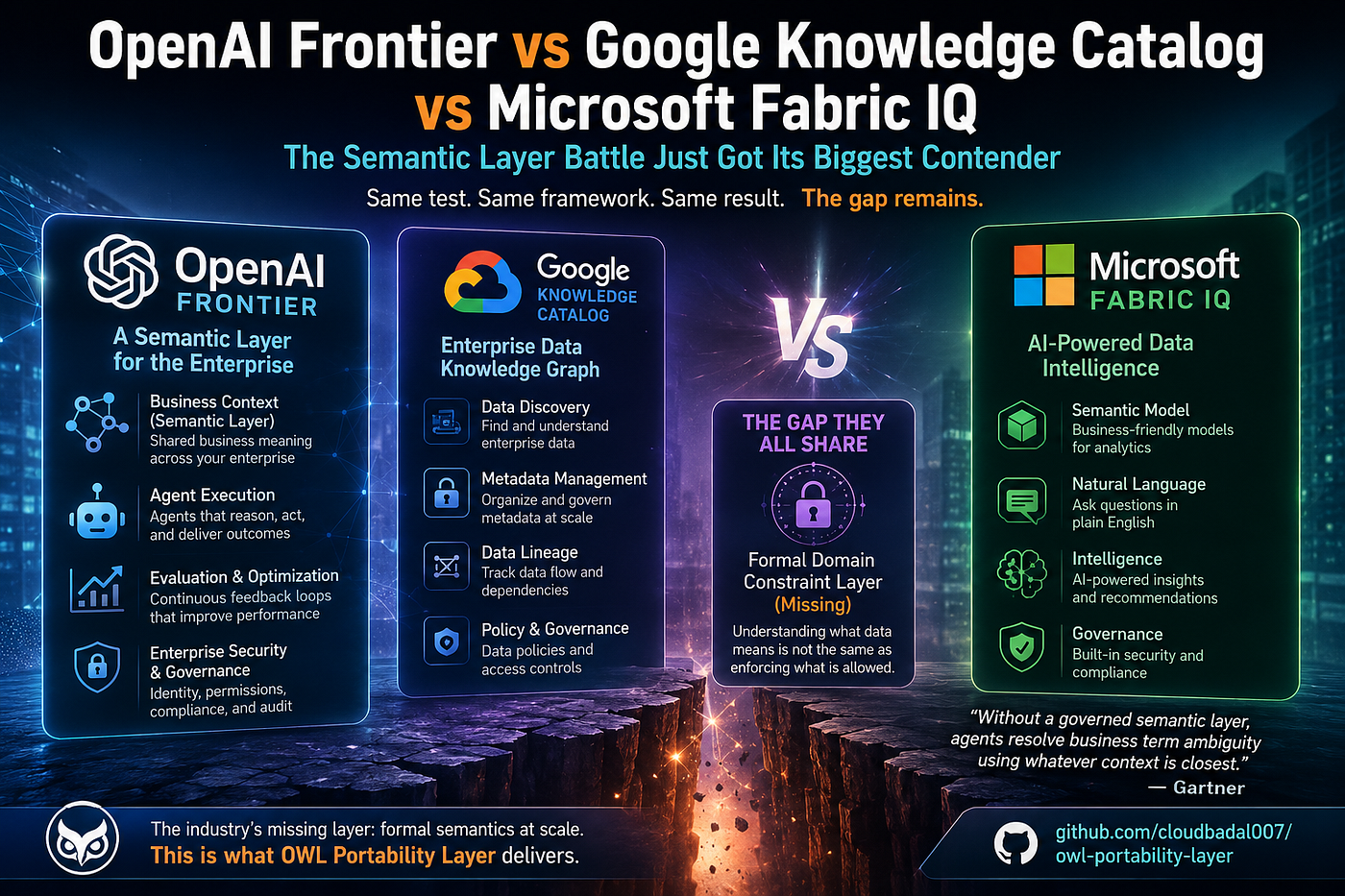
IBM watsonx vs Google Knowledge Catalog vs AWS AgentCore: The Semantic Layer Race Just Got a New…
IBM enters the enterprise semantic layer race at Think 2026 — stress-tested against Google Knowledge Catalog and AWS AgentCore, with the…
IBM watsonx vs Google Knowledge Catalog vs AWS AgentCore: The Semantic Layer Race Just Got a New Contender — and a New Gap
IBM enters the enterprise semantic layer race at Think 2026 — stress-tested against Google Knowledge Catalog and AWS AgentCore, with the gap all three still share
📦 GitHub: OWL Portability Layer — the vendor-neutral semantic layer the industry keeps describing but nobody ships: github.com/cloudbadal007/owl-portability-layer
🗺️ New to ontology for enterprise AI? Start with the full learning roadmap: The Enterprise AI Ontology Roadmap: 30+ Articles, 4 Learning Tracks, and Where to Start
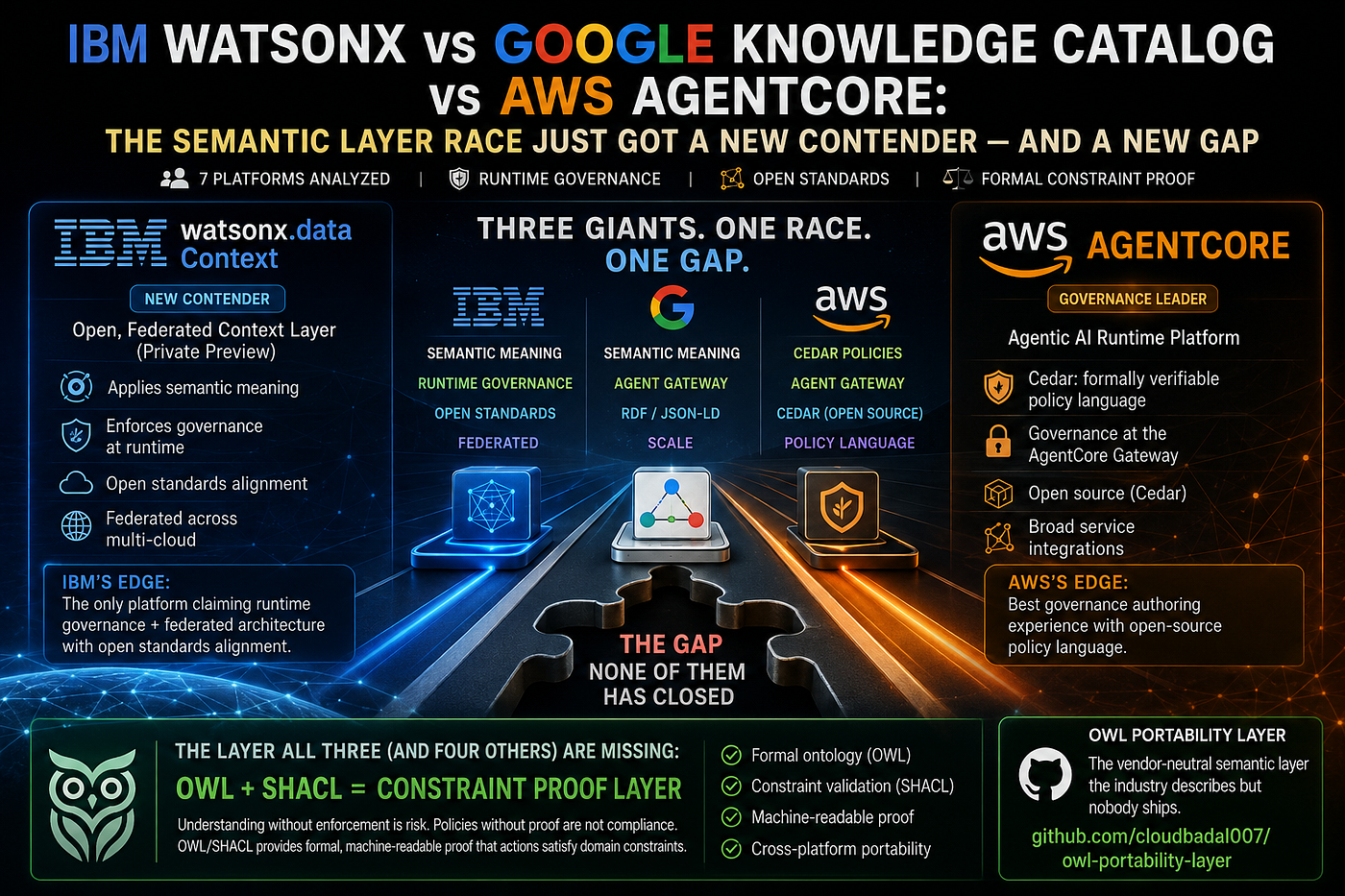
Three Giants. One Race. The Gap Nobody Has Closed.
On May 20, 2026, the fifth annual Semantic Layer Summit concluded with a record 6,000+ data leaders from Anthropic, Snowflake, Databricks, ServiceNow, Carrefour, and Chevron. The opening keynote from AtScale’s CTO David Mariani set the framing for the entire conference:
“The biggest hurdle for enterprise AI in 2026 is not the AI. It is the meaning.”
I’ve been writing this exact argument since December 2025. Across six platforms — Google, Microsoft, Palantir, ServiceNow, Salesforce, and AWS — the conclusion has been the same. The semantic layer is the critical missing piece. The bottleneck isn’t the model. It’s the meaning.
[embed]
Two weeks after the summit, IBM confirmed it from a different direction. At Think 2026, IBM announced watsonx.data Context — described as “an open, federated context layer that makes enterprise AI reason reliably over business data, applying semantic meaning, enforcing governance at runtime, and making decisions explainable.”
The industry has arrived at the conclusion. 6,000 data leaders at a summit. IBM entering the semantic layer race. Google, Microsoft, Palantir, ServiceNow, Salesforce, and AWS all shipping semantic layers in the same six-month window.
The thesis is confirmed. Now let me tell you what the industry is still getting wrong — and what IBM’s entry reveals about the gap that nobody has closed yet.
Part 1: What the Semantic Layer Summit Got Right
The 2026 summit was the moment the semantic layer graduated from a technical architecture topic to a strategic boardroom requirement. Three things the summit got exactly right:
Right 1: The bottleneck is context, not capability.
Every enterprise AI deployment that has failed in production has failed at the same point — not because the model wasn’t smart enough, but because the agent didn’t have the right business context to act correctly. The summit articulated this clearly: AI is only as reliable as the business context that supports it.
This is the same argument I made in the RAG pipeline article — a RAG pipeline that retrieves correctly but lacks domain semantic constraints is an agent liability, not an asset.
Right 2: Platform-native semantic layers don’t scale.
The summit drew a sharp distinction between platform-native semantic layers (tied to one cloud’s compute layer) and vendor-neutral semantic infrastructure. Platform-native semantic layers are tied to one cloud’s compute layer — meaning multi-platform enterprises need multiple semantic layers with no guarantee of consistency between them.
This is precisely the vendor lock-in problem I documented in the Palantir migration stress test — and why the OWL Portability Layer exists.
Right 3: The semantic layer has crossed from experiment to production requirement.
The companies that solve context first are the ones that will put AI into production with confidence. This isn’t an academic observation anymore. It’s a production requirement that 6,000 enterprise architects confirmed at the same summit.
Part 2: What the Summit Got Wrong
The summit got the diagnosis right. The prescription is still incomplete.
The 2026 summit focused heavily on semantic layers for analytics — business context for BI queries, consistent metric definitions, governed data access. The AtScale, Snowflake, and Databricks presentations all approached the semantic layer as infrastructure for analytical AI.
That’s a solved problem. Or at least a well-understood one.
What the summit barely touched: semantic layers for agentic AI. For agents that don’t just query — they act. They write back. They delegate across platforms. They make financial decisions, legal decisions, operational decisions that cannot be undone.
A semantic layer that helps an agent understand “what is a ComplianceHold” is a retrieval layer. A semantic layer that prevents an agent from releasing a ComplianceHold without Legal sign-off is an enforcement layer. The summit was mostly about the first. The enterprise production problem is overwhelmingly the second.
This distinction — retrieval versus enforcement — is the gap that none of the six platforms I’ve stress-tested has closed. And it’s the gap IBM’s new announcement highlights most clearly.
Part 3: The Three New Entrants — IBM, Google, and AWS Compared
Before we stress-test IBM’s entry, let me recap where Google and AWS stand — because the three-way comparison only makes sense against that baseline.
Google Knowledge Catalog — the most open-standards-aligned of the three. RDF/JSON-LD via the Enterprise Knowledge Graph, entity reconciliation at Google Search scale, MCP integration, and Gemini-powered auto-generated semantics. The gap: schema.org is not OWL. No SHACL constraint enforcement. The semantic layer is retrieval-optimised — understanding without formal governance.
AWS AgentCore (Cedar) — the most accessible governance authoring of the three. Cedar’s formally verifiable, open-source policy language is the best agent access control layer any cloud provider has shipped. The gap: Cedar governs tool calls at the AgentCore Gateway boundary. Cross-platform A2A delegations that bypass the Gateway are outside Cedar’s enforcement scope. Policy rules, not formal proofs.
IBM is the seventh platform in the matrix. And it’s the most interesting new entrant since Google Knowledge Catalog.
Here’s what IBM announced at Think 2026:
watsonx.data Context — described as an open, federated context layer available in private preview. The stated capabilities:
- Makes enterprise AI reason reliably over business data
- Applies semantic meaning to structured and unstructured data
- Enforces governance at runtime
- Makes decisions explainable
- Federated architecture — works across multi-cloud environments
- Open standards alignment
That third point — “enforces governance at runtime” — is the most significant claim in any semantic layer announcement I’ve reviewed across seven platforms.
Every other platform I’ve covered claims semantic understanding. Google understands your entity relationships. Dataverse understands your workflow context. Fabric IQ understands your data permissions. Palantir understands your operational graph.
IBM’s claim is different. They’re claiming governance enforcement at runtime — not just understanding, but preventing incorrect actions from executing.
That’s the SHACL argument. That’s the constraint enforcement layer. The question is whether IBM’s implementation delivers what the claim implies.
What IBM’s Context Layer Actually Is
Reading through the technical details available from Think 2026, watsonx.data Context works by building a semantic graph across the enterprise data estate — tagging entities, inferring relationships, and maintaining a runtime context index that agents can query before acting.
The governance enforcement claim appears to work through runtime policy checks — when an agent attempts an action, watsonx.data Context evaluates whether that action is consistent with the semantic context of the entities involved. If an agent attempts to delete a record that the context layer knows is under regulatory hold, the action is blocked.
This is architecturally similar to what I documented for Google’s Agent Gateway — a gateway-level check that intercepts agent actions before execution. The critical difference: IBM’s context layer claims to understand the semantic meaning of the entities being acted on, not just the access control rules around the tools being invoked.
That’s closer to SHACL than anything else any platform has announced.
The Gap That Remains
But here’s the precise technical distinction that still matters.
IBM’s runtime governance appears to be policy-driven — rules written in a policy language (similar to Cedar, or natural language converted to policy) that govern what actions are permitted on which entity types.
What it cannot express natively: the OWL class hierarchy that distinguishes ComplianceHold from BudgetHold from VendorDisputeHold — not as labels, but as formal classes with different inheritance structures, different constraint profiles, and different reasoning implications.
A policy rule can say “don’t release compliance holds without approval.” An OWL reasoner can infer that a payment event classified as a ComplianceHold inherits all the constraints of its parent HoldStatus class, that the holdApprovedBy property is required by the ComplianceHoldShape SHACL constraint, and that any agent action that results in a ComplianceHold entity lacking a holdApprovedBy triple is formally invalid — regardless of how the action was initiated, from which platform, or through which tool.
The difference is between a rule and a formal proof. IBM is shipping a sophisticated rule system. OWL/SHACL is a formal reasoning system. Both matter. They answer different questions.
Part 4: IBM vs Google vs AWS — The Three-Way Stress Test
Adding IBM to the comparison table from the Google vs Microsoft vs Palantir article:

IBM’s unique position: The federated, open-standards alignment claim is the strongest of any platform in the matrix — if it delivers. No other platform claims both runtime governance enforcement and cross-cloud federation with open standards alignment simultaneously.
The caveat: watsonx.data Context is in private preview. The claims are what IBM announced at Think 2026. Production behavior at enterprise scale will determine whether “enforces governance at runtime” means what it implies.
Part 5: The Production Code — IBM Adapter
Here’s the IBM watsonx.data Context adapter for the OWL Portability Layer. The same pattern as every previous adapter — IBM’s semantic context layer as the grounding layer, OWL/SHACL as the formal constraint layer on top:
# ibm_watsonx_context_adapter.py
"""
IBM watsonx.data Context Adapter for the OWL Portability Layer

IBM's watsonx.data Context applies semantic meaning and claims
to enforce governance at runtime. This adapter sits alongside it —
adding the formal OWL class hierarchy and SHACL constraints that
IBM's policy-based runtime governance cannot express natively.

IBM's Context Layer:  semantic meaning + policy-based governance
OWL/SHACL Layer:      formal class hierarchy + constraint proof

Both answer different questions. Both are necessary.

IBM's open-standards and federated architecture claims make it
the most interesting new entrant in the seven-platform matrix.
The private preview status means production validation is pending.

When IBM's Context layer evolves, update the production methods.
Your OWL ontology and SHACL constraints remain unchanged.

Part of the OntoArc enterprise ontology toolkit.
"""

import json
import httpx
from dataclasses import dataclass, field
from typing import Optional
from rdflib import Graph, Namespace, URIRef, Literal, RDF
from rdflib.namespace import XSD
from pyshacl import validate

PROC = Namespace("http://enterprise.org/procurement#")

@dataclass
class WatsonxContextQuery:
    """
    Represents an entity query through IBM watsonx.data Context.

    IBM's Context layer has already applied:
    - Semantic meaning to the entity
    - Runtime policy governance check
    - Federated context graph resolution

    OWL/SHACL validates:
    - Does the entity satisfy formal domain constraints?
    - Does the action violate the OWL class hierarchy?
    - Is the constraint formally provable, not just rule-matched?
    """
    query_id: str
    agent_id: str
    action_type: str
    entity_class: str
    payload: dict
    watsonx_context: dict         # Context returned by watsonx.data
    ibm_governance_decision: str  # "permit" or "deny" from watsonx runtime
    watsonx_semantic_class: Optional[str] = None  # IBM's resolved entity class

@dataclass
class WatsonxValidationResult:
    query_id: str
    agent_id: str
    ibm_governance: str           # IBM's runtime decision
    shacl_valid: bool             # OWL/SHACL constraint result
    violations: list[str] = field(default_factory=list)
    safe_to_execute: bool = False

    def __post_init__(self):
        # IBM governance permits AND OWL/SHACL passes
        self.safe_to_execute = (
            self.ibm_governance == "permit" and self.shacl_valid
        )

class IBMWatsonxContextAdapter:
    """
    IBM watsonx.data Context + OWL/SHACL semantic adapter.

    Extends IBM's semantic context governance with formal
    OWL class hierarchy reasoning and SHACL constraint enforcement.

    Architecture comparison:
      IBM watsonx.data Context: policy-based runtime governance
        → Answers: Is this action permitted by our runtime policies?
        → Scope: federated, cross-cloud, open standards

      OWL/SHACL layer (this adapter):
        → Answers: Does this action satisfy formal domain constraints?
        → Scope: cross-platform, vendor-neutral, formally provable

    IBM's "enforces governance at runtime" claim is the closest
    any platform has come to the SHACL argument. The distinction:
    IBM enforces policies. SHACL enforces formal proofs.
    Both are necessary. IBM ships policies. Build the proofs.
    """

    def __init__(
        self,
        ontology_path: str,
        shacl_path: str,
        watsonx_url: str = "",
        api_key: str = "",
        simulation_mode: bool = True
    ):
        self.ontology = Graph()
        self.ontology.parse(ontology_path, format="turtle")

        self.shacl_graph = Graph()
        self.shacl_graph.parse(shacl_path, format="turtle")

        self.watsonx_url = watsonx_url
        self.api_key = api_key
        self.simulation_mode = simulation_mode

        # IBM entity type → OWL class mapping
        # IBM watsonx uses its own semantic tagging vocabulary
        self.ibm_to_owl_map = {
            "payment_event":       "PaymentEvent",
            "compliance_hold":     "ComplianceHold",
            "budget_hold":         "BudgetHold",
            "vendor_dispute":      "VendorDisputeHold",
            "vendor_record":       "Vendor",
            "contract_record":     "Contract",
            "PaymentEvent":        "PaymentEvent",
            "ComplianceHold":      "ComplianceHold",
        }

    @property
    def platform_name(self) -> str:
        return "ibm_watsonx_context"

    def validate_with_shacl(
        self,
        query: WatsonxContextQuery
    ) -> WatsonxValidationResult:
        """
        Validate a watsonx.data Context entity against OWL/SHACL.

        IBM's runtime governance has already run.
        This adds the formal constraint proof layer IBM cannot provide.

        If IBM denied: return immediately. IBM denial is sufficient.
        If IBM permitted: check OWL/SHACL formal constraints.
        """
        # IBM denial is sufficient — skip SHACL
        if query.ibm_governance_decision == "deny":
            return WatsonxValidationResult(
                query_id=query.query_id,
                agent_id=query.agent_id,
                ibm_governance="deny",
                shacl_valid=False,
                violations=["IBM watsonx.data Context denied this action."]
            )

        # Resolve OWL class
        ibm_class = query.watsonx_semantic_class or query.entity_class
        owl_class = self.ibm_to_owl_map.get(ibm_class, ibm_class)

        # Build RDF from payload
        data_graph = self._build_entity_rdf(query, owl_class)
        combined = data_graph + self.ontology

        # SHACL validation
        conforms, _, report_text = validate(
            combined,
            shacl_graph=self.shacl_graph,
            ont_graph=self.ontology,
            inference='rdfs',
            abort_on_first=False
        )

        violations = []
        for line in report_text.split("\n"):
            if "sh:resultMessage" in line:
                msg = line.replace("sh:resultMessage", "").strip().strip('"')
                if msg:
                    violations.append(msg)

        return WatsonxValidationResult(
            query_id=query.query_id,
            agent_id=query.agent_id,
            ibm_governance="permit",
            shacl_valid=conforms,
            violations=violations
        )

    def _build_entity_rdf(
        self,
        query: WatsonxContextQuery,
        owl_class: str
    ) -> Graph:
        g = Graph()
        g.bind("proc", PROC)

        entity_uri = URIRef(
            f"http://enterprise.org/procurement#{query.query_id}"
        )
        g.add((entity_uri, RDF.type, PROC[owl_class]))

        payload = query.payload

        if "amount" in payload or "amountUSD" in payload:
            amount = payload.get("amountUSD", payload.get("amount", 0))
            g.add((entity_uri, PROC.amountUSD,
                   Literal(float(amount), datatype=XSD.decimal)))

        if "holdType" in payload:
            hold_uri = PROC[payload["holdType"]]
            g.add((entity_uri, PROC.hasHoldStatus, hold_uri))
            g.add((hold_uri, RDF.type, PROC[payload["holdType"]]))

        if "approvedBy" in payload:
            g.add((entity_uri, PROC.holdApprovedBy,
                   Literal(payload["approvedBy"], datatype=XSD.string)))

        if "paymentId" in payload:
            g.add((entity_uri, PROC.paymentId,
                   Literal(payload["paymentId"], datatype=XSD.string)))

        return g

    def write(self, entity_data: dict, entity_class: str) -> bool:
        """Write validated entity to IBM watsonx.data."""
        if self.simulation_mode:
            print(f"  [IBM watsonx Adapter — Simulation]")
            print(f"  Entity: {entity_class}")
            print(f"  Data: {json.dumps(entity_data, indent=4)}")
            return True
        try:
            with httpx.Client() as client:
                response = client.post(
                    f"{self.watsonx_url}/v1/entities",
                    json={"entity_type": entity_class, **entity_data},
                    headers={"Authorization": f"Bearer {self.api_key}",
                             "Content-Type": "application/json"}
                )
                response.raise_for_status()
                return True
        except Exception as e:
            print(f"  [IBM watsonx] Write failed: {e}")
            return False

    def read(self, entity_class: str, filters: dict) -> list[dict]:
        if self.simulation_mode:
            return [{"entity_class": entity_class,
                     "source": "ibm_watsonx", "simulation": True}]
        try:
            with httpx.Client() as client:
                response = client.get(
                    f"{self.watsonx_url}/v1/entities/{entity_class}",
                    params=filters,
                    headers={"Authorization": f"Bearer {self.api_key}"}
                )
                return response.json().get("entities", [])
        except Exception:
            return []

    def health_check(self) -> bool:
        if self.simulation_mode:
            return True
        try:
            with httpx.Client() as client:
                response = client.get(
                    f"{self.watsonx_url}/v1/health",
                    headers={"Authorization": f"Bearer {self.api_key}"}
                )
                return response.status_code == 200
        except Exception:
            return False

def demo():
    """
    IBM watsonx.data Context + OWL/SHACL parallel governance.
    Same pattern as AgentCore Cedar demo — different platform,
    same architectural argument.
    """
    adapter = IBMWatsonxContextAdapter(
        ontology_path="ontologies/procurement.ttl",
        shacl_path="ontologies/procurement.ttl",
        simulation_mode=True
    )

    print("=" * 65)
    print("IBM WATSONX.DATA CONTEXT + OWL/SHACL DEMO")
    print("=" * 65)
    print("""
IBM watsonx.data Context already ran:
  ✅ Semantic meaning applied to entity
  ✅ Runtime policy governance evaluated
  ✅ Federated context graph resolved

IBM governance decision: PERMIT (policy check passed)

OWL/SHACL constraint layer runs now:
  ❓ Does the formal domain constraint require holdApprovedBy?
""")

    # IBM permitted — but OWL/SHACL catches the gap
    query = WatsonxContextQuery(
        query_id="wx-001",
        agent_id="watsonx-finance-agent",
        action_type="release_compliance_hold",
        entity_class="ComplianceHold",
        payload={
            "paymentId": "PAY-001",
            "amountUSD": 340000,
            "holdType": "ComplianceHold",
            # approvedBy missing — IBM policy didn't catch this
        },
        watsonx_context={
            "entity_type": "compliance_hold",
            "federated_source": "ibm-cloud-us-south",
            "semantic_class": "ComplianceHold",
            "governance_policy": "payment_release_policy_v2"
        },
        ibm_governance_decision="permit",  # IBM's runtime said OK
        watsonx_semantic_class="ComplianceHold"
    )

    result = adapter.validate_with_shacl(query)

    print(f"IBM governance:  {result.ibm_governance.upper()}")
    print(f"SHACL valid:     {'✅ YES' if result.shacl_valid else '❌ NO'}")
    print(f"Safe to execute: {'✅ EXECUTE' if result.safe_to_execute else '🚨 BLOCKED'}")

    if result.violations:
        for v in result.violations:
            print(f"↳ {v}")

    print(f"""
The gap: IBM's runtime policy said PERMIT.
The formal SHACL constraint caught what the policy missed.

IBM enforces policies.
OWL/SHACL enforces proofs.
Both are necessary. IBM ships the first.
""")

if __name__ == "__main__":
    demo()
Part 6: What the Industry Still Gets Wrong
The Semantic Layer Summit was a watershed moment. But reading through the sessions, the papers, and the announcements, one pattern stands out.
The industry is converging on the semantic layer as retrieval infrastructure. Better context for agents. Richer business understanding. Governed data access.
What the industry is not yet converging on: the semantic layer as constraint proof infrastructure.
The distinction matters enormously in regulated industries:
Retrieval infrastructure answers: did the agent have enough context to make a reasonable decision?
Constraint proof infrastructure answers: did the agent’s decision formally satisfy the domain constraints that apply to the entities it acted on?
In a healthcare audit, in a financial compliance review, in a government procurement investigation — the second question is the one that matters. “The agent had sufficient context” is not a legal defense. “The agent’s action satisfied all applicable constraints, and here is the machine-readable proof” is.
None of the seven platforms I’ve covered ships constraint proof infrastructure. The Semantic Layer Summit didn’t discuss it. IBM’s watsonx.data Context announcement moves in that direction — but from the available technical details, it’s still policy-based rather than formally provable.
OWL/SHACL provides formal proof. A SHACL validation report is machine-readable, formally structured evidence that a specific entity satisfied or violated specific named constraints. That’s not a log. That’s evidence.
Part 7: The Verdict After Seven Platforms
Six months of stress-testing. Seven platforms. One consistent finding.
What every platform now ships: some form of semantic understanding — schema awareness, entity recognition, relationship mapping, business context enrichment. The industry has solved the retrieval problem reasonably well.
What no platform ships: formal OWL class hierarchy, SHACL constraint enforcement, or machine-readable constraint proof. The enforcement problem remains open.
IBM vs Google vs AWS — the honest verdict:
Google leads on open standards (RDF/JSON-LD) and scale. AWS leads on governance accessibility (Cedar’s formally verifiable policy language). IBM leads on the federated, cross-cloud architecture claim — and is the only one that explicitly claims runtime governance enforcement rather than gateway-level access control.
IBM is the most interesting new entrant because the federated, open-standards, and runtime governance claims are the closest any platform has come to the OWL/SHACL argument. If the private preview delivers on “enforces governance at runtime” with formal constraint proof — not just policy rules — IBM would be the first platform in the matrix to genuinely close the gap.
The Semantic Layer Summit was right: the biggest hurdle is meaning. What the summit underweighted: the distinction between understanding meaning and formally constraining the actions agents take based on that meaning.
The platforms understand your data. The OWL/SHACL layer governs what agents can do with it. Both are infrastructure. Only one ships from the vendor.
What’s Next
The seven-platform matrix is now complete — for this phase of the industry. But the space is moving fast. IBM’s watsonx.data Context is in private preview. Microsoft Build 2026 just concluded with AI agents as the central theme. AWS, Google, and ServiceNow all have roadmap items that could close the formal constraint gap.
The next article covers the definitive decision matrix — not just IBM vs Google vs AWS, but all seven platforms — not a comparison of platforms, but a framework for choosing which semantic layer architecture is right for which enterprise workload. Seven platforms, four workload types, one decision tree.
Resources
- 📦 GitHub — OWL Portability Layer (IBM watsonx adapter + seven platforms): github.com/cloudbadal007/owl-portability-layer
- 🔗 Google vs Microsoft vs Palantir — the race that started the series: The Enterprise Ontology Race
- 🔗 AWS AgentCore: Cedar + the Missing Layer: The Semantic Authority Layer Isn’t One of Them
- 🔗 Microsoft’s Two Semantic Layers: Dataverse vs Fabric IQ
- 🔗 ServiceNow vs Microsoft vs Salesforce: The Semantic Layer War
- 🗺️ Start here if you’re new: The Enterprise AI Ontology Roadmap
The industry just validated the thesis. Does it change how you’re thinking about your semantic layer architecture?
👏 Clap if this was useful (up to 50) 💬 Comment: Have you seen IBM’s watsonx.data Context in action? Does “enforces governance at runtime” deliver formal constraint proof or policy-based blocking? 🔁 Share with any enterprise architect who attended the Semantic Layer Summit or is evaluating IBM watsonx
Follow for the next piece — the seven-platform decision matrix: which semantic layer architecture for which enterprise workload.
GitHub: cloudbadal007 | Substack: badalaiworld.substack.com | X: @CloudyPankaj
메타데이터
- post_id
- eb08723bbd97
- slug
- ibm-watsonx-vs-google-knowledge-catalog-vs-aws-agentcore-the-semantic-layer-race-just-got-a-new-eb08723bbd97
- url
- https://medium.com/@cloudpankaj/ibm-watsonx-vs-google-knowledge-catalog-vs-aws-agentcore-the-semantic-layer-race-just-got-a-new-eb08723bbd97
- canonical_url
- https://medium.com/@cloudpankaj/ibm-watsonx-vs-google-knowledge-catalog-vs-aws-agentcore-the-semantic-layer-race-just-got-a-new-eb08723bbd97
- author_url
- https://medium.com/@cloudpankaj
- status
- ok
- fetched_at
- 2026-06-11 15:16:29