Key Highlights of Korea’s Artificial Sun (KSTAR)
Korea’s “artificial sun,” known as the Korea Superconducting Tokamak Advanced Research (KSTAR), has recently made significant strides in…
Key Highlights of Korea’s Artificial Sun (KSTAR)
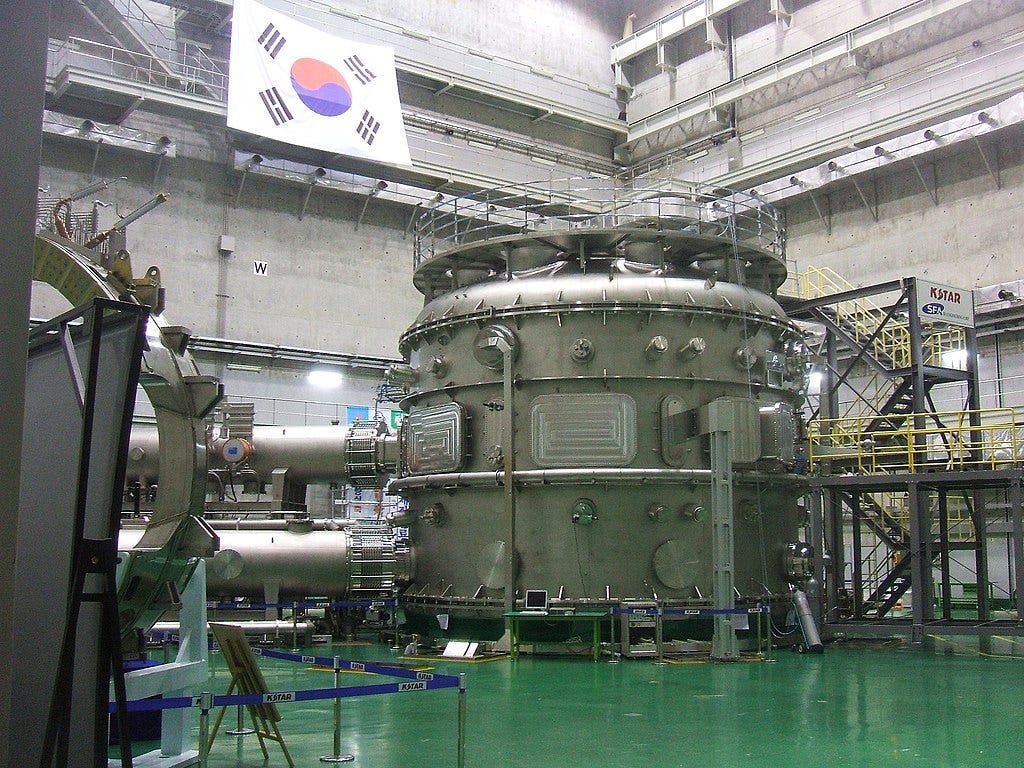
A tokamak is a device which uses a powerful magnetic field generated by external magnets to confine plasma in the shape of an axially symmetrical torus. The tokamak is one of several types of magnetic confinement devices being developed to produce controlled thermonuclear fusion power.
Korea’s “artificial sun,” known as the Korea Superconducting Tokamak Advanced Research (KSTAR), has recently made significant strides in nuclear fusion research. This innovative facility has achieved a new world record by sustaining plasma at an astonishing temperature of 100 million degrees Celsius for 48 seconds. This milestone represents a critical advancement in the quest to harness nuclear fusion as a sustainable energy source.
Understanding Nuclear Fusion
Nuclear fusion is the process that powers stars, including our sun. It occurs when two light atomic nuclei combine to form a heavier nucleus, releasing vast amounts of energy in the process. For fusion to take place on Earth, scientists must recreate the extreme conditions found in stars — specifically, high temperatures and pressures. KSTAR aims to achieve this through its tokamak design, a doughnut-shaped device that uses powerful magnetic fields to contain and heat plasma.
Recent Achievements
The latest record was set during tests conducted between December 2023 and February 2024, where KSTAR surpassed its previous record of 30 seconds established in 2021. This achievement is particularly significant because it demonstrates the potential for sustaining high-temperature plasma, which is notoriously unstable. The upgrade from carbon to tungsten divertors — components designed to manage heat and impurities from the plasma — has been crucial in extending the duration of plasma containment. Tungsten’s higher melting point and atomic mass make it more effective in this role compared to its predecessor
Key Highlights:
- Record Duration: KSTAR sustained plasma at 100 million degrees Celsius for 48 seconds.
- Previous Record: The former record was 30 seconds, set in 2021.
- Temperature Comparison: The achieved temperature is seven times hotter than the sun’s core, which is about 15 million degrees Celsius
- Future Goals: KSTAR aims to reach a target of sustaining plasma for 300 seconds by 2026, a crucial step toward practical fusion energy
The Importance of KSTAR
KSTAR serves not only as a research facility but also as a vital contributor to international fusion projects like the International Thermonuclear Experimental Reactor (ITER) based in France. The insights gained from KSTAR’s operations will inform the development of ITER and future demonstration reactors aimed at commercializing fusion energy. Dr. Suk Jae Yoo, president of the Korea Institute of Fusion Energy (KFE), emphasized that this research is essential for acquiring core technologies needed for future fusion reactors
Challenges Ahead
Despite these advancements, achieving practical nuclear fusion remains challenging. The unstable nature of high-temperature plasmas complicates efforts to maintain sustained reactions necessary for energy generation. However, with ongoing improvements in technology and materials — such as the recent tungsten diverter upgrade — scientists are optimistic about overcoming these hurdles
메타데이터
- post_id
- eb24c8d7073a
- slug
- key-highlights-of-koreas-artificial-sun-kstar-eb24c8d7073a
- url
- https://medium.com/@shrimangalevallabh789/key-highlights-of-koreas-artificial-sun-kstar-eb24c8d7073a
- canonical_url
- https://medium.com/@shrimangalevallabh789/key-highlights-of-koreas-artificial-sun-kstar-eb24c8d7073a
- author_url
- https://medium.com/@shrimangalevallabh789
- status
- ok
- fetched_at
- 2026-07-15 11:12:35

