Follow-the-Sun Support: How inDrive Cut Incident SLA from 72 Hours to 2 Hours — Without a Single…
Real SLA numbers, the legal quirks of hiring in Brazil, and a follow-the-sun rotation that actually works for 24/7 incident support.
Follow-the-Sun Support: How inDrive Cut Incident SLA from 72 Hours to 2 Hours — Without a Single Night Shift
Real SLA numbers, the legal quirks of hiring in Brazil, and a follow-the-sun rotation that actually works for 24/7 incident support.

TL;DR
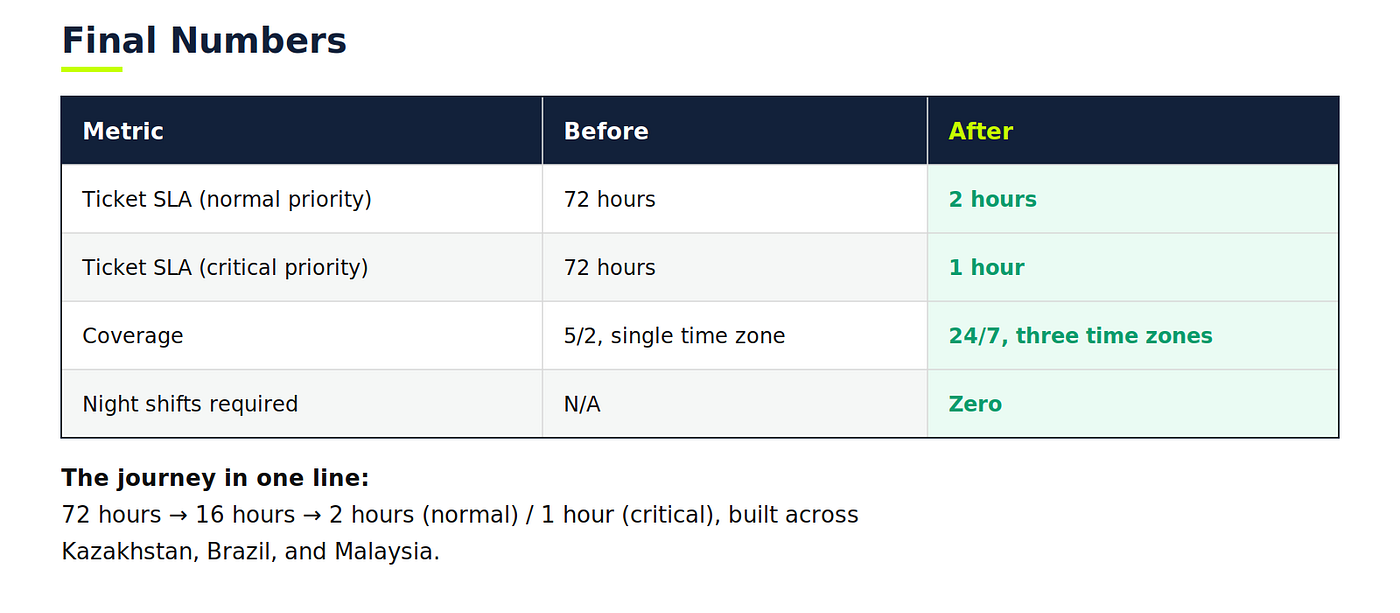
- Problem: A 3-person incident support team on a 5/2 schedule in Kazakhstan had a 72-hour SLA — anything filed after hours or on weekends waited until Monday.
- Solution: A three-country follow-the-sun rotation (Kazakhstan → Brazil → Malaysia), built without any night shifts.
- Result: SLA dropped to 2 hours for normal-priority tickets and 1 hour for critical incidents, with full 24/7 coverage.
- Bonus: What Brazilian labor law (CLT) requires you to know before you build a shift schedule there.
The Problem: A 72-Hour SLA and No Night Coverage
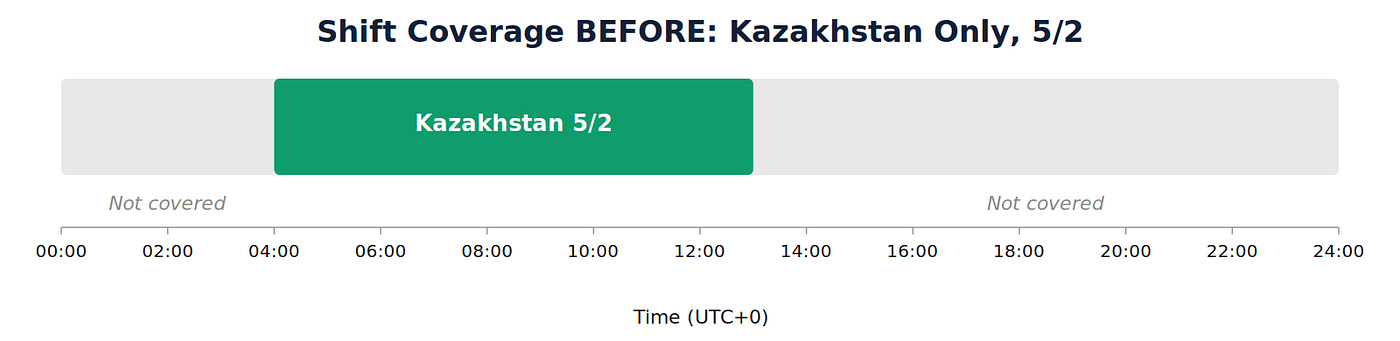
Friday, 18:00. The workday ends, the team heads home — and that’s exactly when the app breaks. Users hit a “Failed to load” error when accepting an order. First-line support runs 24/7 and keeps receiving tickets, but the technical escalation team works a standard 5/2 schedule. The result: unresolved tickets pile up until Monday morning.
At the time our second-line technical support team was formed, there was no formal SLA. In practice, ticket processing time had crept up to 72 working hours — and we couldn’t even say how many tickets were coming in, because there was no ticketing system to track volume.
Starting point:
- 3 engineers based in Kazakhstan (Almaty, UTC+5)
- Schedule: 5/2, 9:00–18:00
- Coverage split by vertical: Intercity/couriers/freight, US/Australia, and Ride-Hailing
- No dashboards, no volume tracking — a fully reactive setup
- Anything filed evenings or weekends sat until Monday
Why We Ruled Out Night Shifts
As inDrive expanded into the US, Australia, and the broader LATAM region, ticket volume grew — and so did the temptation to just add night shifts in Kazakhstan. We deliberately avoided that path, for three reasons:
- Burnout. Night shifts wreck sleep and long-term productivity. Daytime work keeps the team healthier and more sustainable.
- Incident quality. A daytime brain reads logs and admin panels far more accurately than a sleep-deprived one — especially on complex incidents.
- Cross-team collaboration. Working daytime hours means overlapping with HQ teams, which builds context and communication skills that a graveyard shift never gets.
Instead, we built a follow-the-sun support model: hire in time zones that naturally cover the gaps, so every engineer works their own local daytime.
Iteration 1: Kazakhstan, 2/2 Shifts
Goal: Extend coverage beyond the standard 5/2 day without burning out the existing team.
What we did:
- Hired 2 additional specialists in Kazakhstan on a 2/2 rotation
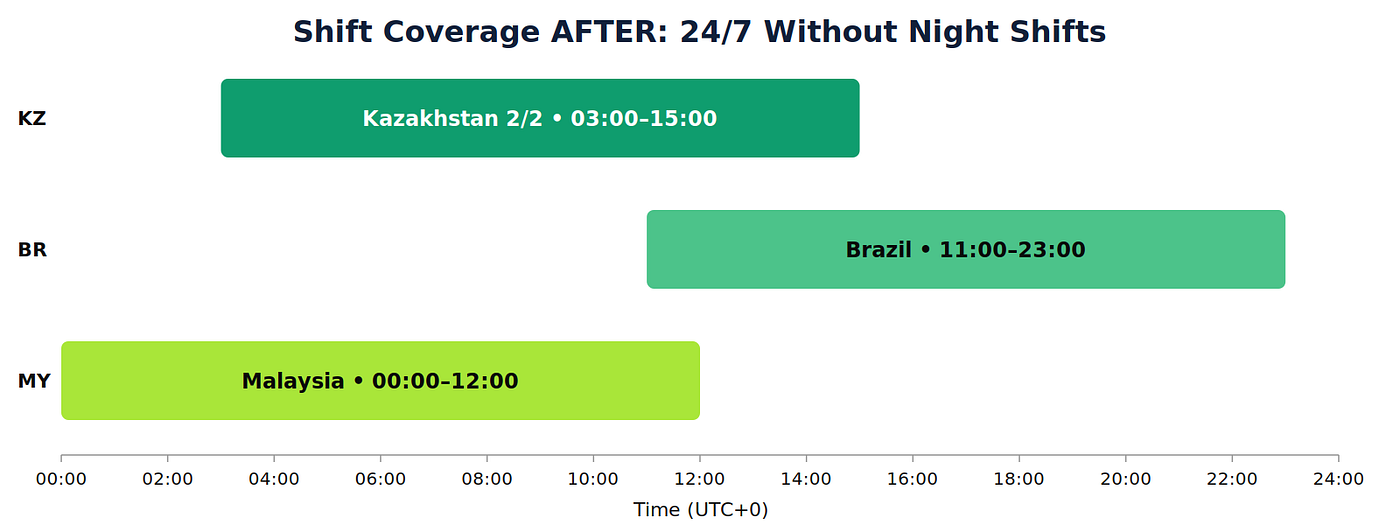
- Shift window: 03:00–15:00 UTC (08:00–20:00 Almaty time, UTC+5)
- Routed the full first-line escalation stream to this team
Why Kazakhstan again: Most of the ticket volume in this hemisphere falls inside Kazakhstan working hours, and we already had strong first-line support talent there to promote internally.
Result: SLA dropped from 72 hours to roughly 16 hours. Evenings in Almaty were now covered — but early morning and overnight for Asia, plus mornings for other regions, were still blind spots.
Iteration 2: Brazil, 1/1 Shifts
Goal: Cover the overnight gap in Almaty and cut response times for LATAM and adjacent regions.
What we did:
- Hired specialists based in Brazil
- Shift window: 11:00–23:00 UTC (08:00–20:00 Recife time, UTC−3)
Result: Night and early-morning coverage improved significantly. One gap remained: a roughly 4-hour seam between the end of the Brazil shift and the start of the Kazakhstan shift (04:00–08:00 Almaty time).
Iteration 3: Malaysia — Closing the Loop
Goal: Close the remaining early-morning gap and strengthen coverage for the Asian region.
What we did:
- Hired specialists in Malaysia
- Shift window: 00:00–12:00 UTC (08:00–20:00 Kuala Lumpur time, UTC+8)
Result: Full, continuous 24/7 coverage across three countries — with zero night shifts anywhere in the rotation.
Final Numbers
P.S. — What to Know Before You Hire in Brazil for Shift Work
Brazilian labor law (CLT — Consolidação das Leis do Trabalho) has two provisions that directly affect shift scheduling and staffing math:
- The 12×36 schedule is the legal norm. Under Article 59-A of the CLT (upheld by the Brazilian Supreme Court, STF), employees can legally work 12 consecutive hours followed by 36 hours of rest. In practice: no single person can staff every day — you need paired slots by design.
- Mandatory Sunday rest. Under Law №605/49, employees must get a rest day that falls on a Sunday at a defined frequency — once every 7 weeks for men, once every 15 days for women (per Article 386 of the CLT). This typically forces a full Saturday+Sunday weekend roughly once every two months, which has to be built into the rotation in advance.
Takeaway for planning: budget a staffing buffer from day one. If you hire “just enough” people to cover the hours on paper, the first mandatory rest period will blow a hole in your schedule.
If you’re building or scaling an incident support rotation, the short version is: don’t add night shifts — add time zones. What gaps has your team hit trying to cover 24/7?
메타데이터
- post_id
- eb40fea5e9f2
- slug
- follow-the-sun-support-how-indrive-cut-incident-sla-from-72-hours-to-2-hours-without-a-single-eb40fea5e9f2
- url
- https://medium.com/indriver-tech/follow-the-sun-support-how-indrive-cut-incident-sla-from-72-hours-to-2-hours-without-a-single-eb40fea5e9f2
- canonical_url
- https://medium.com/indriver-tech/follow-the-sun-support-how-indrive-cut-incident-sla-from-72-hours-to-2-hours-without-a-single-eb40fea5e9f2
- author_url
- https://medium.com/@indrive-tech
- status
- ok
- fetched_at
- 2026-07-17 17:40:40