The fed finds itself trapped between two economic worlds
Jerome Powell’s committee must decide whether to cut rates as cooling housing data and fading Iran supply shock collide with AI-driven…
The fed finds itself trapped between two economic worlds
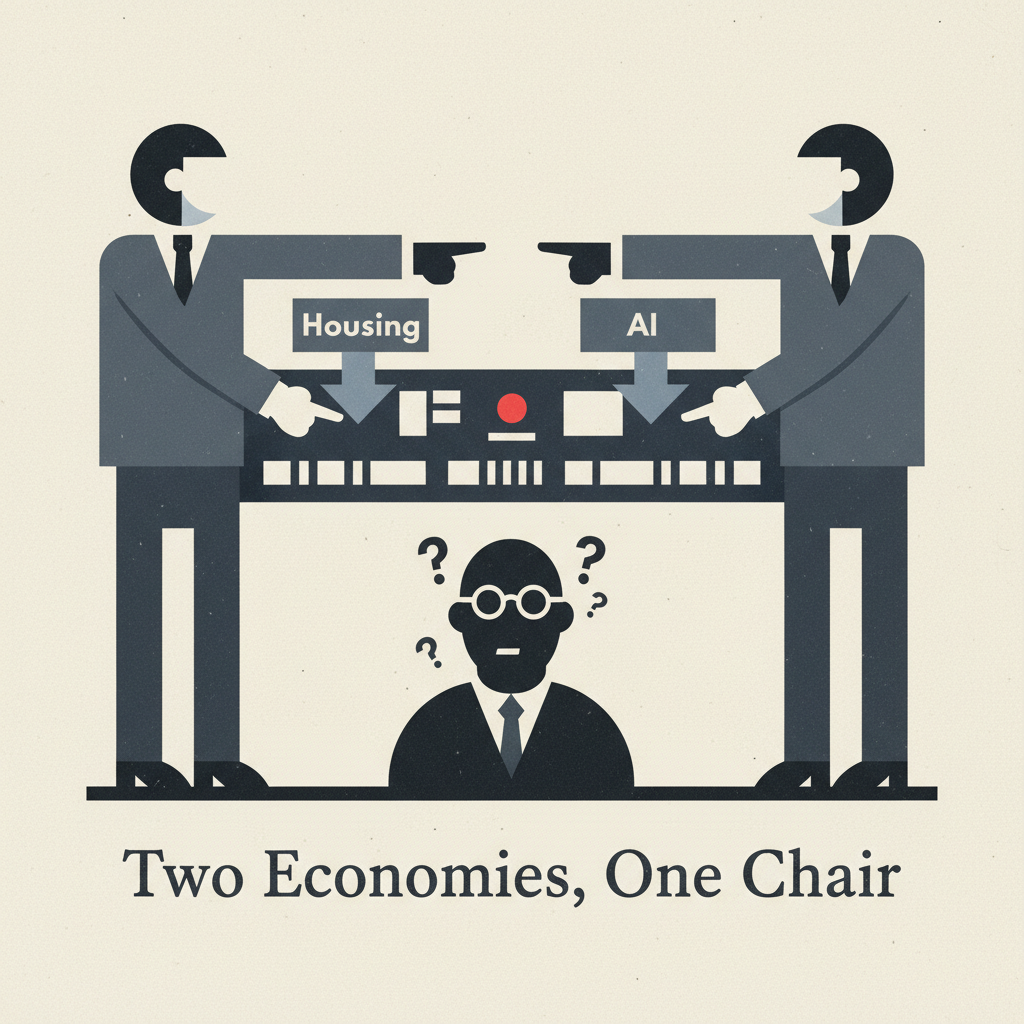
Jerome Powell’s committee must decide whether to cut rates as cooling housing data and fading Iran supply shock collide with AI-driven investment and tariff uncertainty.
The two economies living under one roof
On Wednesday afternoon, Jerome Powell sat before the cameras in the Federal Reserve’s marble-and-bronze briefing room and did what he does best: said a lot while committing to very little. The Chairman noted that the economy “continues to evolve in ways that challenge simple narratives,” which is central-banker code for “we have no idea what happens next.”
He is telling the truth. The U.S. economy today is not one economy. It is two, and they are moving in opposite directions.
The first economy looks tired. Housing starts fell 4.8% in May compared to April, according to the Census Bureau. Mortgage applications have dropped 12% since the beginning of the year. The composite PMI for services slipped to 49.8 in June, just below the expansion threshold. Consumer credit growth slowed to 2.1% annualized, down from 4.3% a year ago. If you look only at these numbers, you see an economy that needs lower rates — and soon.
The second economy looks like it just drank three espressos. Capital expenditures on AI-related infrastructure hit $89 billion in Q2, up 37% year-over-year. The S&P 500 is up 14% this year. Household net worth hit a record $168 trillion, driven by equity and home price gains. The Atlanta Fed’s GDPNow tracker is flashing 2.8% growth for Q3. If you look only at these numbers, you see an economy that would ignite inflation the moment the Fed blinks.
Powell’s committee is stuck between them.
The ghost of 2018
This is not the first time the Fed has found itself at this sort of intersection. In the summer of 2019, the committee had raised rates four times the previous year despite inflation that never hit their 2% target. Then-President Trump began tweeting about it, Judy Shelton reminded us this week, and the Fed cut rates three times in response. They framed it as a response to “uncertainty” from trade policy. But the real uncertainty was whether they had over-tightened in the first place.
The same question hangs over the room today. The Fed’s preferred inflation gauge, the Personal Consumption Expenditures index, ran at 2.6% in May — still above target but down from 4.0% a year ago. The core PCE reading, which strips out food and energy, was 2.4%. Neither number screams emergency. Neither number screams “all clear.”
And yet, the Fed’s Summary of Economic Projections from June showed a median expectation of one more rate cut this year and the federal funds rate settling at 3.25% by end of 2027. That is a higher terminal rate than the market is pricing. It suggests the committee expects to keep policy tighter than investors think is justified.
Nick Timiraos, who covers the Fed for the Wall Street Journal, put it well: the Fed won’t know which economic world it lives in for months. That is not an excuse. It is a confession.
The mandate creep question
A separate thread running through the current debate is whether the Fed has taken on tasks beyond its statutory mandate. The original 1913 Federal Reserve Act gave the institution one job: provide an elastic currency. The 1977 amendments added the dual mandate of maximum employment and stable prices. That is it.
But in recent years, the Fed has issued guidance on climate risk, experimented with digital currency research, and publicly weighed in on cryptocurrency regulation. A new office for “supervision and financial stability” now employs more than 300 people who do not set interest rates. The balance sheet, which stood at $870 billion before the 2008 crisis, peaked at nearly $9 trillion in 2022 and remains above $7.5 trillion today.
Critics — including Trump allies like Kevin Warsh and Scott Bessent, as noted by analyst accounts on social media — argue that this mission creep undermines the Fed’s credibility when it needs to act decisively on rates. They have a point. If the Fed spends years telling markets it cares about everything, markets will stop believing it cares about anything.
The data dilemma
The problem for Powell is that the data is genuinely contradictory. The housing sector is sending distress signals: the National Association of Realtors reported that existing home sales in May were 2.1 million, down 18% from the same month in 2023. The average 30-year fixed mortgage rate is still above 6.8%. Builders are offering rate buydowns and closing-cost credits just to move inventory.
Meanwhile, the labor market is still tight. Nonfarm payrolls added 272,000 jobs in May. The unemployment rate held at 4.0%. Average hourly earnings rose 4.1% year-over-year. That is not a wage-price spiral, but it is not disinflation either.
The Iran supply shock that briefly pushed oil above $95 a barrel in April has faded, with Brent crude trading at $78 as of this week. That helps headline inflation but does nothing for the sticky components — shelter costs, insurance, medical care — that continue to run above 4%.
What the Fed should do
The correct answer is probably nothing. Not because the economy is fine, but because the Fed has already done enough damage by being late both ways: late to raise rates in 2021-2022, and now potentially late to cut them. The lag effects of monetary policy are long and variable. The cumulative effect of 525 basis points of tightening between March 2022 and July 2023 is still working its way through the system.
A cut in September would be a gamble. If the weak-economy world is the real one, it will be too late. If the strong-economy world is the real one, it will reignite inflation and force the Fed to reverse course — destroying whatever credibility remains.
The most prudent path is to hold steady, let the data resolve itself, and resist the temptation to signal anything. That is not dramatic. It is not satisfying. But it is the sort of boring, humble central banking that the country could use more of.
메타데이터
- post_id
- eb4507d7e6b4
- slug
- the-fed-finds-itself-trapped-between-two-economic-worlds-eb4507d7e6b4
- url
- https://medium.com/@bensuper667/the-fed-finds-itself-trapped-between-two-economic-worlds-eb4507d7e6b4
- canonical_url
- https://medium.com/@bensuper667/the-fed-finds-itself-trapped-between-two-economic-worlds-eb4507d7e6b4
- author_url
- https://medium.com/@bensuper667
- status
- ok
- fetched_at
- 2026-07-09 20:10:33






