How GPT Learned to Read the Internet Without a Single Label
Next token prediction is dismissed as glorified autocomplete. It is actually the sole reason modern models can reason, write code, and…
How GPT Learned to Read the Internet Without a Single Label
Next token prediction is dismissed as glorified autocomplete. It is actually the sole reason modern models can reason, write code, and solve complex problems. There is a moment in the history of AI that does not get enough credit. Sometime around 2018, researchers realized they did not need carefully labeled datasets to train powerful language models. They just needed text. Lots of it. The internet, as it turns out, is one of the largest naturally occurring supervision signals ever assembled by humanity, and nobody had to pay a single annotator to create it.
That insight is the foundation of everything modern LLMs do. Before a model can chat, reason, summarize, or write code, it goes through a phase called pre-training, a process of reading billions of documents and learning to predict what word comes next, over and over, across trillions of examples. It sounds almost too simple. The results are anything but.
The Bottleneck That Self Supervision Broke
For decades, machine learning required labeled data. You wanted a model to identify cats in photos? Someone had to label thousands of images. You wanted a spam filter? Engineers hand tagged thousands of emails. The amount of useful AI you could build was directly limited by the amount of labeled data you could afford to produce. It was an expensive, slow, human dependent process.
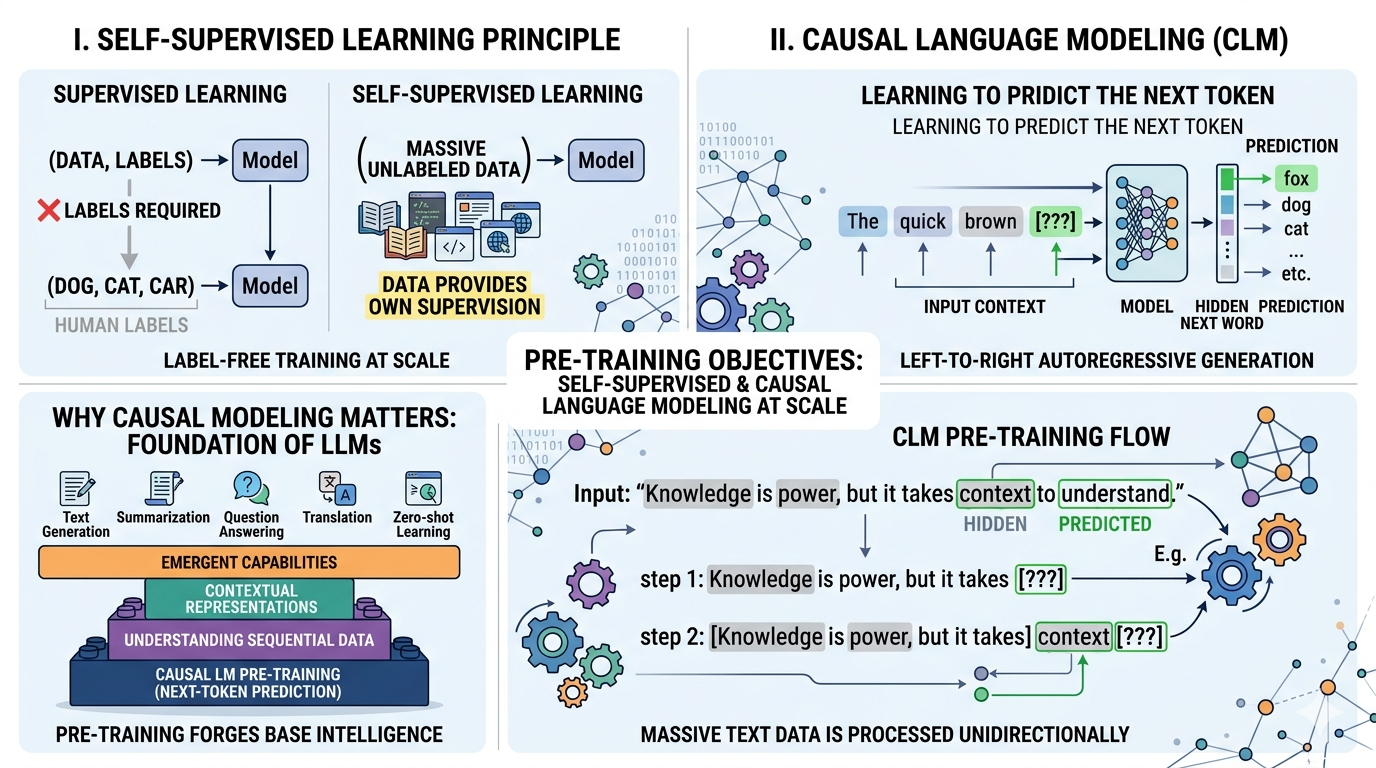
Self-supervised learning broke that bottleneck entirely. The core idea is elegant. Instead of hiring humans to create labels, you generate the labels automatically from the structure of the data itself. For text, this is almost embarrassingly straightforward. Take a sentence. Cover the last word. Ask the model to predict it. The sentence itself provides the correct answer. No annotation required.
This single shift in thinking opened up the entire internet as a training corpus. Every book, forum post, scientific paper, and news article became a source of free, automatically generated supervision. The scale that became possible as a result is what makes modern LLMs fundamentally different from anything that came before.
What the Model Is Actually Doing
Picture a child learning to read by playing a fill in the blank game, millions of times a day, across every book, newspaper, and scientific paper ever written. That is roughly what pre training looks like for an LLM.
More precisely, the model is trained using an objective called Causal Language Modeling (CLM), a framework where the model learns to predict the next token given all the tokens that came before it. A token is a chunk of text, roughly corresponding to a word or part of a word, as covered in Day 3.
The process, step by step, works like this. The model receives a sequence of tokens from a document. At each position in that sequence, it tries to predict the token that comes next using only what it has already seen. It is not allowed to peek ahead. A mechanism called causal masking enforces this rule by blocking any attention to future positions. Think of it as a sliding piece of paper covering the right side of the page as you read left to right.
The model produces a probability score over every token in its vocabulary, expressing how likely each one is to come next. It then compares its top guess against the actual token in the training text. The gap between prediction and reality is measured using cross entropy loss, a mathematical score that essentially asks “how surprised was the model by the correct answer?” The higher the surprise, the larger the penalty. The model’s weights get adjusted slightly to reduce that surprise, and the process repeats across hundreds of billions of tokens. That, in full, is pre-training.
The word “causal” is worth sitting with for a moment. It means the model only learns from what came before, never from what comes after. This left to right constraint is not a limitation. It is actually the right training setup for a model that will eventually generate text one token at a time in production.
Why Scale Produces Something That Looks Like Intelligence
Here is the observation that surprised researchers most when it first appeared. Getting very good at predicting the next word requires building a surprisingly rich model of the world. You cannot accurately predict the next token in a legal brief, a Python script, and a Swahili news article without developing internal representations of grammar, facts, code structure, and even social context. The prediction task forces the model to compress all of it.
This is why scale changes everything. A model trained on a few million tokens learns basic grammar. At a few billion tokens, it starts to internalize facts. At trillions of tokens, it begins to exhibit what researchers call emergent capabilities, things like multi step reasoning, analogy, and code generation that nobody explicitly programmed. They fall out of the prediction objective almost as a byproduct of getting very good at a deceptively demanding task.
A useful way to think about it. A model that accurately predicts the word “shattered” after the phrase “the glass fell off the table” must have some implicit understanding of physics and material properties. It did not learn that from a label. It learned it because that pattern compressed efficiently across millions of similar contexts in the training data.
A Real-World Look: Llama 3’s Data Pipeline
Meta’s Llama 3 models offer a concrete illustration of what pre-training looks like at the frontier. To train Llama 3, Meta processed over 15 trillion tokens, a corpus spanning general web text, scientific papers, code repositories, and multilingual content. That is not raw internet scraping, either. The pipeline involved sophisticated quality classifiers to rank and filter documents, deduplication at multiple levels to prevent the model from overfitting to repeated text, and deliberate balancing of data categories to shape the model’s capabilities.
The data composition itself was a design decision. Roughly half the corpus covered general knowledge and world facts. A substantial chunk was devoted to mathematics and reasoning heavy content. Code made up a significant portion as well. These proportions were not arbitrary. Research has shown that front loading reasoning heavy material during pre training creates a logical foundation that later fine tuning cannot easily replicate. The seeds of reasoning capacity have to be planted here, in the trillion token phase, or they do not grow.
Interestingly, Meta used Llama 2 to help evaluate and rank the quality of documents used to train Llama 3, creating a kind of virtuous cycle where each model generation helps curate better data for the next one.
Busting the Myth: This Is Not Memorization, and Not Parroting
Two related misconceptions tend to follow LLMs around, and both are worth addressing directly.
The first is that models are simply memorizing their training data. If a 7B parameter model were memorizing 2 trillion tokens of text, it would require orders of magnitude more storage than it actually uses. What the model stores in its weights is a compressed, lossy representation of patterns, not a lookup table of text. When a model generates a coherent paragraph about Roman history, it is reconstructing patterns, not replaying stored sentences. That said, verbatim memorization does occur at the margins for text that appears many times in the corpus, and this is a real and active concern for privacy and copyright. The key distinction is that generalization, not memorization, is the primary mechanism.
The second misconception is that models are “stochastic parrots”, statistical systems that string together plausible sounding words without any internal logic. The mechanical process is indeed probability calculation, but the internal representations the model builds to support those predictions are far more structured than simple word association. Studies tracing model behavior back to training origins have found that models use qualitatively different computational mechanisms for mathematical reasoning versus simple fact retrieval. The model is not echoing. It is utilizing reusable reasoning patterns that abstract away from specific training examples.
What This Means If You Are Building with LLMs
Understanding pre-training changes how you interpret model behavior in practical settings.
The knowledge cutoff is a direct consequence of the training corpus. A model trained on data up to a certain date has no awareness of events after that point, not because it is being evasive, but because it genuinely has not seen that information. This is one of the core motivations behind retrieval augmented generation systems, which extend the model’s effective knowledge at inference time rather than requiring a full retraining run.
The model’s defaults, the tone it gravitates toward, the languages it handles fluently, the domains where it feels confident, are all products of corpus composition. A model trained heavily on English web text will naturally perform better in English. A model whose corpus included substantial code will reason more fluidly about programming. Corpus composition is, in a meaningful sense, model personality.
When a model surprises you with something it knows or does not know, the first diagnostic question should not be “is the model capable?” It should be “was this kind of content in the pre-training data, and in what proportion?”
Architect’s Note: Pre-training carries most of the knowledge acquisition burden. Fine tuning, instruction tuning, and alignment techniques coming in the weeks ahead adjust behavior, tone, and task specific performance, but they do not add new factual knowledge in any meaningful way. A capability that is not seeded during pre-training cannot reliably be unlocked by a few hundred fine tuning examples later. This is why data curation decisions made at the pre training stage, covered in Day 2, are among the highest leverage choices in the entire model development pipeline. The quality and diversity of the pre training corpus set the ceiling. Everything else is working within it.
Here is a question worth sitting with: if a model learns entirely by predicting text from the internet, what does that imply about the cultural and linguistic biases it absorbs along the way? Where do you think the biggest blind spots are?
메타데이터
- post_id
- eb4fc76d0d1f
- slug
- how-gpt-learned-to-read-the-internet-without-a-single-label-eb4fc76d0d1f
- url
- https://medium.com/@ameya55n/how-gpt-learned-to-read-the-internet-without-a-single-label-eb4fc76d0d1f
- canonical_url
- https://medium.com/@ameya55n/how-gpt-learned-to-read-the-internet-without-a-single-label-eb4fc76d0d1f
- author_url
- https://medium.com/@ameya55n
- status
- ok
- fetched_at
- 2026-06-17 08:20:12