What Causes Slippage in Trading?
It’s 8:30 a.m. EST on the first Friday of the month. You’ve been watching the U.S. dollar for a few days. The Nonfarm Payrolls (NFP) number…
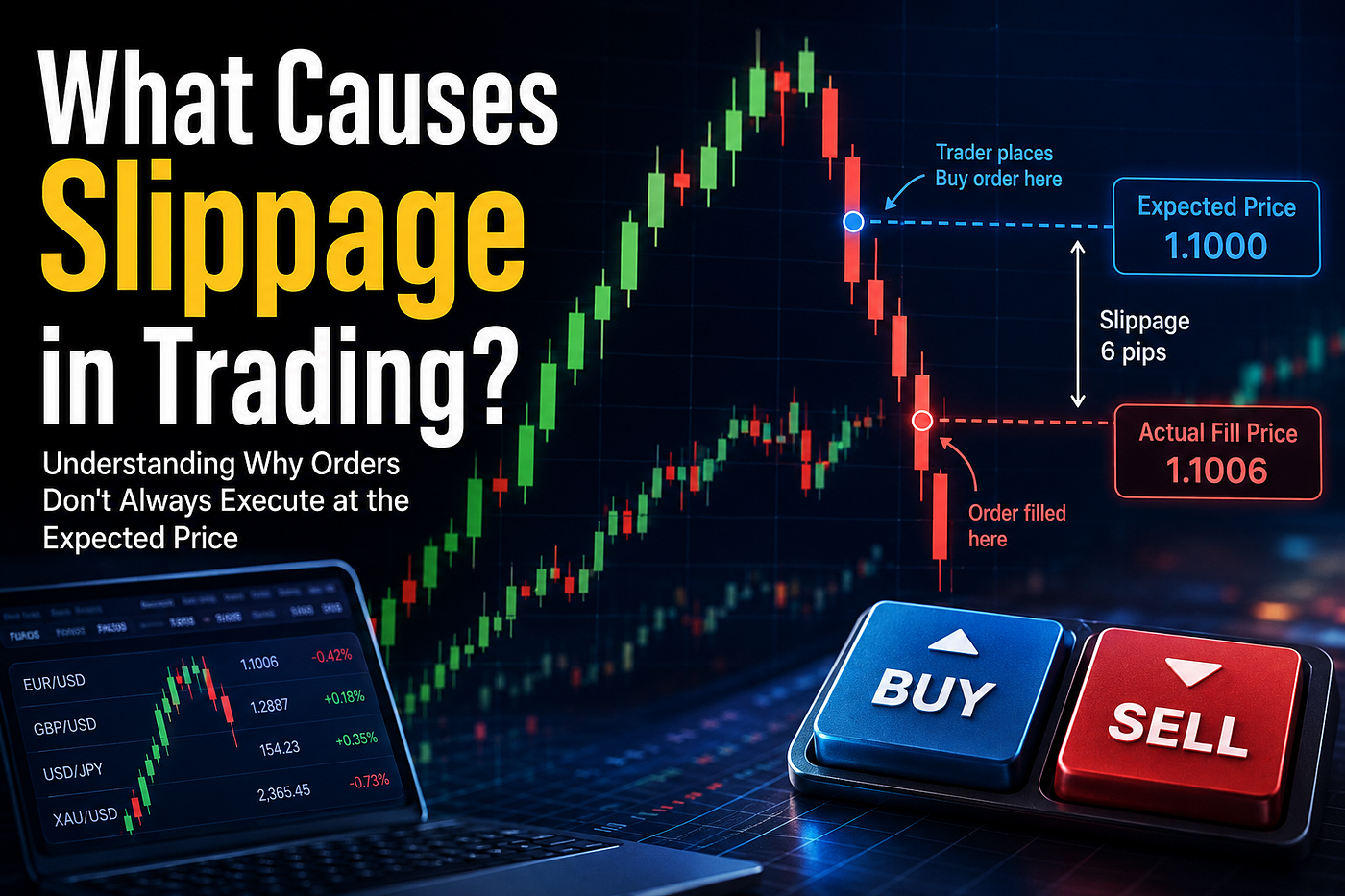
What Causes Slippage in Trading? Understanding Why Orders Don’t Always Execute at the Expected Price
It’s 8:30 a.m. EST on the first Friday of the month. You’ve been watching the U.S. dollar for a few days. The Nonfarm Payrolls (NFP) number dropsjobs added come in sharply below the consensus forecast. You move quickly, entering a sell order on EUR/USD at 1.0842. Your order fills at 1.0857. Fifteen pips away from where you clicked.
You didn’t make a mistake. The market just moved faster than your order could.
That gap between the price you expected and the price you got has a name, slippage. And it’s not a glitch, a broker error, or bad luck. It’s a structural feature of how markets work under pressure.
What Slippage Actually Is
Slippage is the difference between the price at which a trader intends to execute an order and the price at which the order actually fills.
It sounds simple enough, but the mechanics behind it matter. When you place a market order, you’re not buying from or selling to a fixed price board. You’re matching against real orders sitting in the order book, bids and offers placed by other participants like banks, institutions, algorithms, other retail traders. If the price moves between the moment you submit your order and the moment it reaches the exchange or liquidity provider, your fill will reflect the new market reality, not the old one.
That movement can be a fraction of a pip. During calm, liquid sessions, most traders barely notice it. But in the seconds after a major economic release, the order book can look completely different from one moment to the next.
The Main Causes of Slippage
Volatile Markets Create Moving Targets
Price volatility is the most direct cause of slippage. When prices are moving quickly, whether because of a news shock, a large institutional order, or a cascade of stop-losses triggering. Here’s simply less certainty about where your order will land.
Think of it this way. If you want to buy something that’s priced at $100 but the price is changing every millisecond, the “price” you saw is already history by the time your order reaches the market. The faster the market is moving, the wider the gap between your intended price and your actual fill.
Gold markets offered a clear example of this dynamic through early 2025. As geopolitical uncertainty drove gold prices to successive record highs, crossing $3,000 per troy ounce and continuing into record territory, periods of extreme velocity made execution unpredictable even during otherwise liquid trading hours. Traders placing market orders during sharp intraday rallies were routinely filling several dollars per ounce away from the level they’d watched on their screen.
Market Liquidity: The Depth Behind the Price
Liquidity refers to the volume of buy and sell orders available at or near the current price. High liquidity means there are plenty of counterparties at each price level, so large orders can be absorbed without significantly moving the market. Low liquidity means the opposite. Your order might have to sweep through several price levels to fully fill, and each level you reach may be further from your original price.
This is why forex slippage around low-liquidity periods. The overnight session for major currency pairs, for example, or the window between New York close and the Asian open tends to be worse than during peak trading hours. The bid-ask spread widens, and the order book thins out.
Liquidity can also vanish temporarily during high-impact events even in otherwise deep markets. During the Federal Reserve’s rate decision meetings in 2025, particularly the March and May meetings where guidance on the pace of future cuts was closely contested, traders observed liquidity evaporating in the seconds just before and after the statement release. The U.S. dollar moved sharply as the market repriced its rate expectations, and many orders filled well outside the pre-announcement price range.
Order Flow Imbalances
Slippage isn’t just about speed but it’s also about imbalance. When a large number of traders are all trying to do the same thing at the same time, they’re all competing for the same scarce liquidity.
This is what happens after major surprises. If the CPI number comes in significantly hotter than expected, a surge of sell orders floods into bonds, dollars rush in, rate-sensitive assets reprice simultaneously. The order flow becomes one-directional, and anyone trying to execute in that moment is competing with hundreds of other participants for the same available bids and offers. The thin layer of liquidity at any given price gets exhausted quickly, and orders slip further and further down the book.
Major News Events: When the Market Reprices Fast
Some events are predictably disruptive to execution quality, even when traders know they’re coming.
Scheduled economic releases like NFP, CPI, Federal Reserve statements, European Central Bank policy announcements and Bank of Japan decisions are times when the market’s collective estimate of fair value gets recalibrated in seconds. The anticipation itself causes some liquidity providers to pull their quotes just before the release, widening spreads and reducing the available depth.
The January 2025 U.S. CPI release illustrated this clearly. Headline inflation came in above expectations at a time when the market had been leaning toward a more dovish Fed trajectory. The immediate reaction was a sharp dollar rally and a significant move lower in U.S. Treasuries. Traders who had limit orders in the bond market found that prices gapped through their levels entirely and the market moved so quickly that their intended price was skipped altogether. This is sometimes called a gap fill and represents an extreme version of slippage.
Positive Slippage vs. Negative Slippage
Slippage isn’t always harmful. Most traders associate it with getting a worse price, which is negative slippage and your buy order fills higher than expected, or your sell order fills lower. This is the version that stings.
But positive slippage exists too. If you place a buy order and the market dips slightly before your order fills, you might get a better price than you asked for. This happens, though less frequently in fast-moving markets where momentum tends to carry prices away from, rather than toward, your intended entry.
In forex trading, positive slippage occasionally occurs during overnight sessions or when liquidity briefly improves. Some execution models are designed to pass positive slippage on to the client, others are not, which is one reason the type of account and broker structure matters to execution-focused traders.
During the Bank of Japan’s policy shifts in early 2025, as the BOJ continued its careful normalisation away from ultra-loose settings, yen volatility created unusual two-way slippage situations. Traders positioned ahead of announcements sometimes received better fills than expected when the yen moved in their favor before the full market reaction played out.
Why Forex Traders Experience Slippage Around NFP, CPI, and Rate Decisions
The forex market is the most liquid financial market in the world during normal conditions, with daily turnover running into trillions of dollars. But that liquidity is not evenly distributed across time or events.
NFP releases are perhaps the most reliably volatile scheduled events in forex. The employment number feeds directly into Federal Reserve rate expectations, which in turn affect dollar valuations across every major currency pair. A significant miss or beat doesn’t just move EUR/USD, it ripples through GBP/USD, USD/JPY, commodity-linked currencies, and cross pairs simultaneously. This broadens the execution impact which liquidity providers are managing exposure across multiple correlated instruments at once, which often means tighter quotes get pulled in the seconds around the release.
CPI data has taken on heightened importance since the inflation cycle of 2022–2024, and its market impact has remained elevated into 2025–2026 as traders continue to calibrate Fed expectations against each monthly print. An unexpected deviation of even 0.1% from consensus can move currency pairs by 50–100 pips within seconds, making market orders placed at that moment highly vulnerable to slippage.
Interest rate decisions bring a different kind of slippage risk. The headline rate move is usually known or well-telegraphed, but the statement language, the press conference tone, and the updated projections can all shift sentiment rapidly. The May 2025 Fed meeting, where Chair Powell’s comments on the labor market were parsed in real time by algorithmic traders, produced sharp repricing in dollar pairs that left many limit orders unfilled and many market orders executing well outside the pre-statement range.
Practical Ways Traders Can Reduce Slippage
Understanding slippage doesn’t eliminate it, but it does allow traders to manage their exposure to it.
Use limit orders instead of market orders during high-impact events. A limit order specifies the maximum price you’re willing to pay or the minimum you’re willing to accept. You won’t get filled at a worse price but you may not get filled at all if the market moves through your level. That’s a trade off worth understanding.
Be aware of the economic calendar. Knowing when NFP, CPI, and rate decisions are scheduled allows traders to decide in advance whether they want to hold positions through those releases. Execution quality degrades around these events almost predictably.
Understand your order type and how your broker handles fills. Different execution models equals to market maker like STP, ECN handle slippage differently. Some pass positive slippage to clients, some have limits on how far they’ll fill from the requested price (known as maximum slippage settings).
Trade during peak liquidity hours for your instrument. For EUR/USD, that means the London-New York overlap. For USD/JPY, the Tokyo-London overlap matters. Thinner sessions introduce more execution risk for the same size order.
Size positions with execution risk in mind. Larger orders are more exposed to slippage because they require more depth in the order book to fill. During volatile conditions, a large market order may move through multiple price levels before completing.
What Slippage Tells Us About Market Structure
Slippage is sometimes treated as an annoyance or a cost of doing business, but it’s more informative than that. Every time slippage occurs, it’s the market communicating something about its structure at that moment, about the balance between buyers and sellers, about the confidence of liquidity providers, about how fast information is being priced in.
A market that consistently produces large slippage around data releases is a market where uncertainty is genuinely high and where price discovery is happening in real time rather than calmly updating. The NFP or CPI events that cause the worst execution conditions are also the events that carry the most information content and the market’s difficulty pricing them smoothly is evidence of that.
For traders trying to understand how markets work, not just where prices might go, but why they move the way they do, slippage is a useful lens. It reveals the difference between the theoretical market of continuous, frictionless pricing and the actual market of competing interests, finite liquidity, and split-second decisions.
The next time your order fills a few pips away from the level you intended, it’s worth asking not just “how do I avoid this?” but also “what was the market doing in that moment?” The answer often tells you more about market mechanics than any textbook definition would.
Anais | Market covers market mechanics, economic data, and the structural forces shaping financial markets. Nothing published here constitutes investment advice or trading signals.
메타데이터
- post_id
- eb55ff77bc8b
- slug
- what-causes-slippage-in-trading-eb55ff77bc8b
- url
- https://medium.com/@anaisss/what-causes-slippage-in-trading-eb55ff77bc8b
- canonical_url
- https://medium.com/@anaisss/what-causes-slippage-in-trading-eb55ff77bc8b
- author_url
- https://medium.com/@anaisss
- status
- ok
- fetched_at
- 2026-06-12 18:14:10


