Treading the familiar, yet unvisited lane
Treading the familiar, yet unvisited lane
The end credits at the theatre have started rolling in. The hundred-odd audience is glued to their seats. They are slowly absorbing the sentimentality of what they have just witnessed and simultaneously settling in their own emotions, the outpour of which has happened beyond their control. Their gaze is fixated on the screen wherein the cast and crew along with their pictures are being displayed. In a few moments, the workers walk inside the hall and appear bamboozled by the scene. Surely, the movie is done and dusted, and there is nothing left to wait for. But such is the cinematic trance which has captivated the audience that there is yearning for more.
Few months ago, I managed to catch the movie “Batt Koch” (English Translation: The Lane of Kashmiri Pandits) along with my better-half. Ever since I saw its trailer, my interest had piqued. The trailer was in Kashmiri which came as a surprise to me, but I sensed that this was meant for a niche audience.
The shows were, naturally, limited and I ensured to book my ticket as soon as the booking window opened.
This was my first Kashmiri-language movie and with the decent information that I have gathered, a similar experience for most witnessing it. The few who would have watched one before might have done that on the television. Quite simply, it was the first theatrical Kashmiri language film for almost all of the audience.
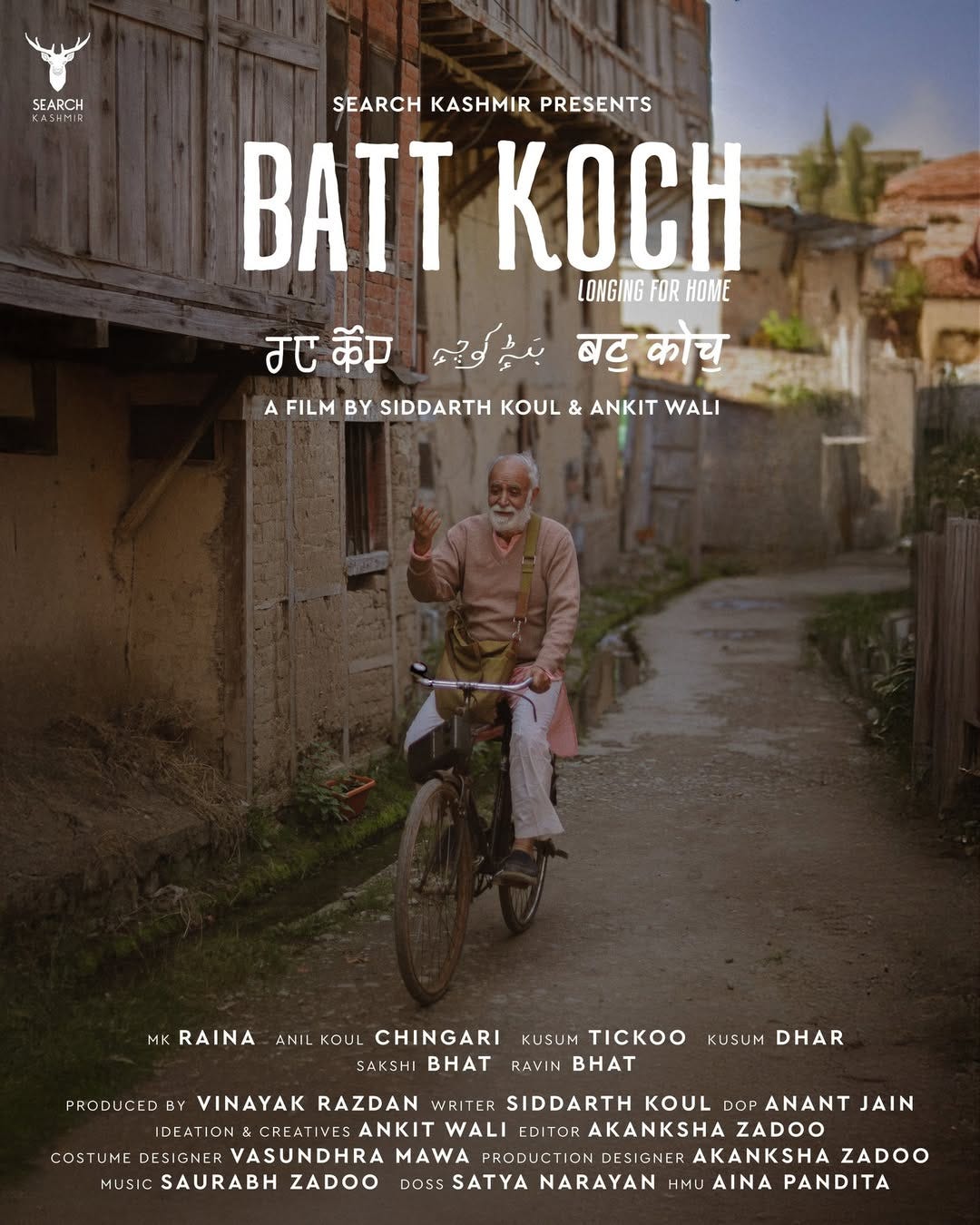
Image Courtesy: IMDB
The movie revolves around a Kashmiri Pandit family of three generations, living together in Jammu. The grand-parents show a constant yearning for visiting their birthplace, Kashmir. When grief befalls them due to unsuccessful plans, other members start developing an urgency and make a successful visit. There, the grandfather lives the life he once lived. He does the routine that he enjoyed and had become a part of his reflex action. He becomes himself.
The hallmark of this movie lies in the authenticity with which it depicts the daily life of Kashmiri Pandits. The routine itself becomes a visual spectacle. The generational traits feel familiar. The inter-personal relationship of the eldest generation, use of the language, support of the grandkids, the constant Aehi (Blessings) to everyone in the family, the remembrance and chanting of the mantras are a few things that I have observed in my own family as well. The movie also depicts the struggles of the middle-generation, including their constant attempts to keep the culture alive, their adoption of Jammu’s culture through its language, the relentless thrust on their children’s education, personal involvement in their exams and college admissions, in addition to the bickering with their kids.
The children in the movie are an epitome of the post-exodus generation. Nothing personifies this more than their inability to speak Kashmiri. They resort to speaking in Hindi, even when conversed to in Kashmiri. They appear rootless, devoid of any familial identity traits, attempting to mainstream-ise themselves. Compounding this is today’s all pervasive digital addiction. I could feel a lot of myself in them.
Through the prism of this movie, you see a generational transition in action wherein the grandfather enjoys his radio while the child dabbles with his smartphone. I have grown up listening to my grandfather’s radio almost everyday. From Vividh Bharti’s iconic intro music to Ameen Sayani’s golden voice, my memories are extremely vivid. Those scenes brought back such memories of yore. But for today’s mobile-centric generation, radio stands as a symbol of a bygone era.
What is unmissable is also the loneliness being felt by the eldest generation, more so in the absence of their partner. As families get smaller and the younger generations stay absorbed in the rut of life, such feelings compound even more.
I believe the raison d’être behind it being able to touch upon so many different tangents is because it depicts the routine of a family. The everyday life has so many elements which one normally takes for granted. But each element is a story. This isn’t just a slice of life, this is life itself. Even the small details of the house setup such as the cushion covers and the rugs make one feel like their own house.
With a movie like this, there would always be thoughts on one’s takeaway. But what can the takeaway be from the time lapse of one’s everyday life? I believe there is something to hold onto. The nuances we often overlook in the rut of life turn conspicuous in the wide-screen of cinema. The perspicacious learn, the imperceptive miss. The strength and inheritance of our culture will be decided by the numerical difference between the two.
Quite often, I have troubled myself with an existential question: How does a culture survive in theory? Maybe such movies could be one answer. Meanwhile, the shade of Chinar is still a distant dream.
메타데이터
- post_id
- eb5b85b2c936
- slug
- treading-the-familiar-yet-unvisited-lane-eb5b85b2c936
- url
- https://medium.com/@vedant12/treading-the-familiar-yet-unvisited-lane-eb5b85b2c936
- canonical_url
- https://medium.com/@vedant12/treading-the-familiar-yet-unvisited-lane-eb5b85b2c936
- author_url
- https://medium.com/@vedant12
- status
- ok
- fetched_at
- 2026-08-09 13:46:10