Vision AI vs Language AI: What is Actually Different?
Artificial intelligence systems that work with text and those that work with images are often described as similar.
Vision AI vs Language AI: What is Actually Different?
Artificial intelligence systems that work with text and those that work with images are often described as similar.
While Multimodal AI relies on shared architectures like Transformers, Vision and Language models fundamentally diverge in how they represent, structure, and learn from data.
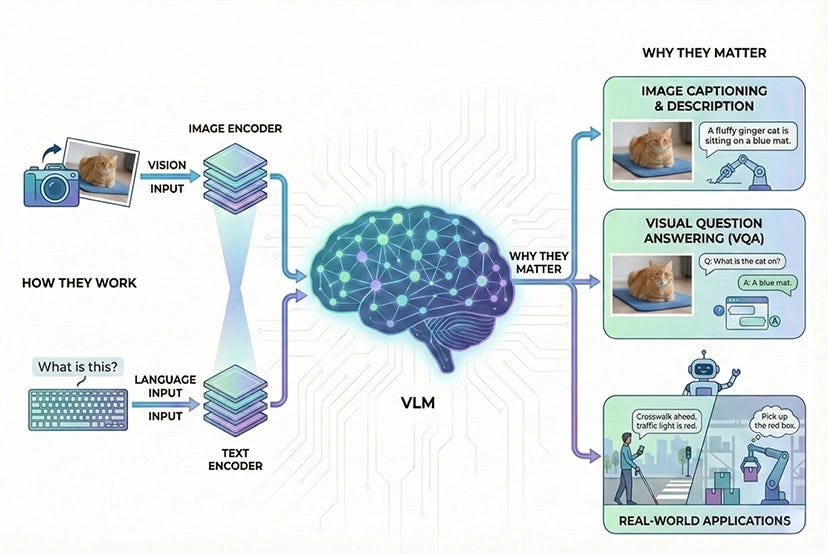
Source Image
Input Structure
Language AI (NLP models)
Language models operate on sequential symbolic data.
Input: text
Unit: tokens (words, subwords, or bytes)
Structure: linear sequence
Example: “Artificial intelligence is useful”
- becomes a sequence of token IDs.
- Each token has a position in a line.
Vision AI
Vision models operate on spatial numerical data.
Input: images
Unit: pixels grouped into patches (ViT) or convolution windows
Structure: 2D grid (height × width)
Example: An image of a cat
- split into patches (e.g., 16×16 pixels)
- each patch becomes a vector representation
Unlike text, spatial relationships matter directly.
How Information Is Converted
NLP Pipeline:
- Text → normalization → tokenization → token IDs → embeddings
Vision Pipeline:
- Image → pixel matrix → patch extraction → linear projection → embeddings
Both systems eventually produce:
sequences of embedding vectors. But the origin of those vectors is different.
Positional Information
Both systems must encode position, but differently:
NLP:
- 1D positional encoding
- order of tokens is critical
Vision:
- 2D positional encoding
- both height and width matter
- spatial locality is important
The difference: language = sequence vision = space
Model Architecture Similarity
Modern systems often use similar architectures: transformer-based models
Key mechanism:
- self-attention
- learned dependencies between input units
But usage differs:
In NLP, attention learns:
- grammar dependencies
- semantic relationships
- long-range context in text
In Vision, it learns:
- object parts
- spatial relationships
- global image structure
Same mechanism, different data geometry.
What the Model Actually Learns
Both Vision and Language models optimize: prediction over input units
In NLP, it:
- predict next token or
- masked token
In vision, it learns to:
- classify image
- predict masked patches
- detect objects
- reconstruct missing regions
So learning objective differs depending on task design.
Important Misconception
There is a common misunderstanding:
- Vision models understand images like humans
- Language models understand meaning like humans
But, in reality:
- Both learn statistical patterns in data representations
- Neither directly understands in a human cognitive sense
- Both operate on learned embeddings and probability distributions
Why They Are Becoming Similar
Newer architectures (like multimodal models) combine both:
- text tokens
- image tokens
- audio tokens
All converted into:
unified embedding spaces
This allows:
- image captioning
- visual question answering
- text-to-image systems
- cross-modal reasoning
But, they still rely on:
- token-like units
- learned attention-based relationships
Summary
Vision AI and Language AI differ mainly in:
- input structure (space vs sequence)
- tokenization method (patches vs subwords)
- positional encoding (2D vs 1D)
But they are similar in:
- embeddings
- transformer-based attention
- probabilistic learning objectives
The main difference is in how information is represented before learning begins.
메타데이터
- post_id
- eb640415e202
- slug
- vision-ai-vs-language-ai-what-is-actually-different-eb640415e202
- url
- https://medium.com/@ml-point/vision-ai-vs-language-ai-what-is-actually-different-eb640415e202
- canonical_url
- https://medium.com/@ml-point/vision-ai-vs-language-ai-what-is-actually-different-eb640415e202
- author_url
- https://medium.com/@ml-point
- status
- ok
- fetched_at
- 2026-06-23 06:34:20