Optical Bonding in Industrial Displays: Enhancing Durability and Visibility
n today’s industrial world, display performance isn’t just about sharp images — it’s about reliability in demanding environments…
Optical Bonding in Industrial Displays: Enhancing Durability and Visibility
In today’s industrial world, display performance isn’t just about sharp images — it’s about reliability in demanding environments. Engineers and product designers need screens that deliver clear visuals, accurate colors, and long-term stability even under vibration, dust, humidity, or direct sunlight.
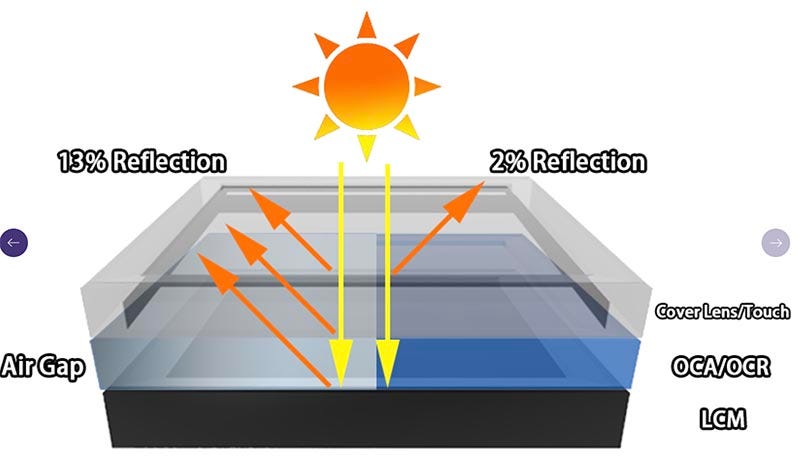
This is where optical bonding technology comes into play — a process that improves both the optical clarity and mechanical durability of displays by eliminating the air gap between the LCD panel and the cover glass or touch layer.
What Is Optical Bonding?
Optical bonding is the process of attaching a protective glass or touch panel directly to an LCD module using an optically clear adhesive (OCA or OCR).
The adhesive fills the microscopic air gap that typically exists in conventional displays. Once cured, these layers act as a single, solid unit, improving both visual performance and mechanical strength.
There are two major types of optical bonding:
- Liquid Optical Clear Resin (OCR): A liquid adhesive cured by UV light, offering superior adhesion and flexibility for irregular surfaces.
- Optical Clear Adhesive (OCA): A pre-formed film adhesive preferred in high-volume production for its precision and clean process.
Why Industrial Displays Require Optical Bonding
In industrial applications — such as factory automation panels, outdoor kiosks, marine equipment, and medical instruments — optical bonding is no longer optional.
Standard air-bonded displays often struggle with glare, condensation, or mechanical stress. Optical bonding effectively solves these challenges by combining optical improvement with structural reinforcement.
Key Benefits
- Improved sunlight readability: Eliminates internal reflections, reducing glare and increasing contrast.
- Enhanced durability: The bonded layers resist shock and vibration better than standard air gaps.
- Better protection: The sealed surface prevents dust and moisture from entering the module.
The Science Behind Better Visuals
In a typical display, light passes through several interfaces — air, glass, and film — each causing reflections that reduce clarity.
By removing the air interface, optical bonding reduces internal reflection by up to 80%, providing crisp images even in strong ambient light.
This also improves color accuracy, making shades appear richer and more lifelike — a major advantage in medical imaging and industrial monitoring where precision matters.
Mechanical and Environmental Advantages
Beyond optical benefits, bonded displays exhibit superior mechanical integrity.
The unified structure behaves like a single piece of glass, improving resistance to vibration and shock — ideal for transportation, heavy machinery, and outdoor signage.
Eliminating the air gap also prevents fogging and dust intrusion, extending the product’s operational lifespan and ensuring consistent performance in environments with rapid temperature changes.
Types of Adhesives Used in Optical Bonding
The choice of adhesive significantly impacts long-term reliability.
Common materials include silicone, epoxy, and UV-curable acrylics, each suited to different operating conditions.
- Silicone adhesives: Flexible and ideal for large or high-vibration displays.
- Epoxy adhesives: Excellent bonding strength and clarity, but require careful process control to prevent yellowing.
- UV-curable acrylics: Provide fast curing and stable optical quality, suitable for mass production.
Selecting the right adhesive requires balancing strength, transparency, curing time, and temperature tolerance.
Comparing Air Bonding vs Optical Bonding

Industrial Applications
Optical bonding is now a standard requirement in many professional display systems, including:
- Factory control panels: Real-time process visualization.
- Medical equipment: High clarity and easy sterilization.
- Outdoor kiosks & ATMs: Sunlight readability and vandal protection.
- Marine & aviation systems: Resistance to humidity and vibration.
Manufacturing Challenges
While the results are impressive, achieving flawless optical bonding is technically demanding.
The process requires cleanroom environments, bubble-free adhesive application, and precise curing control. Even minor dust particles or uneven adhesive layers can cause visible defects.
To ensure consistent results, manufacturers use vacuum laminators, automatic dispensers, and UV curing systems — all carefully calibrated for each display size and adhesive type.
The Future of Optical Bonding
As industrial and commercial display demands grow, optical bonding continues to evolve.
New hybrid adhesives now combine the clarity of acrylics with the flexibility of silicone.
Robotic automation ensures uniform bonding, while integrated anti-reflective coatings and EMI shielding are becoming standard.
With the rise of smart factories, connected medical devices, and intelligent interfaces, optical bonding is no longer a luxury — it’s a fundamental requirement for any professional display solution.
Conclusion
Optical bonding bridges the gap between optical excellence and environmental toughness.
It defines what it means to build a truly industrial-grade display — clear, durable, and dependable.
From marine navigation panels to medical diagnostic screens, this technology ensures visibility and reliability where it matters most.
메타데이터
- post_id
- eb660cf7db1c
- slug
- optical-bonding-in-industrial-displays-enhancing-durability-and-visibility-eb660cf7db1c
- url
- https://medium.com/@kevinzhang1099/optical-bonding-in-industrial-displays-enhancing-durability-and-visibility-eb660cf7db1c
- canonical_url
- https://medium.com/@kevinzhang1099/optical-bonding-in-industrial-displays-enhancing-durability-and-visibility-eb660cf7db1c
- author_url
- https://medium.com/@kevinzhang1099
- status
- ok
- fetched_at
- 2026-07-16 20:55:37