Reimagining Trade Finance Compliance: Moving Beyond Red Flags
Part 2 of my thoughts on the evolving relationship between Trade Finance, Compliance, and intelligent interoperability.
Reimagining Trade Finance Compliance: Moving Beyond Red Flags
Part 2 of my thoughts on the evolving relationship between Trade Finance, Compliance, and intelligent interoperability.
In my earlier article, “Trade and Compliance: Two Sides of the Same Coin,” I discussed how the future of Trade Finance and Compliance may depend on intelligent interoperability — connecting institutional knowledge, external intelligence, technology, operational realities, and human expertise into a unified ecosystem.
This led me to think more deeply about AML and Trade-Based Money Laundering (TBML) controls.
Today, financial institutions are dealing with: • Expanding typologies • Increasing red flags • Evolving sanctions risks • Growing regulatory expectations
As a result, compliance frameworks are becoming increasingly complex and operationally heavy.
But this raises an important question:
Can financial institutions realistically build systems capable of accommodating every possible red flag and emerging typology?
Or should the industry focus more on strengthening foundational control intelligence capable of dynamically interpreting risks as they evolve?
In many ways, I believe the answer lies in the latter.
While typologies continue to evolve, the core validation principles within Trade Finance and TBML remain broadly consistent.
In most trade transactions, institutions are fundamentally trying to validate:
• Assessment of whether the trade transaction aligns with the customer’s known business profile, KYC/CDD information, and expected commercial activity • Who are the counterparties involved? • Does the pricing make commercial sense? • Is the movement of goods genuine and verifiable? • Are there documentation inconsistencies or manipulation risks? • Are there sanctions, export control, or jurisdictional concerns?
Whether the typology involves over-invoicing, phantom shipments, shell counterparties, sanctions evasion, or unusual routing structures, the underlying control objectives are often interconnected.
At the same time, red flags remain extremely important.
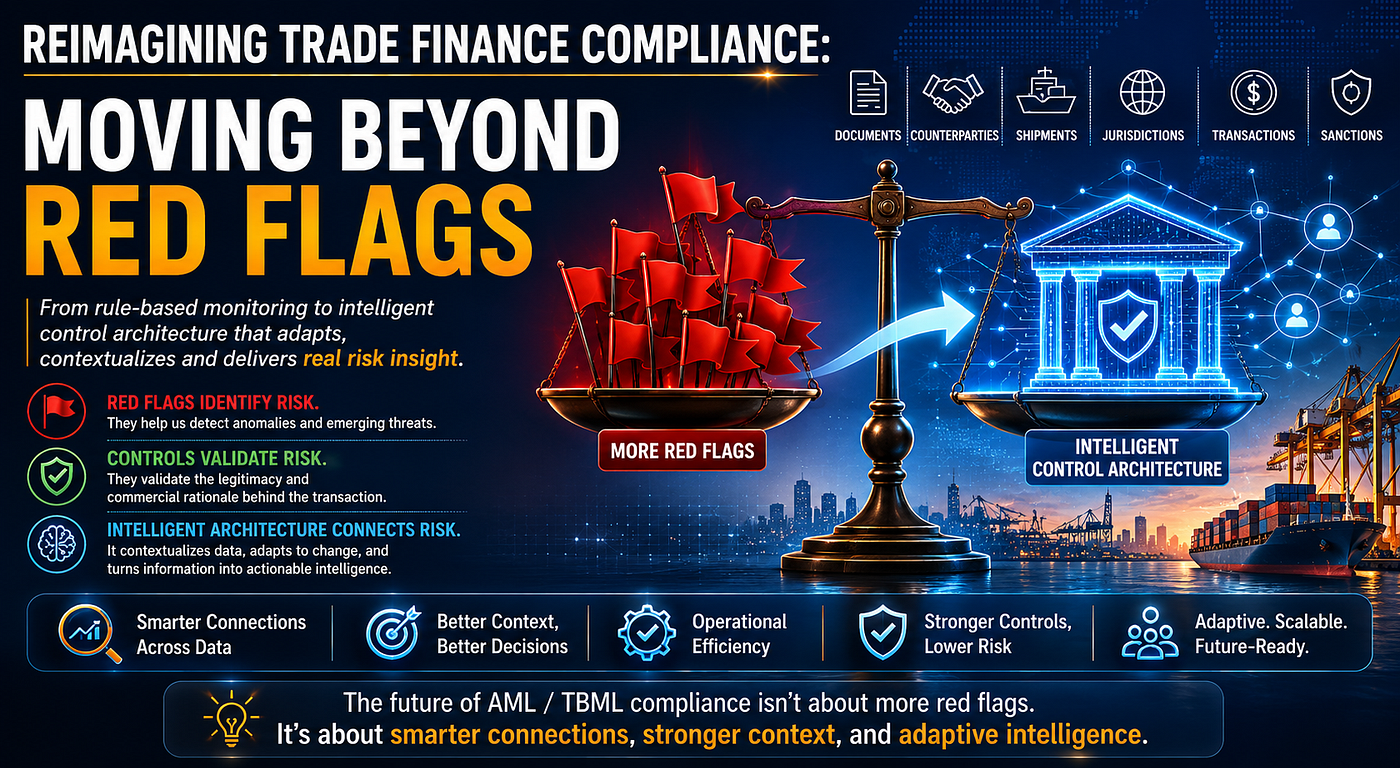
However, red flags are not the controls themselves.
They are indicators that help institutions identify anomalies and emerging risks across customer behavior, counterparties, products, and jurisdictions.
The underlying controls are what ultimately validate the legitimacy and commercial rationale of the transaction.
This is also where a bank’s Risk Appetite Framework becomes highly relevant.
The same red flag may be interpreted differently across institutions depending on: • Risk appetite • Geographic exposure • Product focus • Sector expertise • Control maturity
For many years, the industry has largely evolved through a typology-centric approach: • New risk identified • New rule introduced • New alert generated
While this has strengthened regulatory responsiveness, it has also contributed to fragmented controls, duplicated monitoring, operational inefficiencies, and increasing alert fatigue.
The challenge today is no longer the lack of red flags.
The challenge is how institutions can convert thousands of disconnected alerts into meaningful and operationally usable intelligence.
The industry is becoming increasingly focused on expanding typologies and alert libraries.
However, the real opportunity may not lie in creating more fragmented controls.
It may lie in strengthening foundational intelligence frameworks capable of dynamically contextualizing risks across customers, counterparties, trade activity, documentation, logistics, sanctions exposure, and transactional behavior.
Perhaps the future of AML and TBML compliance is not about predicting every possible typology individually.
Perhaps it is about building adaptive intelligence ecosystems resilient enough to identify risk patterns even when the typology itself is new or previously unseen.
In many ways, the next evolution of financial crime compliance may not be defined by isolated typologies alone.
It may be defined by intelligent control architecture.
Would value perspectives from professionals across AML, Trade Finance, Sanctions, Operations, Technology, and Risk on how they see this evolution shaping the future of financial crime compliance.
Part 3 may explore whether future Trade Finance compliance frameworks should evolve from static rule-based monitoring toward adaptive intelligence ecosystems. We move from theory to design — how a contextual trade pricing intelligence model can actually be structured inside a bank, how internal data can be transformed into a living pricing benchmark system, and how this shift can redefine the way TBML risk is identified, scored, and escalated
메타데이터
- post_id
- eb6d24fdcf74
- slug
- reimagining-trade-finance-compliance-moving-beyond-red-flags-eb6d24fdcf74
- url
- https://medium.com/@jinesh.kutty/reimagining-trade-finance-compliance-moving-beyond-red-flags-eb6d24fdcf74
- canonical_url
- https://medium.com/@jinesh.kutty/reimagining-trade-finance-compliance-moving-beyond-red-flags-eb6d24fdcf74
- author_url
- https://medium.com/@jinesh.kutty
- status
- ok
- fetched_at
- 2026-06-09 14:34:10




