The Hidden Metric That Determines Battery Energy Storage Efficiency
How round-trip efficiency affects battery performance, renewable energy storage, and grid economics.
The Hidden Metric That Determines Battery Energy Storage Efficiency
How round-trip efficiency affects battery performance, renewable energy storage, and grid economics.
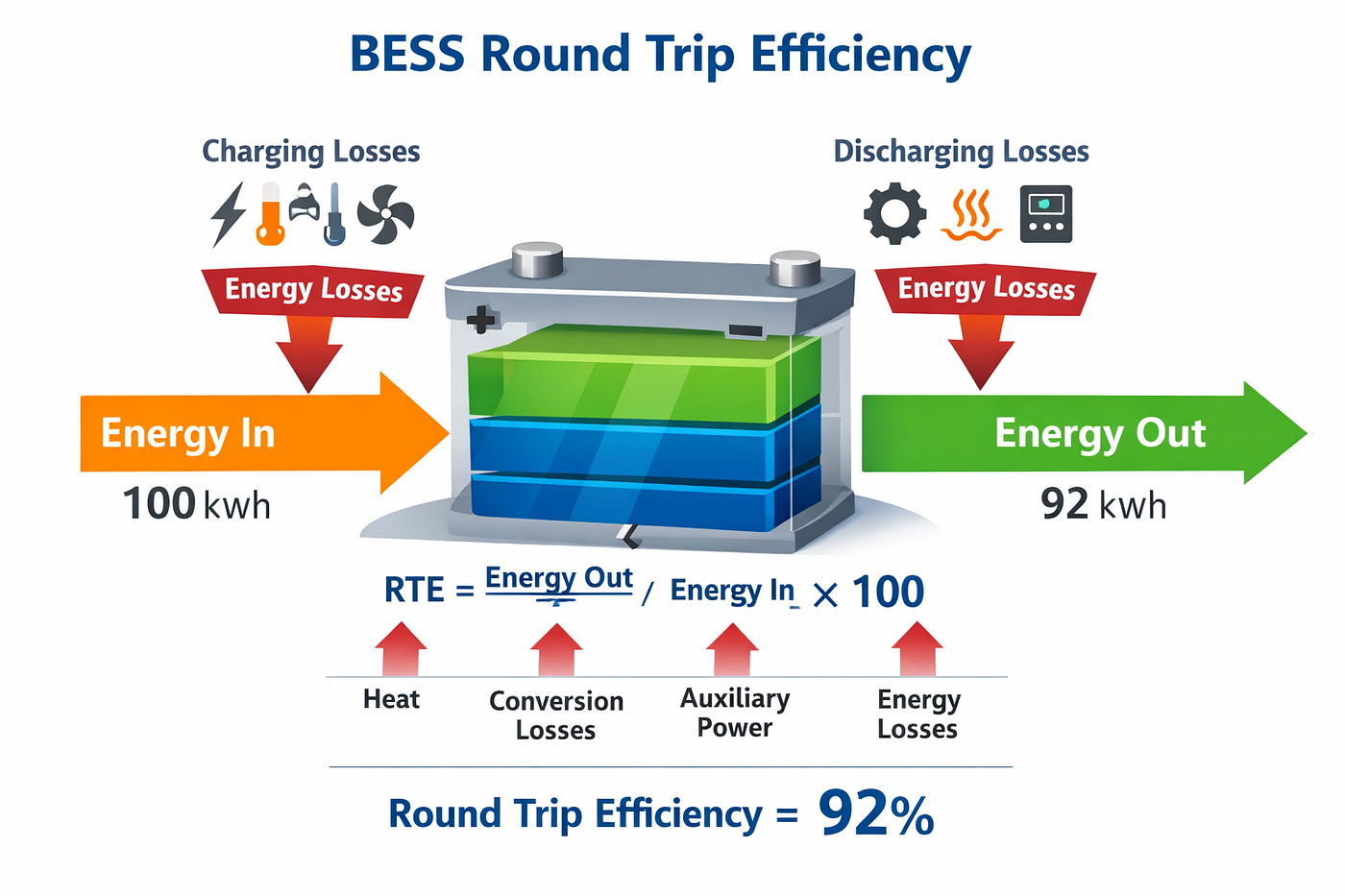
Renewable energy is expanding rapidly.
Solar farms and wind projects are transforming the global energy landscape. However, renewable power has one fundamental challenge: generation does not always match demand.
That is why Battery Energy Storage Systems (BESS) are becoming a critical part of modern power infrastructure.
Batteries store excess electricity and release it when the grid needs it most. Yet many people assume that all stored electricity can be recovered later.
In reality, that is not the case.
A key metric determines how efficiently energy storage systems operate. It is called Round-Trip Efficiency (RTE).
Understanding this metric is essential for energy developers, utilities, and investors evaluating energy storage projects.
What Is Round-Trip Efficiency in Energy Storage?
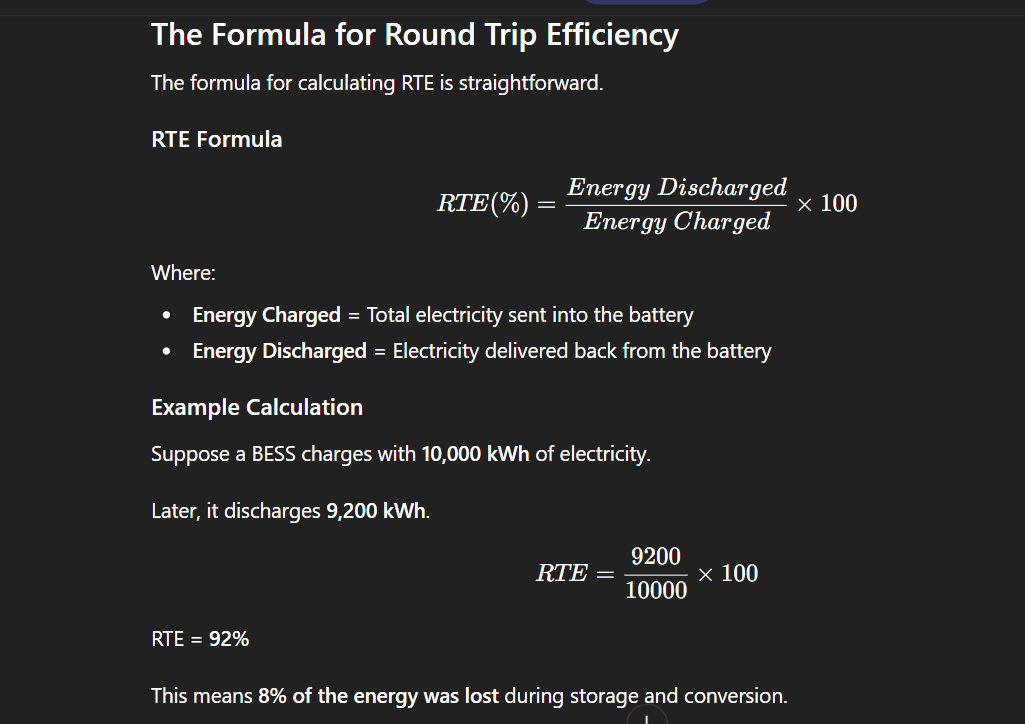
Round-Trip Efficiency measures how much energy a battery can deliver compared to the energy used to charge it.
The formula is simple:
Round-Trip Efficiency = Energy Discharged ÷ Energy Charged
For example:
- 100 MWh stored in a battery
- 90 MWh delivered back to the grid
This means the system operates at 90% efficiency.
The remaining 10% of energy is lost within the system during the charging and discharging process.
Although these losses are unavoidable, engineers work continuously to reduce them.
Why Energy Loss Happens in Battery Storage Systems
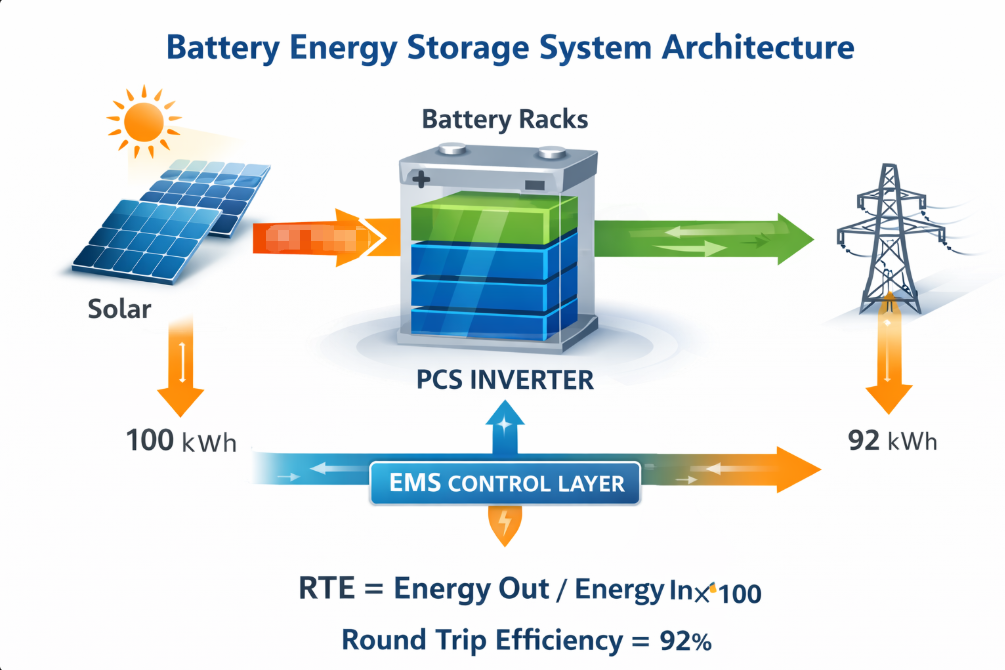
Electricity flows through several components inside a battery energy storage system.
Each stage introduces small losses that collectively reduce the overall efficiency.
Major loss sources include:
Battery cell resistance Electrochemical reactions inside battery cells generate heat, which results in energy loss.
Power conversion systems Inverters convert electricity between DC and AC, introducing conversion inefficiencies.
Transformers and electrical wiring Voltage transformation and electrical transmission create additional losses.
Thermal management systems Cooling systems maintain battery temperature but consume energy during operation.
Battery management electronics Monitoring and safety systems require continuous power.
These combined factors determine the final Round-Trip Efficiency of a storage system.
Typical Round-Trip Efficiency Across Battery Technologies
Different battery technologies have different efficiency levels.
Typical ranges include:
Typical Efficiency for Different Battery Technology Lithium-ion batteries 85–95% Sodium-ion batteries 85–90% Lead-acid batteries 70–85% Flow batteries 65–85%
Lithium-ion batteries currently dominate the global energy storage market because they combine high efficiency, long cycle life, and declining costs.
As battery technology evolves, efficiency improvements continue to drive adoption in large-scale renewable energy projects.
Why Round-Trip Efficiency Matters for Energy Projects
Efficiency directly affects the economics of energy storage.
When a battery system loses energy during storage, less electricity is available to sell or use later.
Even small improvements can have a major impact.
For large solar-plus-storage projects, increasing efficiency by just a few percentage points can significantly increase the amount of energy delivered to the grid over the system’s lifetime.
Higher efficiency results in:
- More usable stored energy
- Improved project profitability
- Reduced operational losses
- Better grid reliability
Because of this, developers evaluate efficiency carefully when selecting battery technologies and system designs.
How Engineers Improve Energy Storage Efficiency
Modern energy storage systems use advanced technologies to minimize losses and improve overall efficiency.
Some of the most important improvements include:
High-efficiency power electronics Advanced inverter technologies reduce conversion losses.
Improved thermal management Optimized cooling systems maintain battery performance while minimizing energy consumption.
Smart battery management systems (BMS) Intelligent monitoring ensures batteries operate within optimal conditions.
AI-driven energy management software Advanced algorithms optimize charging and discharging cycles.
Together, these innovations are making modern battery storage systems more efficient than ever before.
The Future of Efficient Energy Storage
As renewable energy penetration increases worldwide, energy storage will play an even larger role in maintaining grid stability.
Efficiency improvements will help:
- Lower the cost of stored electricity
- Maximize renewable energy utilization
- Support large-scale grid integration
- Reduce energy waste
In the coming years, advances in battery chemistry, power electronics, and intelligent energy management will continue improving Round-Trip Efficiency.
For energy storage developers and utilities, this single metric will remain one of the most important indicators of system performance.
Final Thoughts
Battery energy storage systems are becoming a cornerstone of the modern energy transition.
However, the success of these systems depends not only on capacity but also on efficiency.
Round-Trip Efficiency reveals how much energy actually returns after storage.
Understanding and improving this metric will be essential as the world moves toward a cleaner and more resilient energy future.
Read the full technical explanation: https://sunlithenergy.com/bess-round-trip-efficiency-rte/
RenewableEnergy #EnergyStorage #BatteryTechnology #CleanEnergy #SolarEnergy
메타데이터
- post_id
- eb6e9d3c37d3
- slug
- the-hidden-metric-that-determines-battery-energy-storage-efficiency-eb6e9d3c37d3
- url
- https://medium.com/@rjalthar/the-hidden-metric-that-determines-battery-energy-storage-efficiency-eb6e9d3c37d3
- canonical_url
- https://medium.com/@rjalthar/the-hidden-metric-that-determines-battery-energy-storage-efficiency-eb6e9d3c37d3
- author_url
- https://medium.com/@rjalthar
- status
- ok
- fetched_at
- 2026-06-26 21:52:29




