Your Identity Infrastructure Has a Blind Spot. It Showed Up the Moment You Deployed Agents.
When AI agents start touching enterprise systems, the audit trail goes silent. Here’s why the governance gap between human access and agent…
Your Identity Infrastructure Has a Blind Spot. It Showed Up the Moment You Deployed Agents.
When AI agents start touching enterprise systems, the audit trail goes silent. Here’s why the governance gap between human access and agent access is the infrastructure problem regulated industries aren’t ready for.

Sonu Goswami: Positioning Expert 2026 for funded B2B SaaS in security, compliance & regulated markets | Clarifying the economic wedge that accelerates complex deals
Enterprises spent two decades building access controls for humans. Then a new class of worker arrived — and nobody had a management system for it.
Before ISO 42001 gave enterprises a framework for AI management systems, and before most security policies had caught up to the tools their own engineers were using, Samsung discovered the gap the hard way.
In early 2023, Samsung engineers did something their company’s security policies almost certainly didn’t explicitly prohibit — because the policies hadn’t been written yet.
They pasted proprietary source code into ChatGPT. Internal meeting notes. Semiconductor equipment data. Not because they were careless. Because they were trying to get work done, and the tool was available, and nobody had drawn a clear line around what AI systems were and weren’t permitted to touch.
Samsung banned generative AI tools company-wide within weeks. JPMorgan restricted ChatGPT access. Goldman Sachs, Citi, Deutsche Bank — the pattern repeated across regulated financial institutions through the first half of that year. Not because any of them had been breached in the traditional sense. Because their security and compliance teams looked at what was happening and realized they couldn’t answer a basic question.
What, exactly, did these systems have access to?
That question is harder than it sounds. And it’s about to get significantly harder.
· · ·
The Samsung incident gets discussed as a data leakage story. That framing is accurate but incomplete. What Samsung actually discovered — and what every regulated enterprise is quietly discovering right now — is that their governance infrastructure had a boundary it was never designed to cross.
For twenty years, enterprise access management was built around a single assumption: that the entity taking action inside your systems was a human being. An employee with an identity, a role, a manager, a start date, and eventually an offboarding process. Every major investment in IAM — Okta, SailPoint, CyberArk, BeyondTrust — was built on top of that assumption. You provisioned access when someone joined. You reviewed it quarterly. You revoked it when they left. The audit trail showed a name.

That model worked because it matched organizational reality. Humans were the actors. Systems were the environment they acted in.
AI agents break that assumption at the foundation.
· · ·
An agent isn’t a user. It isn’t software in the traditional sense either. It’s something enterprises don’t have clean organizational language for yet — an entity that can access Salesforce, query a data warehouse, trigger a workflow in Jira, call an internal API, and modify a record, all without a name in the HR system, without a manager, without a quarterly access review, and without a termination date.
Most enterprises deploying agents today are authenticating them through service accounts or API keys. Those credentials say one thing: something authenticated. They don’t say which agent, operating under whose approval, with what permission boundaries, for how long.
That distinction — between authenticated and governed — is where the exposure lives.
When a JPMorgan compliance officer asks for a complete list of entities that accessed customer financial data over the last ninety days, the identity system produces a report. That report shows employees. It shows service accounts. What it doesn’t show, in most enterprise environments right now, is the three agents that were querying that data daily — because those agents have no identity in the governance layer. They have keys. They aren’t persons of record anywhere.
For a regional bank or an insurance carrier operating under SOC 2, SOX, or state-level financial regulations, that gap isn’t a theoretical concern. It’s an audit finding waiting to happen.
· · ·
The IAM market didn’t emerge because enterprises woke up one day wanting identity governance. Nobody planned for it. Through the late 1990s and early 2000s, access management at most companies ran on spreadsheets, IT tickets, and whoever remembered who approved what. Spreadsheets. IT tickets. Institutional memory. A team of fifty people was manageable. A company of five thousand wasn’t. When auditors started asking regulated firms to demonstrate who had access to what — and when — the honest answer at too many organizations was some version of we believe we know. That gap between assumed controls and documented controls is what made Okta and SailPoint inevitable. Not clever technology. Operational necessity meeting regulatory pressure.
The same convergence is forming now. One layer up. With a new class of actor that the existing infrastructure wasn’t built to see.
· · ·
Agents don’t arrive through procurement. They arrive through productivity.
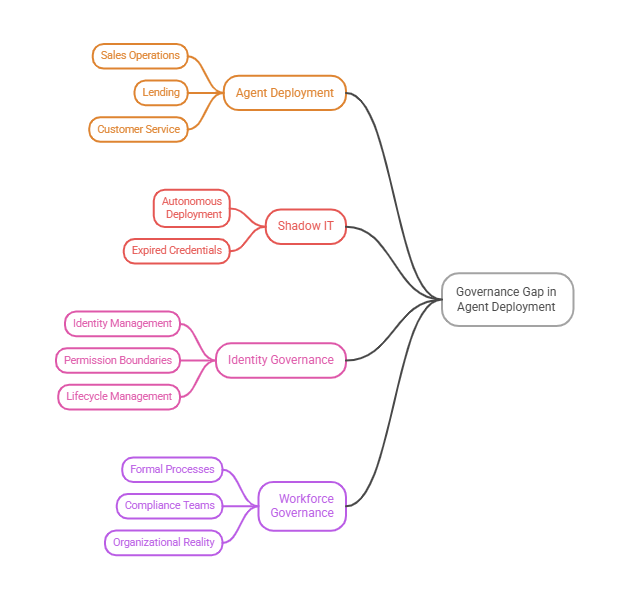
A sales operations team deploys an agent to pull CRM data and prep account summaries. A lending team deploys one to read applicant documents and pre-populate underwriting templates. A customer service team connects one to their ticketing system to route escalations. Each deployment is reasonable. Each solves a real problem. None of them necessarily goes through the same provisioning process that a new employee would.
Six months later, the CISO runs an audit and finds — if they’re looking carefully — not three agents but eleven. Some sanctioned by IT. Some deployed autonomously by business units. Some running on credentials that belong to employees who left the company months ago and whose access was never formally extended to the agents they built.
Nobody did anything wrong. The agents accumulated the way shadow IT always accumulates — quietly, one business problem at a time, until the map no longer matched the territory.
This is not a security architecture failure. It’s a governance visibility failure. The agents were doing exactly what they were deployed to do. The problem is that nothing in the enterprise’s compliance infrastructure had a record of what they were authorized to do, who had approved it, or when that authorization would expire.
· · ·
The category conversation forming around this problem is getting misfiled.
Most of the early market framing has landed in AI security — detecting risky model behavior, monitoring prompts, protecting LLM pipelines from adversarial inputs. Those are real problems with real products addressing them.
But the governance gap isn’t primarily a model behavior problem. The agents in the financial services examples above weren’t behaving badly. They were behaving exactly as intended. The failure was organizational: nobody had formally extended workforce governance to cover non-human actors.
The question a CISO in a regulated environment actually needs answered isn’t is the model safe. It’s which systems is this agent authorized to reach, who approved that authorization, and how do I revoke it when the business need disappears.
Those are identity governance questions. Workforce governance questions. The kind that enterprises already have mature processes for — when the worker in question has an offer letter.
The infrastructure gap isn’t about AI being dangerous. It’s about enterprises running governance systems that stop at the boundary of human identity — at the exact moment they’re deploying a new class of operational actor that sits entirely outside that boundary.
· · ·
The companies that close this gap first won’t necessarily be the ones with the most sophisticated AI security tooling. They’ll be the ones that figured out — before the auditor asked — how to give every agent an identity, a permission boundary, an owner, and a lifecycle.
That’s not a new problem. Enterprises solved it for humans twenty years ago, when the operational cost of not solving it became too high.
But the cost calculation shifting now isn’t just about agents replacing employees in the governance model. It’s about something structurally larger.
SailPoint was built to manage employees. Okta was built to manage employees. CyberArk was built to manage privileged employees. Every major IAM platform built over the last two decades was designed around a single organizational unit: the human worker with a role, a manager, and an employment record.
What’s forming now is a different kind of organizational reality. A mid-size financial services firm in three years won’t just have 2,000 employees. It will have 2,000 employees, several hundred contractors, and potentially thousands of agents — some long-running, some ephemeral, some operating continuously across systems that carry regulatory weight. Some owned by IT. Some deployed by business units. Some inherited from vendors. All of them taking actions that compliance teams will eventually need to account for.
The governance layer that manages that organization doesn’t exist yet.
Not because the technology isn’t there. Because nobody has fully named what it needs to do. The conversation is increasingly being filed under AI security. But the underlying problem may be broader than security alone. Security asks whether something is safe. Governance asks whether something is authorized, accountable, and auditable across its entire operational life.
That’s a workforce management question. And the workforce it applies to is no longer made up entirely of humans.
The next IAM cycle won’t look like Okta with an agent tab bolted on. It will look like a governance platform built from the ground up around the assumption that the operational actors inside an enterprise include employees, contractors, automated workflows, and autonomous agents — and that all of them require identity, permissioning, oversight, and lifecycle controls to function inside a regulated environment.
Regulated industries will feel the pressure first. The audit finding that surfaces it won’t be dramatic. It will look exactly like the Samsung moment — not a breach, not an attack, just a governance layer that went silent at the boundary it was never designed to cross.
Most enterprises are a deployment cycle or two away from that moment.
The ones preparing now are asking a question their identity systems weren’t designed to answer: not who are our employees — but what is our workforce, and what have we actually authorized it to do.
The next IAM cycle isn’t about employees. It’s about governing everything that acts on behalf of the organization — whether or not it has a name in the HR system.
메타데이터
- post_id
- eb765934da77
- slug
- your-identity-infrastructure-has-a-blind-spot-it-showed-up-the-moment-you-deployed-agents-eb765934da77
- url
- https://medium.com/@sonuarticles74/your-identity-infrastructure-has-a-blind-spot-it-showed-up-the-moment-you-deployed-agents-eb765934da77
- canonical_url
- https://medium.com/@sonuarticles74/your-identity-infrastructure-has-a-blind-spot-it-showed-up-the-moment-you-deployed-agents-eb765934da77
- author_url
- https://medium.com/@sonuarticles74
- status
- ok
- fetched_at
- 2026-06-09 14:42:20