Five Lenses I Didn’t Mean to Love This Much
I’ve been living with a small handful of older lenses that keep surprising me — not with perfection, but with personality. Ranked from…
Five Lenses I Didn’t Mean to Love This Much
I’ve been living with a small handful of older lenses that keep surprising me — not with perfection, but with personality. Ranked from “quietly excellent” to “true classic,” these are the ones I reach for when I want the picture to feel like something.
Why These Five

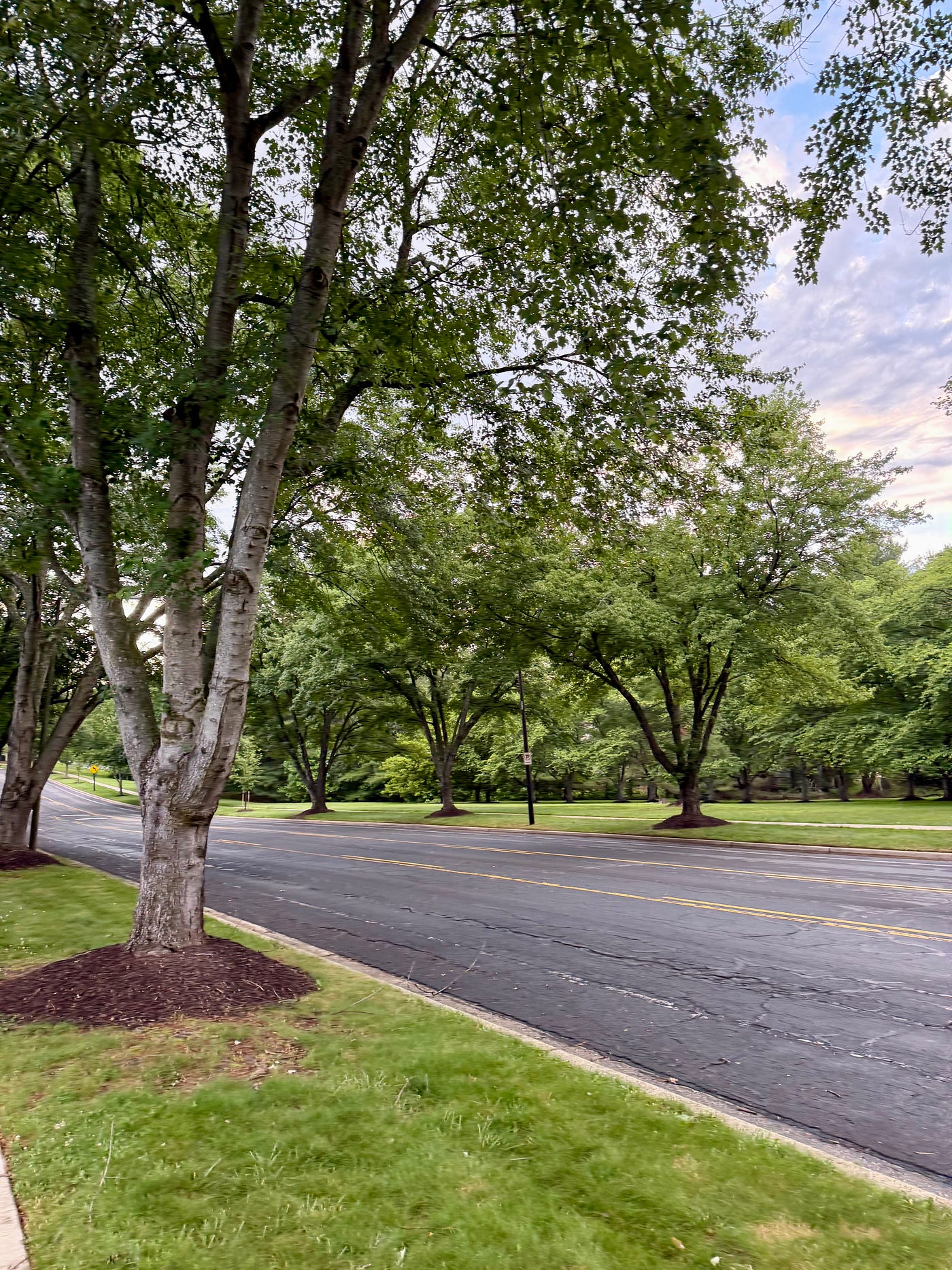
When I’m choosing a lens for pleasure — not for a job, not for a chart — I’m listening for character. I’m watching how the out-of-focus areas behave, how contrast holds in tricky light, whether glow feels like atmosphere or just mess, and what flare looks like when you invite it in.
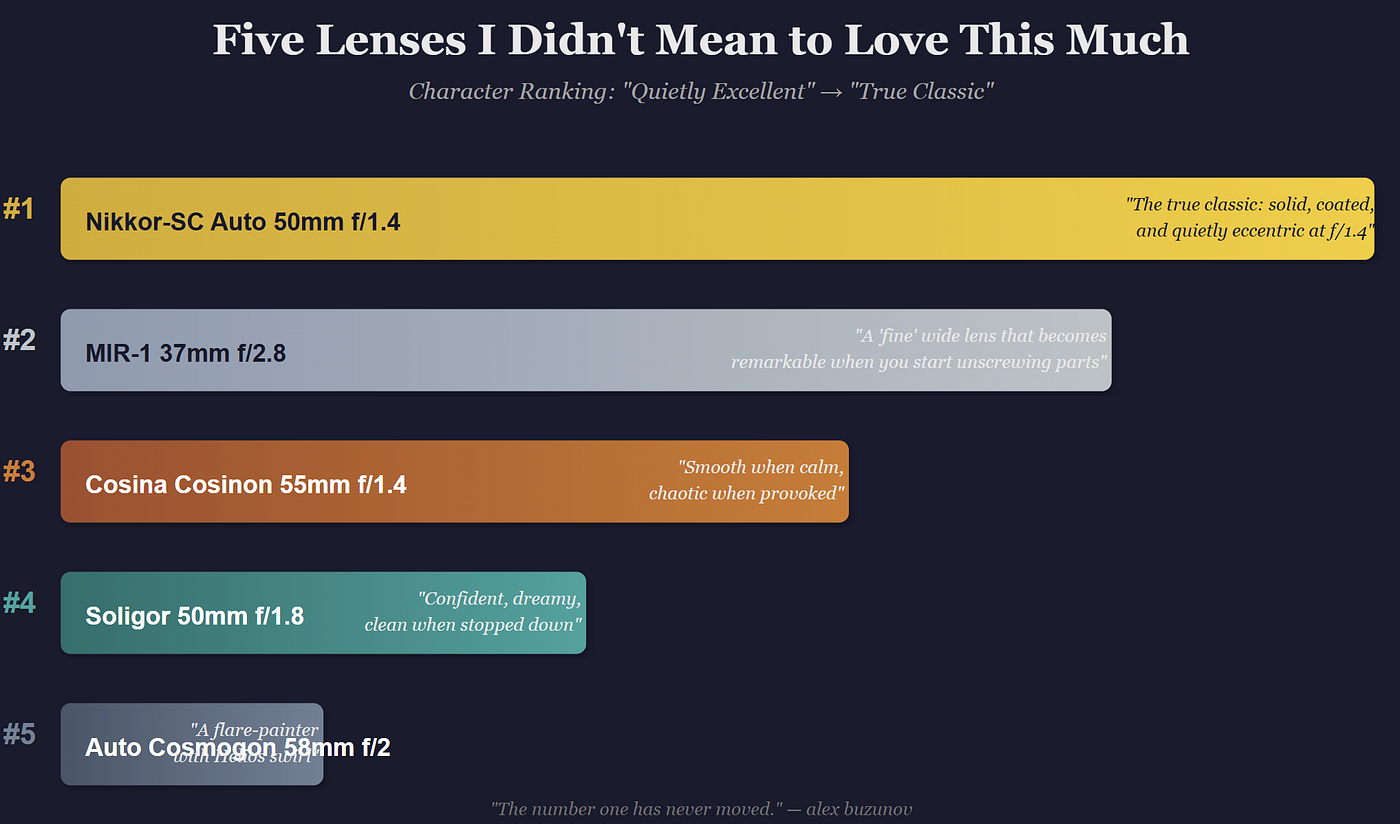
So here are five lenses I’ve had a lot of fun with, ranked from 5 to 1 by how much I enjoy their images. The ordering can wobble, depending on my mood and the season. The number one, though, has never moved.
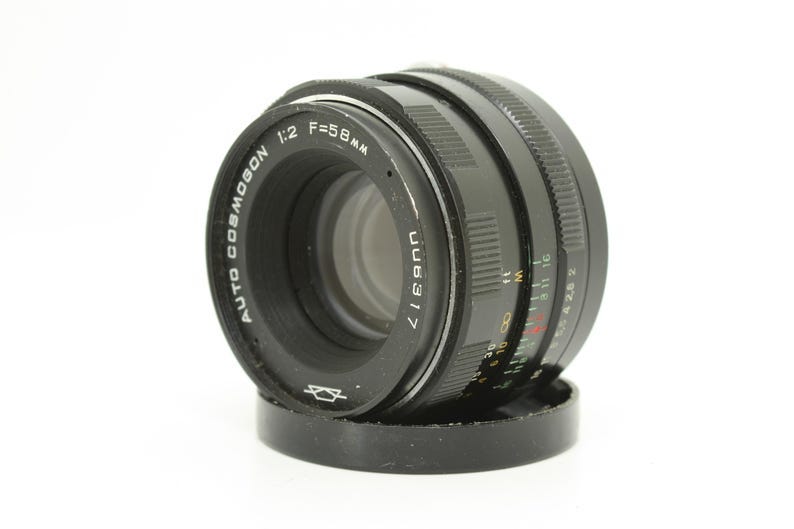
Auto Cosmogon 58mm f/2
The name alone feels like a little time capsule — especially when you learn it’s essentially a Helios 44M in a different suit, made at KMZ in the early 1980s and sold with a rebranded Zenit kit in the U.S. There’s something quietly funny about a Soviet lens wearing a space-race nod on its front ring. “Auto Cosmonaut” would’ve been even better, to my eyes.
Bokeh and subject separation Wide open, you get that familiar Biotar-derived Helios swirl — the kind that can turn ordinary backgrounds into motion. Center sharpness is there when you land focus, but in very bright light you can also see a halo of glow around in-focus areas. I don’t mind it. With a lens like this, glow is part of the vocabulary.
Color, contrast, and the file This is one of those lenses that responds beautifully to post-processing. Give the files a little more contrast, let the colors breathe, and suddenly the frame feels intentional. It’s genuinely a joy to work with.
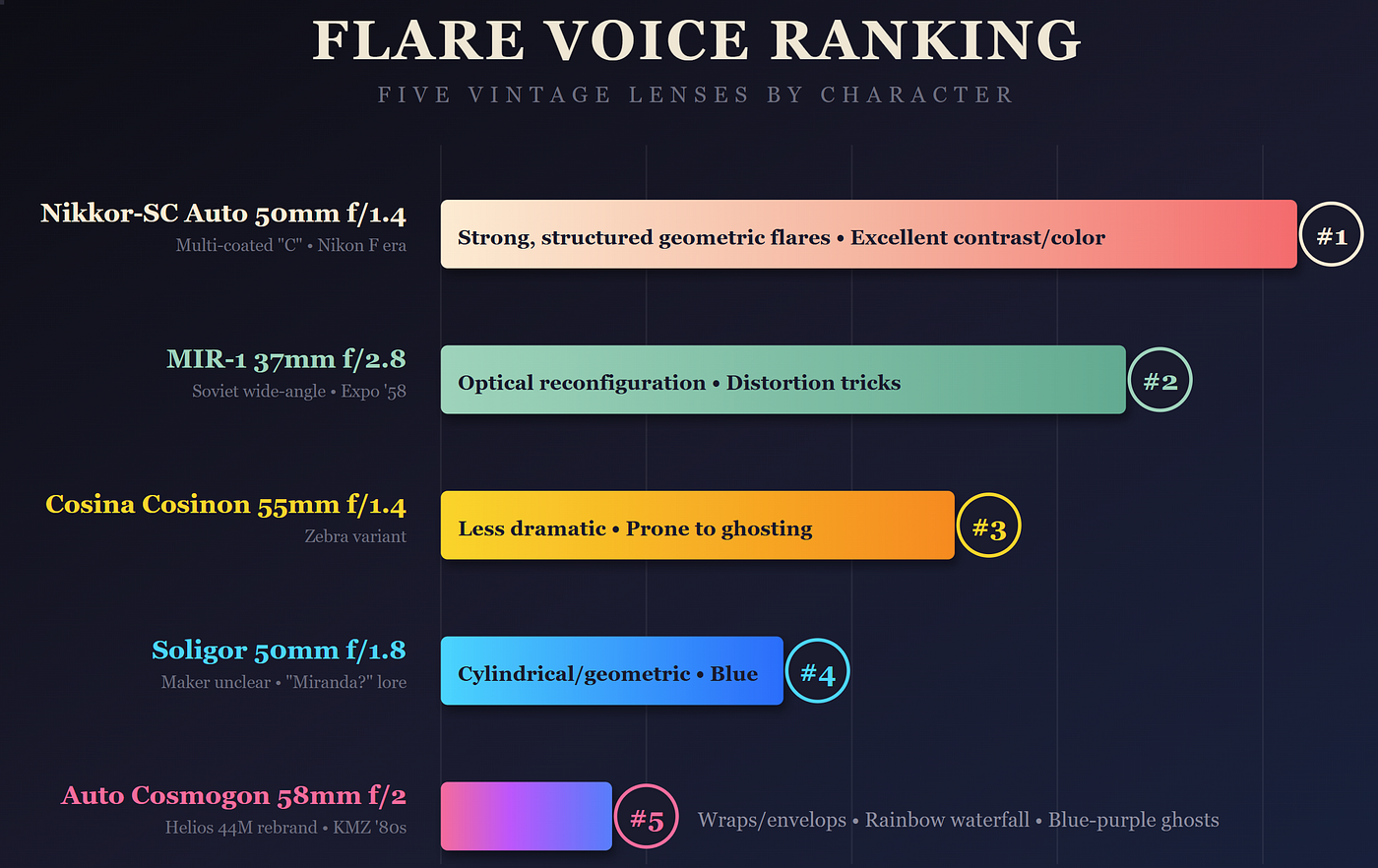
Flare as a feature Stopped down, it’s “perfectly serviceable” in the practical sense — sharp enough, pleasing color in good light — but that’s not why I keep it around. I keep it for the flares.
In the right setup, the flare can wrap around the subject like it’s trying to hug it. It doesn’t just streak; it envelops. And then, occasionally, it does stranger things:
- Rainbow / “waterfall” flare effects that feel unusually kinetic
- Blue-purple geometric ghosts that are softer than some lenses, but rather beautiful when they appear
Practical note If you’re chasing flare, don’t look into the sun. I composed these kinds of shots using the rear screen on my Sony a7 IV — safe habits make it possible to keep playing.
One limitation I can’t ignore That glow in harsh, bright conditions can get heavy if you’re not careful. Sometimes it’s romance; sometimes it’s just too much. The trick is choosing scenes that want that softness.
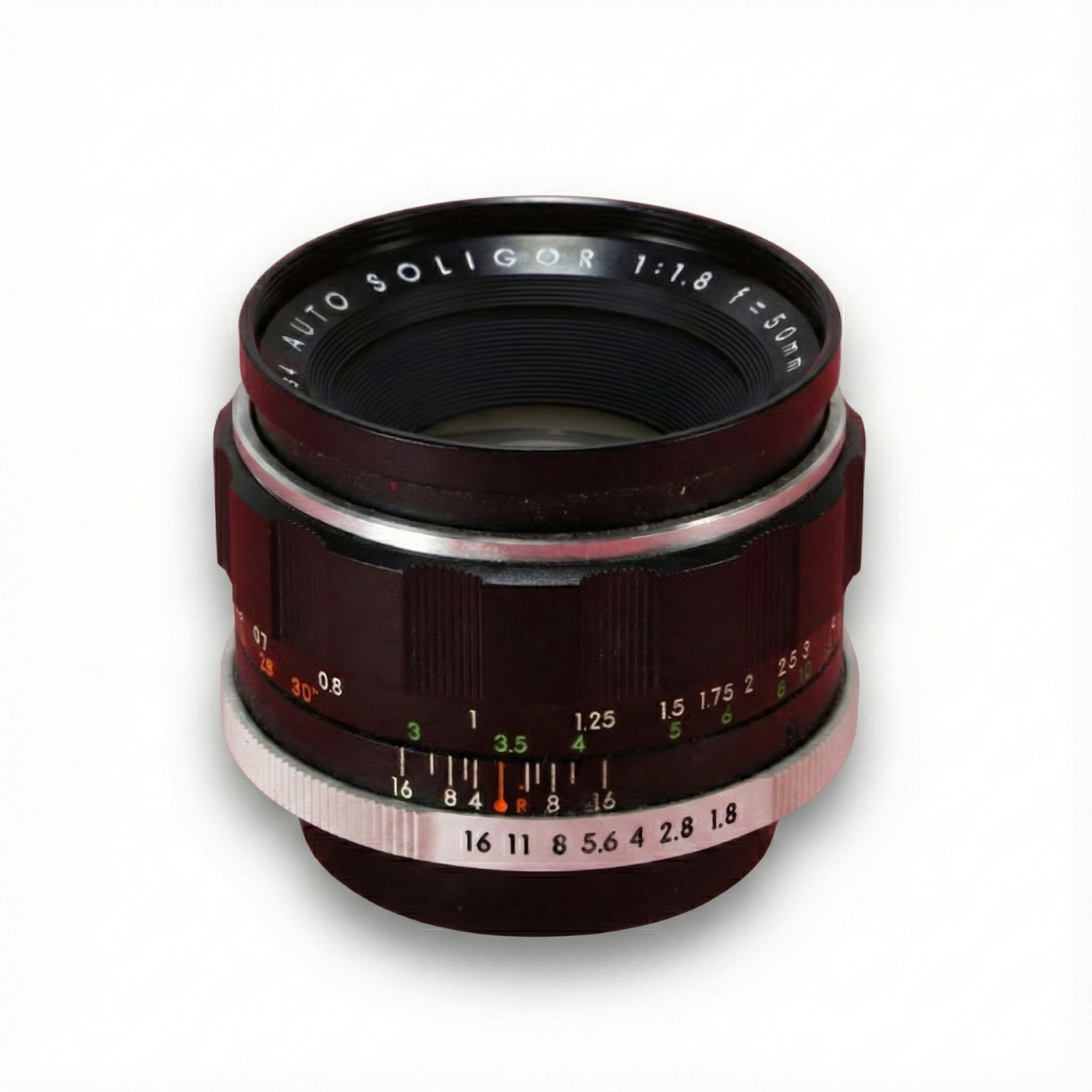
Soligor 50mm f/1.8
This one arrives with a small cloud of lens-lore. Depending on where you read, it’s Miranda, Tokina, or something else entirely. I’ve seen enough hints to think “Miranda,” but I’ve seen no definitive proof — so I treat the origin story as trivia and judge the pictures.
Wide-open rendering My copy is “vintage sharp” at f/1.8 — sharp enough to feel confident, yet still carrying a gentle softness in transitions. It can produce dreamy bokeh with lovely bubbles, and in the right situation there’s even a touch of swirl. Not Helios-level theatrics, but the swirls are there if you give them a stage.
Color and tonal feel Wide open, the colors have a pleasing lightness. In brighter light, the tones can lean cool in a way I find refreshing — like a winter window rather than a golden filter.
Stopped down Stop it down and it becomes a genuinely strong walkaround lens: sharp across the frame, dynamic color when the light cooperates. It has that satisfying “old lens behaving well” feeling.
Flare personality Like the Cosmogon, this is a flare lens for me — but the flare language is different. Wide open, the shapes feel more cylindrical and geometric, with a striking blue coloration that shows up again and again. One of the simple pleasures is rolling through apertures — watching the flare geometry change while that blue signature stays stubbornly present.
One limitation I can’t ignore It’s easy to fall in love with the wide-open look and forget the “ordinary” side. In flatter light, without highlights or backlight to play with, it can feel less special than it does at its best.
Cosina Cosinon 55mm f/1.4 (Zebra)
This lens deserves more attention than it gets. For its age, it’s simply very good — and it lives in the shadow of a more famous lookalike.
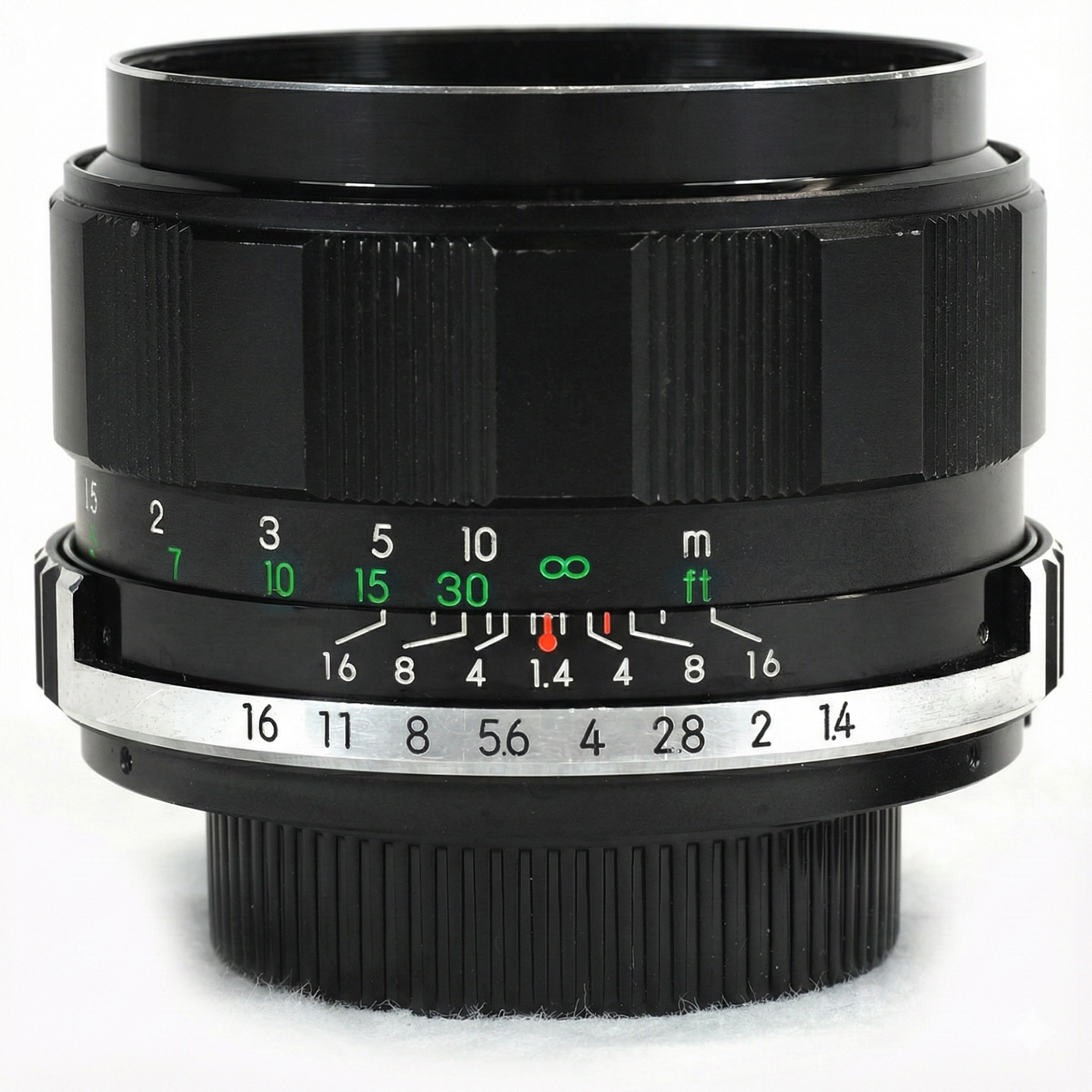
The Tomioka-shaped shadow In size and spec, this Cosinon can be mistaken for the revered Tomioka-made 55mm f/1.4 lenses that appear under many brand names and body designs. Those Tomiokas have their own reputation — beautiful, sometimes radioactive-glass-warm, sometimes a little unruly. The Cosina doesn’t have radioactive glass, which matters to some people, and it gives the rendering a cleaner baseline.
There’s also debate about who made this lens. My guess is Cosina themselves, but again: no definitive statement that I’ve seen. I’m comfortable leaving that as an open question, because the images are the real evidence.
How it renders wide open

This lens can be either super smooth or wonderfully crazy, depending on what’s in front of it. In calmer scenes — where reflections and bright distractions aren’t pushing the optics around — it can be nicely sharp if you nail focus. But in bright light, or with strong reflections, it can bloom with glow, ghosting, and aberrations around in-focus edges.
And honestly? I’m fine with that. Razor sharpness at f/1.4 isn’t the point here. The point is what happens behind the subject.
Bokeh, swirl, and “wild” highlights When the background is gentle, the bokeh can be soft, smooth, and gorgeously colored. When the background is busy — little points of light, glints, foliage — it becomes a cabinet of curiosities: swirl in the outer zones, and those large, juicy bubble highlights that feel almost edible.
This is also a lens whose files come alive with thoughtful post work. A bit of contrast shaping and color tuning doesn’t “fix” the lens — it reveals it.
Stopped down behavior Stopped down, it’s sharp, with center performance just a touch ahead of the edges — nothing you’d notice unless you’re hunting for it. Colors become cleaner and more accurate than the warmly tinted radioactive Tomiokas (though I understand why some people adore that warmth).
Comparative note In my own side-by-sides, this Cosinon seems to flare less dramatically than my Tomioka-made lens wide open. And intriguingly, it appears slightly faster — showing a lighter exposure and a marginally narrower depth of field under the same settings, beyond what tint alone would explain.
One limitation I can’t ignore Bright, contrasty scenes can push it into a kind of luminous chaos — glow and ghosting that can overwhelm the subject if you’re not composing carefully.
MIR-1 37mm f/2.8
This lens wears its history proudly, even loudly: “Grand Prix, Expo 58, Brussels.” It’s also surrounded by a common misconception. You’ll sometimes read that it derives from the Carl Zeiss Jena Flektogon 35mm f/2.4 — but the closer lineage is the Flektogon 35mm f/2.8, with a different optical design.
And then there’s the big practical difference: minimum focus distance. Some Flektogons go down to about 0.18m. The MIR-1 sits at 0.7m. That’s a real shame, because close focus is a major part of what makes a wide lens feel versatile and intimate.
As a normal wide lens In straightforward use, it’s… fine. It has vintage character in rendering and color, but it won’t outshine a decent modern zoom on pure performance. That’s not why it’s here.
The two tricks The MIR-1 earns its rank by becoming something else entirely when you start unscrewing things.
First trick: reverse the front assembly You can unscrew the whole front section and reverse it back into the lens body. It’s easy enough to do while you’re out shooting, and the results are wonderfully distorted — like the scene is erupting outward from the focus plane. On full frame you may see the physical edges of the lens intruding; switching to a crop sensor setting cleans that up and lets you live inside the effect.
The surprising part: in-focus areas can remain impressively sharp, sharper than similar “reversed front element” experiments with other lenses.
Second trick: remove the front entirely for macro Leave the front element off and the lens becomes a close-up tool — proper, real macro-like views, very close and sharp, though with distortion that can show itself toward the edges.
Handling note If you’re reversing the front or leaving it off, it’s worth securing it. I’ve held it in place with fingers, but I prefer a bit of tape to keep it snug and safe.
One limitation I can’t ignore That 0.7m minimum focus distance is a creative constraint in “normal” mode. The lens practically begs you to push into the strange modes, because that’s where it becomes truly itself.
Nikkor-SC Auto 50mm f/1.4
This is the one that never moved in the ranking.

I didn’t chase it with intention. I’d been curious about other classic Nikon normals — particularly the Nikkor-H Nippon Kogaku 50mm f/2, which has a wonderful reputation. But when I picked up a first-generation Nikon F from the early 1960s, this is the lens that arrived with it.
A small historical footnote matters here: my Nikon F dates to 1962, and the contemporary f/1.4 would have been the Nikkor-S. This SC came a little later. The “C” tells you it’s multi-coated — and in use, it earns that letter.
The feel and the build It’s chunky for its era: about 325 grams, with seven elements in five groups. Next to some Takumar-era competitors, it feels almost comically solid — like it was built for a world where cameras were expected to be knocked around and keep working.
Wide-open magic: “bubblishous” Around Christmas, with festive lights and the kind of scenes that tempt you into f/1.4, this lens genuinely blew me away. Wide open, it can produce an astonishing collection of bokeh shapes — distinctive rendering, rich color, and a sense of depth that feels almost sculpted.
There’s also a very modern twist to how it renders on my Sony a7 IV: shutter choice matters.
Electronic shutter vs mechanical shutter With the electronic shutter in very bright light, the movement of the sensor readout can “chop” bokeh bubbles — making them look like they’re rising or bubbling up from below. Switch to the mechanical shutter, and you get complete circles or ovals instead. It’s one of those rare cases where a camera setting becomes a deliberate aesthetic tool.
How it compares to the Cosinon To my eyes, the Nikon’s wide-open results are more artistic and a bit less chaotic than the Cosinon 55/1.4. Still characterful, still imperfect, but with a steadier hand.
Sharpness, glow, and flare It’s acceptably sharp wide open if you nail focus, though it can glow in bright light — normal for old fast glass. Wide open, it can also produce strong, well-structured geometric flares.
Stopped down, the coatings shine. Contrast and color are excellent for a 1960s lens, and in my experience it handles bright lights and contrast better than the Cosinon.
The honest drawbacks Two things keep it from being flawless (and I’m not sure I’d want it flawless anyway):
- The minimum focus distance is long at 0.6m; I’d prefer closer, around 0.45m, because I like bokeh-rich near shots
- I’m not always fond of how the aperture blades present themselves in out-of-focus highlights when you stop down a little
And yet Every time I use it, I catch myself thinking: wow. This is a fine lens. A true classic, and one that deserves more love than it tends to receive when people talk about Nikon’s legacy.
What I Take From This Little Ranking
If there’s a theme here, it’s that “good” isn’t the same as “alive.”
- The Cosmogon is a flare painter that happens to also be a competent Helios
- The Soligor balances sharpness with dreamy bokeh and a signature blue flare voice
- The Cosinon is a sleeper: smooth when you want it, wild when the background gets noisy
- The MIR-1 is a respectable wide lens that becomes remarkable when you start unscrewing it
- The Nikkor-SC Auto is the classic that surprised me most — solid, coated, and quietly eccentric wide open
In the end, these are lenses I keep not because they behave, but because they say something. And on the days when I want photographs to feel a little less correct and a little more human, that’s exactly what I’m after.
Bokeh Quality

Character Ranking
Flare Ranking
Use Cases

Key Limitations / Gotchas

Practical Notes

메타데이터
- post_id
- eb88147b8315
- slug
- five-lenses-i-didnt-mean-to-love-this-much-eb88147b8315
- url
- https://medium.com/@alexbuzunov/five-lenses-i-didnt-mean-to-love-this-much-eb88147b8315
- canonical_url
- https://medium.com/@alexbuzunov/five-lenses-i-didnt-mean-to-love-this-much-eb88147b8315
- author_url
- https://medium.com/@alexbuzunov
- status
- ok
- fetched_at
- 2026-07-17 18:11:52